August 25, 2026
When Water Becomes the Constraint, Processing Technology Must Evolve
Across the western United States, groundwater tables are falling at rates that have alarmed hydrologists for more than a decade. In Nevada's mining corridors, Arizona's copper belt, and the iron ore regions of Utah, water is no longer an abundant industrial input — it is a finite, contested, and increasingly expensive resource. For mining operators who have built entire processing circuits around slurry-based separation, this is not merely an inconvenience. It is an existential engineering problem.
The conventional approach to mineral beneficiation consumes water at extraordinary scale. Wet processing circuits for iron ore typically require anywhere from several hundred to over a thousand litres of water per tonne of ore processed, depending on ore type, circuit design, and recovery targets. When freshwater access tightens, operators face a stark choice: invest heavily in water recycling infrastructure, pay scarcity premiums for alternative water sources, or fundamentally rethink how ore is processed. DryFlow waterless mineral processing technology in the US represents the third path — and its first commercial-scale export unit is now making that case in real operational conditions.
When big ASX news breaks, our subscribers know first
What Dry Magnetic Separation Actually Does at the Process Level
Understanding why waterless processing matters requires a clear picture of how it actually works. Conventional wet beneficiation uses water as the medium through which minerals are separated — particles are suspended in slurry, and density, particle size, or chemical affinity is used to sort valuable minerals from waste rock. The entire circuit depends on water being present, which means tailings dams are required to contain the resulting slurry waste, and energy-intensive dewatering stages are needed to recover the final concentrate in a usable form.
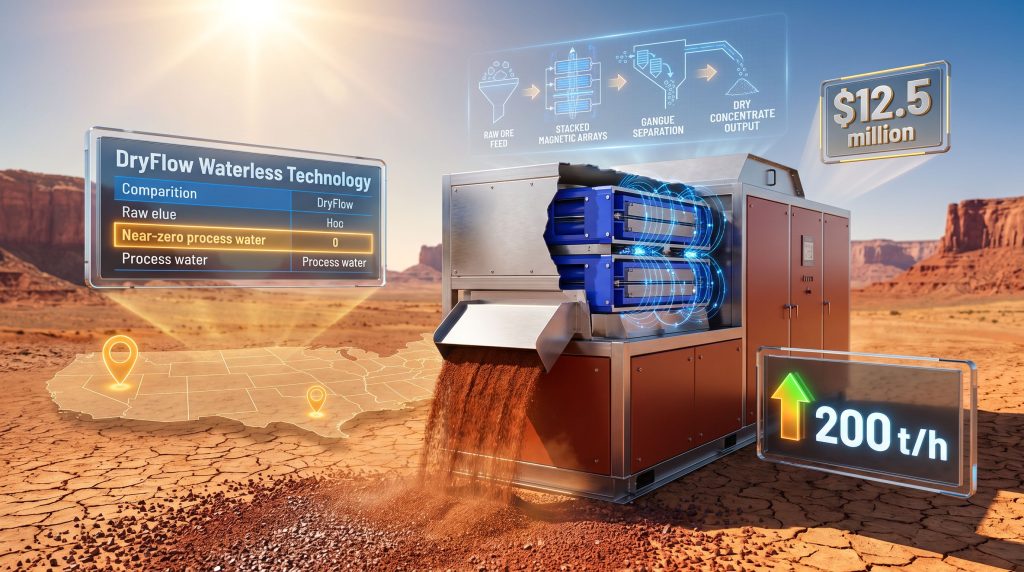
Dry magnetic separation inverts this logic entirely. Rather than using a liquid medium, the process exploits differences in magnetic susceptibility between mineral types. Here is how the process sequence works in practice:
-
Raw ore feed is introduced into the modular processing unit at a controlled particle size.
-
The feed passes through stacked magnetic arrays that generate differential field intensities at multiple stages.
-
Minerals with varying degrees of magnetic response are deflected by different amounts, achieving separation from non-magnetic gangue material.
-
The output concentrate exits the system as a dry, high-purity product stream — with no liquid medium involved at any stage.
The absence of a liquid medium means no tailings ponds, no water recycling infrastructure, and no energy cost for drying the final product. What separates DryFlow's approach from earlier attempts at dry magnetic separation is the elimination of forced-air fluidisation, which was historically required to keep dry particles mobile enough to separate effectively. Forced-air systems added mechanical complexity, energy cost, and sensitivity to particle moisture. DryFlow's patented architecture, rooted in what the company calls the Kuchel Process, addresses these limitations through a different mechanical design philosophy that maintains effective separation without requiring air injection.
The following comparison illustrates the operational difference between conventional wet processing and DryFlow's waterless approach:
| Parameter | Conventional Wet Processing | DryFlow Waterless Technology |
|---|---|---|
| Water consumption | High (hundreds of litres per tonne) | Near-zero process water |
| Tailings infrastructure | Required (dams, ponds) | Not required |
| Energy for drying stage | Post-processing dewatering needed | Eliminated entirely |
| Suitable environments | Water-accessible regions | Arid, remote, water-stressed regions |
| Output form | Wet concentrate or slurry | Dry, high-purity concentrate |
| Modular deployment | Limited scalability | Designed for incremental scaling |
The Origins of DryFlow Magnetics: From Research Bench to Commercial Unit
DryFlow Magnetics is a South Australian mining technology company whose development pathway followed a route that is relatively rare in deep-tech hardware: meaningful public research support combined with private venture capital, resulting in a manufactured commercial unit rather than just a prototype. The company's technology development received backing from the Commonwealth Scientific and Industrial Research Organisation (CSIRO), Australia's peak applied science body, whose involvement carries significant weight in international markets where technology credibility is scrutinised carefully.
The South Australian Government also participated as a co-development partner during the research and development phase. Importantly, the commercial-scale unit now being prepared for export was both designed and manufactured within South Australia — a distinction that matters not just for national manufacturing credibility but also for quality assurance traceability.
The funding architecture that underpins DryFlow's international expansion is structured conservatively. In June 2026, the company extended its seed funding round from an initial target of $10 million (approximately A$14.2 million) to a total of $12.5 million, drawing in Significant Ventures as an additional participant alongside existing investors Orion Industrial Ventures, Virescent Ventures, and Taronga Ventures.
The decision to extend the seed round rather than move directly to a Series A raise is a deliberate capital management choice that is common among deep-tech hardware companies. Proof-of-concept milestones in physical processing equipment must be demonstrated in real operational environments before institutional capital at scale is typically committed. The extended seed structure allows DryFlow to generate the operational data that will de-risk subsequent raises.
The investor syndicate spans venture capital mandates covering industrial technology, clean energy transition, and critical minerals demand — a spread that reflects the multiple value propositions embedded in a single processing technology platform.
Why the United States Is the Right First Export Market
Water Scarcity as a Structural Commercial Opportunity
The selection of the western United States as the destination for DryFlow's first commercial export is not arbitrary. The region represents one of the most acute intersections of mining activity and freshwater stress anywhere in the world. States including Nevada, Arizona, Utah, and New Mexico are classified as severely water-stressed by multiple international indices, and groundwater depletion in these regions has accelerated as mining, agriculture, and population growth compete for the same aquifer systems.
For mine operators in these jurisdictions, water access is increasingly a permitting constraint rather than simply an operational cost. Environmental impact assessments for new processing infrastructure require detailed water balance modelling, and community opposition to water-intensive mining operations has intensified in many western US counties. A processing technology that eliminates process water consumption removes an entire category of permitting and social licence risk.
The Critical Minerals Policy Context
The United States has accelerated its domestic critical minerals policy agenda significantly over the past several years, with the objective of reducing dependence on foreign processing capacity for minerals essential to defence, energy storage, and advanced manufacturing. This policy environment has not produced any project-specific support for DryFlow's deployment, but it has created a market context in which domestic processing capability using innovative technology is commercially valued by mine operators seeking to demonstrate environmental responsibility and supply chain resilience.
Furthermore, DryFlow's first US deployment will be at an existing mine site in the western United States, where the technology will be applied primarily to upgrading iron ore quality. The deployment is also expected to demonstrate the potential for recovering energy transition minerals from ore streams that conventional wet processing would handle uneconomically in water-stressed environments.
The Texas Research Laboratory: A Long-Term Commitment
Beyond the western US mine site deployment, DryFlow is establishing a dedicated research laboratory in Texas as part of a collaborative critical minerals research initiative. The Texas location places the company within reach of major US energy and industrial research ecosystems, providing access to potential institutional research partnerships and positioning DryFlow for longer-term engagement with US-based mine developers.
The laboratory's primary function will be advancing the science of critical mineral recovery using waterless processing methods — work that goes considerably beyond iron ore upgrading and into the recovery of minerals such as rare earth elements associated with iron ore deposits, titanium-bearing minerals, and manganese. These are categories of mineral recovery where dry processing techniques remain scientifically underexplored relative to wet methods, and where early research leadership could establish significant intellectual property advantages.
The 200 Tonne Per Hour Modular System: What It Means for the Industry
Engineering Validation Through Commercial Deployment
The western US deployment serves a dual commercial purpose. It generates revenue and validates the technology in an international operational environment, but it also functions as an engineering data collection exercise. The real-world performance data from this unit will directly inform the design specifications of DryFlow's next-generation platform: a modular mineral processing system rated at 200 tonnes per hour (t/h).
For context, a 200 t/h throughput rating positions this system within the processing capacity range relevant to mid-tier mining operations and larger junior producers. It is not a pilot-scale unit — it is a commercially meaningful throughput level that bridges the gap between small demonstration plants and the large fixed-plant circuits operated by major mining companies.
The modular architecture of the 200 t/h system is as important as its throughput rating. Key advantages of modular processing design include:
- Reduced upfront capital expenditure compared to constructing fixed processing plants.
- Faster deployment timelines from order to operation.
- The ability to add processing modules incrementally as mine production ramps up.
- Portability between mine sites as ore bodies are depleted.
- Lower residual asset risk if a mining project underperforms.
Peak Iron Mines: The First Commercial Agreement for the 200 t/h Platform
DryFlow has secured a commercial agreement with Peak Iron Mines in South Australia for the initial deployment of the 200 t/h modular units. This domestic agreement, supported by a Federal Government grant, provides DryFlow with a foundation revenue base and a controlled environment in which to commission the new platform before extending it internationally.
The dual-market commercialisation strategy — simultaneous domestic deployment in South Australia and international entry via the US — is a deliberate risk management structure. It prevents the company from becoming wholly dependent on a single deployment outcome during the most critical phase of its commercial maturation.
Dry Processing and the Green Steel Supply Chain
Why Iron Ore Purity Is a Green Steel Prerequisite
One of the less widely understood dimensions of the energy transition is its impact on iron ore quality requirements. Conventional blast furnace steelmaking is tolerant of lower-grade iron ore feedstocks because the coke-based reduction process can accommodate significant levels of silica, alumina, and other impurities. Electric arc furnace (EAF) steelmaking and direct reduced iron (DRI) processes — the production routes being adopted by steel producers pursuing low-emissions targets — are considerably less tolerant of impurity levels.
DRI processes in particular, especially those using hydrogen iron ore reduction rather than natural gas, require iron ore feedstocks with iron content typically above 67% Fe, compared to the 62% Fe benchmark grade that dominates seaborne iron ore trade. This creates a structural quality premium for high-purity iron ore that DryFlow's dry beneficiation output is positioned to address in the evolving steel and iron ore market.
The green steel transition is not just an emissions story — it is a quality story. The shift from blast furnaces to hydrogen-based DRI creates demand for a grade of iron ore that much of the world's existing iron ore production cannot meet without upgrading. Waterless beneficiation technology that can economically upgrade lower-grade deposits to DRI-grade concentrate opens an entirely new market segment.
Unlocking Stranded Resources in Water-Stressed Regions
A speculative but commercially compelling dimension of DryFlow's technology is its potential to unlock iron ore and critical mineral deposits that are currently classified as uneconomic specifically because of water access constraints. In arid mining regions, there are known mineralised systems where the resource economics are sound but the absence of process water makes conventional beneficiation impractical without prohibitive infrastructure investment.
Waterless processing technology does not eliminate all development challenges for such deposits, but it removes one of the most significant capital and environmental barriers. As water scarcity intensifies and the economics of water access deteriorate further in major mining jurisdictions, the inventory of viable deposits that DryFlow's platform could serve is likely to grow rather than shrink. This is particularly relevant for green iron production supply chains that require upgraded, high-purity feedstocks.
The next major ASX story will hit our subscribers first
Competitive Positioning and Barriers to Adoption
Where Dry Processing Technologies Currently Stand
Dry mineral processing encompasses several distinct technological approaches: air classification, electrostatic separation, sensor-based ore sorting, and dry magnetic separation. Each has specific ore type applicability and operational constraints. DryFlow's approach differentiates on the elimination of both forced-air fluidisation and process water — a combination that simplifies the mechanical system and reduces both capital and operating cost relative to competing dry methods.
The most honest assessment of where dry processing technologies remain challenged includes several factors:
- Feed moisture sensitivity: dry magnetic separation performs best when feed material is below certain moisture thresholds, creating operational challenges in humid climates or during wet seasons.
- Particle size distribution requirements: effective dry separation requires controlled feed sizing, adding a preparation step that wet circuits sometimes avoid.
- Operator familiarity: the mining industry's institutional knowledge base is built overwhelmingly around wet processing, and technology transitions in capital-intensive industries are slow even when the economics are favourable.
- Permitting novelty: novel processing technologies in US jurisdictions may face longer regulatory review periods simply because there is less established precedent for their environmental impact assessments.
Frequently Asked Questions: DryFlow Waterless Mineral Processing Technology in the US
What is DryFlow waterless mineral processing technology?
DryFlow is a patented dry magnetic separation technology developed in South Australia that upgrades iron ore and recovers critical minerals without using process water. It uses stacked magnetic arrays with differential field intensities to separate valuable minerals from waste rock, eliminating the need for tailings infrastructure, water recycling systems, or post-processing dewatering. According to DryFlow Magnetics, the technology is designed for scalable, commercial deployment across water-stressed mining regions globally.
How does the technology separate minerals without water?
The system exploits differences in magnetic susceptibility between mineral types. As dry ore feed passes through stacked magnetic arrays, minerals respond differently to varying field intensities and are physically separated from non-magnetic gangue material. No liquid medium is required at any stage of the process.
How much funding has DryFlow Magnetics raised?
DryFlow extended its seed funding round in June 2026 from an initial $10 million (approximately A$14.2 million) to a total of $12.5 million, with Significant Ventures joining existing investors Orion Industrial Ventures, Virescent Ventures, and Taronga Ventures.
What is the 200 t/h modular system?
DryFlow's next-generation commercial platform, designed to process 200 tonnes of ore per hour in a modular format. Initial units are committed to Peak Iron Mines in South Australia under a commercial agreement supported by a Federal Government grant, with design specifications being informed by operational data from the US deployment.
Where is DryFlow establishing its US research presence?
The company is setting up a research laboratory in Texas as part of a collaborative critical minerals research initiative, complementing the western US mine site deployment and establishing a permanent scientific footprint in the American market.
From South Australian Innovation to Global Processing Technology
The commercialisation trajectory of DryFlow Magnetics illustrates a broader dynamic that is reshaping how processing technology companies reach international markets. The pathway from CSIRO-backed research to South Australian manufacturing to US commercial export compresses a technology development cycle that would historically have taken considerably longer without co-investment from both public research bodies and venture capital.
Consequently, what the US entry signals most clearly is that water risk in mining has crossed a threshold. It is no longer treated by sophisticated mine operators as an external cost to be managed politically or offset through community engagement. It has become a core engineering constraint that influences technology selection, permitting strategy, and long-term project economics. DryFlow waterless mineral processing technology in the US is arriving at precisely the moment when that constraint is acute enough to drive genuine adoption rather than merely generate interest.
For investors and industry observers tracking the intersection of critical minerals, green steel supply chains, and mining technology innovation, DryFlow's dual deployment strategy across domestic and US markets represents a structured approach to de-risking commercialisation in a sector where hardware validation is non-negotiable. The real test, as always in deep-tech processing equipment, will be what the operational data from the western US site reveals about performance consistency across variable ore conditions. In addition, coverage from Australian Mining highlights the broader industry significance of DryFlow's pilot programme and its implications for the green steel supply chain.
This article contains forward-looking statements and speculative analysis regarding technology commercialisation, market dynamics, and investment outcomes. Readers should conduct independent due diligence before making any investment decisions. Past technology development milestones do not guarantee future commercial performance.
For ongoing coverage of processing innovation and mining technology developments, visit Mining Technology.
Want to Stay Ahead of the Next Major Mineral Discovery?
Discovery Alert's proprietary Discovery IQ model delivers real-time alerts on significant ASX mineral discoveries — instantly turning complex mineral data into actionable insights for both short-term traders and long-term investors. Explore historic examples of exceptional discovery returns and begin your 14-day free trial today to position yourself ahead of the broader market.