August 6, 2026
The Geological Accident That Could Reshape Carbon Removal Economics
Most discussions about carbon capture focus on what industry must build: compressors, pipelines, injection wells, monitoring infrastructure. The assumption embedded in nearly every large-scale CCS proposal is that carbon removal requires dedicated, purpose-built systems operating at significant energy cost and ongoing regulatory oversight. That assumption may be worth revisiting.
A geological formation in northern Ontario quietly challenges this framing. The Crawford Nickel Sulphide Project, being developed by Canada Nickel Company, sits atop one of the world's largest known concentrations of ultramafic rock — a substrate that happens to be among the most chemically reactive materials on Earth when exposed to carbon dioxide. What makes the Canada Nickel Crawford project carbon storage proposition genuinely distinctive is not simply that it can absorb CO₂, but that the carbon removal happens as a natural consequence of mining the rock itself.
This is not a carbon capture project that happens to mine nickel. It is a nickel mine whose geology makes carbon storage structurally unavoidable, given the right engineering. Furthermore, understanding the broader nickel properties and uses helps contextualise why this deposit matters so significantly to clean energy supply chains.
When big ASX news breaks, our subscribers know first
Why Ultramafic Rock Is the Unsung Hero of Mineral Carbonation
The Chemistry That Makes This Work
Mineral carbonation is a geochemical reaction in which carbon dioxide bonds with magnesium- and calcium-rich silicate minerals to produce thermodynamically stable carbonate compounds such as magnesite and calcite. The reaction is not new — it has been occurring naturally in the Earth's mantle for billions of years. What changes the strategic calculus at Crawford is the concentration and reactivity of the mineral assemblage.
The Crawford deposit is dominated by serpentine and olivine group minerals, both of which carry exceptionally high theoretical CO₂ absorption capacity relative to common mining host rocks like granite or limestone. In natural settings, these minerals weather over centuries to millennia, slowly pulling atmospheric carbon into carbonate form. Industrial carbonation accelerates this process to a timeframe of days to weeks by manipulating temperature, pressure, and particle surface area within a processing environment.
The critical distinction from conventional carbon capture and storage is permanence without surveillance. The carbonate minerals produced through this reaction are not gases stored under pressure in saline aquifers — they are solid rock-like materials that require no ongoing leakage monitoring. Once formed, they are stable for thousands of years under ambient conditions.
Resource Scale Creates Proportional Carbon Opportunity
Canada Nickel estimates the Crawford deposit at more than 3.7 billion tonnes of measured and indicated resources, making it the second-largest nickel sulphide reserve globally. The sheer scale of the ore body matters for carbon purposes because every tonne of ultramafic rock processed through the mine represents additional carbonation substrate. The deposit's mineral composition essentially creates what could be described as embedded carbon storage capacity distributed across decades of planned mine life.
How In-Process Tailings Carbonation Converts Mine Waste Into a Carbon Sink
The Technical Logic Behind IPT Carbonation
Conventional mining operations generate large volumes of tailings — the fine-grained residual material remaining after target minerals have been extracted. In most operations, tailings are pumped into engineered containment facilities where they serve no productive function beyond basic geotechnical stability. The magnesium silicate minerals within those tailings retain their CO₂ absorption capacity indefinitely, but that capacity is never activated.
Canada Nickel's proprietary In-Process Tailings (IPT) Carbonation technology redirects CO₂ into the tailings stream during active processing, before material reaches the containment facility. This means the carbonation reaction occurs within the industrial circuit rather than passively in storage, allowing reaction conditions to be optimised for maximum capture efficiency.
Step-by-Step: From Ore Extraction to Permanent Carbon Storage
-
Ore is extracted and processed through conventional nickel sulphide flotation and concentration circuits.
-
The residual tailings stream — rich in serpentine and olivine minerals — is directed into a controlled carbonation environment.
-
CO₂, sourced from industrial emissions or directly from the atmosphere, is introduced into the tailings slurry under managed temperature and pressure conditions.
-
Magnesium silicate minerals in the tailings react with CO₂ to form stable carbonate compounds, principally magnesite.
-
Carbonated tailings are deposited in engineered storage facilities, with the carbon now permanently mineralised in solid form.
-
No ongoing CO₂ leakage monitoring is required — a structural advantage over geological injection-based CCS methods.
Technical Context: Canada Nickel's 2023 laboratory test work indicated a theoretical maximum capture rate of up to 37 tonnes of CO₂ per tonne of nickel produced. The company has explicitly characterised this as an upper bound under optimised laboratory conditions. Commercial-scale performance under continuous operations will almost certainly differ, and independent verification of real-world capture rates has not yet been completed.
Crawford's Carbon Storage Projections: Numbers and Their Limits
What the Data Actually Shows
| Metric | Figure | Basis |
|---|---|---|
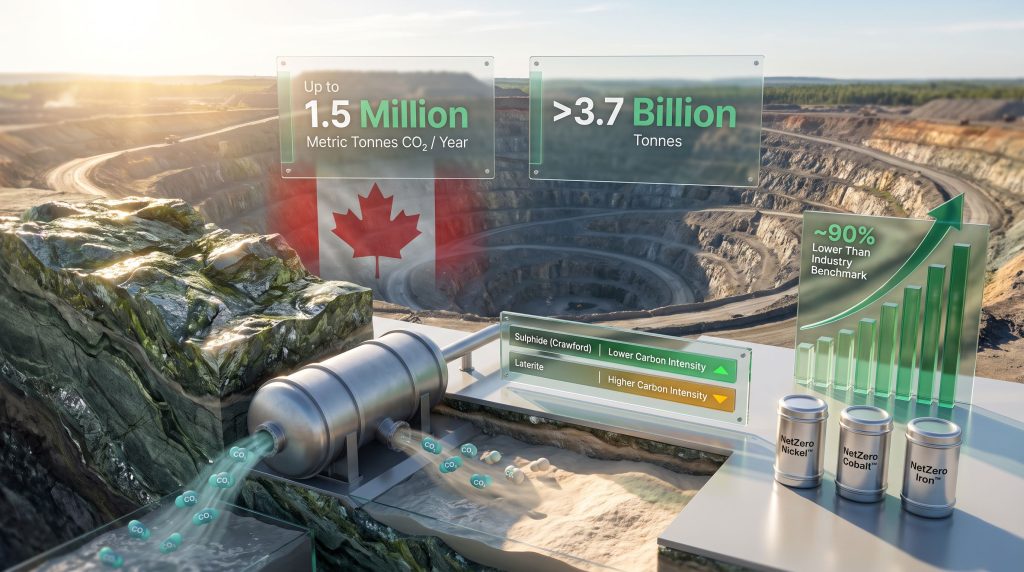
| Annual CO₂ storage capacity (peak operations) | Up to 1.5 million metric tonnes | Canada Nickel company projections |
| CO₂ capture ratio (2023 lab testing) | Up to 37 t CO₂ per tonne Ni | Laboratory maximum, not commercial guarantee |
| In-situ pilot sequestration (2026 result) | ~12 tonnes CO₂ stored at depth | Canada Nickel / University of Texas pilot |
| Estimated emissions vs. global industry average | ~90% lower than industry benchmark | Canada's Major Projects Office assessment |
The 2026 in-situ pilot conducted in partnership with the University of Texas demonstrated a separate but complementary sequestration pathway: injecting CO₂ dissolved in water directly into the subsurface geology beneath the Crawford site. Approximately 12 tonnes of CO₂ were stored during the pilot with no surface leakage detected, validating the geological integrity of the formation as a containment medium.
It is important to contextualise the gap between this pilot-scale result and the projected 1.5 million tonne annual figure. Scaling from controlled pilots to continuous commercial operations introduces variables that laboratory and small-scale field testing cannot fully replicate: reagent costs, energy consumption for CO₂ injection, mineralogical variability across different parts of the ore body, and processing throughput fluctuations. These are technology readiness risks rather than fundamental scientific problems, but they represent the critical unproven step between concept and commercial performance.
Federal Approval and What It Does and Does Not Mean
371 Binding Conditions: The Regulatory Milestone in Context
Crawford received federal approval following a comprehensive impact assessment conducted under Canada's Impact Assessment Act. The approval is subject to 371 legally binding conditions covering environmental protection, water quality management, wildlife monitoring, Indigenous participation, and long-term operational oversight.
This is a significant regulatory milestone for a project of this scale, but it does not constitute a construction permit. Provincial approvals from Ontario remain outstanding and represent the next critical checkpoint before site preparation and construction can commence. Canada's Major Projects Office coordinates federal-provincial permitting alignment for major resource projects, providing a coordination mechanism but not an accelerated approvals guarantee.
The binding nature of Indigenous participation requirements within the federal approval reflects a meaningful evolution in Canadian resource law. The conditions require substantive economic and governance involvement from Indigenous Nations — not simply procedural consultation — a distinction that carries legal weight under Canada's constitutional duty-to-consult framework and recent Supreme Court jurisprudence.
Nickel's Strategic Position and Why Deposit Type Determines Supply Chain Value
Sulphide vs. Laterite: A Distinction That Matters for Battery Manufacturers
Global nickel mine production reached approximately 3.7 million metric tonnes in 2025 according to United States Geological Survey estimates, with Indonesia supplying more than half of total output. However, the origin of nickel matters as much as its volume when viewed through a battery supply chain lens. In addition, Indonesian nickel market trends highlight how deposit type and processing pathways increasingly influence buyer preferences at the procurement level.
| Deposit Type | Processing Pathway | Battery-Grade Suitability | Relative Carbon Intensity |
|---|---|---|---|
| Sulphide (e.g., Crawford) | Flotation + hydrometallurgy | High — direct to Class 1 nickel | Lower |
| Laterite (e.g., Indonesia) | High-pressure acid leach (HPAL) | Moderate — requires additional refining | Higher |
The majority of Indonesian production comes from laterite deposits processed via high-pressure acid leaching, a technically intensive and energy-heavy pathway that produces nickel with a higher carbon footprint and greater processing complexity than sulphide-sourced material. Battery manufacturers and automakers increasingly face Scope 3 emissions reporting obligations, creating genuine commercial incentives to source traceable, low-carbon nickel rather than simply the cheapest available supply.
The International Energy Agency projects that global nickel demand could more than double by 2040 under current national climate commitments, with further upside under net-zero aligned scenarios. Crawford's sulphide ore type positions the project to serve the premium, battery-grade segment of that demand growth rather than the commoditised stainless steel market that has historically absorbed most of the world's nickel output. Consequently, battery materials demand growth is reshaping how mining companies approach project development and product positioning.
The next major ASX story will hit our subscribers first
Mining's Green Paradox and the Commercial Logic of NetZero Metals
The Emissions Profile of an Industry Building Clean Energy
Data from the International Council on Mining and Metals (ICMM) indicates that mining and metals collectively accounted for approximately 11% of global Scope 1 and 2 greenhouse gas emissions in 2024, with mining operations contributing roughly 3% and metal processing adding approximately 8%. This creates a structural tension at the heart of the energy transition: the materials essential to building solar panels, wind turbines, and electric vehicle batteries are themselves produced through emissions-intensive industrial processes.
This is what analysts sometimes call the green paradox of decarbonisation — the short-term emissions cost of building long-term clean energy capacity. Projects that embed carbon removal directly into production represent one potential resolution to this paradox, though the scale of demonstration remains limited. The broader picture of mining decarbonisation benefits underscores why integrated approaches like Crawford's are attracting serious policy and investor attention.
What NetZero Metals Actually Means as a Product Category
Canada Nickel plans to produce three branded product streams through its planned NetZero Metals processing facility:
-
NetZero Nickel™ — battery-grade nickel with a verified low or net-negative lifecycle carbon footprint
-
NetZero Cobalt™ — cobalt produced within the same mineral carbonation offset framework
-
NetZero Iron™ — iron by-product with integrated carbon accounting applied across the production process
The commercial logic is straightforward: as Scope 3 reporting obligations tighten under regulations including the EU's Corporate Sustainability Reporting Directive and evolving supply chain due diligence frameworks in North America, the ability to supply materials with independently verified low-carbon credentials becomes a procurement differentiator. This creates a potential dual revenue stream for Crawford — commodity sales supplemented by carbon credit monetisation — a structure that does not exist in conventional single-commodity mining operations.
Investor Consideration: The dual-revenue model is commercially compelling in theory, but its realisation depends on two parallel developments: commercial-scale validation of the IPT Carbonation process and the maturation of regulatory frameworks that recognise mineral carbonation credits within compliance carbon markets. Neither is guaranteed on a specific timeline. This is not financial advice.
Comparing Crawford to Other Carbon Removal Approaches
Where Mineral Carbonation Sits in the Carbon Removal Landscape
| Carbon Removal Method | Permanence | Monitoring Required | Energy Intensity | Estimated Cost Range | Scale Potential |
|---|---|---|---|---|---|
| Mineral Carbonation (IPT) | Thousands of years | Minimal | Moderate | Low-medium | Very high (co-located with mining) |
| Geological CCS (saline aquifers) | Centuries to millennia | Ongoing | High | High | High |
| Direct Air Capture (DAC) | Permanent (if mineralised) | Moderate | Very high | Very high | Constrained by energy cost |
| Bioenergy + CCS (BECCS) | Decades to centuries | Moderate | Medium | Medium | Land-constrained |
| Enhanced Rock Weathering | Centuries | Difficult to verify | Low | Low | Agricultural land-dependent |
The structural cost advantage of co-located mining and carbonation deserves particular attention. Because IPT Carbonation leverages existing mining infrastructure — processing circuits, tailings management systems, and site utilities already required for mineral extraction — the marginal cost of adding carbonation chemistry is substantially lower than constructing a standalone carbon capture facility. In projects where tailings management already requires engineered containment, the additional capital required to activate the carbonation potential within those tailings may represent one of the lowest-cost pathways to permanent, verifiable carbon storage at scale.
Economic Scale: Crawford's Projected Contribution to Ontario and Canada
Key Economic Indicators
| Economic Indicator | Projected Figure |
|---|---|
| Construction phase employment | ~5,000 jobs |
| Permanent operational employment | ~1,300 jobs |
| Economic contribution over project life | More than C$70 billion |
| Nickel resource base (measured and indicated) | More than 3.7 billion tonnes |
| Global ranking of nickel sulphide reserve | Second-largest globally |
Large-scale mining operations typically generate indirect employment and supply chain activity at two to four times the direct employment figure in resource-dependent regions, meaning Crawford's stated employment numbers likely underrepresent total regional economic impact. The C$70 billion economic contribution projection spans the project's full operating life and should be understood as a cumulative figure rather than an annual contribution.
Key Risks and Unresolved Questions
Three Critical Variables That Will Determine Outcomes
1. Technology Commercialisation Risk
The IPT Carbonation process has not been demonstrated at continuous commercial scale. The gap between laboratory maximum performance of up to 37 tonnes of CO₂ per tonne of nickel and real-world industrial operations introduces meaningful uncertainty into any carbon credit revenue projection. Independent third-party verification will be required for credits to be accepted in either compliance or voluntary carbon markets.
2. Permitting and Capital Execution Risk
Federal approval is a necessary but insufficient condition for construction. Provincial permits from Ontario remain outstanding. Capital intensity for a project of this scale is substantial, and the financing environment for large greenfield mining operations incorporating novel processing technologies carries execution risk. Cost overruns and schedule delays are statistically common in projects of comparable complexity.
3. Carbon Credit Market and Regulatory Risk
The commercial value of carbon storage credits depends entirely on the regulatory framework under which they are issued and traded. The distinction between Canada's Output-Based Pricing System (a compliance market) and voluntary carbon markets involves different verification standards, price levels, and buyer pools. Critically, monitoring, reporting, and verification standards specifically applicable to mineral carbonation credits are still being developed globally, meaning the regulatory infrastructure needed to monetise Crawford's carbon storage has not yet fully materialised.
Risk Summary: Crawford's carbon storage proposition is scientifically credible and geologically well-founded. Commercial-scale performance validation, regulatory credit recognition, and project execution discipline remain the three variables that will determine whether the projected 1.5 million tonne annual storage figure is achieved.
Frequently Asked Questions: Canada Nickel Crawford Carbon Storage
What is the Crawford Nickel Sulphide Project?
Crawford is a large-scale nickel sulphide mining project in Ontario, Canada, being developed by Canada Nickel Company as a dual-purpose operation: producing battery-grade nickel while permanently storing CO₂ through mineral carbonation of mine tailings.
How does the Canada Nickel Crawford project carbon storage process work?
The project uses a proprietary IPT Carbonation technology that introduces CO₂ into mine tailings during active processing. Magnesium silicate minerals in the tailings chemically bind the CO₂ into stable carbonate minerals, storing it in solid form for thousands of years without requiring underground injection or ongoing leakage monitoring.
How much CO₂ could Crawford store annually?
Canada Nickel projects storage of up to 1.5 million metric tonnes of CO₂ per year during peak operations. This figure is based on company modelling and has not yet been verified through continuous commercial-scale operations.
Has Crawford received full regulatory approval?
Crawford received federal approval subject to 371 legally binding conditions. Provincial permits from Ontario are still required before construction can commence.
What is NetZero Nickel™?
NetZero Nickel™ is a branded product category representing battery-grade nickel produced with a verified low or net-negative carbon footprint, enabled by the project's integrated mineral carbonation process. Canada Nickel also plans to produce NetZero Cobalt™ and NetZero Iron™ under the same framework.
Could Crawford serve as a regional carbon storage hub?
Canada Nickel has articulated ambitions for Crawford to accept CO₂ from nearby industrial emitters, functioning as a regional carbon storage facility beyond its own operational emissions. This remains a company projection and has not been validated through binding offtake agreements or regulatory carbon storage certification. It would require CO₂ transport infrastructure and regulatory authorisation under Canadian carbon sequestration frameworks. Furthermore, the role of critical minerals in the energy transition will only intensify demand for projects that combine resource extraction with credible decarbonisation pathways.
Readers seeking additional context on carbon markets, critical mineral supply chains, and carbon removal economics can find related reporting and educational content at CarbonCredits.com, which covers these topics across news, analysis, and investor education formats. Nothing in this article constitutes financial or investment advice. All projections and forecasts cited are sourced from company disclosures and should be evaluated alongside the risk considerations outlined above.
Want To Stay Ahead of the Next Major Critical Mineral Discovery?
Discovery Alert's proprietary Discovery IQ model scans ASX announcements in real time, delivering instant alerts on significant mineral discoveries — including the nickel and battery materials projects reshaping clean energy supply chains — so subscribers can act on actionable opportunities before the broader market. Explore historic discoveries and their returns or start your 14-day free trial today to gain a market-leading edge.