August 6, 2026
When the Safest Ideas Come From the Most Dangerous Places
There is a persistent assumption embedded in how large industrial organisations approach safety innovation: that the best solutions originate from engineering departments, external consultancies, or centralised R&D teams armed with data dashboards and simulation software. This assumption has a fundamental flaw. The people who understand operational hazards most intimately are not the ones designing the responses to them.
Across the global mining sector, this gap between where knowledge lives and where decisions get made has quietly accumulated into one of the industry's most underappreciated structural inefficiencies. The workers who absorb daily exposure to thermal extremes, confined spaces, high-voltage equipment, and mechanically complex environments carry a form of operational intelligence that no laboratory model can replicate.
The question facing major miners is no longer whether that knowledge has value. It is whether their organisations are structurally capable of capturing it. Furthermore, the BHP innovation program for frontline mining solutions represents one of the most structured attempts in global mining to answer that question at scale.
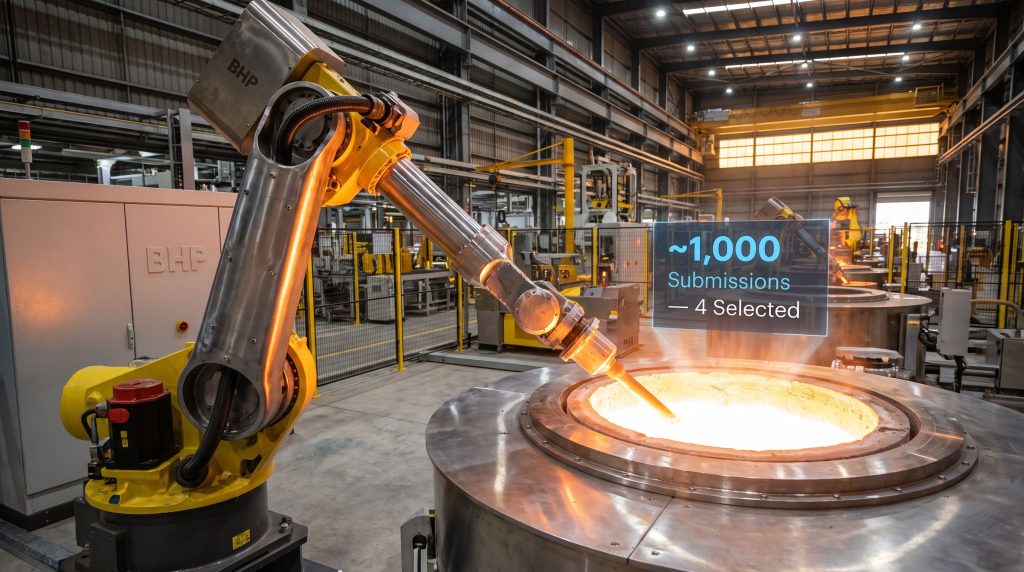
BHP's answer has taken the form of the Breakthrough Open House program, an internal employee innovation initiative that produced nearly 1,000 submissions in its inaugural 2026 cycle and advanced four of them to funded proof-of-concept development. The scale of participation alone tells a significant story about the depth of untapped problem-solving capacity sitting within large mining workforces.
When big ASX news breaks, our subscribers know first
BHP Invent and the Architecture Behind the Program
The Breakthrough Open House operates under the umbrella of BHP Invent, the company's internal innovation infrastructure. Rather than functioning as a suggestion box or a periodic hackathon, the program is engineered as a structured development pathway. Employees and embedded contractors submit ideas, and selected teams receive a comprehensive support package that includes funding, technical mentorship, access to subject matter experts, and operational data relevant to their concept.
What makes the governance design particularly noteworthy is the requirement that the idea originator remains embedded in the project throughout the proof-of-concept phase. In most large organisations, ideas submitted by frontline workers are absorbed into engineering or procurement pipelines and separated from their originators almost immediately. BHP's model deliberately resists this, on the basis that the worker who identified the problem holds contextual knowledge that cannot be fully transferred through documentation alone.
The 2026 cohort produced four winning teams drawn from geographically and operationally diverse corners of the BHP portfolio:
- Olympic Dam (South Australia) – copper and uranium smelting operations
- WA Iron Ore – Pilbara-based iron ore mining and processing
- Operations Services – BHP's internal mining services division
- BHP Mitsubishi Alliance (BMA) – Queensland metallurgical coal operations
- Escondida (Chile) – one of the world's largest copper mines by production volume
This geographic spread is significant. It signals that the program is not a localised initiative for a single asset class but a company-wide mechanism for surfacing solutions across commodity types, regulatory environments, and operational contexts. In addition, these mining transformation strategies align closely with BHP's broader operational philosophy.
The Olympic Dam Burnout Arm: A Case Study in Hazard Elimination
The most publicly detailed of the four winning concepts comes from Olympic Dam, BHP's copper-uranium operation in South Australia's outback. A casting technician working in the facility's smelter identified a critical and recurring hazard embedded in the anode furnace casting process.
Before each cast cycle, operators are required to manually initiate a burn into the side of the anode furnace. The thermal environment generated by this process reaches approximately 3,000 degrees Celsius, placing workers in direct proximity to extreme radiant heat and the associated risks of thermal injury. The task cannot be reclassified as low-risk through administrative controls alone. The hazard is intrinsic to the process.
The proposed solution is an automated robotic arm capable of executing the burnout procedure without direct human involvement. In engineering terms, this approach applies the highest tier of the hierarchy of controls framework, moving from personal protective equipment and administrative procedures directly to hazard elimination through engineering substitution.
How Does the Hierarchy of Controls Apply Here?
The hierarchy of controls is a risk management framework widely used in Australian workplaces and embedded in Safe Work Australia guidelines. It ranks control measures from most to least effective: elimination, substitution, engineering controls, administrative controls, and personal protective equipment. Automation that removes a worker from a hazardous environment entirely sits at the top of this hierarchy.
The significance of this solution extends beyond Olympic Dam itself. Anode furnace operations are a standard component of pyrometallurgical copper processing globally. A validated robotic burnout solution developed at one facility could, in principle, be adapted for similar casting processes at other copper smelters, including BHP's interests at Escondida in Chile. Consequently, the AI-powered mining efficiency principles driving broader industry modernisation are directly relevant to how such robotic systems might be further enhanced.
What the Other Three Winning Ideas Reveal About Innovation Priorities
While the burnout arm has attracted the most detailed public commentary, the remaining three winning concepts share a common thematic thread. BHP has confirmed that the other selected ideas involve robotic maintenance applications and underwater cleaning technology, all designed around the same core objective: removing personnel from environments where the consequence of error is high.
This convergence is not coincidental. It reflects a broader philosophical shift within mining safety thinking, one that is moving away from managing exposure to hazards and toward structurally eliminating the need for human presence in hazardous zones. The distinction matters because risk mitigation and risk elimination produce fundamentally different safety cultures and long-term incident trajectories.
The underwater cleaning technology concept is particularly interesting from a technical standpoint. Subsurface inspection and maintenance tasks in mining and mineral processing environments — such as cleaning water storage infrastructure, tailings pond equipment, or submerged pump systems — typically require either diver deployment or plant shutdown. A purpose-designed robotic cleaning system addresses both the safety risk and the productivity cost simultaneously.
How Do These Solutions Fit Broader Industry Trends?
The shift toward automated, worker-designed solutions also intersects directly with mining automation trends reshaping the global industry. However, what distinguishes BHP's approach is that the automation concepts are not being imported wholesale from technology vendors — they are being conceived by the workers who understand the operational context most intimately.
Comparing BHP's Internal and External Innovation Channels
BHP operates two parallel but distinct innovation pipelines, and understanding how they interact provides a clearer picture of the company's overall innovation strategy.
| Feature | Breakthrough Open House | Supplier Innovation Program |
|---|---|---|
| Participant Type | Internal employees and embedded contractors | External suppliers and technology providers |
| Idea Origin | Firsthand operational experience | Supplier-developed or market-available technology |
| Support Provided | Funding, mentors, technical expertise, data access | On-site pilot opportunity |
| Primary Objective | Workforce safety and productivity improvement | Operational challenge crowdsourcing |
| Originator Involvement | Embedded throughout development | Typically supplier-managed |
| Program Administrator | BHP Invent | BHP Procurement and Innovation |
The dual-channel structure is strategically coherent. Problems that frontline workers can conceptualise and partially design solutions for are routed through the internal channel. Challenges that require commercially available technology or specialist supplier capability are directed externally. Together, they create more complete coverage of the innovation surface area available to a company of BHP's operational complexity.
The Submission-to-Selection Ratio and What It Signals
The raw numbers from the 2026 program are worth examining carefully.
| Program Metric | 2026 Breakthrough Open House |
|---|---|
| Total Submissions Received | ~1,000 |
| Winning Projects Selected | 4 |
| Selection Rate | ~0.4% |
| Geographic Coverage | Australia (SA, WA, QLD) and Chile |
| Commodity Coverage | Copper, uranium, iron ore, coal |
A 0.4% selection rate is extraordinarily competitive. For context, top-tier technology accelerator programs and venture capital funds often cite acceptance rates in the 1 to 3 percent range. BHP's inaugural program achieved a more stringent filter while also generating a submission volume that most internal innovation programs would consider a strong outcome in their third or fourth year of operation.
This level of engagement suggests two things. First, BHP's workforce contains a substantial reservoir of latent problem-solving capacity that had not previously been given a structured outlet. Second, the program design was sufficiently credible that employees believed participation was worthwhile — an important cultural signal in organisations where initiative is sometimes perceived as professionally risky.
The next major ASX story will hit our subscribers first
How BHP's Model Compares to Peer Approaches in Global Mining
Major mining companies have pursued frontline and operational innovation through a range of structural models, and the BHP innovation program for frontline mining solutions occupies a distinctive position within that landscape.
Rio Tinto has invested heavily in autonomous systems through its Mine of the Future program, focusing primarily on technology procurement and large-scale deployment of driverless haul trucks and remote operations centres. The emphasis is on external technology acquisition rather than internal ideation at the frontline level.
Vale has developed innovation hubs within its operational network, but the focus has centred primarily on digital twin technology and remote operations capability. Worker-generated concept development at the proof-of-concept stage is less central to the model.
Newmont conducts structured innovation challenges but maintains a stronger orientation toward external technology partnerships than toward internal workforce-originated problem solving.
What distinguishes BHP's Breakthrough Open House is not simply that it invites employee ideas. Many companies have suggestion programmes. The differentiating factors are:
- The scale of infrastructure behind selected ideas, including funding, mentorship, and data access
- The originator-embedded development model, which keeps the worker who identified the problem involved in designing the solution
- The explicit scalability mandate, with successful proof-of-concept outcomes earmarked for potential adaptation across multiple sites and commodities
- The dual-channel architecture that pairs internal workforce innovation with external supplier crowdsourcing
The Organisational Behaviour Dimension: Why Culture Matters as Much as the Technology
BHP's leadership has been explicit that the Breakthrough Open House is designed to produce two simultaneous outcomes, not one. The first is tangible: validated safety and productivity solutions. The second is cultural: an organisation-wide shift toward an innovation mindset at the operational level.
Jess Farrell, BHP's president of North America and acting president of South America, has articulated this dual mandate clearly. Her position, as reported through BHP's official communications, is that the workers closest to daily operational challenges are uniquely placed to both identify risks and contribute to solving them, and that this dual participation simultaneously strengthens safety culture and business performance.
This framing has a strong research basis. Studies in occupational health and safety consistently find that workers who participate in designing safety controls demonstrate higher rates of compliance with those controls and lower rates of workaround behaviour. Furthermore, data-driven mining operations increasingly rely on this kind of embedded workforce insight to ensure that technological solutions actually perform in real-world conditions rather than only in controlled testing environments.
Long-Term Implications for Mining Safety Technology and Workforce Strategy
The BHP innovation program for frontline mining solutions carries implications that extend well beyond the four proof-of-concept projects currently in development.
For safety performance, the shift toward hazard elimination through robotics and automation represents the most durable approach to reducing serious injury frequency rates. Administrative controls degrade over time as fatigue, complacency, and procedure drift accumulate. Engineering elimination does not.
For workforce strategy, programmes that engage workers as co-designers of their own safety infrastructure address one of the mining sector's persistent retention challenges. The Australian mining industry has faced sustained skilled labour shortages across both technical and operational roles. Organisations that demonstrably invest in worker-driven improvement tend to report stronger engagement metrics and lower voluntary turnover.
For capital efficiency, proof-of-concept validation at operational scale before full deployment reduces the risk of large-scale technology investments that fail to translate from controlled testing environments to live mining conditions. This is a genuine and frequently underestimated risk, where solutions that perform well in pilot settings sometimes struggle with the variability, dust, vibration, and humidity present in actual operations.
For cross-site value creation, the scalability principle embedded in BHP's programme design transforms individual worker insights into potentially enterprise-wide infrastructure. Moreover, the principles of AI in mining operations suggest that validated robotic solutions could be further enhanced through intelligent automation, multiplying the return on investment from a single proof-of-concept project across an entire asset portfolio.
The inaugural Breakthrough Open House has demonstrated that the distance between a frontline worker's observation and a deployable safety technology does not have to be measured in years of bureaucratic navigation. With the right structural support, it can be measured in proof-of-concept cycles.
Frequently Asked Questions: BHP's Breakthrough Open House Programme
What is the Breakthrough Open House programme?
Breakthrough Open House is BHP's internal employee innovation initiative, administered through BHP Invent. It invites workers and embedded contractors to submit practical ideas for improving safety and operational performance, with selected concepts receiving funded proof-of-concept development support.
How many submissions did the 2026 programme receive?
The inaugural 2026 programme received approximately 1,000 submissions, from which four winning ideas were selected for proof-of-concept development, representing a selection rate of roughly 0.4%.
What kinds of solutions did the 2026 winners focus on?
The four selected innovations span automated maintenance robotics, underwater cleaning technology, and an automated robotic arm designed to replace a hazardous manual burnout task in the anode furnace casting process at Olympic Dam in South Australia.
Can solutions developed through the programme be deployed at multiple BHP sites?
BHP has indicated that successful proof-of-concept outcomes carry the potential to be adapted and deployed across different sites and commodity types within the company's portfolio, which includes copper, iron ore, and coal operations across Australia and South America.
How does the Breakthrough Open House differ from BHP's Supplier Innovation Programme?
The Breakthrough Open House is exclusively for internal employees and embedded contractors, drawing directly on firsthand operational experience. The Supplier Innovation Programme is externally oriented, inviting third-party suppliers to propose solutions to specific operational challenges, with successful proposals rewarded with on-site pilot opportunities.
What support do selected participants receive?
Winning participants gain access to funding, technical expertise, dedicated mentors, operational data, and structured programme support. Critically, they remain actively involved throughout the entire proof-of-concept development process rather than handing off their idea to a separate development team.
Want to Spot the Next Major ASX Mineral Discovery Before the Market Does?
Discovery Alert's proprietary Discovery IQ model scans ASX announcements in real time, turning complex mineral data into clear, actionable insights for both short-term traders and long-term investors — just as the mining sector's most transformative innovations reward those who act early. Start your 14-day free trial today, or explore Discovery Alert's discoveries page to see the kind of historic returns that major mineral discoveries have delivered.