August 6, 2026

The Geography of Benefit: Why Africa's Resource Projects Keep Failing Host Communities
Across the African continent, a quiet but persistent tension shapes the relationship between large-scale resource extraction and the communities that live closest to the wells, pipelines, and processing facilities. It is not always about whether investment arrives. It is about where the benefits land once it does. Technical training programs, procurement frameworks, and workforce development initiatives are routinely celebrated in capital cities, while the provinces bearing the environmental, social, and security costs of extraction watch from a distance.
This dynamic is playing out again in Mozambique, where the launch of a new vocational training program for the country's liquefied natural gas industry has triggered a swift and pointed backlash from civil society groups in the very province the program is supposed to serve. The Mozambique LNG Academy backlash offers a window into one of the most structurally persistent challenges in African resource development: the gap between local content as a written commitment and local content as a lived reality. Understanding these mining communication risks is essential for operators navigating complex host community relationships.
When big ASX news breaks, our subscribers know first
What the Mozambique LNG Academy Actually Is
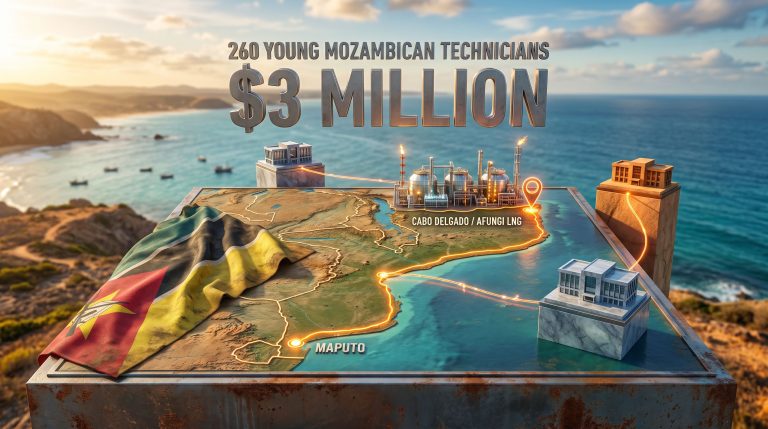
On July 28, 2026, TotalEnergies, Mozambique's Ministry of Education, and the Matola Industrial and Commercial Institute formalised a $3 million agreement to establish the Mozambique LNG Academy. The program targets 260 young Mozambican technicians, preparing them for production and maintenance roles at the Afungi LNG complex in Cabo Delgado province, which sits on the northern coast of the country and represents one of Africa's most significant natural gas developments.
The curriculum is structured in two phases:
| Program Component | Details |
|---|---|
| Total Investment | $3 million USD |
| Target Trainees | 260 technicians |
| Classroom Phase | 1 year at Matola Industrial and Commercial Institute |
| Practical Training Phase | 3 years at Afungi LNG site, Palma |
| Backing Partners | TotalEnergies, Mozambican Ministry of Education |
| Intended Roles | Production and maintenance at Afungi LNG complex |
The Afungi complex is expected to operate for several decades, which makes sustained workforce development a genuine long-term priority for both the operating consortium and the Mozambican state. Against that backdrop, the academy was presented as a meaningful step toward building national technical capacity for an industry that could define the country's economic trajectory for a generation.
The problem, according to critics, is not the program itself. It is where the program begins.
A 2,000-Kilometre Problem
The Matola Industrial and Commercial Institute sits in Matola, a municipality adjacent to Maputo, Mozambique's capital. The Afungi LNG complex is located in Palma, Cabo Delgado province, more than 2,000 kilometres away. That physical distance is not merely a logistical footnote. For communities in Cabo Delgado, it functions as a symbol of a much older and deeper pattern of geographic marginalisation.
Less than one week after the academy's launch, the Forum of Civil Society Organizations of Cabo Delgado (FOCADE) issued a formal statement opposing the decision on August 4, 2026, to anchor the program's classroom training phase in Maputo. The organisation was joined in its concerns by the provincial business council and other local stakeholders.
FOCADE's position rests on a straightforward geographic and economic logic: a province that absorbs the disruption, displacement, and risks associated with a major industrial project should also be positioned to absorb the knowledge, employment, and institutional capacity that come with it. The organisation identified Pemba, Cabo Delgado's provincial capital, as a city that already possesses the institutional infrastructure needed to host the training program and has served as the operational hub for the LNG project since construction resumed in January 2026.
The core civil society argument holds that local content frameworks only generate lasting regional benefit when the institutions of training and knowledge are physically embedded within the affected communities, rather than being established in distant urban centres with only the practical phase returning to the host province.
The Government's Counterargument and the Infrastructure Defence
Does the Technical Justification Hold Up?
Mozambique's government has defended the choice of Matola on technical grounds. The position is that the facility was selected because it possesses the specialised laboratories and technical equipment required to deliver LNG-relevant vocational training, infrastructure that does not currently exist at an equivalent standard in Pemba.
Officials have also pointed to the curriculum's three-year practical phase at the Afungi site as evidence that the host province will ultimately receive the program's most intensive workforce development component. From this perspective, the classroom phase in Maputo is a transitional necessity rather than a deliberate exclusion.
This is not an implausible argument. LNG operations require training in highly specialised areas, including cryogenic process management, gas compression systems, and safety protocols governed by international standards. Replicating that laboratory environment in an underfunded provincial institution is not a trivial undertaking.
However, critics counter that this framing inverts the logic of genuine local content. If the host province lacks the infrastructure to support training for an industry operating within its borders, the appropriate response from project operators and government is to build that infrastructure in the host province, not to route training elsewhere.
The Consortium's Broader Local Content Record
It would be incomplete to assess the Mozambique LNG Academy backlash without acknowledging the scale of the consortium's existing local content commitments. Furthermore, the broader context of natural capital in mining and resource operations increasingly frames how these commitments are evaluated by international stakeholders. As of mid-2026, the operating consortium has reported the following:
LNG Workforce Development Snapshot (mid-2026):
- More than 9,000 Mozambican workers are actively contributing to construction at the Afungi site
- Over 1,700 young Mozambicans have already completed technical training through consortium-linked programs
- Approximately 500 small and medium-sized enterprises (SMEs) are receiving capacity-building support through the consortium
- A business seminar held in Pemba in March 2026 connected local suppliers to procurement opportunities within the project's supply chain
These figures represent a substantive commitment that goes beyond symbolic gesture. The Pemba seminar is particularly notable because it demonstrates that the consortium recognises the city's role in the project's operational ecosystem. That recognition makes the decision to locate the academy's foundational training phase in Maputo more, not less, difficult to explain to local stakeholders.
Scale, however, does not resolve questions of geographic equity. Delivering training to 1,700 young Mozambicans nationally is a different outcome from directing that training toward Cabo Delgado's own communities in proportion to the burden they carry.
Local Content as Architecture, Not Announcement
The Mozambique LNG Academy backlash surfaces a conceptual distinction that matters deeply in African resource governance: the difference between local content as a compliance exercise and local content as a structural economic intervention.
Compliance-oriented local content asks whether minimum thresholds for national hiring or procurement have been met. Structural local content asks whether the economic gains from extraction are building durable capacity within the specific communities most affected. These are not the same question, and the answers can diverge significantly.
A province-of-impact approach to training would require that a meaningful proportion of skills development occur within or immediately adjacent to the host community. This model:
- Builds permanent laboratory and equipment capacity in regional institutions
- Creates a locally available skilled labour pool that can serve the project across its full operational lifespan
- Generates multiplier effects within the provincial economy rather than exporting economic value to the capital
- Establishes institutional legacies that outlast the project itself, providing long-term human capital benefits to the region
None of these outcomes are achievable when the knowledge infrastructure is concentrated two thousand kilometres away.
The next major ASX story will hit our subscribers first
Cabo Delgado's Compounding Context
A Province Already Under Pressure
Understanding the intensity of the Mozambique LNG Academy backlash requires situating it within Cabo Delgado's recent history. The province has been the epicentre of a jihadist insurgency since 2017, an ongoing security crisis that directly caused TotalEnergies to suspend the Mozambique LNG project in April 2021 following a major attack on Palma. The suspension stalled one of Africa's most anticipated energy investments and had devastating consequences for local employment and economic activity.
Construction resumed in January 2026 following improved security conditions, a development that generated significant community expectation. For many residents of Cabo Delgado, the project's return represented an opportunity to finally see the economic promise of LNG materialise in their daily lives. An academy launched within months of the restart, but headquartered in Maputo, has understandably landed as a disappointing signal at a politically sensitive moment.
This context also adds urgency to the question of institutional trust. Community relationships between LNG project operators and host populations in Cabo Delgado were strained before the suspension and have required deliberate rebuilding since. Decisions that read as capital-centric to local stakeholders, regardless of their technical justification, carry a disproportionate trust cost in this environment. Indeed, mining sustainability transformation frameworks increasingly emphasise that trust is built through place-based institutional investment, not through headline employment figures alone.
How Mozambique Compares to Other African Resource Projects
The geographic tension exposed by the Mozambique LNG Academy backlash is not unique to Mozambique. A comparison across African resource corridors reveals consistent patterns:
| Country / Project | Training Location | Host Community Integration | Outcome |
|---|---|---|---|
| Mozambique LNG (Afungi) | Maputo/Matola | Partial, practical phase in Palma | Under active dispute |
| Tanzania LNG (proposed) | Dar es Salaam-centric | Limited host province focus | Ongoing policy debate |
| Senegal (Sangomar Field) | Dakar-based institutions | Mixed, local content law enforced | Moderate community benefit |
| Nigeria (Niger Delta projects) | Port Harcourt and Lagos split | Historically capital-heavy | Persistent host community grievances |
The pattern that emerges from this comparison is consistent: when training and procurement infrastructure gravitates toward capital cities, host communities perceive the benefits of extraction as leaking outward. The most durable community relationships tend to develop in contexts where operators and governments have made deliberate investments in regional institutional capacity, not just employment numbers.
What a Pemba-Centred Model Could Deliver
If the $3 million investment that established the Mozambique LNG Academy had been directed toward upgrading or establishing a comparable facility in Pemba, the structural outcomes would differ substantially. This is an analytical scenario rather than a policy announcement, but it illustrates the opportunity cost of the current arrangement:
- Pemba's existing technical institutions would gain permanent laboratory and equipment upgrades with multi-decade utility
- Training delivery would operate within the economic ecosystem of Cabo Delgado, keeping spending, employment, and knowledge within the host province
- SME suppliers already engaged through the March 2026 Pemba seminar would benefit from a co-located pool of technically trained graduates
- The institutional legacy of the academy would remain in the province rather than transferring to the capital upon the project's eventual closure
A satellite campus model, complementing the Matola facility rather than replacing it, could offer a practical middle path that satisfies both the technical infrastructure argument and the geographic equity imperative. The broader geopolitical mining landscape in 2025 and beyond further underscores why equitable local development models are becoming a competitive necessity for resource operators, not merely an ethical preference.
Pathways Forward for Each Stakeholder
For the Consortium and Government
- Initiate a formal stakeholder consultation with FOCADE and the provincial business council to co-design the next phase of the academy's delivery model
- Commission a feasibility study for establishing a Pemba satellite training facility, drawing on institutions already identified by local civil society
- Publish a transparent local content audit disaggregating training, employment, and procurement data by province to demonstrate geographic distribution of benefits
For Civil Society Advocates
- Transition from reactive opposition toward proactive infrastructure proposals, presenting government and consortium partners with detailed assessments of Pemba's hosting capacity and institutional readiness
- Engage national and international development partners to elevate the local content equity debate beyond provincial media coverage
For Policymakers
- Review whether Mozambique's existing local content legislation contains enforceable geographic proximity requirements for training programs linked to resource extraction
- Consider introducing province-of-impact provisions requiring that a defined proportion of workforce development activity occur within host communities
Frequently Asked Questions
What is the Mozambique LNG Academy?
It is a $3 million vocational training initiative established in July 2026 through a partnership between TotalEnergies, Mozambique's Ministry of Education, and the Matola Industrial and Commercial Institute, designed to prepare 260 Mozambican technicians for operational roles at the Afungi LNG complex.
Why Has the Backlash Emerged So Quickly?
The backlash centres on the decision to locate the classroom training phase in Matola, near Maputo, rather than in Cabo Delgado, the host province of the LNG project. Civil society groups argue this arrangement contradicts the spirit of local content obligations by directing the program's institutional benefits to the capital. The critical minerals demand driving global LNG investment makes these local equity questions increasingly prominent in international development discourse.
Who Is Leading the Opposition?
FOCADE, the Forum of Civil Society Organizations of Cabo Delgado, issued a formal statement on August 4, 2026. The organisation is supported by the provincial business council and other local stakeholders. Civil society pressure has, in comparable contexts, prompted financial institutions to reconsider their disbursements to large LNG projects in the region.
Does the Government Have a Defensible Position?
The government argues the Matola facility was selected because it possesses the technical laboratories required for the curriculum. This is a legitimate infrastructure argument but does not address the longer-term question of why that infrastructure has not been developed in the host province.
Is This Dispute Unique to Mozambique?
No. Similar tensions between capital-city training infrastructure and host community expectations have been documented across Nigerian, Tanzanian, and Senegalese resource projects, making this a structurally recurring challenge in African resource governance.
The Deeper Lesson
The Mozambique LNG Academy backlash is not, at its core, a dispute about one training facility. It is a concentrated expression of a structural challenge that has defined the relationship between large-scale resource extraction and African host communities for decades. When the institutions of knowledge, training, and economic opportunity are built where the investment decisions are made rather than where the burdens are felt, the promise of local content becomes difficult to distinguish from a public relations exercise.
With more than 9,000 Mozambicans on site, 1,700 already trained, and 500 SMEs supported, the operational local content record of the Mozambique LNG project is substantive. However, numbers alone cannot resolve a question about institutional geography. The communities of Cabo Delgado are not asking for more employment statistics. They are asking for the kind of durable, place-based capacity that will still be generating value long after the gas has been shipped.
This article contains analytical scenarios and forward-looking assessments. These are provided for informational purposes only and do not constitute investment advice. Readers are encouraged to consult primary sources and independent analysis when evaluating the commercial or policy outlook for any resource development project.
Want to Track the Next Major African Resource Discovery Before the Market Does?
Discovery Alert's proprietary Discovery IQ model scans ASX announcements in real time, delivering instant alerts on significant mineral discoveries across more than 30 commodities — turning complex data into clear, actionable opportunities for investors at every level. Explore how historic discoveries have generated extraordinary returns and begin your 14-day free trial today to secure a market-leading edge.