July 28, 2026
When Green Policy Meets Industrial Reality: The Bell Bay Aluminium Paradox
There is a quiet contradiction running through Australia's green industrial transition that rarely surfaces in policy announcements or ministerial press releases. The assumption embedded in most clean energy incentive frameworks is straightforward: facilities that already operate on renewable power are the natural beneficiaries of schemes designed to reward low-emission production. Bell Bay Aluminium, powered by nearly 100% hydroelectric energy in Tasmania, should be the textbook case for that reward. Instead, it has become the most visible example of how the distance between a political promise and a functioning policy mechanism can threaten the survival of an entire regional economy.
The Bell Bay Aluminium green funding snub is not simply a bureaucratic oversight. It exposes a deeper structural problem in how Australian industrial policy is designed, announced, and ultimately delivered.
When big ASX news breaks, our subscribers know first
Understanding the Green Aluminium Production Credit
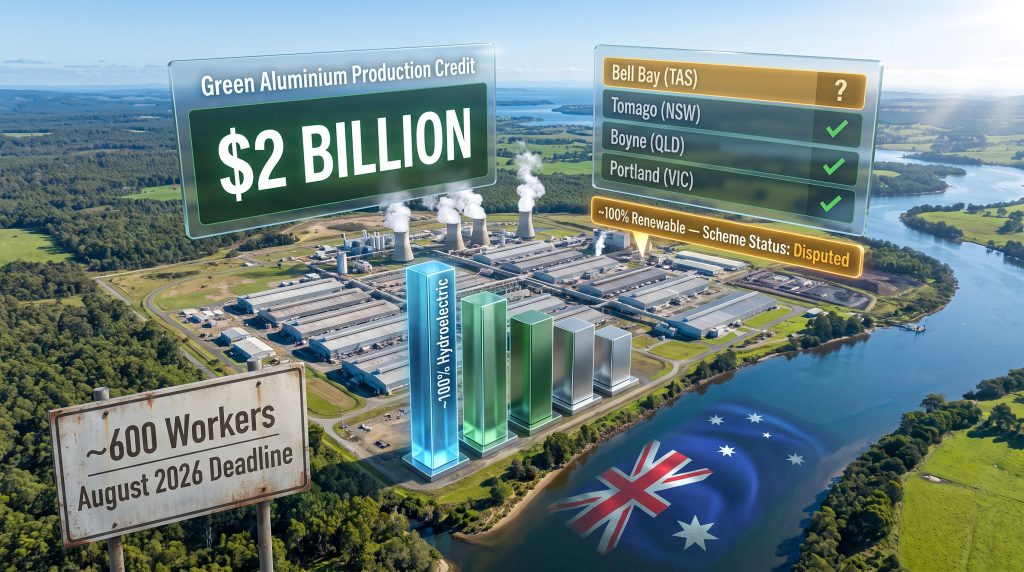
The federal government's Green Aluminium Production Credit is a $2 billion scheme structured as a production-linked financial mechanism rather than a capital grant program. This distinction matters considerably. Rather than funding infrastructure upgrades or capacity expansions, the scheme ties financial credits directly to output volumes, meaning eligible smelters receive ongoing support proportional to how much aluminium they actually produce under qualifying low-emission conditions.
The scheme is scheduled to commence in the 2028-29 financial year, giving facilities a multi-year lead time to position themselves within the eligibility framework. However, that framework was still being finalised as of mid-2026, creating a critical window of uncertainty for operators making near-term commercial decisions. Furthermore, the aluminium sector transition underway across Australia makes this uncertainty particularly consequential.
The Four Smelters Originally Named in the Announcement
When Prime Minister Anthony Albanese announced the scheme in January 2025 at the Tomago aluminium facility in New South Wales, four smelters were explicitly referenced as intended beneficiaries:
| Smelter | Location | Primary Power Source | Named in January 2025 Announcement |
|---|---|---|---|
| Tomago Aluminium | New South Wales | Grid (transitioning) | Yes |
| Bell Bay Aluminium | Tasmania | ~100% renewable hydroelectric | Yes |
| Boyne Smelters | Gladstone, Queensland | Coal-heavy grid | Yes |
| Portland Aluminium | Victoria | Mixed grid | Yes |
The irony embedded in this table is analytically significant. Bell Bay operates on the cleanest energy profile of any smelter on this list, yet it is the only facility whose eligibility had become disputed by mid-2026. Smelters drawing power from coal-heavy grids remained within the scheme's anticipated framework while the one facility already achieving the scheme's stated environmental objective faced exclusion.
The Promise That Wasn't Kept
The Bell Bay Aluminium green funding snub cannot be understood without tracing the specific sequence of political commitments that preceded it.
In January 2025, Industry Minister Tim Ayres gave a clear public assurance that Bell Bay would be eligible for the scheme, describing the initiative as designed to secure the future of every Australian aluminium facility, Bell Bay specifically included. That statement was made to ABC Northern Tasmania and was unambiguous in its framing.
By July 2026, federal Bass MP Jess Teesdale publicly stated that Bell Bay was not eligible under the scheme as currently structured. This was not a subtle policy refinement. It represented a direct reversal of the position articulated by a senior minister eighteen months earlier.
The gap between a minister's public commitment and a scheme's operational eligibility criteria is not a technicality. For a regional economy built around a single major industrial employer, it is the difference between a viable future and a managed decline.
The federal government's subsequent position linked Bell Bay's potential inclusion to the resolution of its power supply negotiations with Hydro Tasmania, effectively making scheme access conditional on a separate commercial dispute. This created a circular dependency: Bell Bay could not secure long-term commercial certainty without scheme inclusion, and scheme inclusion was being withheld pending commercial certainty.
Aluminium Smelting Economics: Why Energy Price Is Everything
To understand why the Bell Bay situation carries such urgency, it helps to understand the fundamental economics of aluminium smelting. The electrolytic reduction process used to refine aluminium from alumina is extraordinarily energy-intensive. Electricity costs typically account for 30 to 40 percent of total production costs at a smelter, a proportion that dwarfs most other industrial processes.
This means that power price negotiations are not routine procurement exercises for aluminium producers. They are existential commercial decisions. Consequently, energy costs and viability are inseparable considerations when assessing a smelter's long-term future. A shift of even a few dollars per megawatt hour in the contracted electricity rate can determine whether a facility is globally competitive or structurally unviable.
Key Operational Facts About Bell Bay Aluminium
- Owned and operated by Rio Tinto, one of the world's largest diversified mining and metals companies
- Employs approximately 600 direct workers at the Bell Bay site
- One of Tasmania's largest single electricity consumers, making it a major revenue source for Hydro Tasmania
- Powered almost entirely by hydroelectric generation, giving it one of the lowest emissions profiles of any aluminium smelter globally
- Operating under a one-year interim power agreement signed in 2025 after the prior long-term deal expired, with that interim arrangement set to lapse in December 2025
Rio Tinto set an internal deadline of August 2026 for a new long-term power agreement to be finalised. Federal Bass MP Jess Teesdale stated publicly that failure to reach an agreement by that point carried a very high risk of smelter closure.
The Power Negotiation Timeline
| Period | Key Development |
|---|---|
| Pre-2025 | Long-term power agreement in place with Hydro Tasmania |
| 2025 | One-year interim agreement signed to maintain operations |
| December 2025 | Interim agreement scheduled to expire |
| Mid-2026 | Negotiations ongoing; no long-term deal confirmed |
| August 2026 | Rio Tinto's self-imposed deadline for resolution |
Hydro Tasmania's Dual Mandate and the Commercial Tension
Hydro Tasmania occupies an uncomfortable position in this dispute. As a state-owned enterprise, it carries a dual mandate: serving major industrial customers while generating commercial returns on behalf of Tasmanian taxpayers. These obligations are not always compatible, particularly when a major customer requires concessional pricing to remain viable.
Hydro Tasmania's public position has been that negotiations with Rio Tinto are proceeding constructively and in good faith. The organisation has stated its objective is to reach agreements that deliver value for industrial customers while still securing a commercially appropriate price for the electricity it provides on behalf of Tasmanians.
The Tasmanian state government, through Industry Minister Felix Ellis, confirmed that a significantly concessional power offer had been placed on the table. Ellis described the potential exclusion of Bell Bay from the federal scheme as outrageous, calling on the federal government to deliver on the commitment made to northern Tasmania in January 2025.
This triangular dynamic between the federal government, Hydro Tasmania, and Rio Tinto illustrates a recurring tension in Australian industrial policy: the federal government can announce incentive frameworks, but the commercial energy pricing decisions that determine a facility's viability sit with state-level entities operating under entirely different mandates.
Liberty Bell Bay: The Warning Already Ignored
The urgency surrounding Bell Bay Aluminium's situation is sharpened considerably by what happened at the nearby Liberty Bell Bay manganese smelter in the first half of 2026.
Liberty Bell Bay operated as Australia's only manganese smelter, a strategically significant distinction given manganese's role in steel production and battery chemistry. The facility entered voluntary administration in March 2026 and closed shortly after, displacing more than 200 workers in a region already under economic stress.
A post-administration report prepared by EY identified the cost of securing a viable power agreement as the central reason a buyer could not be found for the facility. No prospective acquirer could construct a financially viable operating model when electricity pricing remained the decisive unresolved variable.
The EY finding on Liberty Bell Bay is not peripheral context for the Bell Bay Aluminium story. It is a direct precedent. The same energy cost dynamic that made the manganese smelter unsaleable is now being replicated in the aluminium smelter's power negotiations, suggesting this is a systemic issue rather than an isolated commercial failure.
Compounding Industrial Stress in Northern Tasmania
| Impact Category | Liberty Bell Bay (Closed) | Bell Bay Aluminium (At Risk) |
|---|---|---|
| Direct jobs affected | 200+ workers | ~600 workers |
| Industry significance | Only manganese smelter in Australia | Major aluminium producer |
| Primary closure factor | Power agreement cost (EY finding) | Power agreement uncertainty |
| Closure year | 2026 | Risk materialises August 2026+ |
The combined potential economic impact of both closures on northern Tasmania's industrial base represents a scale of disruption that no regional economy could absorb without lasting structural damage.
The next major ASX story will hit our subscribers first
The Renewable Credentials Paradox
Perhaps the most analytically striking dimension of the Bell Bay Aluminium green funding snub is the environmental credentials paradox at its core.
The Green Aluminium Production Credit was explicitly designed to incentivise Australian smelters to transition toward lower-emission production by pairing with renewable energy sources. Bell Bay Aluminium has already completed that transition. Its hydroelectric power supply gives it an emissions profile that the scheme's other named beneficiaries are still working toward.
The logical consequence of the current eligibility ambiguity is that smelters still drawing power from coal-dependent grids may qualify for the scheme's financial support while the facility that has already achieved the scheme's environmental objective does not. This is not merely an administrative anomaly. It undermines the credibility of the scheme's design logic and creates a perverse incentive structure where having already decarbonised your operations provides no advantage over those yet to begin the transition.
In addition, Rio Tinto aluminium operations elsewhere in Australia are receiving clearer pathways to scheme benefits, making Bell Bay's exclusion even more difficult to justify internally. Tasmanian officials have framed Bell Bay as representing the pinnacle of what the scheme should be rewarding: a facility that has achieved the environmental outcome the federal government is spending $2 billion trying to produce elsewhere.
Three Scenarios for Bell Bay's Future
Based on the available evidence, three distinct trajectories exist for Bell Bay Aluminium heading into the second half of 2026 and beyond.
Scenario 1: Full Resolution
Rio Tinto and Hydro Tasmania reach a commercially viable long-term power agreement before the August deadline. The federal government finalises the scheme's eligibility criteria in a manner that includes Bell Bay. The smelter enters the 2028-29 commencement window with both energy cost certainty and production credit support locked in.
Scenario 2: Partial Resolution
A short or medium-term power agreement is reached, buying operational continuity. However, Bell Bay's scheme eligibility remains unresolved, leaving the facility without access to production credits from 2028-29 onward. Viability concerns persist beyond the immediate crisis.
Scenario 3: Closure
Power negotiations fail to produce a viable agreement before Rio Tinto's deadline. Without scheme support or an affordable long-term energy contract, closure becomes the economically rational outcome. Northern Tasmania experiences its second major smelter closure within a single calendar year.
Disclaimer: Scenario projections are analytical frameworks based on publicly available information and should not be interpreted as forecasts. Industrial negotiations involve commercial variables not accessible to external analysis.
The Structural Lesson: Announcement Risk in Australian Industrial Policy
The Bell Bay Aluminium situation carries lessons that extend well beyond a single Tasmanian smelter. It illustrates what might be termed announcement risk in Australian industrial policy: the gap between a high-profile political commitment and a functional, enforceable policy mechanism.
When the Prime Minister names a facility as a beneficiary of a $2 billion scheme at a media event, that statement creates commercial expectations. Investors, operators, and communities make planning decisions based on those expectations. When scheme design subsequently diverges from those statements, the consequences are not merely political. They are commercial and economic.
The Bell Bay case also highlights the federal-state accountability gap that characterises many Australian industrial transition challenges. The federal government controls the incentive framework. State governments and state-owned enterprises control the energy pricing reality. When those two systems are not aligned, facilities operating between them can fall through the resulting gap regardless of their environmental credentials, their employment significance, or the political promises made on their behalf.
Furthermore, Australia's green metals push will struggle to gain international credibility if its flagship incentive scheme excludes the facility that best exemplifies the transition it claims to be funding. A coherent low-emissions industrial strategy must align its stated ambitions with its operational eligibility criteria — otherwise, the gap between announcement and delivery becomes the defining story.
For northern Tasmania, that gap has a very specific August 2026 deadline attached to it.
Frequently Asked Questions
What is the Bell Bay Aluminium green funding snub?
The term refers to the situation in which Bell Bay Aluminium, despite being publicly named as a beneficiary of the federal government's $2 billion Green Aluminium Production Credit scheme in January 2025, was found to be ineligible under the scheme's design as of mid-2026.
Who owns Bell Bay Aluminium?
The facility is owned by Rio Tinto, one of the world's largest mining and metals companies.
Why is the power deal so critical to Bell Bay's survival?
Electricity costs represent approximately 30 to 40 percent of total production costs for aluminium smelters. An unaffordable or unavailable power contract makes continued operation commercially unviable.
What happened to the Liberty Bell Bay manganese smelter?
Australia's only manganese smelter entered voluntary administration in March 2026 and closed after a buyer could not be secured. Administrators EY identified power pricing as the decisive factor preventing a successful sale.
Has Bell Bay been formally rejected from the green scheme?
No formal rejection has been issued. The scheme's eligibility criteria remained under development as of mid-2026, creating de facto exclusion through ambiguity rather than an explicit determination.
When does the Green Aluminium Production Credit commence?
The scheme is scheduled to begin in the 2028-29 financial year.
Want to Know Which ASX Mineral Discoveries Could Deliver the Next Major Return?
While Australia's green metals debate continues to reshape industrial priorities, savvy investors are already positioning themselves around the commodities that underpin the energy transition — and Discovery Alert's proprietary Discovery IQ model delivers real-time alerts the moment significant ASX mineral discoveries are announced, turning complex data across 30+ commodities into clear, actionable opportunities. Explore historic discovery returns on Discovery Alert's discoveries page and begin your 14-day free trial to ensure you're never behind the market when the next major find is made.