July 27, 2026
When Safety Becomes the Bottom Line: Understanding the Implats Rustenburg Mine Shutdown After Worker Deaths
Underground mining has always operated at the intersection of industrial ambition and human vulnerability. Nowhere is this tension more visible than in the deep platinum shafts of South Africa's Bushveld Igneous Complex, where kilometre-long haulage networks, extreme rock pressures, and operationally complex machinery create conditions that demand constant vigilance. When that vigilance falters, the consequences are irreversible. The Implats Rustenburg mine shutdown after worker deaths in 2026 is not simply a production event — it is a window into the structural safety challenges that define deep-level PGM mining and the governance decisions that follow when those challenges claim lives.
When big ASX news breaks, our subscribers know first
The Operational Weight of Rustenburg in Global Platinum Supply
To understand why this shutdown commands attention beyond South Africa's borders, it helps to grasp the scale of what Rustenburg represents within global platinum supply chains.
The Rustenburg complex sits within the Bushveld Igneous Complex, a geological formation that holds an estimated 80% of the world's platinum reserves and is unique in its concentration of all six platinum-group metals within a single layered intrusion. Unlike gold or copper deposits, which are broadly distributed across dozens of mining jurisdictions, platinum supply is geographically concentrated to a degree that makes any disruption at a major Bushveld operation a globally relevant event. Furthermore, PGM supply constraints in the region have long been a concern for global procurement planners.
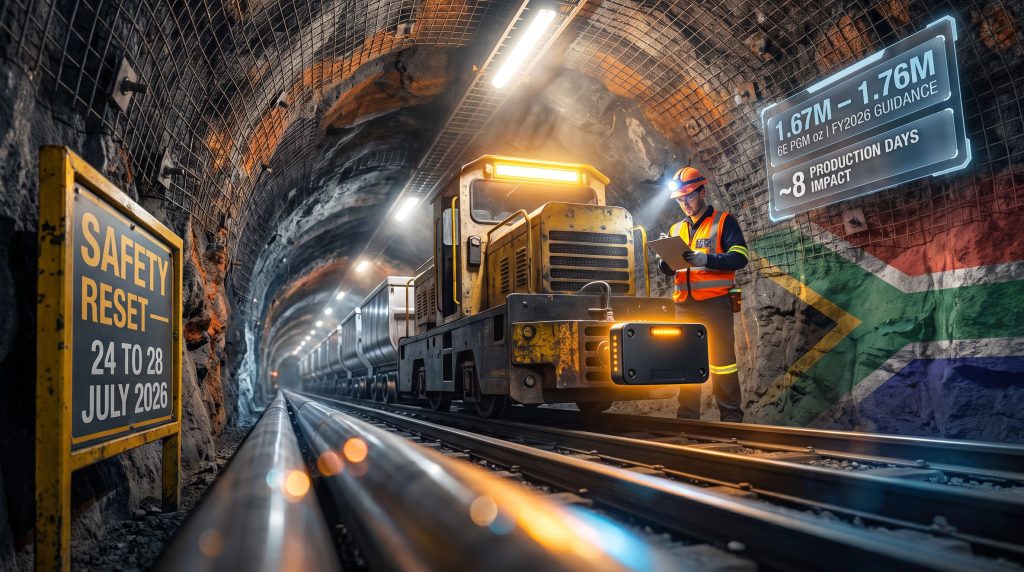
Rustenburg itself is Impala Platinum Holdings' (Implats) largest single mining complex, employing approximately 51,500 workers across underground and surface processing activities. Annual production guidance for the 2026 financial year sits at 1.67 million to 1.76 million six-element platinum-group metal (6E PGM) ounces, representing close to half of the company's total group output. The six elements counted within the 6E basket are platinum, palladium, rhodium, ruthenium, iridium, and gold — each serving distinct industrial roles, with platinum and rhodium being particularly critical to automotive catalytic converter manufacturing.
The end markets served by this output span:
- Automotive catalytic converters for petrol and diesel vehicles
- Industrial chemical processing, including nitric acid and fertiliser production
- Medical devices and laboratory equipment
- Emerging proton exchange membrane fuel cells for hydrogen mobility
- Jewellery manufacturing, particularly in Asian markets
Supply Chain Context: Automotive manufacturers typically maintain only weeks of PGM inventory. A sustained disruption at a Bushveld operation of Rustenburg's scale would ripple through procurement schedules far more quickly than equivalent disruptions in other commodity classes.
Six Fatalities, One Decision: The Trigger Behind the Shutdown
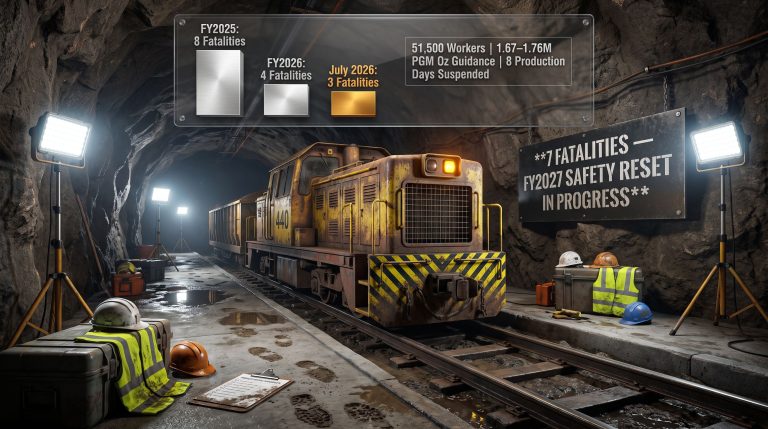
The Implats Rustenburg mine shutdown after worker deaths was not a sudden regulatory imposition. It was a voluntary operational suspension announced by the company itself, covering the period from 24 to 28 July 2026 — approximately five calendar days in duration.
The fatality sequence that preceded this decision unfolded as follows:
- Four workers died during the financial year ended 30 June 2026
- Two additional workers died in July 2026, early in the new financial year
- The July 2026 deaths were linked to underground rail-bound equipment incidents, with the specific causes remaining under active investigation at the time of the announcement
- The Association of Mineworkers and Construction Union (AMCU) had raised formal concerns about the fatality rate at Rustenburg before Implats announced the voluntary suspension
The sequence of AMCU raising concerns followed by a company-initiated shutdown is operationally significant. Under South Africa's Mine Health and Safety Act (No. 29 of 1996), the Department of Mineral Resources and Energy (DMRE) holds authority to issue Section 54 stoppages — mandatory shutdowns triggered by inspectors identifying unsafe working conditions. A Section 54 carries legal obligations, public disclosure requirements, and removes operational control from the mining company. By acting ahead of potential regulatory intervention, Implats retained control over the timeline, scope, and remediation framework of the shutdown.
| Shutdown Metric | Detail |
|---|---|
| Formal suspension period | 24 July – 28 July 2026 |
| Calendar duration | Approximately 5 days |
| Estimated production impact | ~8 production days in FY2027 |
| Financial year affected | FY2027 (ending 30 June 2027) |
| Primary incident type | Rail-bound locomotive collisions |
| Regulatory trigger | Voluntary (company-initiated) |
The gap between five calendar days and eight production days reflects the operational reality of deep-level mining. Underground ramp-down protocols, mandatory safety audits before re-entry, equipment revalidation, and worker retraining all add time on both sides of a planned stoppage. Production does not simply resume at full capacity the moment the calendar suspension ends.
The Hidden Risk in Underground Rail Networks
Most media coverage of mining fatalities focuses on rockfalls and shaft accidents, which are the most visually dramatic incidents and historically the most common sources of fatality in South African deep-level mines. The 2026 Rustenburg deaths highlight a less commonly discussed but equally serious hazard: rail-bound haulage systems.
Platinum mines at the scale of Rustenburg operate extensive underground rail networks that transport ore, equipment, and personnel across kilometres of tunnel drives. These systems use diesel or electric locomotives hauling multi-tonne loads through narrow, poorly lit underground corridors. The collision risk profile is shaped by several compounding factors:
- Limited sightlines in curved underground drives, where locomotive operators may have only seconds of visible stopping distance
- Communication latency between operators at different points in the haulage network
- High-traffic intersection zones where multiple haulage routes converge
- Anti-collision system reliability, which depends on proximity sensors, speed monitoring hardware, and automatic braking software functioning correctly in dusty, vibration-intensive underground environments
- Human-machine interface complexity, where operator response time and system alert design both influence outcomes
Technical Note: Anti-collision technology for underground rail systems typically operates on a combination of proximity detection, track-mounted transponders, and onboard speed governors. Failure modes include sensor contamination from rock dust, software latency issues, and transponder misalignment after track maintenance. Each failure pathway requires a different engineering response.
Implats confirmed it would engage directly with the manufacturer of its underground locomotive anti-collision technology during the suspension period — a step that suggests the investigation had identified possible gaps in the technological safeguards rather than exclusively human error.
What a Safety Reset Actually Involves: A Step-by-Step Breakdown
The term "safety reset" is used across the mining industry but its operational content varies significantly. In Implats' case, the structured activities during the Rustenburg suspension included:
- Systematic underground workplace inspections across all active mining zones, with concentrated focus on rail haulage corridors where the fatal incidents occurred
- Independent specialist engagement to audit existing safety frameworks and identify control gaps that internal teams may have normalised over time
- Anti-collision technology review conducted in partnership with the equipment manufacturer to assess whether current systems meet operational demands
- Mandatory operator retraining and revalidation for all workers who operate or work near rail-bound equipment
- Critical control re-verification requiring each safety mechanism to be tested, documented, and formally signed off against current standards
- Supervisory accountability review examining whether procedural breakdowns at the management and shift supervision level contributed to the fatal incidents
The inclusion of independent specialists is particularly notable. Internal safety reviews are susceptible to what occupational safety researchers describe as normalisation of deviance — a gradual process by which small procedural shortcuts or equipment imperfections become accepted as normal operating practice, until a catastrophic failure makes visible what had been incrementally building. External reviewers bring fresh risk perception unfiltered by operational familiarity. Consequently, thorough mine safety and mine life planning frameworks have become increasingly critical to responsible deep-level operations.
Leadership Positioning: Reading Between the Lines of Executive Statements
Rustenburg Chief Executive Moses Mothlhage communicated that the aspiration for every worker to return home safely each day had been reinforced by the recent incidents, and that pausing operations to reflect and take decisive action was necessary. This framing positions the shutdown as a proactive governance decision rather than a reactive damage limitation exercise.
Group Chief Executive Nico Muller's messaging added a dimension that is worth examining carefully. His emphasis on workforce engagement as a pillar of safety outcomes implies that the safety reporting pipeline — the mechanisms by which workers communicate hazard observations to management — may not have been functioning optimally before the fatalities. In high-consequence industrial environments, it is well established that fatal incidents are rarely the first signal of a systemic problem.
Near-misses and minor incidents typically precede major events, and effective safety cultures depend on workers feeling empowered and protected when escalating concerns. In addition, responsible platinum mining standards across the broader industry reflect growing institutional pressure for transparent safety governance at this level.
Governance Insight: The voluntary nature of this shutdown, combined with the framing around workforce engagement, suggests Implats may be responding not only to the fatalities themselves but also to evidence that earlier warning signals did not receive adequate operational attention.
The next major ASX story will hit our subscribers first
Comparing 2026 to 2023: A Pattern the Industry Cannot Ignore
The November 2023 hoisting accident at Rustenburg's 11 Shaft killed 13 workers and injured dozens more, making it one of the most severe underground mining disasters in South Africa in recent memory. That incident involved a fundamentally different mechanical system — a shaft hoisting apparatus rather than a surface rail network — and triggered a national review of hoisting standards across the platinum belt.
| Comparison Metric | November 2023 Incident | July 2026 Safety Reset |
|---|---|---|
| Incident mechanism | Shaft hoisting failure | Rail-bound locomotive collision |
| Immediate fatality count | 13 workers | 2 (July 2026 alone) |
| Total fatalities over period | 13+ | 6 over 12 months |
| Regulatory response | Shaft closure and national review | Elevated scrutiny, AMCU involvement |
| Operational response scope | Shaft-specific closure | Full complex suspension |
| Shutdown duration | Extended | ~5 calendar days |
The two events are mechanically unrelated, but their co-occurrence at the same complex within three years raises a systemic question that commodity analysts and institutional investors are likely to be tracking: whether Rustenburg faces infrastructure-level safety challenges that exceed what routine maintenance and incident-response programmes can address. This is a speculative position, but one that the pattern of recurring fatal incidents at the same facility makes difficult to dismiss entirely.
Production Mathematics: Quantifying the Market Impact
For investors and commodity market participants, the immediate question following the Implats Rustenburg mine shutdown after worker deaths concerns the scale of the production impact and its downstream effects on platinum pricing. Understanding the broader platinum and palladium market dynamics helps contextualise how supply disruptions of this nature translate into price behaviour.
Working from Implats' own production guidance for FY2026, the approximate daily output rate at Rustenburg's midpoint guidance sits around 4,700 to 4,900 6E PGM ounces per day. Applying the eight-day production impact figure the company disclosed:
- Estimated lost production: approximately 37,600 to 39,200 6E ounces
- As a proportion of annual guidance: roughly 2.1% to 2.4% of full-year output
- FY2027 timing advantage: the shutdown occurs at the very start of the financial year, providing a 12-month runway to recover volumes
Disclaimer: These production impact figures are estimates derived from publicly disclosed guidance ranges and the company's stated eight-day impact assessment. Final production figures will only be confirmed after operations resume and Implats completes its post-resumption assessment.
Three factors limit the immediate market impact:
- The shutdown is time-bound and planned, removing the uncertainty premium markets assign to open-ended stoppages
- Surface stockpiles of processed PGM material provide short-term delivery continuity for offtake customers
- The early-year timing allows production scheduling teams to adjust shift plans and potentially recover lost volumes within the same financial year
PGM Application Sensitivity Table
| End Market | Platinum Dependence | Near-Term Supply Sensitivity |
|---|---|---|
| Automotive catalytic converters | Very high | Medium-high |
| Hydrogen fuel cells | Growing rapidly | High (long-term horizon) |
| Industrial chemical catalysts | Moderate | Medium |
| Jewellery | Moderate | Low-medium |
| Medical devices | Low-moderate | Low |
The Deeper Structural Challenge: Why Deep-Level PGM Mining Remains High-Risk
South Africa's platinum shafts descend to depths that would be commercially unviable in most other jurisdictions. At these depths, several compounding physical and operational challenges intensify safety risk beyond what surface-level statistical comparisons capture:
- Seismic activity generated by the removal of large ore volumes from deep geological formations creates dynamic rock mechanics that are difficult to model and predict with precision
- Thermal stress on workers increases as depth increases, with temperatures in deeper drives frequently exceeding comfortable physiological limits and affecting cognitive performance during safety-critical tasks
- Evacuation complexity means that in the event of an underground emergency, the time required to safely egress large numbers of workers from multiple kilometres of tunnel is far greater than in shallower operations
- Infrastructure age across many Bushveld shafts introduces maintenance risk in haulage equipment, ventilation systems, and support structures that were designed to standards that predate current best practice
The Rustenburg complex also operates at a workforce scale — more than 51,000 people — that makes consistent safety culture maintenance an organisational challenge of the highest order. Maintaining procedural discipline across multiple shafts, dozens of active mining areas, and thousands of equipment operators across rotating shifts requires safety management systems of exceptional rigour. However, mining project risk assessment frameworks increasingly recognise that operational safety at this scale must be embedded from the earliest planning stages, not retrofitted after incidents occur.
Key Metrics to Watch as Rustenburg Resumes Operations
For investors, commodity analysts, and industry observers tracking the aftermath of the Implats Rustenburg mine shutdown after worker deaths, the following indicators will provide the clearest forward signal:
- Lost Time Injury Frequency Rate (LTIFR) for FY2027 compared to the prior year's trajectory
- Whether the DMRE issues any formal directives or Section 54 notices following its own review of the July incidents
- AMCU's formal assessment of the safety reset outcomes and whether the union considers the measures adequate
- Any revision to FY2027 production guidance that incorporates the shutdown impact into updated full-year output targets
- Progress disclosures on anti-collision technology upgrades across Rustenburg's underground rail network
- Whether additional independent safety audit outcomes are publicly disclosed or remain internal
What Does This Mean for Platinum Spot Prices?
The platinum market's response to the resumption of Rustenburg operations will itself be instructive. If spot prices remain stable through the shutdown period, it will confirm the market's read that the production impact is contained. If prices show sensitivity, it may indicate that traders are pricing in a probability of extended or recurring stoppages — a scenario that would warrant closer monitoring of Implats' safety governance reporting in subsequent quarters.
South Africa's Chamber of Mines safety reporting frameworks provide an additional reference point for understanding how voluntary stoppages compare to industry-wide fatality trends. Furthermore, the International Labour Organization's mining safety guidelines offer a useful benchmark for evaluating whether Implats' safety reset measures align with internationally recognised best practice standards.
This article is intended for informational purposes only and does not constitute financial advice. Production impact estimates are derived from publicly available guidance figures and involve inherent uncertainty. Readers should conduct their own research before making any investment decisions related to platinum markets or mining equities.
Want to Stay Ahead of Major ASX Mineral Discoveries in Real Time?
Discovery Alert's proprietary Discovery IQ model instantly notifies subscribers of significant ASX mineral discoveries — turning complex data across 30+ commodities into clear, actionable insights for traders and investors alike. Start your 14-day free trial at Discovery Alert today, or explore historic discovery returns to understand just how transformative early positioning in major mineral discoveries can be.