July 27, 2026
When Safety Systems Fail: Understanding the Structural Risk Behind Underground PGM Mining Fatalities
The economics of platinum group metal extraction have always carried an invisible cost that balance sheets struggle to fully capture. Deep-level underground mining in South Africa's Bushveld Complex operates at depths and mechanical intensities that place extraordinary demands on both equipment and the humans who manage it. When fatality rates at a single operation cluster within a narrow time window, the instinct is to treat each incident as isolated. But experienced safety professionals and sector analysts increasingly recognise that clustering patterns are rarely coincidental.
They are signals of systemic stress, and the question is whether organisations detect and act on those signals before the next fatality, or after. Understanding modern mine lifecycle risks is therefore essential for anyone seeking to interpret what these patterns truly represent at an operational level.
The Implats Rustenburg safety incidents suspension that unfolded in late July 2026 offers a detailed case study in both the failure mode and the response architecture that mature mining governance demands.
When big ASX news breaks, our subscribers know first
The Fatality Cluster That Forced a Decision
Impala Platinum Holdings, known as Implats, voluntarily suspended mining operations at its Impala Rustenburg complex from July 24 to July 28, 2026. The trigger was not a single catastrophic event but a compression of fatal incidents over a short period that created an unmistakable trend signal.
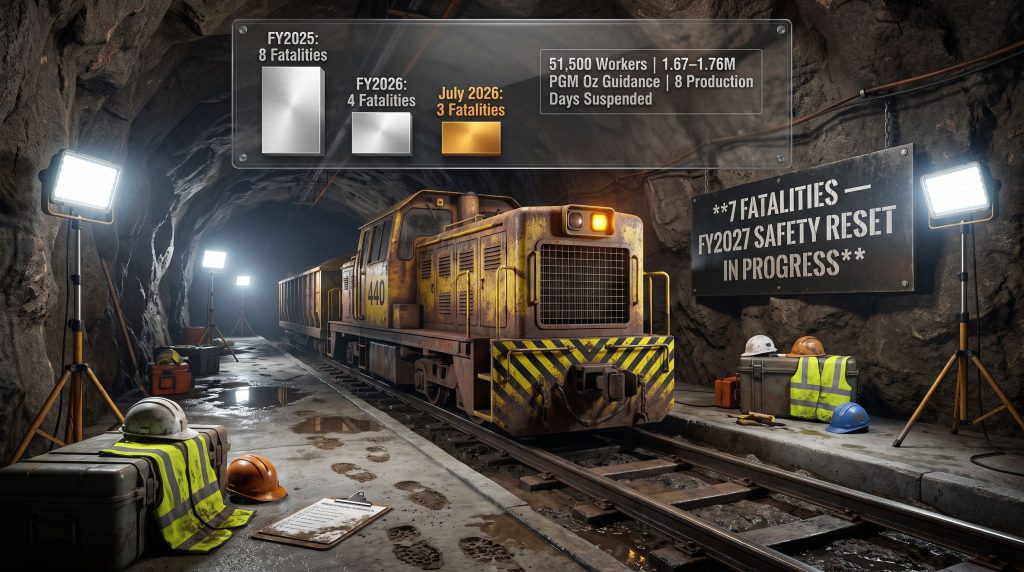
Three fatalities occurred at Impala Rustenburg during July 2026 alone. Two of these were directly linked to rail-bound locomotive operations underground. A third involved an employee at 10 Shaft who was declared unresponsive by paramedics on July 23 and whose cause of death remained under active investigation at the time of the suspension announcement. Taken alongside earlier incidents, the combined toll reached seven employee fatalities at Implats' operations since the start of the 2026 calendar year.
The trajectory is significant when viewed across multiple reporting periods:
| Financial Year | Fatal Injuries Recorded at Implats |
|---|---|
| FY2025 (ended June 30, 2025) | 8 fatalities |
| FY2026 (ended June 30, 2026) | 4 fatalities |
| FY2027 July 2026 (month-to-date at suspension) | 3 fatalities |
While the year-on-year improvement from FY2025 to FY2026 appears encouraging on the surface, the sharp re-acceleration in the very first month of FY2027 erased that optimism rapidly. Notably, Implats recorded zero fatalities across its entire mining and processing operations during the six months ended December 31, 2025, making the July 2026 concentration even more jarring by contrast.
The shift from a six-month fatality-free period to three deaths within a single month is precisely the kind of leading indicator deterioration that modern safety governance frameworks are designed to catch before they become systemic failures.
Anatomy of the 14 Shaft Locomotive Fatality
Of the July incidents, the 14 Shaft fatality provided the clearest window into the mechanical and procedural failure modes at the centre of the crisis. The sequence of events involved locomotive 437 hauling fully loaded hoppers from the 27 UG2 level when the locomotive derailed at the tipping section at 27 Level Tips.
As re-railing operations commenced, a second locomotive, numbered 440, approached and collided with the derailed hopper. The operator of locomotive 440 was pinned against the underground sidewall and sustained fatal injuries. The deceased was a 48-year-old male employee from Phokeng in the North West province with 11 months of service at the shaft. The Mine Health and Safety Inspectorate (MHSI) initiated a formal investigation immediately.
Why Did the Proximity Detection System Fail?
What makes this incident particularly significant from a technology governance standpoint is the behaviour of the proximity detection system installed on locomotive 440. Proximity detection and collision avoidance technology is a mandated focus area across South African underground mining engineering following amendments to the Mine Health and Safety Act regulatory framework. The system's apparent failure to identify the collision risk and prevent the impact raises questions that extend well beyond a single incident or a single operation.
The Association of Mineworkers and Construction Union (AMCU) formally demanded that the original equipment manufacturer responsible for the proximity detection system be included in the investigation to determine why the technology did not prevent the collision. Impala Rustenburg committed to engaging the OEM to evaluate system performance gaps.
This is a relatively rare instance of a mining company formally drawing an equipment manufacturer into a fatality investigation. The precedent it sets for technology accountability in underground tramming environments could reshape how proximity detection systems are validated and audited across the South African PGM sector.
Understanding Underground Rail-Bound Equipment Risk
For readers less familiar with deep-level PGM mining operations, the term "rail-bound equipment" refers to locomotives and associated rolling stock used in underground tramming systems. Tramming is the process of transporting ore, waste rock, and materials horizontally through underground tunnel networks using track-mounted equipment.
This infrastructure operates in confined spaces, often at significant depth, with limited sightlines and challenging ventilation conditions. Furthermore, narrow-reef mining technology introduces additional complexity in South African operations. Key risk factors that are not always visible in surface-level safety assessments include:
- Restricted stopping distances at underground grades, where gradient changes affect braking performance
- Communication limitations between locomotive operators separated by tunnel geometry
- Dynamic loading conditions during tipping and re-railing operations, when multiple pieces of equipment converge in confined areas
- Technology reliance gaps, where proximity detection systems may not perform reliably in dusty, high-vibration underground environments
- Operator fatigue and shift-pattern pressures in high-throughput operations with large workforce footprints
The concentration of three rail-bound equipment fatalities at Implats' Rustenburg operations within a single 12-month window points specifically to this risk category as undercontrolled relative to other principal fatal hazards.
The Safety Reset Programme: Structure and Intent
Rather than waiting for regulatory intervention, Impala Rustenburg management initiated a proactive safety reset covering the period July 24 to 28, 2026. Impala Rustenburg Chief Executive Moses Motlhageng led the programme personally, anchoring the process in a central mass employee engagement session before any return to operations.
The reset was structured across four functional phases:
- Workforce re-engagement through a mass meeting to re-establish safety commitments, behavioural expectations, and visible felt leadership across all operating areas.
- Physical verification involving comprehensive workplace inspections, make-safe activities, and revalidation of underground conditions across all shafts.
- Rail-bound equipment specific intervention, including full competency retesting for locomotive operators, re-verification of all tramming equipment before return to service, and formal OEM engagement on proximity detection performance.
- Independent assessment through third-party safety specialists tasked with auditing existing safety management systems and structured employee focus groups designed to surface personal, behavioural, and social contributing factors.
Why Do Focus Groups Matter in Mining Safety?
The focus group component deserves particular attention. Mining fatalities rarely have single-factor causes. Human factors research in underground environments consistently identifies the interaction between individual stress, team dynamics, workplace culture, and production pressure as a compound risk that technical controls alone cannot address. The structured focus group approach represents an attempt to access this latent risk layer rather than treating the fatalities purely as mechanical or procedural failures.
AMCU's Role and the Significance of Union-Management Alignment
AMCU president Joseph Mathunjwa characterised the pattern of rail-bound equipment fatalities as evidence of systemic safety failures requiring immediate structural intervention — a characterisation that management's own actions implicitly validated by initiating the reset before AMCU's demands were formally received.
AMCU's written demands to Implats CEO Nico Muller outlined a specific action framework:
| AMCU Demand | Stated Purpose |
|---|---|
| Emergency safety briefing on July 28 | Workforce-wide re-engagement before resumption |
| Joint shaft inspection teams | Multi-stakeholder compliance verification |
| Independent safety experts on teams | Objectivity and credibility of findings |
| OEM inclusion in locomotive investigation | Technical accountability for proximity detection failure |
| Single consolidated audit report | Unified corrective action framework with named responsibilities and deadlines |
Implats agreed to the July 28 emergency briefing date, and the company's independently announced reset programme aligned substantively with AMCU's core demands. In a sector historically defined by adversarial labour relations, this degree of convergence between union demands and management response is noteworthy. It suggests that both parties recognised the severity of the pattern and the reputational and human cost of continued discord.
The next major ASX story will hit our subscribers first
Comparing 2026 to the 2023 Rustenburg Suspension
This is not the first time Impala Rustenburg has faced a production suspension driven by safety failures. In November 2023, a shaft conveyance incident at 11 Shaft resulted in 11 initial worker fatalities and 75 injuries, with a subsequent death bringing the confirmed toll to 12. That event triggered an industry-wide reassessment of hoisting system safety across South African underground operations.
The differences between the two suspension events are instructive:
| Factor | November 2023 Suspension | July 2026 Suspension |
|---|---|---|
| Primary trigger | Single shaft conveyance catastrophe | Cumulative locomotive fatality pattern |
| Fatalities at trigger point | 11 to 12 in a single incident | 3 in July; 7 year-to-date |
| Nature of shutdown | Reactive, post-catastrophe | Proactive, pattern-triggered |
| Regulatory involvement | MHSI-driven investigation | MHSI investigation plus voluntary management reset |
| Equipment type implicated | Shaft winders and conveyances (hoisting) | Rail-bound locomotives (tramming) |
The shift from reactive to proactive suspension management across these two events does reflect a measurable evolution in Implats' safety governance posture. However, the recurrence of fatal incidents at the same operation within three years raises legitimate questions about whether prior corrective measures produced durable systemic change or primarily addressed surface-level compliance indicators.
Production Impact and Investor Considerations
Impala Rustenburg employs approximately 51,500 workers across its mining and processing operations and was projected to have produced between 1.67 million and 1.76 million PGM ounces on a stock-adjusted basis during FY2026. The six PGMs produced at the operation are platinum, palladium, rhodium, ruthenium, osmium, and iridium.
The operational pause covers approximately eight production days within the FY2027 reporting period, which ends June 30, 2027. Based on annualised production guidance of 1.67 to 1.76 million PGM ounces against a 365-day operating year, the theoretical maximum production displacement from an eight-day pause approaches 36,000 to 38,000 PGM ounces, though actual displacement will be moderated by processing continuity during the mining pause and recovery factors following resumption.
Investor Note: The production impact falls entirely within the FY2027 reporting period, meaning it will not affect FY2026 results. Precise tonnage and ounce impact figures were pending operational assessment at the time of the suspension announcement. Investors should monitor FY2027 guidance updates from Implats for quantified production revisions.
Disclaimer: This article contains forward-looking production estimates derived from company guidance ranges and mathematical extrapolation. Actual production outcomes may differ materially from estimates due to operational recovery factors, regulatory interventions, and conditions not known at the time of writing. This does not constitute financial advice.
What This Means for the Broader PGM Sector
The Implats Rustenburg safety incidents suspension carries implications that stretch across the South African PGM industry. Consequently, several dynamics are worth monitoring closely.
Technology accountability is entering the safety governance conversation. The formal inclusion of a proximity detection OEM in a fatality investigation is not standard practice. If the investigation surfaces systematic performance gaps in collision avoidance technology under underground tramming conditions, it could trigger mandatory equipment reassessment across competing operations using similar systems.
Deep-level operational complexity resists simple solutions. The Bushveld Complex operations that supply the majority of the world's platinum and rhodium operate at depths and scales that create risk profiles fundamentally different from open-pit or shallow underground mines. Rail-bound tramming systems, shaft hoisting, and ventilation management at depth involve layered interdependencies that single-point technical fixes rarely resolve permanently.
Production concentration risk remains a sector-level concern. Impala Rustenburg alone accounts for a significant share of global PGM supply. Safety-driven suspensions, even when measured in days rather than weeks, concentrate attention on the vulnerability of global platinum and palladium market dynamics to operational disruptions at a small number of Bushveld Complex operations.
Proactive safety governance may be emerging as an investor-relevant differentiator. As ESG frameworks mature and institutional investors sharpen their focus on operational risk, effective mining risk management — not merely fatality statistics — may increasingly influence capital allocation decisions in the PGM sector.
FAQ: Key Questions About the Implats Rustenburg Safety Suspension
How Long Did the Impala Rustenburg Production Suspension Last?
Mining operations were suspended from July 24 to July 28, 2026, representing approximately eight production days within the FY2027 reporting period.
How Many Fatalities Occurred at Implats in FY2026?
Implats recorded four fatal injuries in the financial year ended June 30, 2026, compared with eight in FY2025.
What Equipment Was Involved in the July 2026 Fatalities?
Both fatalities in July 2026 involved rail-bound locomotive operations underground, specifically tramming equipment used to haul loaded hoppers between underground levels and tipping stations.
Did AMCU Support the Suspension?
AMCU formally requested an emergency safety briefing and controlled operational stoppage before Implats' announcement. The company's subsequent safety reset aligned closely with AMCU's demands, and Implats agreed to the union's requested July 28 briefing date.
Has Impala Rustenburg Been Suspended Before for Safety Reasons?
Yes. A significant safety-related suspension occurred in November 2023 following a shaft conveyance incident at 11 Shaft that resulted in 12 worker deaths and 75 injuries.
What Is the Significance of the Proximity Detection System Failure?
Proximity detection technology is a mandated safety focus across South African underground mining. The apparent failure of the system on locomotive 440 to prevent a collision during re-railing operations raises broader questions about technology performance standards in underground tramming environments, prompting formal OEM engagement as part of the investigation. The Implats Rustenburg safety incidents suspension has, in this respect, opened a wider conversation about how the entire sector validates and audits collision avoidance systems going forward.
Want to Stay Ahead of Significant ASX Mineral Discoveries in Real Time?
Discovery Alert's proprietary Discovery IQ model instantly identifies high-potential ASX announcements across more than 30 commodities, delivering actionable insights to both short-term traders and long-term investors before the broader market reacts. Start your 14-day free trial at Discovery Alert today, or explore the discoveries page to understand how historic mineral discoveries have generated substantial returns.