July 27, 2026
The Productivity Imperative: Why Minerals Processing Can No Longer Afford Reactive Thinking
Across the global mining sector, a quiet but profound operational shift is underway. As ore grades decline at established deposits and processing flowsheets grow increasingly complex, the margin for equipment failure is narrowing sharply. The economics of modern minerals processing have made one thing unmistakably clear: unplanned downtime is no longer just an operational inconvenience — it is a direct threat to mine viability.
This is the structural reality driving adoption of Metso data-driven services for mining, a framework that combines connected equipment, artificial intelligence, and specialist remote support to fundamentally redefine how processing operations manage risk and protect throughput.
When big ASX news breaks, our subscribers know first
Why Traditional Maintenance Models Are Breaking Down
For decades, minerals processing operations relied on two dominant maintenance philosophies: fix equipment after it fails, or replace components on a fixed schedule regardless of actual condition. Both approaches carry significant cost inefficiencies, but in today's operating environment, their limitations are becoming harder to absorb.
Time-based preventive maintenance, while an improvement over pure reactive approaches, introduces its own inefficiencies. Components are replaced before reaching the end of their useful life, generating unnecessary parts expenditure and scheduled downtime that may not always align with actual equipment condition. Meanwhile, condition-based monitoring using simple sensor thresholds generates data without necessarily generating insight.
The critical gap in most conventional approaches is the analytical layer. Raw sensor data, without contextual interpretation grounded in equipment-specific failure knowledge, cannot reliably distinguish between a developing fault signature and normal operational variation. This is precisely where intelligence-led operations create a structural advantage. Furthermore, data-driven mining operations are increasingly demonstrating that the analytical layer is where the greatest value is unlocked.
"The transition from reactive to predictive operations is not simply a technology upgrade. It represents a fundamental restructuring of how mine sites manage risk, plan maintenance windows, and protect throughput continuity."
The table below illustrates how different maintenance philosophies compare across key operational dimensions:
| Operational Model | Trigger for Action | Detection Timing | Cost Profile | Risk Exposure |
|---|---|---|---|---|
| Reactive Maintenance | Equipment failure | Post-failure | High (emergency) | Very high |
| Preventive (Time-Based) | Scheduled interval | Pre-failure (fixed) | Moderate | Moderate |
| Condition-Based Monitoring | Sensor threshold breach | Near real-time | Lower | Lower |
| Intelligence-Led (AI + FMEA + Remote Expert) | Predictive pattern recognition | Pre-symptom onset | Lowest long-term | Minimal |
What Metso's Data-Driven Performance Services Actually Do
Launched in September 2025, Metso's Data-driven Performance Services have scaled rapidly, with the number of connected equipment units exceeding 800 as of mid-2026, more than doubling since the programme's introduction. This growth rate signals that the offering is moving beyond early-adopter territory into broader operational deployment.
The architecture underpinning these services is built on four integrated components:
- Live equipment connectivity through standard instrumentation already present at most processing facilities
- Advanced analytics and AI-powered diagnostic models capable of detecting deviation patterns before they escalate into failures
- Failure Modes and Effects Analysis (FMEA) knowledge integration, which gives AI models structured, equipment-specific contextual grounding
- Remote expert support delivered through dedicated Metso Performance Centres, where experienced engineers validate model outputs before field action is recommended
This last element is significant. The human-in-the-loop validation layer prevents the false-positive alerts that undermine trust in automated monitoring systems and cause maintenance teams to disengage from early-warning signals. By combining algorithmic pattern recognition with domain-expert review, the system filters noise and delivers actionable intelligence.
Critically, Metso now supports two operational scales simultaneously: individual asset monitoring for single pieces of equipment, and holistic process island analysis that captures how performance variations across interconnected assets affect overall circuit throughput. In addition, AI-powered mining efficiency frameworks are increasingly complementing these connected service models across the sector.
The Performance Numbers: What Connected Equipment Actually Delivers
The reported outcomes from Metso's connected equipment deployments are notable both for their scale and their specificity. Based on data from operational deployments to date, the programme has demonstrated:
| Metric | Reported Outcome |
|---|---|
| Connected equipment units | Exceeding 800 (mid-2026) |
| Programme launch | September 2025 |
| Growth since launch | More than doubled |
| Failure risk detection rate | 80-90% of identified issues |
| Equipment availability improvement | Up to 6% increase |
| CO₂ emissions reduction | Up to 20% per tonne processed |
| Issue resolution time improvement | Up to 50% reduction in some cases |
Important Note: The performance figures cited above are drawn from Metso's own operational reporting and customer case data. Independent third-party benchmarking of these metrics has not been publicly confirmed at the time of publication. Investors and operators should treat these figures as indicative of potential outcomes rather than guaranteed results across all deployment contexts.
The 6% availability improvement figure deserves particular attention. At high-throughput processing operations, equipment availability improvements of even a few percentage points translate disproportionately into revenue. A concentrator processing tens of thousands of tonnes per day operates on throughput economics where small availability gains compound significantly across an operating year.
The sustainability co-benefit is equally noteworthy. The potential for up to a 20% reduction in CO₂ emissions per tonne processed stems from the relationship between optimised equipment performance and energy intensity. Grinding circuits, which are among the most energy-intensive operations in minerals processing, consume significantly more power when operating in degraded states. Proactive condition management reduces this energy overhead, creating a measurable emissions benefit alongside the operational efficiency gain.
FMEA Integration: The Technical Edge That Separates This Approach
One of the less-discussed but technically significant aspects of Metso's approach is the integration of Failure Modes and Effects Analysis (FMEA) knowledge into its AI diagnostic models. Understanding why this matters requires a brief explanation of what FMEA actually is.
FMEA is a structured engineering methodology that systematically identifies all the ways a piece of equipment can fail, the likely causes of each failure mode, and the downstream effects that failure would produce. When this knowledge base is used to train and calibrate AI models, it gives those models a fundamentally different capability compared to generic anomaly detection algorithms.
Rather than simply flagging unusual sensor readings, an FMEA-informed AI model can interpret a specific pattern of deviations and associate it with a known failure pathway. This distinction has material consequences for detection accuracy and the quality of corrective action recommendations. However, it is worth noting that AI transforming mining extends well beyond diagnostics into operational planning and execution.
The combination of:
- Real-time sensor data from connected equipment
- AI models calibrated against FMEA failure libraries
- Performance Centre engineers who understand both the equipment and the site context
…creates a diagnostic capability that is qualitatively different from what any single component could achieve independently. This is a structural advantage that generic industrial IoT monitoring platforms struggle to replicate without the OEM's depth of equipment-specific failure knowledge.
South American Deployment: A Case Study in Captured Value
The most concrete validation of Metso's connected equipment framework comes from a minerals processing site in South America, where the service was deployed as an early operational case study. The results recorded over the first six months of operation provide a specific, quantified view of what these services can deliver.
| Performance Indicator | Measured Result |
|---|---|
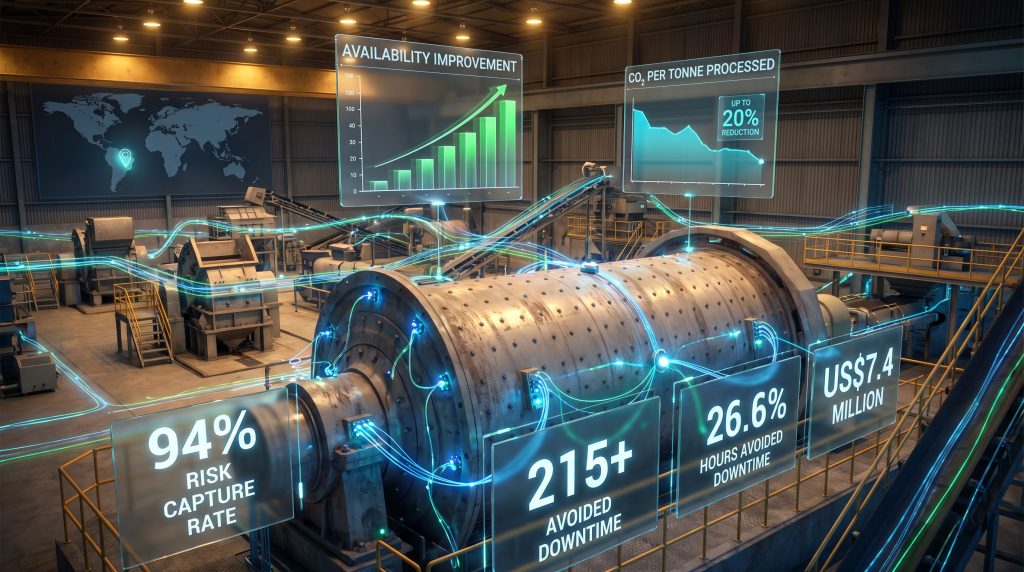
| Risk capture rate | 94% of identified risks detected |
| Potential downtime avoided | More than 215 hours |
| Total captured operational value | US$7.4 million |
| Measurement period | First six months of deployment |
The 94% risk capture rate recorded at this site exceeds the programme-wide 80-90% figure, suggesting that site-specific calibration and instrumentation quality play a meaningful role in detection accuracy. This has practical implications for operators planning deployments: the investment made in instrumentation quality and FMEA knowledge customisation for specific equipment types will directly influence detection performance.
To contextualise the US$7.4 million in captured value, consider the economics of unplanned downtime in a typical processing operation. For a copper concentrator running at meaningful daily throughput, a single unplanned shutdown event can represent millions of dollars in lost production value depending on head grade, copper price, and recovery rates. Avoiding more than 215 hours of potential downtime over six months, combined with reduced emergency spare parts procurement and the carrying cost savings that come with more predictable maintenance planning, creates a return profile that is difficult to dismiss.
"The captured value figure at the South American site illustrates a broader point: the financial case for connected performance services is not built on marginal efficiency gains but on the prevention of discrete, high-cost failure events that can individually dwarf the annual service investment."
The next major ASX story will hit our subscribers first
What Mine Operators Need to Evaluate Before Adopting Connected Services
For processing operations considering adoption of Metso data-driven services for mining, a structured evaluation framework reduces the risk of misaligned expectations and maximises the probability of a strong return on investment.
Step 1: Quantify current unplanned downtime frequency and the associated production loss value at your specific operation. This baseline establishes the risk exposure that connected monitoring is being asked to reduce.
Step 2: Assess existing instrumentation and connectivity infrastructure. Metso's framework is designed to integrate with standard instrumentation, but the quality and coverage of existing sensors will influence what can be monitored and at what resolution.
Step 3: Map your maintenance cost structure. What proportion of current maintenance spend is emergency versus planned? Operations with high emergency maintenance ratios typically carry the largest addressable opportunity. Consequently, predictive maintenance in mining has become a priority focus for operators seeking to rebalance this cost structure.
Step 4: Prioritise equipment by criticality. Grinding mills, crushers, and flotation circuits that sit on the critical path of the processing flowsheet should be connected first, as failures in these assets generate the greatest production impact. For instance, AI mill drive optimisation represents one of the highest-value early deployment targets for many operations.
Step 5: Define success metrics that align with operational KPIs. Mean time between failures (MTBF), overall equipment effectiveness (OEE), and availability percentage are the most commonly used benchmarks for evaluating predictive maintenance programme performance.
Beyond the technical assessment, there are organisational dimensions that frequently determine whether connected services deliver their potential value:
- Data governance clarity: Operators need to establish at the outset who owns the operational data generated by connected equipment and how it can be used.
- Maintenance team alignment: Predictive monitoring only delivers value if maintenance teams are culturally equipped and operationally empowered to act on early-warning signals rather than waiting for confirmed failures.
- Model calibration to site conditions: AI diagnostic models perform best when failure mode libraries and alert thresholds are calibrated to site-specific operating conditions rather than applied as generic templates.
The Broader Shift: OEMs as Lifecycle Performance Partners
The scaling of Metso's data-driven services reflects a structural repositioning underway across the major minerals processing equipment manufacturers. The traditional OEM value proposition centred on equipment quality and after-sales parts supply. The emerging model extends this into continuous performance partnership, where the OEM's value is measured not just by equipment uptime but by the cumulative operational intelligence generated across the connected fleet.
This shift has significant implications for how mining operators should evaluate supplier relationships. An OEM with a connected fleet exceeding 800 units is generating aggregated failure signature data at a scale that meaningfully improves the diagnostic models applied to any individual site. Each new connected asset contributes to a growing library of real-world failure patterns that makes the system more accurate over time.
The evolution from single-asset monitoring to process island analysis is a particularly important development in this context. Processing circuits are interconnected systems where the performance of each asset influences the throughput and condition of downstream equipment. A holistic flowsheet view enables operators to identify not just individual equipment faults but systemic inefficiencies in how processing stages are interacting, unlocking optimisation opportunities that asset-level monitoring alone cannot capture.
Frequently Asked Questions
What types of equipment can be connected to Metso's performance platform?
The framework is designed for minerals processing assets including grinding mills, crushers, flotation cells, and associated process equipment, integrating with standard instrumentation already present at most facilities to minimise the additional hardware investment required.
How quickly can value be realised after deployment?
Based on the South American case study, measurable performance improvements — including reduced unplanned downtime and a 94% risk capture rate — were demonstrated within the first six months of operation, with US$7.4 million in captured value recorded over that period.
Why does FMEA integration matter for detection accuracy?
FMEA knowledge bases allow AI models to interpret specific patterns of sensor deviation in the context of known failure pathways for each equipment type, producing more actionable and accurate diagnostics than generic anomaly detection algorithms that lack this structured equipment knowledge.
How does process island analysis differ from individual asset monitoring?
Individual asset monitoring tracks the health of a single piece of equipment. Process island analysis evaluates how an interconnected group of assets within a circuit are performing collectively, enabling operators to understand how variations in one asset propagate throughput and condition effects across the broader flowsheet.
What role do Performance Centre engineers play?
Performance Centre engineers act as a validation layer between AI model outputs and field action recommendations. Their role is to review analytical findings, apply site-specific operational context, and ensure that interventions recommended to maintenance teams are grounded in both data and practical engineering judgement.
Key Takeaways for Mining Operators and Industry Observers
- The minerals processing industry is at a meaningful inflection point where operational intelligence has become as important a competitive differentiator as equipment quality itself.
- A connected fleet exceeding 800 units, having more than doubled since September 2025, signals accelerating mainstream adoption of Metso data-driven services for mining.
- The integration of FMEA knowledge with AI diagnostics and remote expert validation creates a detection and intervention capability that is structurally more advanced than generic condition monitoring platforms.
- The South American deployment case study provides quantified validation: US$7.4 million in captured value, 215+ hours of avoided downtime, and a 94% risk capture rate within the first six months of operation.
- Sustainability and operational efficiency are increasingly co-dependent outcomes. Optimised equipment performance reduces both direct operating costs and per-tonne CO₂ emissions, supporting mine operators' dual mandate of profitability and ESG performance.
- Operators evaluating adoption should prioritise high-criticality equipment, invest in instrumentation quality, ensure site-specific model calibration, and align maintenance team workflows to act on predictive signals before they become confirmed failures.
This article incorporates operational data reported by Metso and published via Global Mining Review. Performance outcomes cited reflect specific deployment conditions and should not be interpreted as guaranteed results across all operating environments. Forward-looking figures and scenario analyses are presented for illustrative purposes only and do not constitute financial advice.
Want to Identify the Next Major Mineral Discovery Before the Broader Market?
Discovery Alert's proprietary Discovery IQ model delivers real-time alerts on significant ASX mineral discoveries, transforming complex mineral data into clear, actionable insights for both short-term traders and long-term investors — explore historic discoveries and their returns to understand the scale of opportunity, then begin your 14-day free trial to position yourself ahead of the market.