July 26, 2026
When the Desert Floods: Extreme Weather and the Hidden Vulnerabilities of High-Altitude Mining
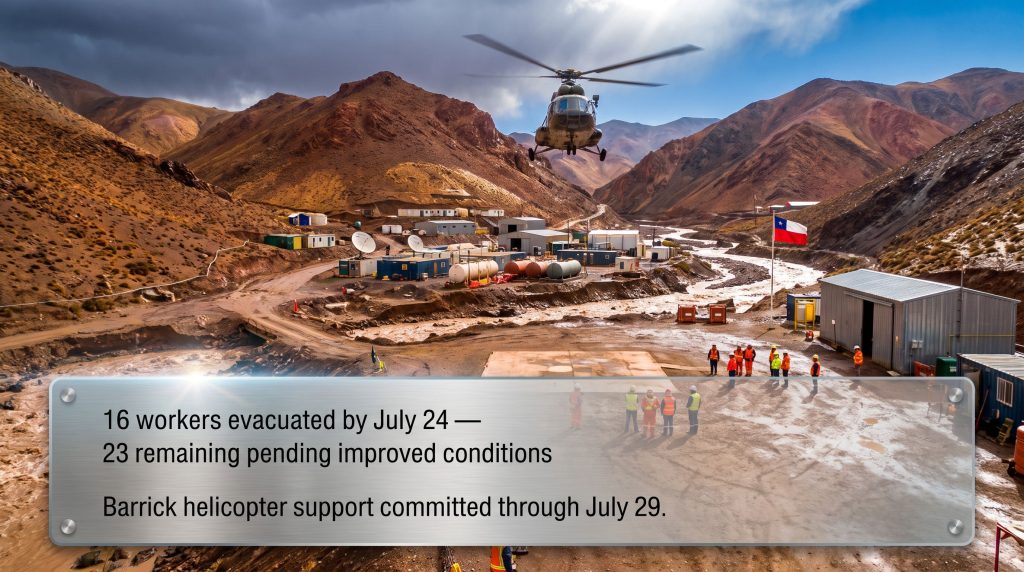
The Atacama Desert is widely regarded as the driest non-polar desert on Earth, receiving less than one millimetre of rainfall annually across its most arid stretches. For generations, this climatic stability has made northern Chile's high plateau one of the world's most predictable mining environments. But extreme weather systems do not respect geological fortune, and when they arrive in a landscape built around the assumption of perpetual drought, the consequences are disproportionately severe. The events of late July 2026 illustrated this reality with stark clarity, as Barrick evacuates Chile workers by helicopter after storm conditions severed road access across the region, stranding personnel at remote high-altitude camps.
When big ASX news breaks, our subscribers know first
How Severe Were the Northern Chile Storms?
The storm system that struck northern Chile in late July 2026 was far from an ordinary weather event. Flash flooding tore through arid lowland regions that rarely see standing water, key mining highways were severed, and remote camp access was entirely eliminated for days. The broader destruction exceeded hundreds of millions of dollars in regional economic damage, and more than a dozen lives were lost across the affected area.
What makes this particularly significant from an industry perspective is the geography involved. The Atacama sits atop the world's most productive copper belt, with its northern corridor also hosting major gold and silver deposits. Furthermore, this mineral wealth exists within a landscape that is simultaneously resource-rich and logistically fragile. The same aridity that preserves ore grades and simplifies tailings management also means that infrastructure is not designed for high-volume water events. Drainage systems, roads, and earthworks calibrated for minimal rainfall become liabilities the moment an anomalous storm system arrives.
Why Altitude Amplifies the Risk
High-altitude mining camps in the Andes face a compounding set of challenges that lowland operations simply do not encounter. Wind speeds at elevation are significantly higher and more variable than at sea level, which directly affects the operational windows available for helicopter flight. Even when a storm passes at ground level, residual wind shear at altitude can ground rotary-wing aircraft for hours or days after conditions appear to have improved.
This is not a minor operational detail. In mountainous terrain, the difference between a flyable and no-fly condition can be as narrow as ten to fifteen knots of sustained wind. Pilots operating at high altitude also contend with reduced air density, which diminishes rotor efficiency and limits payload capacity. Rescue helicopters in Andean terrain often operate near the upper boundary of their certified performance envelope, meaning weather margin requirements are considerably tighter than at sea level. Projects like the high-altitude copper-gold project in Pakistan face analogous elevation-driven risks, underscoring how altitude is a universal complicating factor in remote mining evacuation planning.
What Happened at Barrick's Barriales and Potrerillos Camps
The sequence of events across Barrick's affected camps unfolded over several days, shaped by the interaction between deteriorating weather, logistical constraints, and risk assessment frameworks.
| Date | Event |
|---|---|
| Thursday | Storm blocks road access; helicopter rescue deemed unsafe due to weather |
| Friday | Initial evacuation efforts begin at Barriales camp |
| Saturday | Helicopter operations resume as conditions improve |
| By July 24 | 16 workers successfully evacuated; 23 remaining pending conditions |
| Until July 29 | Barrick commits helicopter availability to Chilean authorities for ongoing support |
Barriales: The Primary Evacuation Site
Workers at the Barriales camp became the primary focus of aerial evacuation once weather conditions permitted helicopter operations. The extraction proceeded in stages, constrained by the narrow flyable windows available in mountainous terrain and the logistical complexity of coordinating multiple rotations. All personnel extracted from Barriales were confirmed to be in good health following the operation.
Reports indicated that initial plans involved at least two helicopters, though wind conditions and altitude-related performance limitations affected the pace at which workers could be moved. This is a common operational reality in Andean evacuation scenarios: even with aircraft available, the mountain environment dictates the schedule, not the operator.
Potrerillos: A Deliberate Decision to Shelter in Place
Three workers at the Potrerillos camp were not evacuated by air during the initial operation. This was not an oversight or a resource shortage. Barrick confirmed that the camp retained full access to electricity, potable water, food supplies, heating systems, and medical support. Given those conditions, the assessed risk of conducting an aerial extraction under marginal weather was judged to be higher than the risk of remaining on-site.
The shelter-in-place decision at Potrerillos reflects a risk calculus that experienced emergency managers will recognise immediately: a verified safe environment on the ground is often preferable to a potentially dangerous aerial extraction conducted in suboptimal conditions.
The resource inventory available to workers during the isolation period included:
- Continuous electrical power
- Potable water supply
- Adequate food reserves
- Functioning heating systems
- On-site medical support and personnel
How Barrick Managed the Crisis Response
Emergency Communication and Stakeholder Engagement
Barrick issued a formal public statement confirming the safe status of all personnel across both affected camps. Chile's Economy and Mining Minister Daniel Mas independently confirmed the successful evacuation through official channels, providing public verification from a government source. This dual-track communication, combining company disclosure with ministerial confirmation, is a recognised best practice in mining crisis management. It signals transparency while reinforcing accountability to both workers and the broader community.
Barrick also committed to leaving a helicopter available to Chilean authorities through July 29 to support ongoing rescue and logistics operations in the wider storm-affected region. This type of voluntary resource contribution to broader emergency response efforts is increasingly expected of major mining operators as part of their social licence to operate in host communities.
Government-Industry Interface During Natural Disasters
Chile's regulatory environment for mining is among the most structured in Latin America, and the country's mining ministry maintains established protocols for engaging with major operators during emergency events. The coordination observed during this incident reflects years of framework development between the Chilean government and the mining sector following previous natural disasters, including earthquakes and flooding events in prior decades.
One aspect not widely appreciated by outside observers is the degree to which pre-established communication channels between mine operators and national authorities can compress response timelines. In jurisdictions where these protocols are absent or underdeveloped, crisis response can be delayed by hours simply through the friction of establishing initial contact and authority hierarchies. Chile's maturity in this area, well reflected in the broader Chile copper market dynamics, is a genuine operational advantage for companies working in the country.
What This Event Reveals About Operational Risk in Andean Mining
Geographic Concentration Risk and Single Points of Failure
Northern Chile's copper and gold mining belt represents one of the most productive mineral corridors on the planet. The region hosts a significant share of global copper reserves and is central to the production strategies of multiple major mining companies. However, this extraordinary mineral endowment sits within a geographic context that creates concentrated logistical vulnerability.
Road dependency is the central risk factor. Remote high-altitude camps are typically serviced by a small number of access roads, many of which traverse terrain that is highly susceptible to washout, landslide, or inundation during atypical precipitation events. When a single road is severed, the entire supply chain and personnel movement capability for a camp can be eliminated simultaneously. This is what engineers and risk analysts call a single point of failure: a configuration where one event can neutralise an entire system function.
The growing case for aerial contingency planning as a standard component of mine site emergency preparedness has never been stronger. Operations that maintain on-call helicopter contracts, designated landing zones, and trained evacuation personnel are materially better positioned to manage weather-related isolation events than those that treat aerial access as an exceptional rather than routine contingency.
Climate Variability as an Emerging Material Risk
The mining industry has historically treated extreme weather events in hyper-arid zones as low-probability, high-consequence scenarios, incorporating them into emergency plans but not into core operational design. That framing is increasingly difficult to sustain. The intensification of weather patterns affecting Andean mining regions has begun attracting attention from project insurers and institutional investors who evaluate physical climate risk as a component of asset valuation. Consequently, the mining risk landscape is evolving to encompass environmental hazards alongside the more traditional geopolitical and regulatory concerns.
For high-altitude operations specifically, the relevant climate variables include:
- Increased frequency and intensity of precipitation events driven by shifts in Pacific moisture transport patterns
- Changes in snowpack accumulation and melt timing that affect both water availability and flood risk
- Greater temperature variability affecting permafrost stability in some high-altitude zones
- Extended periods of wind anomalies that constrain aerial operations
Climate-related disruptions are no longer edge cases in Andean mining risk registers. They are becoming recurring line items in operational planning, insurance negotiations, and investor due diligence frameworks.
Workforce Safety Standards in Extreme Environments
Industry best practice for remote camp preparedness has evolved considerably over the past two decades, driven partly by regulatory expectations and partly by the reputational and financial consequences of inadequate emergency response. Modern standards for isolated high-altitude camps typically require:
- Minimum strategic supply stockpiles sufficient for an extended isolation period
- Redundant communication systems independent of road infrastructure
- Verified medical capability and trained personnel on-site
- Pre-arranged aerial evacuation agreements with certified operators
- Regular emergency drills that simulate road-access denial scenarios
The Barrick response at both Barriales and Potrerillos suggests these frameworks were in place and functional. The ability to assess camp conditions accurately, communicate that assessment publicly, and coordinate with government authorities within a tight timeframe reflects institutional preparedness rather than improvised crisis management. In addition, the broader shift towards mining sustainability transformation has driven many operators to embed emergency resilience more deeply into their operational frameworks.
Barrick's Broader Presence in Northern Chile
The Barriales and Potrerillos camps exist within the context of Barrick's larger operational footprint in the Atacama region. The company's Pascua-Lama project, a long-contested high-altitude asset straddling the Chile-Argentina border and hosting gold, silver, and copper mineralisation, also experienced disruption from the same storm system. Pascua-Lama sits at elevations exceeding 4,000 metres above sea level, placing it firmly within the altitude band most vulnerable to the operational constraints described above.
Northern Chile represents a strategically significant jurisdiction within Barrick's global portfolio. The region's copper and gold geology is well understood, the regulatory environment is relatively mature by global standards, and the country maintains stable investment frameworks compared to many other Latin American mining jurisdictions. These structural advantages do not eliminate operational risk, but they do provide a foundation for effective crisis management when events like the July 2026 storms occur.
From a production continuity standpoint, weather-related disruptions of this type carry costs that extend beyond the immediate evacuation operation. Extended road closures affect resupply timelines, personnel rotation schedules, and potentially equipment maintenance cycles. The financial materiality of such disruptions depends on the duration of access denial and the operating status of mine facilities during the isolation period. Bloomberg's reporting on Barrick's helicopter evacuation provided early confirmation of the scale of operations involved, highlighting how quickly the story attracted global financial media attention.
The next major ASX story will hit our subscribers first
Frequently Asked Questions
How many workers were evacuated from Barrick's Chile camps by helicopter?
By July 24, approximately 16 workers had been successfully evacuated from the Barriales camp, with 23 additional personnel still awaiting extraction pending improved weather conditions.
Were any Barrick workers injured during the storm or evacuation?
Barrick confirmed that all personnel at both the Barriales and Potrerillos camps were in good health. No injuries to personnel were reported as a result of the storm event or the evacuation operation.
Why weren't all workers evacuated immediately?
Severe wind conditions at altitude grounded helicopter operations initially. Rescue began on Friday and resumed on Saturday once weather permitted safe flight. Workers at Potrerillos were assessed as safe to remain given their full access to essential supplies and support systems.
Why did workers remain at Potrerillos instead of being airlifted?
Potrerillos retained full access to electricity, potable water, food, heating, and medical personnel. Under those conditions, aerial extraction in marginal weather was assessed as a higher risk than remaining on-site until road access was restored.
Key Takeaways for Mining Operators and Investors
- Aerial evacuation capability must be treated as a mission-critical operational requirement for high-altitude remote mining operations, not an optional contingency measure
- Shelter-in-place protocols supported by verified supply adequacy represent a legitimate and sometimes safer alternative to aerial extraction under dangerous conditions
- Government-industry coordination frameworks developed in advance of emergencies are a material factor in response effectiveness and should be assessed during project due diligence
- Climate variability in traditionally stable arid mining zones is emerging as a recurring operational risk that demands proactive scenario planning and investment in resilient mining infrastructure
- Transparent and timely communication with workers, governments, and the investment community is a non-negotiable component of crisis management for major mining operators
- Single-point-of-failure road dependency in remote mining camps represents a systemic risk that the industry needs to address through expanded aerial contingency planning and infrastructure redundancy investment
Disclaimer: This article contains references to events, timelines, and operational details reported by Bloomberg News and published on MINING.COM. Readers should conduct independent research before making any investment or operational decisions based on information in this article. Forward-looking observations regarding climate risk and operational preparedness represent general industry analysis and should not be construed as specific financial advice.
Want to Stay Ahead of Significant ASX Mineral Discoveries in Real Time?
Discovery Alert's proprietary Discovery IQ model instantly identifies high-potential ASX mineral announcements across more than 30 commodities — converting complex data into clear, actionable insights for traders and investors at every experience level. Explore historic discoveries and the substantial returns they generated, then begin your 14-day free trial to position yourself ahead of the broader market.