July 25, 2026
The Hidden Architecture of Africa's Skills Diplomacy
Across the Sahel and sub-Saharan Africa, a quiet but consequential competition is unfolding. Traditional aid donors are losing ground to a new generation of development actors who are deploying education, infrastructure, and institutional relationships as instruments of long-term influence. Morocco has emerged as one of the most sophisticated practitioners of this model, and the King Mohammed VI vocational training complex in Mali represents one of its clearest expressions yet.
Understanding what this facility means requires looking beyond the ribbon-cutting. The Bamako complex sits at the intersection of human capital strategy, commercial interest, and geopolitical positioning, and its implications extend well beyond the 1,000 trainees it will serve each year. Furthermore, understanding the broader African mining finance trends helps contextualise why Morocco is investing so deliberately in this region.
When big ASX news breaks, our subscribers know first
What the King Mohammed VI Vocational Training Complex in Mali Actually Delivers
The Mohammed VI Foundation for Sustainable Development constructed the Bamako facility across a covered footprint of 5,200 square metres, making it one of the most physically substantial vocational infrastructure transfers Morocco has executed on the continent. Following instructions from King Mohammed VI, the foundation formally handed the complex over to Malian authorities.
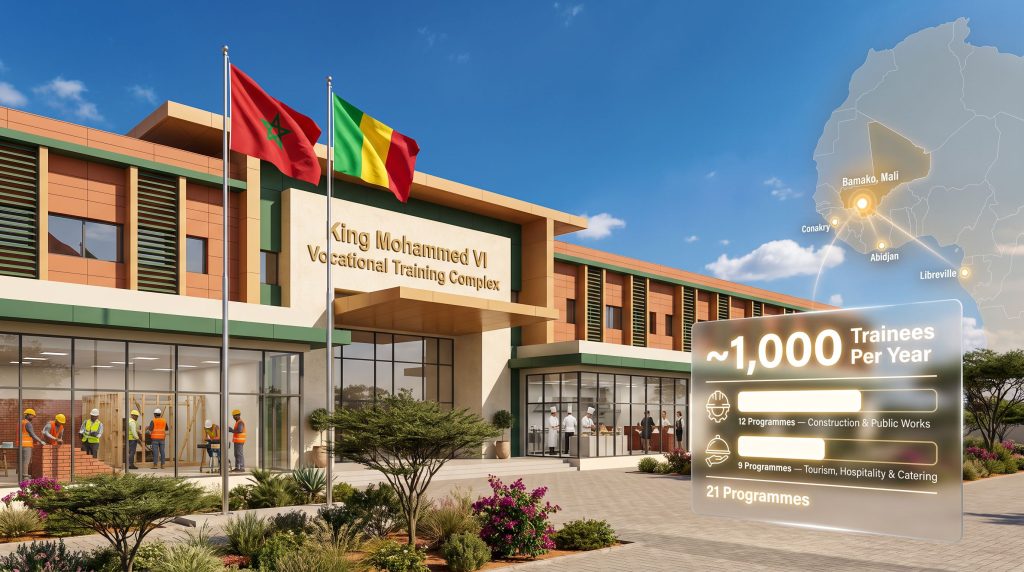
The centre's curriculum spans 21 training programmes divided across two economically critical clusters:
- 12 programmes covering construction and public works
- 9 programmes focused on tourism, hospitality, and catering
Annual throughput capacity is estimated at approximately 1,000 trainees, with the two sector clusters absorbing roughly 570 and 430 participants respectively. Notably, neither Moroccan authorities nor the foundation publicly disclosed the total construction cost of the Bamako project.
| Feature | Specification |
|---|---|
| Location | Bamako, Mali |
| Total Built Area | 5,200 square metres |
| Annual Training Capacity | ~1,000 trainees |
| Total Programmes | 21 |
| Construction and Public Works | 12 programmes |
| Tourism, Hospitality and Catering | 9 programmes |
| Delivering Institution | Mohammed VI Foundation for Sustainable Development |
The deliberate split between hard infrastructure skills and service sector training reflects a sophisticated reading of Mali's actual labour market gaps, rather than a generic development formula applied uniformly across partner countries.
Mali's Skills Deficit: The Labour Market Reality This Centre Confronts
Why Does the Skills Gap Matter?
Mali's working-age population is expanding at a pace that consistently outstrips formal employment creation. Structural underemployment is particularly acute in construction and hospitality, two sectors that theoretically benefit from Mali's ongoing urbanisation and its historical and cultural tourism assets, but which have historically relied on informally acquired skills rather than structured vocational pathways.
Vocational training enrolment rates across the Sahel remain among the lowest on the African continent. This creates a persistent mismatch: infrastructure investment generates demand for skilled domestic labour, but the workforce pipeline to fill those roles simply does not exist at scale. Importing expertise from outside the country is expensive and creates long-term dependency rather than durable local capacity.
Mali's Minister of National Entrepreneurship, Employment and Vocational Training, Oumou Sall Seck, characterised the facility as addressing a structural skills gap in sectors considered essential to the country's economic growth trajectory. She framed the handover as a meaningful expression of the long-standing bilateral relationship between Rabat and Bamako.
Moroccan Foreign Minister Nasser Bourita articulated the project's rationale through three interconnected principles that define Morocco's broader South-South cooperation philosophy:
- Solidarity with African peer nations
- Expertise sharing that transfers institutional knowledge rather than imposing external dependency
- Local capacity strengthening that builds systems designed to be domestically owned and sustained
South-South cooperation frameworks differ structurally from conventional donor-recipient aid models. The emphasis is on reciprocal benefit, shared institutional knowledge, and workforce integration rather than short-term humanitarian transfers. Morocco's approach is a textbook application of this principle.
Mali's Gold Economy and the Resource Context Behind the Partnership
How Does Mali's Export Profile Shape the Partnership?
To understand why Morocco chose Mali as a priority destination for its most comprehensive vocational centre to date, it is necessary to examine what Mali's economy actually looks like and where its vulnerabilities lie. In addition, Mali's mineral wealth and investment landscape provides important background for interpreting this bilateral relationship.
Gold dominates Mali's export profile to a degree that creates significant systemic risk. In 2024, gold accounted for approximately 80% of Mali's total export revenues. Industrial production reached roughly 51 tonnes that year, before falling sharply from 54.8 tonnes to 42.2 tonnes in 2025 following disruptions at major mining operations. Artisanal miners contributed an additional estimated six tonnes annually, but this informal output provides limited macroeconomic stabilisation.
| Indicator | Data |
|---|---|
| Gold's share of Mali's exports (2024) | ~80% |
| Industrial gold output (2024) | ~51 tonnes |
| Industrial output (2025, post-disruption) | 42.2 tonnes |
| Year-on-year output decline | ~23% |
| Artisanal production estimate | ~6 tonnes per year |
This single-commodity exposure is precisely the kind of structural fragility that makes Mali vulnerable to external shocks. A country generating four-fifths of its export income from one commodity has limited economic buffers when that commodity's production falters. The 23% decline in industrial gold output between 2024 and 2025 illustrates just how quickly that exposure can translate into economic pressure.
Skills diversification initiatives like the Bamako vocational complex do not solve this problem overnight, but they begin to build the human capital foundation that broader economic diversification requires. Construction workers and hospitality professionals cannot substitute for gold export revenues in the short term, but over a generation they represent the kind of domestic capacity that reduces Mali's dependence on a single export stream.
Morocco's Prior Commercial Footprint in Mali and What Changed
Morocco's engagement with Mali is not a new phenomenon, and it extends well beyond education infrastructure. Managem Group, a Moroccan mining conglomerate with structural ties to the Al Mada royal holding company, had previously pursued entry into Mali's gold sector through a $282 million agreement that included the Diakha-Siribaya gold project.
That transaction expired on 31 December 2024, leaving Morocco without an active commercial mining position in Mali. The timing of the vocational complex handover, occurring shortly after this commercial exit, is therefore analytically significant. The Bamako facility now provides an institutional channel through which Morocco maintains meaningful presence in Mali independent of any specific commercial transaction.
Does This Pattern Repeat Across Africa?
This pattern is not unique to Mali. A recurring feature of Morocco's African engagement model is the geographic overlap between its vocational training deployments and Managem's mining interests across the continent:
- Guinea: Vocational training centre in Conakry + Managem's Tri-K gold mine
- Gabon: Transport and logistics centre in Libreville + Managem's Etéké gold project
- Côte d'Ivoire: Hospitality and tourism centre in Abidjan + active gold exploration activities
- Senegal (adjacent): Managem operates the Boto gold project
The convergence of skills diplomacy and resource-sector interest across multiple host countries suggests a deliberately integrated strategy rather than coincidental alignment. Development cooperation and commercial positioning are operating as mutually reinforcing mechanisms within a single overarching framework.
Consequently, understanding the wider mining geopolitical landscape is essential for anyone tracking how soft power and resource strategy intersect across the continent.
The Pan-African Vocational Network Morocco Is Building
The King Mohammed VI vocational training complex in Mali is one node within a geographically distributed skills infrastructure network that Morocco has systematically constructed across sub-Saharan Africa.
| Country | City | Sector Focus |
|---|---|---|
| Mali | Bamako | Construction, public works, hospitality, tourism, catering |
| Côte d'Ivoire | Abidjan | Hospitality and tourism |
| Guinea | Conakry | Hospitality and tourism |
| Gabon | Libreville | Transport and logistics |
What makes the Bamako centre distinctive within this network is its combination of scale and curriculum breadth. At 5,200 square metres and 21 programmes spanning two distinct economic sectors, it is the most diversified facility Morocco has deployed. The annual throughput of approximately 1,000 trainees also positions it as a high-volume operation relative to comparable regional centres.
Anchoring this network is the African Alliance for the Development of Vocational Training, a multilateral initiative Morocco leads that currently unites more than 20 African member countries. The Alliance operates across three functional mandates:
- Cross-border expertise and knowledge sharing between member nations
- Instructor and trainer capacity development at the institutional level
- Programme design calibrated to actual local and national labour market conditions
By leading this Alliance, Morocco has positioned itself as the primary institutional architect of South-South vocational cooperation on the continent, a role that carries durable diplomatic credibility and long-term influence regardless of the commercial deal landscape at any given moment.
The next major ASX story will hit our subscribers first
The Three-Layer Model: How Morocco Builds Durable African Relationships
Morocco's Africa strategy operates through three mutually reinforcing layers that work in combination rather than in isolation.
Layer 1: Commercial Investment
Entities like Managem Group pursue resource extraction opportunities, establishing economic stakes in host country sectors and generating revenue flows that justify sustained bilateral engagement.
Layer 2: Skills Infrastructure
The Mohammed VI Foundation deploys vocational training centres that build genuine human capital in host nations, creating goodwill that persists independently of commercial deal outcomes and that operates on a longer time horizon than any individual transaction.
Layer 3: Multilateral Leadership
Through the African Alliance for the Development of Vocational Training and broader South-South cooperation frameworks, Morocco builds institutional credibility at a continental scale, positioning itself as a peer partner rather than an external investor.
Unlike infrastructure loans that create debt obligations or resource concessions that can generate local resentment, skills transfer programmes generate durable institutional goodwill. A government that has received a functional vocational training centre staffed with trained instructors and serving a thousand young people annually has a concrete, visible demonstration of partnership benefit. This remains relevant long after any specific commercial negotiation concludes.
This is precisely why the King Mohammed VI vocational training complex in Mali should not be read as a philanthropic gesture. It is a calculated instrument within a multi-decade African engagement strategy that treats education infrastructure as both a development contribution and a long-term relationship asset. Furthermore, this approach connects closely with the growing critical minerals demand driving investment decisions across the African continent.
For comparative context, Australia's own critical minerals strategy offers an instructive parallel in how nations integrate resource policy with long-term strategic positioning.
Key Facts: King Mohammed VI Vocational Training Complex in Mali
- The Bamako facility spans 5,200 square metres and will serve approximately 1,000 Malian trainees annually
- Training is divided across 21 programmes: 12 in construction and public works, 9 in tourism, hospitality, and catering
- The complex was built by the Mohammed VI Foundation for Sustainable Development and formally transferred to Malian authorities
- It forms part of a pan-African vocational network that includes centres in Côte d'Ivoire, Guinea, and Gabon
- Morocco leads the African Alliance for the Development of Vocational Training, bringing together more than 20 African nations
- Mali's gold sector represented approximately 80% of the country's exports in 2024, with industrial output declining roughly 23% between 2024 and 2025
- Managem Group's $282 million agreement covering the Diakha-Siribaya gold project in Mali expired on 31 December 2024, making the vocational centre Morocco's primary active institutional presence in the country
Disclaimer: Forward-looking statements regarding training capacity, economic impact, and Morocco's strategic positioning are based on publicly available information and analytical interpretation. Readers should not treat this article as financial advice or a definitive assessment of geopolitical outcomes.
Want to Track the Next Major Mineral Discovery Before the Broader Market Does?
Discovery Alert's proprietary Discovery IQ model delivers real-time alerts on significant ASX mineral discoveries — cutting through the noise of over 30 commodities to surface actionable opportunities the moment they are announced. Explore Discovery Alert's discoveries page to understand how historic finds have generated substantial returns, and begin your 14-day free trial today to position yourself ahead of the market.