July 27, 2026

When the Mountain Closes In: Understanding the Weather Risk Profile of High-Altitude Mining
Few industries are as physically exposed to the natural environment as hard-rock mining in the high Andes. At elevations exceeding 3,000 to 4,000 metres above sea level, where oxygen thins and temperatures swing violently between seasons, mining operations face a category of risk that simply does not exist at lower-altitude industrial sites. Road networks cut through narrow mountain passes, worker camps sit in geographically isolated basins, and supply chains depend on routes that can be severed by a single weather event. When severe storms sweep through northern Chile's Andean corridor, the consequences cascade rapidly from infrastructure damage into operational disruption and, in the worst cases, genuine humanitarian emergency.
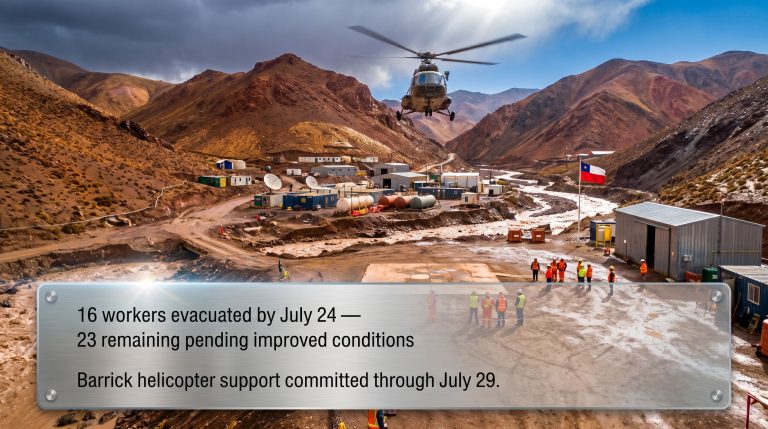
The events of late July 2026 brought this vulnerability into sharp focus. Barrick Mining Corporation confirmed that it successfully evacuated workers stranded at its Barriales camp in northern Chile after severe storms blocked road access to the site. The operation to Barrick evacuates Chile workers by helicopter after storm became one of the most visible examples of high-altitude mining emergency response in the region in recent years. The rescue effort began on the Friday following the storm, with helicopter flights resuming into Saturday as weather conditions created workable windows for aerial operations.
When big ASX news breaks, our subscribers know first
The Geographic and Climatic Context Behind the Crisis
Northern Chile's Atacama and Andean mining corridor occupies one of the most geologically rich yet climatically unpredictable environments on Earth. The region hosts some of the world's most significant deposits of copper, gold, and silver, drawing major global miners to operate at altitudes that most industrial facilities would consider impractical. Yet the same Andean topography that concentrates mineral wealth also acts as a funnel for extreme weather systems. Furthermore, understanding the Chile copper market helps contextualise just how much is at stake when these weather events disrupt operations.
Winter storm events in the Chilean Andes, while not uncommon, can escalate rapidly in severity. The July 2026 storm system that triggered the Barrick evacuation was described as causing more than a dozen fatalities across the broader region and generating hundreds of millions of dollars in infrastructure and property damage. These figures situate the event not as an isolated incident but as a systemic stress test for the entire mining corridor's emergency preparedness infrastructure.
What Makes High-Altitude Camps So Vulnerable?
Several compounding factors make high-altitude mining camps particularly vulnerable during such events:
- Road access is typically the sole viable supply and evacuation route under normal conditions, meaning a single blocked pass can isolate an entire camp
- Altitude amplifies the physiological risk to workers if heating, oxygen supplies, or medical resources are compromised
- Weather systems at elevation can shift faster than ground-based logistics can respond, compressing the decision window for emergency managers
- Helicopter operations, while effective, are themselves constrained by wind speeds, cloud ceilings, and air density at altitude, meaning aerial rescue is not always immediately available when it is most needed
How the Barriales and Potrerillos Response Unfolded
Barrick's operational response to the July 2026 storm event illustrates the tiered decision-making that governs modern mining emergency management. The two camps at the centre of the response, Barriales and Potrerillos, required fundamentally different approaches based on their respective conditions.
At Barriales, workers were successfully evacuated by helicopter once weather conditions permitted flight operations. The company confirmed that all evacuated personnel were in good health. Critically, the initial response was delayed not by a failure of planning but by the weather itself. Helicopter deployment could not commence until conditions had improved sufficiently to allow safe flight operations at altitude, with rescue flights beginning Friday and extending into Saturday.
At Potrerillos, the decision was made to leave three workers on-site pending road clearance rather than force an aerial evacuation. This distinction is operationally significant. The workers at Potrerillos had confirmed access to electricity, water, and food supplies, meaning the camp remained a stable and safe environment. Under these circumstances, remaining in place represented the lower-risk option compared to an aerial extraction under marginal or deteriorating weather conditions.
The decision to shelter workers in place at Potrerillos rather than pursue helicopter extraction reflects a fundamental principle in remote site emergency management: the act of rescue must not itself create a greater risk than the situation being resolved. When on-site conditions are stable, patience is a strategic asset.
Barrick also confirmed that it made a helicopter available to Chilean authorities through July 29 to support broader rescue and logistics operations across the affected region. Chile's Economy and Mining Minister Daniel Mas publicly confirmed the successful evacuation outcome, marking an example of the government-industry coordination that characterises well-managed mining emergencies.
Operational Risk Framework: Mapping Vulnerability in Andean Mining
The Barrick evacuates Chile workers by helicopter after storm response offers a useful lens through which to assess the broader vulnerability profile of mining operations across the Chilean and Andean corridor. The following table maps key risk factors against their operational impact and standard mitigation approaches:
| Risk Factor | Impact Level | Standard Mitigation Approach |
|---|---|---|
| Road access dependency | High | Pre-contracted helicopter contingency arrangements |
| Altitude and storm exposure | High | On-site stockpiling of food, water, fuel, and medical supplies |
| Communication blackouts | Medium | Satellite communications and redundant system architecture |
| Worker welfare during isolation | Medium | Pre-positioned emergency provisions exceeding regulatory minimums |
| Regulatory and reputational exposure | Medium-High | Proactive coordination with government ministries and public communication |
| Aerial evacuation weather constraints | High | Real-time meteorological monitoring and go/no-go threshold protocols |
This framework highlights a key structural vulnerability: the entire risk architecture of high-altitude remote mining camps ultimately depends on pre-event preparation. Once a storm hits and roads close, the only variables that remain within operational control are those that were already in place before the weather turned.
Pre-Event Preparation: What Best-Practice Emergency Planning Requires
Industry-leading emergency preparedness for remote and high-altitude mining camps typically encompasses several interconnected layers:
- Supply stockpiling: Maintaining food, water, fuel, and medical equipment at remote camps sufficient to sustain the workforce for a defined minimum period without resupply
- Communication redundancy: Deploying satellite communication systems capable of operating independently of road-based infrastructure
- Helicopter contractor agreements: Pre-establishing contractual arrangements with aviation providers, including agreed response times and weather protocols
- Weather monitoring systems: Installing site-specific meteorological monitoring with direct integration into operations centre decision tools
- Shelter-in-place vs. evacuation protocols: Defining in advance the specific criteria that trigger each response pathway, removing ambiguity during high-stress events
- Government liaison frameworks: Establishing relationships with regional emergency services and mining ministries before incidents occur
The value of this preparation becomes apparent precisely when it is most needed. In the Barrick case, the confirmed availability of electricity, water, and food at Potrerillos is not coincidental. It reflects a system that was designed to maintain worker welfare even when external access is severed. This approach also aligns with broader principles of mine site resilience that leading operators are embedding into their long-term planning frameworks.
Climate Trends and the Growing Financial Case for Resilience
What was once treated as an edge-case planning scenario is increasingly becoming a central operational consideration. Extreme weather frequency and intensity across the Andean region has been trending upward, driven by broader atmospheric changes that are reshaping precipitation and storm patterns at altitude. For mining operators, this shift has direct financial implications.
The cost of unplanned operational shutdowns driven by weather events typically includes:
- Lost production output during the shutdown period
- Costs associated with emergency evacuation logistics
- Potential damage to site infrastructure and equipment
- Regulatory scrutiny and potential liability in the event of worker harm
- Reputational impact affecting relationships with host governments and communities
Against these costs, investment in resilience infrastructure presents a compelling financial argument. Institutional investors and ESG-focused capital allocators are increasingly incorporating climate-related operational risk into their assessment of mining sector valuations. Consequently, operators who cannot demonstrate credible resilience frameworks face a growing cost-of-capital premium. The Chile copper outlook further underscores the financial weight that disruptions to Andean operations can carry for global commodity markets.
The next major ASX story will hit our subscribers first
Workforce Safety as a Social Licence Imperative
Beyond the financial calculus, the management of worker safety during extreme weather events carries significant social licence implications for mining companies operating in host countries like Chile. The Chilean mining sector is one of the most important contributors to the national economy, with copper alone accounting for a substantial share of export revenues. This economic centrality grants the mining industry significant operating latitude, but it also means that high-profile safety failures carry outsized reputational and political consequences.
Conversely, transparent and well-executed emergency responses, of the kind demonstrated in the Barrick Chile operation, actively reinforce the social licence to operate. When a government minister publicly confirms a successful evacuation outcome and a company voluntarily extends helicopter availability to broader community rescue efforts, the signal to regulators, communities, and investors is clear: this operator can be trusted to manage its workforce responsibly under pressure. In addition, the mining sustainability transformation underway across the sector is making these social licence considerations increasingly central to long-term operational strategy.
Frequently Asked Questions: Mining Worker Safety in Extreme Weather
What happens when mining workers are stranded at a remote camp?
Workers at well-prepared remote camps typically have access to food, water, electricity, heating, and medical supplies, allowing them to shelter safely until conditions improve or evacuation becomes viable. The adequacy of these provisions determines whether sheltering in place is a safe option or an emergency in itself.
How do mining companies decide between helicopter evacuation and shelter-in-place?
The decision is governed by a combination of on-site safety conditions, meteorological assessments of available flight windows, and a calibrated comparison of the risks associated with aerial extraction versus remaining in a stable camp environment. No single factor is determinative.
What role does government play in mining emergency evacuations?
Government agencies, including mining ministries and regional emergency services, typically coordinate with operators, may supplement rescue resources, and serve as official communicators to the public. In the Barrick case, Chile's Economy and Mining Minister publicly confirmed the successful evacuation outcome.
How does severe weather affect mining production and financial performance?
Road blockages and worker evacuations can halt production at affected sites. The financial impact varies based on the duration of disruption, the commodity being mined, and whether downstream supply commitments are affected. Extended shutdowns at large-scale operations can result in material production losses.
Are high-altitude mining camps required to maintain emergency supplies?
Regulatory requirements vary by jurisdiction, but Chilean regulatory frameworks and broader industry best practice mandate minimum on-site emergency provisions for remote and high-altitude operations. Leading operators typically exceed regulatory minimums as a matter of risk management, reflecting a broader commitment to natural capital in mining and responsible stewardship of both human and environmental resources.
The Sector Imperative: Building Climate Resilience Into Mine Design
The July 2026 storm event, with its toll of more than a dozen fatalities and hundreds of millions of dollars in regional damage, reinforces a message that the mining sector can no longer treat as peripheral. Climate-related weather risk is not an occasional disruption to be managed reactively. It is a structural feature of operating in high-altitude, remote environments that must be embedded into mine design, operational architecture, and long-term planning from the outset.
The instance of Barrick evacuates Chile workers by helicopter after storm serves as a timely reminder that miners who approach this challenge proactively — incorporating alternative egress route design, climate scenario modelling, expanded emergency infrastructure, and robust government relationships — will be better positioned to protect their workforces, maintain production continuity, and preserve the social licence that underpins their long-term presence in host communities.
Those that treat resilience as a discretionary cost rather than a core operational investment will find that a single severe storm can expose the full cost of that miscalculation.
Readers seeking further context on mining operations and safety frameworks across South America and the broader global sector can access ongoing coverage and analysis at miningweekly.com.
Want to Stay Ahead of Significant ASX Mineral Discoveries in Real Time?
Discovery Alert's proprietary Discovery IQ model delivers instant alerts on major ASX mineral discoveries, transforming complex geological data into clear, actionable investment insights for traders and long-term investors alike — begin your 14-day free trial today and see why historic discoveries like those made by De Grey Mining and WA1 Resources, featured on Discovery Alert's dedicated discoveries page, have generated extraordinary market returns.