July 28, 2026

When the Ground Itself Becomes the Hazard: Deep-Level Mining and the Limits of Safety Control
South Africa's platinum belt sits atop one of the most geologically extraordinary formations on Earth — the Bushveld Igneous Complex, a layered intrusion stretching across thousands of square kilometres that hosts the majority of the world's known platinum-group metal (PGM) reserves. However, what makes this geology so valuable also makes it exceptionally dangerous to extract. The deeper a mine extends, the more intense the ground pressure, ambient heat, and seismic activity become.
At operations where shafts descend more than a kilometre underground, the physics of rock mechanics create hazard profiles that simply do not exist in shallower mining environments. Consequently, deep underground mines of this nature demand extraordinary safety rigour at every operational level.
This is the context in which the Implats Rustenburg operations halt after six deaths must be understood. It is not merely a corporate safety failure. It is a window into a structural tension that has defined South African platinum mining for decades: the collision between extraordinary mineral wealth located at extraordinary depth, and the human cost of extracting it.
When big ASX news breaks, our subscribers know first
The Fatality Pattern That Triggered the Shutdown
The operational suspension at Impala Platinum's (JSE: IMP) Rustenburg complex was not a response to a single catastrophic event. Instead, it reflected the accumulation of a fatality pattern across two distinct periods in 2026.
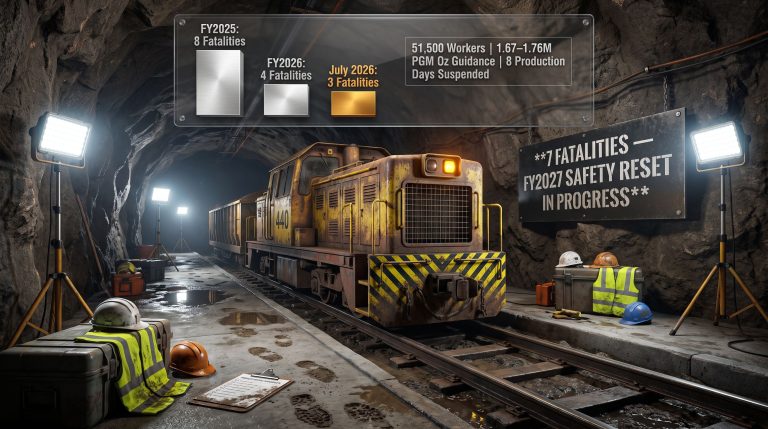
During the financial year ended June 30, 2026, the Rustenburg complex recorded four fatal workplace injuries. Then, in July 2026 alone, two further underground deaths occurred, both linked to locomotive-related incidents involving rail-bound mining equipment. The combined toll of six Rustenburg-attributed fatalities in 2026 prompted the company to initiate a voluntary four-day production suspension commencing July 24. For further context on this incident, Mining Weekly reported on the operational suspension in detail.
The Association of Mineworkers and Construction Union (AMCU) cited a figure of seven deaths across all Implats operations in 2026 to date, a number slightly higher than the six attributed specifically to Rustenburg in company disclosures. This discrepancy reflects the difference between site-specific reporting and union-level tracking across the entire Implats operational portfolio.
| Incident Category | Period | Fatalities |
|---|---|---|
| General workplace injuries | FY ending June 30, 2026 | 4 |
| Underground locomotive accidents | July 2026 | 2 |
| Total (Rustenburg-attributed) | 2026 YTD | ~6 |
| Total (All Implats operations per AMCU) | 2026 YTD | 7 |
The locomotive fatality category warrants particular attention. Rail-bound equipment in underground mining environments operates in confined spaces with limited visibility, where stopping distances and collision avoidance depend heavily on maintenance standards, operator training, and track condition. When two deaths of this type occur in a single month at one operation, it points to a specific systemic vulnerability rather than random misfortune.
The Scale of What Was Stopped: Understanding Rustenburg's Global Significance
Few mining operations anywhere in the world carry the same systemic weight as the Rustenburg complex. Located approximately 120 kilometres north-west of Johannesburg, the operation employs around 51,500 people, making it one of the largest single-site private employers in South Africa.
More critically for global commodity markets, Rustenburg accounts for close to half of Impala Platinum's total annual production output. Given that South African producers, including Implats and Sibanye-Stillwater (JSE: SSW / NYSE: SBSW), collectively supply the majority of the world's mined platinum, any disruption at Rustenburg carries supply chain implications that extend well beyond South Africa's borders. Furthermore, the platinum and palladium markets are particularly sensitive to South African operational disruptions given the Bushveld Complex's global dominance.
Platinum's primary industrial application is in catalytic converters fitted to gasoline and diesel vehicles, where it facilitates the chemical reactions that reduce harmful exhaust emissions. Palladium and rhodium, the two other primary PGMs produced at Rustenburg, serve adjacent roles in emissions control technology. The concentration of this production capacity in a single geographic and geological corridor creates a supply vulnerability that global automotive manufacturers and industrial users are acutely aware of.
The Bushveld Igneous Complex hosts an estimated 80% or more of the world's known platinum reserves, meaning that operational disruptions at major South African producers are never purely a local story. They register across global PGM supply chains.
What the Four-Day Safety Reset Actually Involved
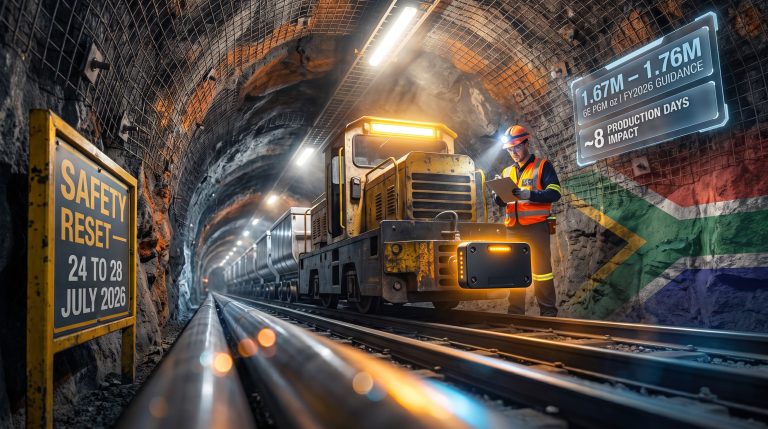
Mining was suspended from July 24 to July 28, 2026, a four-day calendar pause that Implats structured around four intervention pillars:
- Systematic workplace inspections of underground and surface areas, with targeted focus on rail-bound equipment and locomotive systems given the nature of the July fatalities.
- Targeted retraining programs for workers operating in the highest-risk zones, particularly those interfacing with trackless and rail-bound mobile machinery.
- Mass employee engagement sessions designed to reinforce safety culture across all shifts, encourage hazard reporting from the workforce, and address the psychological impact of recent fatalities on the broader workforce.
- Independent specialist review, with external safety experts appointed to audit existing safety management systems and provide recommendations for improvement.
The fourth intervention is arguably the most significant. The appointment of external specialists, rather than conducting a purely internal review, signals that Implats is treating this situation as potentially indicative of systemic gaps rather than isolated human error.
Despite the four-day calendar suspension, the estimated impact on metal production volumes extends further, with processing and logistics downstream from the mining face requiring additional time to stabilise. The company indicated that precise production impact figures would only be quantified after operations fully resumed.
The Hidden Economics of Deep-Level PGM Mining
South Africa's deep-level platinum mines sit at a challenging intersection of geology, economics, and labour intensity that has few parallels globally. Understanding this intersection is essential to interpreting why safety incidents of this nature occur with more frequency than in shallower mining jurisdictions.
Several factors compound the challenge:
- Narrow reef geometry: The Merensky Reef and UG2 Reef, the two primary ore-bearing horizons at Bushveld Complex mines, are typically only 0.6 to 2 metres thick. In particular, narrow reef mining technology has advanced considerably, yet the confined stope environments still create persistent exposure to ground fall and equipment hazards where conventional heavy equipment cannot fit.
- Grade dilution pressures: At current PGM price cycles, operators face constant pressure to mine efficiently without cutting corners. The typical combined PGM grade across the Rustenburg corridor runs in the range of 3 to 6 grams per tonne of ore, meaning that large volumes of rock must be processed to yield commercially viable quantities of metal, driving high operational throughput demands.
- Ageing infrastructure: Many of the shaft systems operating along the Bushveld Complex were commissioned decades ago. Legacy underground rail networks and ventilation infrastructure require continuous maintenance capital that competes with other investment priorities, particularly during periods of lower PGM prices.
- Workforce scale: Operations employing tens of thousands of workers underground simultaneously create coordination and supervision challenges that are structurally different from smaller, more mechanised mines. Maintaining consistent safety culture across dozens of shifts, shaft systems, and stoping areas is a genuine management challenge.
South Africa's Mining Safety Regulatory Framework
The Mines Health and Safety Act (MHSA) of 1996 governs workplace safety standards for South African mines and provides the Department of Mineral Resources and Energy (DMRE) with enforcement powers that include section 54 stop orders, which compel operations to cease work when inspectors identify unsafe conditions.
The fact that Implats initiated this suspension voluntarily, before any regulatory enforcement action was taken, is not a minor detail. Pre-emptive voluntary shutdowns serve multiple strategic functions. In addition, broader mining safety and sustainability considerations increasingly influence how regulators and investors respond to incidents of this scale.
- They demonstrate to the DMRE that the operator is treating safety incidents with appropriate gravity, reducing the likelihood of a more prolonged government-mandated stop order.
- They provide legal and reputational protection, establishing a documented record of proactive safety governance in any subsequent regulatory or legal proceedings.
- They signal to institutional investors, who increasingly apply ESG screens to mining sector allocations, that the company is willing to absorb short-term production losses in exchange for demonstrating safety accountability.
Investor Note: For ESG-focused institutional investors, a voluntary suspension paired with an independent review is generally a more favourable signal than a regulatory-forced halt. The former reflects governance capacity; the latter reflects governance failure. How investors price this distinction can influence near-term share price behaviour following safety-related production interruptions.
The next major ASX story will hit our subscribers first
What Independent Safety Reviews Examine in Practice
An independent specialist review at a complex the size of Rustenburg would typically extend across several areas that internal reviews may underemphasise:
- Underground locomotive management systems, including maintenance scheduling, speed restriction compliance, and proximity detection technology deployment on rail-bound equipment
- Fatigue and shift pattern risk, examining whether roster structures create elevated fatigue profiles in workers operating high-risk equipment
- Supervisor-to-worker ratios in high-hazard areas, particularly on production panels with active stoping activity
- Hazard identification culture at the supervisory level, including whether near-miss reporting is systematically encouraged or informally discouraged to protect production metrics
- Emergency response and evacuation protocols, particularly for underground areas with limited egress options
- MHSA compliance specific to trackless and rail-bound mobile machinery provisions
The distinction between an audit that produces a compliance checklist and one that diagnoses cultural and systemic failures is significant. Furthermore, surface-level compliance audits rarely prevent repeat incidents if the underlying supervisory culture does not change.
Production and Market Impact: What the Numbers Mean
How Significant Is the Supply Disruption?
The short-term production impact of the Rustenburg halt is material but unlikely to shift global platinum price dynamics meaningfully, given its limited duration. However, the medium-term picture depends heavily on the outcome of the independent review. Indeed, PGM supply constraints of any duration are closely monitored by downstream industrial users given the concentrated nature of global platinum production.
| Factor | Short-Term Impact | Medium-Term Impact |
|---|---|---|
| Production volume loss | Modest supply reduction from ~8 lost production days | Minimal if operations stabilise post-review |
| PGM spot price sensitivity | Limited given short duration | More significant if safety incidents continue |
| ESG investor sentiment | Negative short-term signal | Recoverable if review demonstrates credible improvement |
| Regulatory exposure | Low if voluntary action is seen as adequate | Elevated if DMRE identifies systemic failures in a parallel review |
| Union relations | AMCU scrutiny elevated given 7-death count | Depends on transparency of independent review outcomes |
For investors tracking Impala Platinum at the JSE level, the key variable is not the immediate production loss but the trajectory of safety performance over the following two to three quarters. A pattern of continued incidents following a safety reset would represent a fundamentally different risk profile than an isolated cluster. As IOL Business reported, the Implats Rustenburg operations halt after six deaths underscores just how significant the stakes are for both workforce welfare and investor confidence.
Frequently Asked Questions
Why Did Implats Halt Rustenburg Operations?
Impala Platinum suspended mining at its Rustenburg complex following the Implats Rustenburg operations halt after six deaths, including two underground locomotive fatalities in July. The company initiated a four-day safety reset involving inspections, retraining, workforce engagement, and an independent safety systems review.
How Long Was the Rustenburg Mine Shut Down?
Mining was suspended from July 24 to July 28, 2026. While this represents a four-day calendar pause, the estimated impact on total metal production extends to approximately eight production days when downstream processing and logistics effects are included.
What Metals Does Rustenburg Produce?
The operation primarily produces platinum, palladium, and rhodium, the three core PGMs used in automotive catalytic converter technology for emissions reduction.
Will the Shutdown Affect Platinum Prices?
The short-term supply impact from an eight-day production disruption at a single, albeit large, operation is unlikely to materially shift global platinum prices. However, if safety incidents continue and regulatory intervention escalates to prolonged enforced shutdowns, medium-term supply implications would become more pronounced.
What Is AMCU's Position?
AMCU reported that the total number of employee deaths across all Implats operations in 2026 reached seven, a figure slightly higher than the six deaths attributed specifically to Rustenburg in company and media disclosures. This reflects the union's broader tracking across the entire Implats South African operational portfolio. The Implats Rustenburg operations halt after six deaths remains a focal point for union scrutiny in the months ahead.
Disclaimer: This article is for informational purposes only and does not constitute financial or investment advice. References to production impacts, price sensitivities, and market outcomes involve forward-looking assessments that carry uncertainty. Readers should conduct independent research before making any investment decisions.
Want To Stay Ahead of Significant ASX Mineral Discoveries in Real Time?
Discovery Alert's proprietary Discovery IQ model continuously scans ASX announcements across more than 30 commodities, delivering instant, actionable alerts the moment a significant discovery is made — visit the discoveries page to see how historic finds have generated substantial returns, and begin your 14-day free trial today to secure a market-leading edge.