
July 28, 2026
When Scale Meets Systemic Risk: Understanding the Implats Rustenburg Suspension
Underground mining at industrial scale is one of the most operationally complex environments on earth. The deeper a mine goes, the more interdependent its safety systems become. Geotechnical pressure, ventilation requirements, equipment density, workforce coordination, and supervisory coverage all compound simultaneously. When fatalities begin accumulating at a large-scale operation, the question that serious analysts ask is rarely limited to what happened in a single incident.
The more pressing question is what the pattern of incidents reveals about the reliability of the entire safety architecture. This is a challenge well understood within the broader context of South Africa mining decline, where systemic pressures have long tested the industry's ability to maintain consistent safety standards.
That is precisely the lens through which the Impala Rustenburg situation demands to be understood. When Implats suspends Rustenburg operations after deaths, it is not simply enacting a temporary pause. It is acknowledging, at the highest operational level, that the existing system of controls was not functioning reliably enough to protect workers.
When big ASX news breaks, our subscribers know first
What the Known Facts Reveal About Exposure and Complexity
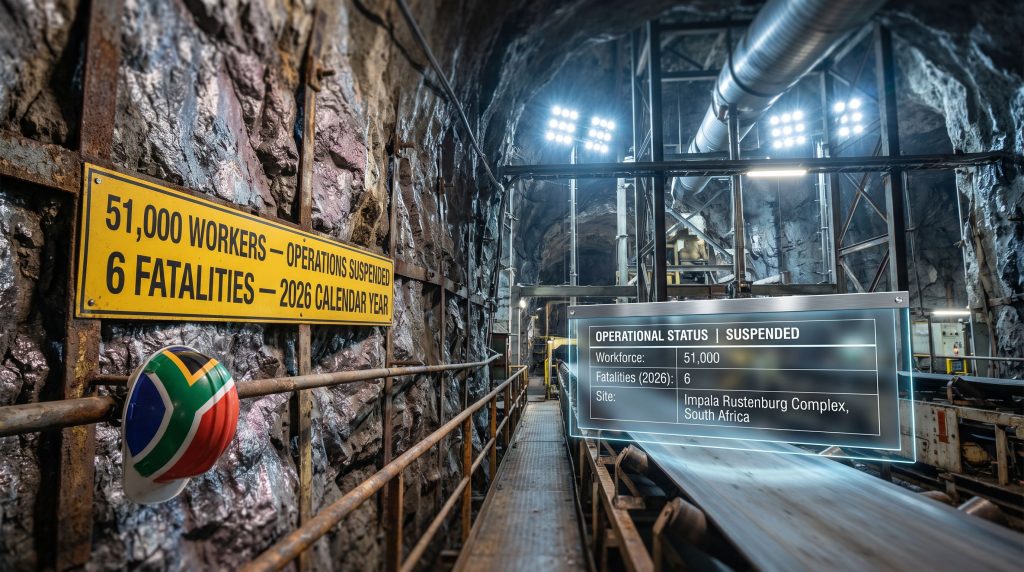
Before any analytical framework can be applied, the confirmed facts need to be clearly laid out. The Impala Rustenburg complex, operated by Implats in South Africa, recorded six fatalities during the 2026 calendar year. Mining operations across the site were suspended on a Friday in response to the accumulation of serious safety incidents. The site employs approximately 51,000 workers, making it one of the largest mining complexes on the African continent.
| Metric | Reported Figure | Why It Matters |
|---|---|---|
| Workforce size | ~51,000 | Reflects enormous supervisory complexity across shifts, shafts, and contractors |
| Fatalities in 2026 calendar year | 6 | Indicates a severity trend beyond isolated incidents |
| Operational status | Suspended | Signals management-level escalation beyond localised review |
| Jurisdiction | South Africa | Activates Mine Health and Safety Act obligations and inspector powers |
| Operation type | Underground PGM mining | Deep-level environment with multiple simultaneous hazard categories |
Six fatalities at an operation of this scale creates a difficult analytical tension. On one hand, a workforce of 51,000 creates a statistical baseline that requires careful interpretation. On the other, mining safety professionals consistently argue that scale amplifies the need for high-reliability systems, not the tolerance for failure.
A large headcount is not a mitigating factor in fatality analysis. If anything, workforce scale increases the number of exposure pathways and demands proportionally stronger control verification. No fatality benchmark makes loss of life acceptable.
Without knowing the total hours worked across the complex in 2026, it would be premature to calculate a definitive fatality frequency rate. What can be stated with confidence is that six fatalities within a single calendar year, across a single operation, is a serious concentration of harm that warrants exactly the kind of response Implats has taken.
How Mine Suspensions Function as Safety Reset Mechanisms
A safety-driven operational suspension is a distinct management tool. It differs from a regulatory shutdown imposed by an inspector, a weather-related halt, or a mechanical stoppage. When management voluntarily suspends a complex of this size, it typically signals that internal leadership has concluded the hazard exposure is not currently manageable under existing operating conditions.
The mechanics of such a suspension generally involve:
- Securing all underground working areas and preserving conditions for investigation
- Halting ore movement, blasting schedules, and development advances
- Withdrawing crews from active work areas pending safety assessments
- Convening cross-functional review teams covering geotechnical, engineering, and operational disciplines
- Engaging worker representatives and union structures in the assessment process
- Communicating clearly to the workforce about the conditions required before resuming
The decision to apply a complex-wide halt rather than a section-by-section restriction is particularly significant. When incidents are contained to a single shaft or working area, localised stoppages are more common. A broader suspension tends to indicate that management has identified either systemic weaknesses spanning multiple areas, or that the safety culture itself requires a site-wide intervention.
Assessing Whether a Shutdown Is Reactive or Strategically Structured
A useful framework for evaluating the depth of a mine's safety response involves five analytical steps:
- Determine the scope of the halt: single section, individual shaft, or full complex
- Examine causation patterns: do the fatalities reflect similar hazard types or diverse incident categories?
- Review management communications for references to systemic corrective actions versus point-in-time fixes
- Compare the response to precedents in South African mining history and similar operations
- Track restart conditions: are they defined by clear, verifiable thresholds or general assurances?
If Implats communicates that each shaft must clear independent safety verification before resuming, the restart framework is likely more credible than a blanket resumption announcement with no defined benchmarks.
Underground Platinum Mining: Hazard Categories That Drive Fatality Risk
Deep-level platinum mining in South Africa operates in some of the most challenging geological conditions on earth. The Bushveld Igneous Complex, which hosts the world's largest known platinum group metal reserves, requires mining at depths that create significant ground stress, heat accumulation, and complex ventilation demands. Understanding the hazard landscape is essential to interpreting any fatality trend.
The primary hazard categories in this environment include:
- Fall of ground (FOG): Historically the dominant cause of fatalities in South African deep-level mining, driven by seismicity, changing geological structure, and support system failures
- Mobile equipment interactions: Tramming vehicles, load-haul-dump machines, and surface trucks create collision and crush risk, particularly at access intersections and shaft entry points
- Hoisting and shaft systems: Communication failures, signalling errors, and unexpected movement create acute risk for workers near shaft infrastructure
- Ventilation and thermal stress: At significant depth, inadequate airflow combined with heat from rock and equipment can impair cognitive function and decision-making
- Explosives handling: Misfires, delayed detonation, or storage failures create acute fatality risk
- Human factors: Fatigue, shift handover gaps, rule normalisation, and production pressure are systemic contributors that cut across all hazard categories
| Hazard Type | Typical Control | Common Failure Mode | Review Priority Post-Fatality |
|---|---|---|---|
| Fall of ground | Geotechnical support design, structured inspections | Support non-compliance or undetected changing geology | Very high |
| Vehicle interaction | Separation protocols, traffic management plans | Poor visibility zones, route discipline breakdown | High |
| Shaft and hoisting | Lockout systems, communication protocols, signalling | Procedural breach or equipment fault | High |
| Ventilation/heat | Airflow design, heat stress monitoring | Under-reporting of symptoms, inadequate monitoring | Medium to high |
| Fatigue | Roster design, shift length controls, supervision | Normalisation of extended hours or insufficient rest | Medium to high |
A critical but underappreciated dimension of platinum mining safety is the role of seismicity. The Bushveld Complex's hard rock geology generates seismic events that can destabilise excavations with little warning, making real-time geotechnical monitoring not just useful but operationally essential. The question of whether these systems were functioning optimally in the affected areas will likely form part of any serious investigation.
Safety Culture, Leadership Accountability, and High-Reliability Thinking
Repeat fatality events at large operations rarely trace back to a single point of failure. Safety researchers and industrial psychologists studying high-hazard industries have consistently found that when severe incidents cluster, the contributing factors usually include gaps at multiple levels simultaneously: frontline supervision, middle management prioritisation, and board-level governance.
High-reliability organisation (HRO) theory, developed through studies of nuclear power, aviation, and offshore drilling, suggests that operations achieving very low rates of serious incidents share several characteristics:
- Leaders treat near misses with the same seriousness as actual incidents
- Frontline workers have genuine authority to stop unsafe work without fear of reprisal
- Incident learning is distributed rapidly and transparently across all operational units
- Production targets are never allowed to override safety control thresholds in practice, not just on paper
- Contractors and permanent employees operate under identical safety expectations
At an operation of Rustenburg's scale, the gap between documented procedures and actual field practice can widen gradually and invisibly. A mine can hold comprehensive written standards, conduct regular safety meetings, and still underperform systemically if production urgency, supervisory turnover, or workforce communication gaps allow procedural drift to become normalised.
The most dangerous phrase in underground mining safety is not that a control failed once. It is that a control degraded slowly, and no one escalated it.
Key leadership questions that any serious post-incident review should be examining include:
- Were frontline supervisors receiving adequate preparation, mentoring, and field time?
- Were near-miss reports being captured, investigated, and shared across the operation?
- Did the incident data prior to each fatality show warning signals that went unaddressed?
- Were contractors held to the same accountability standards as permanent employees?
- Was stop-work authority genuinely understood and exercised by workers at all levels?
Operational and Business Continuity Consequences of the Suspension
The Impala Rustenburg complex is a cornerstone platinum group metals (PGM) operation in global terms. Furthermore, the platinum and palladium markets feed catalytic converter manufacturing, hydrogen fuel cell applications, and industrial chemical processes worldwide. Supply disruptions from a complex of this size carry implications well beyond the operation itself.
Short-term operational effects of the suspension are likely to include:
- Immediate loss of ore movement from active underground sections
- Concentrator feed disruption as stockpiled ore is processed but not replenished at normal rates
- Fixed cost continuation despite production downtime, compressing unit economics
- Contractor demobilisation and remobilisation costs if the stoppage extends
- Possible revision of full-year production guidance if the suspension duration lengthens materially
Three Restart Pathway Scenarios
| Scenario | Operational Implication | Cost Pressure | Safety Credibility | Key Signals to Watch |
|---|---|---|---|---|
| Rapid restart (1-2 weeks) | Minimal production loss, quick normalisation | Low to moderate | Moderate, only if specific fixes are verified | Detailed corrective action disclosure |
| Phased controlled restart (2-6 weeks) | Graduated recovery by shaft, deliberate sequencing | Moderate | High, if each phase requires formal sign-off | Section-by-section clearance reporting |
| Extended suspension (6+ weeks) | Material production impact, potential guidance revision | High | Highest if used for genuine systemic redesign | Regulator engagement, leadership changes, redesign announcements |
The phased restart scenario, while operationally costly, tends to generate the strongest stakeholder confidence because it creates checkpoints that cannot easily be bypassed for production convenience.
The next major ASX story will hit our subscribers first
South African Mine Safety Regulation: The Enforcement Context
South Africa's Mine Health and Safety Act (No. 29 of 1996) establishes one of the more comprehensive legal frameworks for mine safety on the continent. Under this framework, the principal inspector of mines holds significant powers, including the ability to issue directives requiring operations to cease, mandate investigations, and compel remedial actions before work can resume.
Following a fatality in a South African mine, statutory reporting obligations are triggered immediately. These include formal notification to the inspectorate, preservation of the incident scene, and the requirement to conduct an inquiry. Worker representative bodies, including union structures, have formal rights to participate in safety investigations, and their engagement is often a meaningful indicator of whether a post-incident process is substantive or cosmetic.
Importantly, if inspectors determine that the circumstances leading to fatalities reflect ongoing systemic risk rather than isolated events, enforcement attention can broaden considerably. South African mining law also enables the inspectorate to require specific remediation steps as preconditions for restart, adding an external constraint to any internally determined timeline. These regulatory dynamics are part of wider mining transformation trends that are reshaping how operators approach both compliance and operational design.
ESG, Governance, and the Metrics That Matter Most
For institutional investors and ESG-focused analysts, the Rustenburg suspension raises governance questions that extend well beyond near-term production tracking. The relevant framing is not whether the share price reacts, but whether the operation's safety governance systems are functioning as designed at board level.
Leading vs Lagging Safety Indicators: A Critical Distinction
| Indicator Type | Examples | Why It Matters After Fatalities |
|---|---|---|
| Leading | Safety observations, critical control verification rates, near-miss reporting volumes, supervisor field hours, training completion quality | Reveals whether preventive systems were working before incidents escalated |
| Lagging | Fatalities, lost-time injuries, recordable incident frequency, suspension events | Reflects outcomes after controls have already failed |
One of the more important but underappreciated analytical insights in mine safety governance is that companies reporting high volumes of near-miss captures often have stronger safety cultures than those reporting very low numbers. A low near-miss count at a large underground operation typically indicates under-reporting rather than exceptional safety performance.
Analysts evaluating Implats' published safety data should examine whether near-miss and hazard-identification trends showed any forewarning pattern ahead of the 2026 fatality cluster. This type of scrutiny is central to the broader agenda of mining sustainability transformation, where governance and operational accountability are increasingly inseparable.
Broader ESG implications of the suspension include:
- Pressure on the quality and specificity of safety disclosures in upcoming reporting periods
- Board-level scrutiny of whether safety leading indicators were being tracked and escalated correctly
- Possible revision of internal productivity and throughput metrics if these were creating safety-production trade-offs
- Increased emphasis on workforce trust-building as a precondition for operational recovery
A Credible Recovery Framework: What Genuine Change Requires
A mine suspension is only as meaningful as the actions taken before operations resume. The following sequence represents what safety professionals generally regard as the minimum threshold for a credible post-incident recovery process:
- Secure affected areas and preserve all physical evidence for independent analysis
- Commission an independent causal investigation, not solely an internal one
- Audit critical controls across all hazard categories, not just those directly linked to the fatalities
- Revalidate geotechnical models, equipment maintenance records, and procedural compliance
- Reset accountability expectations with frontline supervisors, with field verification rather than classroom sign-off
- Implement phased restart only after documented control checks clear defined thresholds
- Publish findings and corrective actions transparently, including to worker representatives
- Commit to monitoring leading indicators visibly for a defined period post-restart
What separates a credible restart from a purely reactive one is evidence that lessons are applied across the entire complex, not just in the areas where incidents occurred. This is the systemic difference that separates organisations that achieve lasting safety improvement from those that cycle through suspensions repeatedly. Consequently, the broader mining industry evolution towards more accountable operational frameworks will depend on how cases like this are resolved.
Frequently Asked Questions
Why did Implats suspend Rustenburg operations after deaths?
Implats suspends Rustenburg operations after deaths when a pattern of serious safety incidents demands a comprehensive operational review. In this instance, six workers lost their lives at the Impala Rustenburg complex during the 2026 calendar year, prompting a full suspension to allow safety systems to be thoroughly assessed before mining could responsibly resume.
How significant is the Rustenburg complex?
Impala Rustenburg is among the largest mining complexes in Africa, employing approximately 51,000 people and producing platinum group metals from the Bushveld Igneous Complex in South Africa.
Does a suspension automatically mean a prolonged closure?
Not necessarily. The duration depends on investigation outcomes, the scope of required corrective actions, regulatory expectations, and whether management can demonstrate to workers and external stakeholders that materially safer conditions exist before work resumes.
What should observers monitor going forward?
- The defined conditions and timeline for restart
- Scope and independence of the causal investigation
- Whether regulatory inspectors issue formal directives
- Transparency of disclosed findings and remedial actions
- Changes to safety oversight structures, supervisory systems, and training delivery
The Real Question Is Not When, But Whether
The central issue the Rustenburg suspension raises is not how quickly operations can resume. A complex of 51,000 workers generating six fatalities within a single year is not experiencing bad luck. It is experiencing system failure of some kind, and the task of identifying that failure with precision is far more important than minimising downtime.
South African deep-level platinum mining operates at the frontier of what industrial systems can safely sustain. The geology is demanding, the workforce is vast, and the economic pressures are real. None of those factors eliminate the fundamental obligation to return workers home safely at the end of every shift.
The most consequential outcome of this suspension will not be measured in production days recovered. It will be measured in whether the controls, culture, and leadership accountability at Impala Rustenburg are materially stronger when the next shift descends underground than they were before Implats suspends Rustenburg operations after deaths became the defining headline of the 2026 operational year.
This article is an operational and safety analysis based on publicly available information. It does not constitute financial advice. Readers should conduct their own research and consult relevant professional advisors before making investment or operational decisions. Projections and scenario analyses represent analytical possibilities, not confirmed outcomes.
Want to Stay Ahead of Significant ASX Mineral Discoveries?
While operational suspensions like Rustenburg highlight the complexities of large-scale mining, Discovery Alert's proprietary Discovery IQ model scans ASX announcements in real time, delivering instant alerts on significant mineral discoveries across 30-plus commodities — turning complex data into actionable investment insights. Explore historic discovery returns on Discovery Alert's dedicated discoveries page and begin your 14-day free trial at Discovery Alert to position yourself ahead of the broader market.