July 28, 2026
Underground Rail Transport and the Hidden Fatality Risk Reshaping PGM Mining Safety
Every few years, the South African platinum mining industry is forced to confront a fundamental question: are the systems designed to protect workers underground genuinely fit for purpose, or are they adequate only until the next incident exposes a gap? The Implats Rustenburg safety reset initiated in late July 2026 is the latest stress test of that question, and its implications extend well beyond a single five-day production suspension.
Understanding what this intervention actually represents, technically, operationally, and from an investor standpoint, requires moving past the headline and examining the mechanics of underground rail-bound transport risk, the architecture of voluntary safety governance, and what the broader 2026 fatality data reveals about where the platinum sector's most dangerous vulnerabilities now lie.
When big ASX news breaks, our subscribers know first
What Makes Underground Rail-Bound Equipment Uniquely Dangerous
To appreciate why two tramming-related fatalities at Rustenburg triggered a complex-wide production halt, it helps to understand the physical operating environment of underground locomotive systems in Bushveld Igneous Complex (BIC) mines.
Unlike surface rail operations, underground mining systems function within confined reef-horizon tunnels where sightlines can be measured in metres, not kilometres. Locomotives hauling ore cars through these tunnels encounter:
- Extremely limited stopping distances relative to operating speeds in narrow-gauge trackways
- Intersection blind spots at shaft crosscuts, where multiple haulage routes converge
- Shift-change pedestrian traffic peaks, when hundreds of workers move through the same underground corridors as active equipment
- Communication dead zones, where radio and proximity system coverage can degrade in deep-level hard-rock environments
- Variable track conditions caused by ground movement along the Merensky and UG2 reef horizons
Rail-bound equipment incidents are formally categorised separately from falls of ground (FOG) and surface vehicle accidents in South African mine safety reporting, yet they consistently feature among the top three fatality cause categories in hard-rock underground operations. That classification distinction matters, because it means each category requires its own dedicated control framework rather than a generalised safety programme.
The Implats Rustenburg Safety Reset: What Triggered It and What It Covers
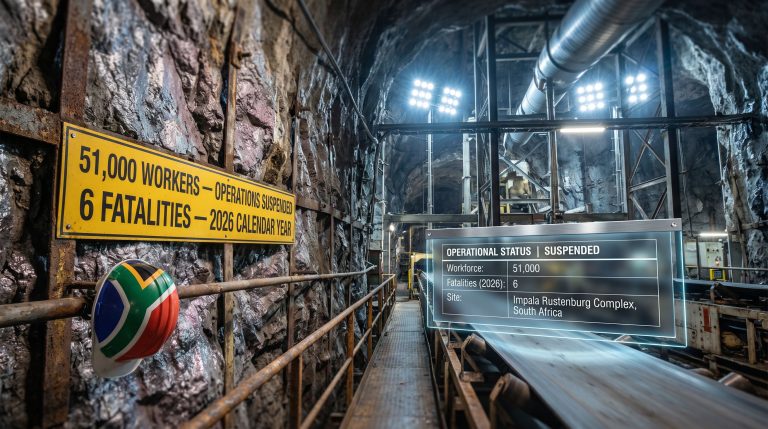
Impala Platinum suspended production across its Rustenburg shafts from July 24 to 28, 2026, following two underground fatalities in July, both involving tramming-related incidents. When shift-cycle accounting is applied to that five-calendar-day window, the stoppage translates to eight production days, with full resumption expected by July 30.
This came on top of four fatal injuries recorded during Implats' FY2026 financial year (ended June 30, 2026), which included incidents related to falls of ground, rigging, motor vehicle operations, and underground locomotive activity. The subsequent July fatalities, both tramming-related, pushed the cumulative toll to a level that warranted a structured operational intervention, according to a statement from Johan Theron, Implats' spokesman, as reported by MiningMX.
The reset is a voluntary action, not a government-ordered shutdown. This distinction is critical. Under South Africa's Mine Health and Safety Act (MHSA), Act 29 of 1996, the Department of Mineral Resources and Energy (DMRE) retains authority to issue Section 54 stoppages when an inspector identifies conditions of imminent danger. A company-initiated safety reset operates outside that framework, representing internal governance exercising its authority before regulatory intervention becomes necessary.
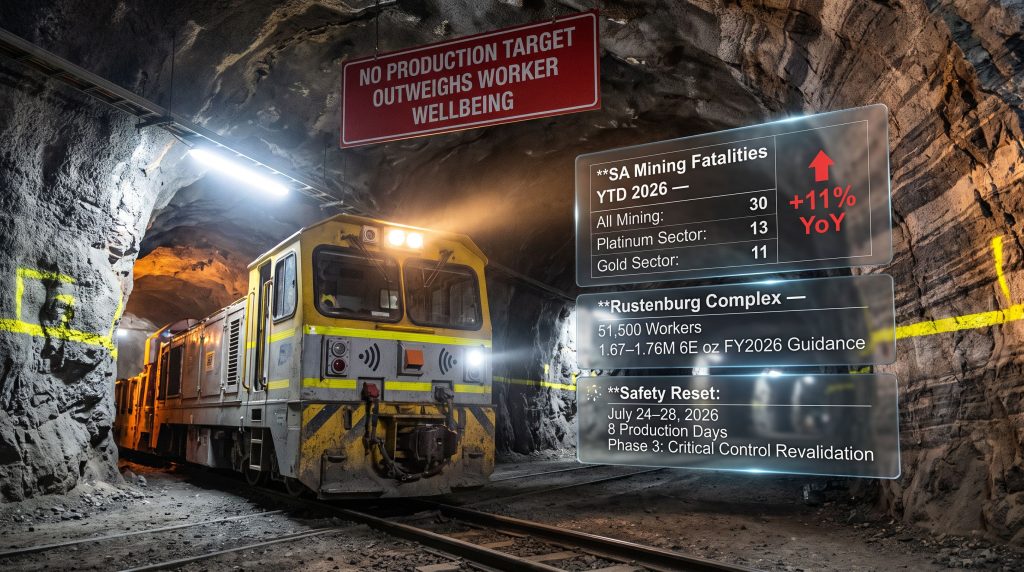
Moses Motlhageng, CEO of Implats Rustenburg, stated publicly that when workers return to their posts, they will do so with the assurance that all rail-bound equipment has been thoroughly reassessed and reverified, and that no production target or operational objective outweighs the wellbeing of the workforce. That position, according to MiningMX's reporting, reflects a values-based safety governance model increasingly embedded in leading PGM operators. Furthermore, platinum mine safety standards across the Bushveld Complex continue to evolve in response to exactly these kinds of incidents.
A Five-Phase Operational Breakdown of the Safety Reset Process
A structured safety reset of this scale is not simply a pause in production. It is a systematic operational audit conducted under time pressure. At Rustenburg, the intervention followed a multi-phase approach:
- Workforce engagement: All-employee safety briefings conducted at shaft level, with management-led sessions reinforcing zero-harm behavioural standards and specifically addressing the tramming incident types that triggered the reset.
- Underground workplace inspections: Systematic audits across all active production areas, identifying non-conformances in rail-bound equipment operating zones.
- Make-safe activities: Physical rectification of identified hazards, with no worker re-entry permitted until remediation is confirmed.
- Critical control revalidation: Full reverification of all rail-bound equipment, including locomotives, conveyances, and tramming infrastructure, with particular attention to anti-collision and proximity detection systems.
- Third-party technical review and retraining: Independent specialist consultants and original equipment manufacturers (OEMs) engaged to audit locomotive safety systems and assess whether anti-collision technology upgrades are required. All rail-bound equipment operators undergo mandatory retraining and competency reassessment before returning to active duties.
This structured sequence transforms what could be a superficial pause into a documented, auditable safety intervention — one that generates evidence of due diligence for both internal governance and potential DMRE review. In addition, underground safety efficiency measures of this kind are increasingly recognised as integral to responsible operational management across the sector.
Rustenburg's Place in the Implats Portfolio and the Production Impact Assessment
Rustenburg is not a peripheral asset within Implats. It accounted for just over one-third of the group's refined PGM output in FY2025, and for the FY2026 financial year (ended June 30, 2026), the complex was expected to produce between 1.67 and 1.76 million 6E ounces. The complex employs approximately 51,500 workers, making it one of the largest concentrated mining workforces in the Southern Hemisphere.
The Rustenburg operation extracts ore from both the Merensky Reef and the UG2 Reef, the two primary platinum-bearing horizons of the Bushveld Igneous Complex. Both require extensive underground rail infrastructure for ore transport, which is precisely why tramming risk is so structurally significant to this specific operation.
| Production Metric | FY2026 Data |
|---|---|
| Rustenburg share of Implats refined output | Just over one-third |
| FY2026 production guidance (6E oz) | 1.67 to 1.76 million |
| Approximate workforce | 51,500 |
| Safety reset duration | July 24–28, 2026 |
| Production days affected | 8 (including shift cycles) |
| FY year impacted | FY2027 (from July 1, 2026) |
On the financial impact question, market analysts have noted the timing is favourable from an operational recovery perspective. The stoppage fell at the very start of Implats' FY2027 financial year, meaning the company retains the full year to absorb the shortfall. Analyst René Hochreiter of Noah Capital, quoted by MiningMX, characterised the event as a near-term buying opportunity, noting that Implats' annual results due September 3, 2026 were expected to be excellent. Sales continuity is expected to be maintained through surface stockpile drawdown during the suspension period.
Investor Note: This article contains references to analyst commentary and market assessments. These represent independent views and should not be construed as financial advice. Investors should conduct their own due diligence before making investment decisions.
The 2023 Hoisting Disaster and the Concept of Risk Migration
The current tramming fatalities cannot be assessed in isolation. In November 2023, a mechanical failure in a winding conveyance cage at 11 Shaft within the Rustenburg complex resulted in 13 fatalities and 73 injuries. The conveyance was carrying 86 miners to surface when the failure occurred. Nico Muller, then CEO of Implats, described it as the darkest day in the company's 57-year operating history, as reported by MiningMX.
What makes the 2026 tramming incidents particularly instructive from a safety systems perspective is not that they occurred in the same category as 2023, but that they occurred in a different category. This pattern illustrates a concept known in occupational safety literature as risk migration: the phenomenon whereby intensive remediation of one fatality category can inadvertently concentrate managerial attention and investment there, while parallel vulnerabilities in other equipment systems remain under-monitored.
The 2023 incident involved vertical transport (hoisting). The 2026 fatalities involve horizontal transport (tramming). Two distinct systems, two distinct failure modes, same complex. This suggests that comprehensive safety management in large-scale deep-level PGM operations requires simultaneous multi-system surveillance rather than sequential remediation cycles.
The next major ASX story will hit our subscribers first
South Africa's 2026 Fatality Data: A Statistical Reversal That Demands Attention
The sector-level data context for the Implats Rustenburg safety reset is troubling in its own right. According to Minerals Council South Africa data cited by MiningMX:
| Sector | YTD Fatalities (2026) | YoY Change |
|---|---|---|
| All mining (total) | 30 | +11% vs. 2025 |
| Platinum sector | 13 | +4 vs. same period 2025 |
| Gold sector | 11 | Comparison benchmark |
The platinum sector has recorded more year-to-date fatalities than gold in the first half of 2026, a statistical inversion that defies the conventional assumption embedded in decades of South African mining safety narratives. Gold mining, with its extreme depths frequently exceeding 3,000 metres below surface, has historically carried the highest per-worker mortality risk. That platinum has surpassed it in 2026 is a signal the industry cannot afford to dismiss.
Several structural factors likely contribute to the elevated PGM fatality rate:
- Production intensity pressure as PGM commodity prices incentivise maximising output from existing shaft infrastructure
- Ageing underground rail networks in mature Bushveld Complex operations that have expanded their footprint without commensurate infrastructure renewal
- Labour turnover in specialist equipment roles, where competency gaps in locomotive operation create heightened collision risk
- Multi-level underground rail network complexity in large shaft systems operating multiple concurrent haulage routes
However, the supply constraints in the PGM market that are driving production intensity also make it commercially tempting to defer the infrastructure renewal that ageing rail networks increasingly require.
The Surface Stockpile Buffer: An Underappreciated Safety Governance Tool
One structural feature that enables voluntary safety resets without triggering investor panic is the strategic maintenance of surface stockpiles. For large-scale PGM producers, holding adequate concentrate and refined metal inventory provides the commercial flexibility to absorb short-duration production stoppages without forcing immediate revenue shortfalls.
This buffer mechanism is more than a logistical convenience. It is a form of operational resilience planning that directly enables better safety decision-making. A management team that knows it can sustain sales from stockpiles for one to two weeks faces a fundamentally different risk calculus when considering a voluntary shutdown than one operating with minimal surface inventory.
Implats confirmed that sales would not be materially impacted during the Rustenburg reset precisely because surface stockpiles would be drawn upon to maintain continuity. This capability should be recognised by investors as a safety governance enabler, not merely a financial buffer. Consequently, the broader mining industry evolution toward proactive risk management is increasingly reflected in how leading operators structure their inventory and operational resilience strategies.
FAQ: Implats Rustenburg Safety Reset
What triggered the Implats Rustenburg safety reset in July 2026?
Two underground fatalities involving rail-bound tramming equipment in July 2026, occurring after the company had already recorded four fatal injuries during FY2026, prompted management to initiate a complex-wide voluntary production suspension for structured safety intervention.
How long does the safety reset last, and when will production resume?
The suspension ran from July 24 to 28, 2026, covering five calendar days but equating to eight production days when operational shift cycles are accounted for. Full resumption was expected by July 30, 2026.
Will the reset affect Implats' financial results?
The production shortfall falls within FY2027 (beginning July 1, 2026). Sales continuity is maintained through surface stockpile drawdown. Given the early placement in the financial year, operational catch-up capacity is considered substantial by independent analysts.
How does a voluntary safety reset differ from a Section 54 stoppage?
A Section 54 stoppage is issued by the DMRE when an inspector identifies imminent danger conditions. A voluntary reset is company-initiated and reflects proactive internal governance rather than regulatory non-compliance.
How does this compare to the 2023 Rustenburg hoisting accident?
The 2023 incident involved a vertical hoisting conveyance failure causing 13 fatalities. The 2026 incidents involve horizontal underground tramming, a distinct risk category requiring separate control systems, which illustrates the challenge of managing multiple simultaneous equipment risk profiles in large-scale underground operations.
Safety Resets as a Structural Indicator of Governance Maturity
The evolution from post-incident regulatory response toward proactive voluntary intervention is one of the more meaningful shifts in how major PGM producers approach occupational safety. A safety reset, when executed with genuine operational rigour across all five phases outlined above, functions as a system-level stress test that generates auditable evidence of control effectiveness before regulators are required to intervene.
For Rustenburg specifically, the July 2026 reset marks a critical juncture. The complex must demonstrate not only that its tramming safety controls have been comprehensively upgraded, but that its broader multi-system risk management framework — encompassing both vertical and horizontal underground transport — is sufficiently robust to prevent the kind of risk migration pattern that allowed a new fatality category to emerge in the years following the 2023 hoisting disaster.
With 30 mining fatalities recorded nationally in the first half of 2026 and the platinum sector accounting for the largest single-commodity share, the industry faces a credibility test on its safety commitments. Voluntary resets by operators of Implats' scale set an implicit behavioural benchmark across the sector. The longer-term trajectory of PGM mining safety will ultimately be determined not by individual interventions, however well-structured, but by whether systemic underground transport risk controls become permanent operational standards embedded across the full Bushveld Complex operator ecosystem.
Want to Stay Ahead of Significant ASX Mineral Discoveries in the PGM Sector?
Discovery Alert's proprietary Discovery IQ model instantly identifies high-potential ASX announcements across platinum group metals and more than 30 other commodities, delivering real-time alerts that empower investors to act before the broader market catches on — explore historic discovery returns on Discovery Alert's dedicated discoveries page to understand the scale of opportunity these moments can represent, then begin your 14-day free trial at Discovery Alert to secure your market-leading advantage.