July 29, 2026
The Infrastructure Arbitrage That Makes Cronos Possible
Deepwater gas development has historically been one of the most capital-intensive undertakings in the energy sector. Fields discovered in water depths exceeding 1,000 metres routinely require dedicated floating production systems, standalone processing platforms, and purpose-built export pipelines that collectively push development costs into the tens of billions of dollars. The financial commitment required often means decade-long gaps between discovery and first gas.
Furthermore, FID processes alone can stretch across multiple years of technical studies, commercial negotiations, and regulatory approvals. The Eni Cronos project Cyprus FID, announced on July 28, 2026, represents a deliberate departure from that conventional model. By routing production through infrastructure that already exists across two sovereign jurisdictions, the project compresses both the capital requirement and the development timeline in ways that have significant implications not just for Cyprus, but for how the Eastern Mediterranean gas basin is likely to be monetised over the coming decade.
When big ASX news breaks, our subscribers know first
Cyprus in the Eastern Mediterranean Gas Hierarchy
To understand what the Eni Cronos project Cyprus FID actually means, it helps to first understand where Cyprus sits relative to its neighbours in the Eastern Mediterranean hydrocarbon picture. The region has been the subject of intense exploration activity since Eni's Zohr discovery in Egyptian waters in 2015, which at the time was the largest deepwater gas find ever made in the Mediterranean.
That was followed by continued development of the Leviathan and Karish fields off Israel's coast, and the long-delayed Aphrodite field in Cyprus's own waters, which has struggled to reach commercialisation for over a decade due to pricing disputes and infrastructure challenges. The geopolitical risk landscape across the region has further complicated timelines, making Cyprus's progress all the more notable.
Cyprus has lagged behind both Israel and Egypt in converting its offshore resource base into producing assets. Several structural factors explain this gap:
- Smaller domestic demand base, meaning exports require international infrastructure from day one
- Limited domestic processing and liquefaction capacity, creating dependency on third-party infrastructure in Egypt or Greece
- Unresolved maritime boundary sensitivities with Turkey, which has periodically challenged Cypriot and Greek EEZ claims in the Eastern Mediterranean
- Contractual complexity in securing cross-border infrastructure access on commercially viable terms
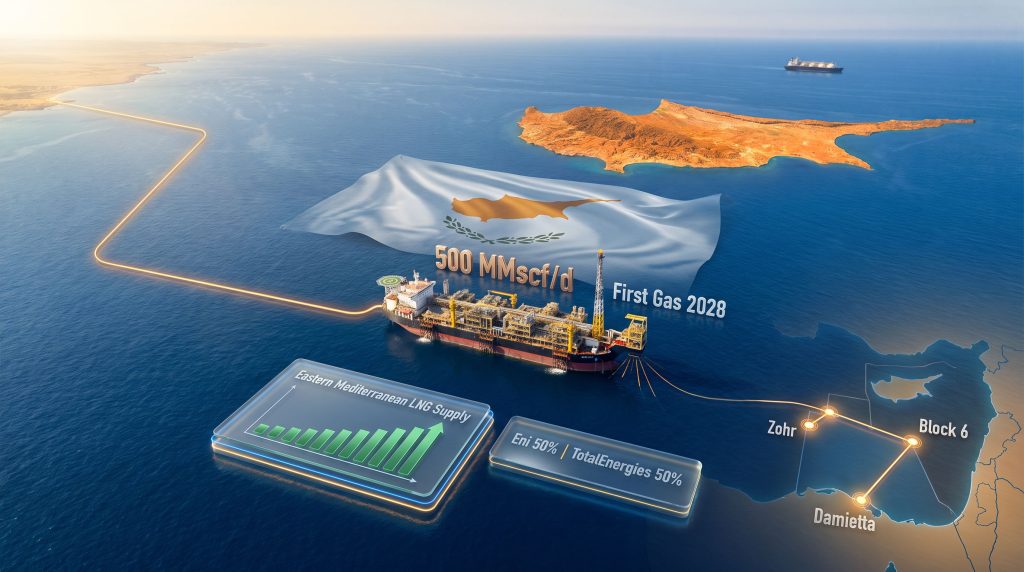
Block 6, where Cronos is located, sits in the deepwater offshore zone and is geographically proximate to the Egyptian shelf where Zohr operates. This geographic positioning is not incidental; it is what makes the fast-track development philosophy viable.
Project Fundamentals: What the Numbers Actually Mean
| Parameter | Detail |
|---|---|
| Location | Block 6, deepwater offshore Cyprus |
| Operator | Eni SpA (50%) |
| Co-developer | TotalEnergies SE (50%) |
| Gas initially in place | More than 3 trillion cubic feet (Tcf) |
| Production plateau target | 500 million standard cubic feet per day (MMscf/d) |
| First gas target | 2028 |
| Processing route | Eni's existing Zohr infrastructure, Egypt |
| Liquefaction facility | Damietta LNG plant, Egypt |
| Primary export market | European Union |
At a plateau rate of 500 MMscf/d, Cronos would produce approximately 18.25 billion cubic feet per year, equivalent to roughly 5.2 billion cubic metres annually. That volume is not transformative for European gas supply in isolation, but it adds a meaningful non-Russian supply vector to a regional mix that has been under structural pressure since 2022. Consequently, the LNG supply outlook for Europe becomes incrementally more diversified with each project of this kind reaching FID.
The critical distinction with Cronos is how it reaches that plateau. Rather than constructing a standalone floating LNG vessel or a dedicated export pipeline, Eni is leveraging its existing stake and operational footprint at the Zohr field to process Cronos gas, then piping it onward to the Damietta liquefaction facility for LNG export. This approach sidesteps the most capital-intensive components of a typical deepwater development and is the primary reason a 2026 FID to 2028 first gas timeline is achievable. For context, deepwater projects that require greenfield processing infrastructure routinely take five to eight years from FID to first production.
The Damietta Restart: An Overlooked Dimension
One aspect of the Cronos FID that deserves more analytical attention than it typically receives is what it means for the Damietta LNG plant. The facility, located on Egypt's Mediterranean coast, has a complicated operational history. It was originally brought online in 2004 but suffered prolonged curtailments and periods of near-complete shutdown due to Egyptian domestic gas supply constraints, which periodically left the plant without sufficient feedgas to operate commercially.
The restart enabled by Cronos volumes is therefore not simply a matter of flipping a switch. It represents the commercial rehabilitation of a significant piece of Eastern Mediterranean export infrastructure that has been underutilised for years. For European buyers seeking to diversify LNG supply sources, Damietta adds a geographically proximate loading terminal to complement Egypt's other liquefaction facility at Idku, operated by a consortium that includes Shell.
The reactivation of Damietta should be understood as a structural expansion of Eastern Mediterranean LNG export capacity, not merely a throughput optimisation exercise for a single upstream project.
How the FID Deadlock Was Broken
The path to the Eni Cronos project Cyprus FID was not straightforward. By early 2026, industry reporting indicated that the decision had stalled, with contractual liability disagreements over infrastructure usage terms and unresolved development plan approvals identified as the primary obstacles. The sequence of events that cleared the path to sanction unfolded over several months:
- Pre-2026: Resource estimation, discovery validation, and early development concept selection completed
- March 2026: Reports confirm FID has been delayed; contractual and regulatory obstacles cited
- May 2026: Cyprus formally approves the Cronos development and production plan, removing a critical regulatory prerequisite
- June 2026: Cyprus's energy ministry signals publicly that FID and associated commercial agreements are close to finalisation
- July 28, 2026: Eni formally announces FID, transitioning Cronos from exploration asset to sanctioned development
The resolution of the cross-border contractual framework governing gas transit between Cypriot and Egyptian jurisdictions was a central enabling condition. Multi-sovereign infrastructure agreements of this kind require alignment between upstream operators, national governments, and infrastructure owners on questions of liability, throughput priority, tariff structures, and force majeure provisions. Getting four parties — Eni, TotalEnergies, Cyprus, and Egypt — to a commercially aligned position across all of these dimensions explains why the process took longer than initially anticipated.
What Cronos Means for Cyprus as an Energy Nation
The significance of Cronos for Cyprus extends well beyond the immediate revenue implications. This is the country's first hydrocarbon development project, and as such it carries institutional weight that goes far beyond the production volumes involved. In addition, the broader economic ripple effects could reshape Cyprus's long-term fiscal position.
Establishing Cyprus as an active producer creates several compounding effects:
- Regulatory credibility: A completed development demonstrates that Cyprus's upstream regulatory framework is functional and capable of supporting complex international projects, which lowers perceived risk for other operators considering EEZ exploration
- Fiscal framework activation: Production royalties, hydrocarbon taxes, and any government participation arrangements move from theoretical to actual, creating a revenue stream that can be modelled and budgeted
- Operator confidence signalling: A successful FID by two majors (Eni and TotalEnergies) is the most credible possible advertisement for Cyprus's hydrocarbon sector to other potential investors
- Human capital development: Hosting an active deepwater gas industry builds the technical workforce, regulatory expertise, and institutional knowledge that sustains a long-term hydrocarbon sector
Scenario Pathways for Cyprus's Longer-Term Role
Scenario A (Base Case): Cronos operates as designed, reaching plateau by approximately 2029–2030. Cyprus collects royalty revenues. Gas flows through Egypt. No additional EEZ blocks reach FID before 2030. Cyprus functions as a modest but credible gas producer within the regional supply architecture.
Scenario B (Accelerated Development): Cronos's commercial success catalyses FID decisions on additional Cypriot blocks. Cyprus negotiates more favourable infrastructure access terms with Egypt as its bargaining position strengthens. Discussion of domestic interconnection infrastructure — a Cyprus-Greece pipeline has been proposed in various forms — gains renewed momentum.
Scenario C (Geopolitical Disruption): Renewed maritime boundary tensions in the Eastern Mediterranean, or Egyptian domestic gas demand growth that competes with Cronos processing throughput, delays the project's ramp to plateau. European buyers activate alternative supply arrangements, though Damietta's restart capacity is delayed.
The next major ASX story will hit our subscribers first
Eastern Mediterranean LNG in the European Supply Calculus
The European gas market has undergone a structural transformation since 2022 that makes the Cronos project commercially viable in ways it might not have been a decade ago. The rapid expansion of European LNG import terminal capacity, combined with sustained political commitment to reducing dependence on Russian pipeline gas, has created durable demand for geographically diverse LNG supply. The trade war energy impact on global supply chains has further reinforced Europe's drive to lock in stable, proximate energy sources.
| Supply Source | Proximity to EU | Geopolitical Risk Profile | LNG Infrastructure Maturity |
|---|---|---|---|
| Eastern Mediterranean (Cronos/Damietta) | High | Moderate | Established (restart) |
| United States (Gulf Coast) | Low | Low | High |
| Qatar | Low | Moderate-High | Very High |
| West Africa (Nigeria, Angola) | Moderate | Moderate-High | Established |
Eastern Mediterranean LNG carries a natural freight advantage over US Gulf Coast or Qatari cargoes destined for European terminals. Shorter shipping distances translate into lower delivered cost and faster cargo turnaround, which matters to buyers managing regasification terminal scheduling. The tradeoff is that Eastern Mediterranean supply remains smaller in absolute volume terms and carries moderate geopolitical exposure given regional maritime sensitivities.
For European energy security planners, however, the primary metric is source diversification rather than pure volume. Every additional non-Russian, non-Gulf supply vector that can be activated reduces systemic supply concentration risk, even if individual project volumes are modest relative to total EU import requirements.
Key Risks That Investors and Policymakers Should Monitor
Despite the significance of the FID, several risk categories warrant careful ongoing monitoring.
Technical execution risks:
- Subsea infrastructure installation in deepwater Mediterranean conditions presents engineering complexity, particularly around manifold and flowline systems in water depths typical of Block 6
- Egyptian domestic gas consumption has grown materially in recent years, and if Zohr's throughput capacity becomes constrained by competing domestic demand, Cronos processing volumes could face prioritisation challenges
Commercial and market risks:
- Commodity price volatility over the 2026–2028 development period affects project economics and the attractiveness of long-term offtake agreements
- Accelerating European renewable deployment could reduce structural gas demand faster than current projections assume, affecting the long-term revenue outlook for projects with production lives extending into the 2040s
Geopolitical risk dimensions:
- Turkey's non-recognition of Cyprus's EEZ and its competing maritime claims represent a persistent background risk to Eastern Mediterranean offshore operations, though Eni and TotalEnergies have structured the project with this exposure in mind
- Political transitions in either Egypt or Cyprus could affect the durability of cross-sovereign infrastructure agreements, particularly if new administrations seek to renegotiate commercial terms
However, it is worth noting that both Eni and TotalEnergies have demonstrated sustained commitment to the region across multiple political cycles, which provides a degree of institutional continuity that purely national projects would lack. The global steel outlook for pipeline and subsea hardware also remains relevant, as construction cost inflation for deepwater projects is closely tied to steel pricing dynamics.
Disclaimer: The scenario analyses and risk assessments presented in this article are based on publicly available information and analytical frameworks. They do not constitute investment advice. Readers should conduct independent due diligence before making any investment decisions related to companies or projects discussed herein.
Frequently Asked Questions: Eni Cronos Project Cyprus FID
What is the Eni Cronos project?
Cronos is a deepwater natural gas development in Block 6 of Cyprus's Exclusive Economic Zone, operated by Eni with TotalEnergies as an equal partner. The field holds an estimated gas resource exceeding 3 Tcf and is designed to deliver LNG to European markets via existing Egyptian infrastructure.
When did Eni take FID on Cronos?
Eni announced its final investment decision on July 28, 2026, following a period of contractual negotiations and regulatory approvals that had delayed the announcement from earlier in the year.
When will Cronos produce first gas?
The project targets first gas in 2028, representing a fast-track timeline of approximately two years from FID to initial production.
What is the production plateau for Cronos?
The project is designed to reach 500 MMscf/d, equating to approximately 5.2 billion cubic metres of gas annually.
How will Cronos gas reach European markets?
Gas from Block 6 will be transported to and processed through Eni's Zohr installations in Egypt, before liquefaction at the Damietta LNG plant and export as LNG, primarily to EU buyers.
Why is Cronos historically significant for Cyprus?
Cronos is Cyprus's first-ever hydrocarbon development project, establishing the country as an active gas producer and creating the commercial and institutional foundations for future offshore development within its EEZ.
Who owns and operates the Cronos project?
Eni SpA operates Block 6 with a 50% working interest. TotalEnergies SE holds the remaining 50%.
Want to Stay Ahead of the Next Major Resource Discovery?
Discovery Alert's proprietary Discovery IQ model scans ASX announcements in real time, delivering instant alerts on significant mineral discoveries — from emerging energy plays to transformative commodity finds — so subscribers can act before the broader market catches on. Explore historic examples of exceptional discovery returns and begin your 14-day free trial at Discovery Alert to secure your market-leading edge.