July 29, 2026
How Critical Minerals Demand Is Reshaping OEM Market Entry Strategies
The economics of screening equipment procurement have shifted considerably over the past decade. Buyers across European mining and aggregates markets are no longer evaluating capital equipment on upfront cost alone. Total cost of ownership, predictive maintenance integration, and the availability of locally embedded technical support have become decisive factors in supplier selection. This structural shift in procurement behaviour is creating a meaningful opening for internationally established original equipment manufacturers (OEMs) willing to commit genuine regional resources rather than simply servicing markets from afar.
For the Haver & Boecker Niagara UK mining and aggregates expansion to make commercial sense, the market fundamentals need to justify the investment. By most credible measures, they do.
The Global Screening Equipment Market: Structural Growth Drivers
Processing equipment demand across European markets is being propelled by two reinforcing cycles. The first is conventional infrastructure investment: road programmes, rail upgrades, and housing delivery targets all require processed aggregates at scale. The second is the emerging critical minerals demand processing cycle, which is expanding the addressable market for screening and separation technology well beyond traditional quarrying applications.
The UK aggregates sector produces approximately 200 million tonnes per year, establishing it as one of Europe's most active quarrying environments by volume. This output level sustains consistent procurement cycles for screening capital equipment, screen media consumables, and associated service contracts.
Key structural drivers underpinning sustained OEM demand in the region include:
- Long-term infrastructure pipelines requiring reliable aggregate supply chains at consistent specification
- Growing critical minerals exploration activity in regions including Cornwall and Wales, with lithium, tungsten, and tin deposits expanding the processing equipment addressable market beyond conventional aggregates
- Regulatory emphasis on domestic mineral processing capability across both the UK and EU, creating fresh procurement cycles for suppliers capable of serving minerals processing at higher specification levels
- A well-established aftermarket culture among British quarry operators, meaning relationships with locally present technical representatives are valued and frequently rewarded with long-term supply agreements
The UK's position as both a high-volume aggregates producer and an emerging critical minerals jurisdiction creates a dual-market opportunity that is difficult to replicate elsewhere in Europe at comparable scale.
Where Haver & Boecker Niagara Fits Within the Global OEM Landscape
Haver & Boecker Niagara operates as a specialist across screening, washing, pelletizing, and primary crushing systems for aggregates, mining, and mineral processing applications. The company's Canadian operational heritage has shaped a product engineering philosophy focused on high-tonnage environments where reliability under sustained mechanical load is non-negotiable.
What separates Haver & Boecker Niagara from commodity screening suppliers is the integration of operational diagnostics directly into its hardware offering. This positions the company at the intersection of processing equipment and data-driven mining operations, a convergence point that procurement teams at sophisticated operators increasingly prioritise over price-competitive but diagnostically inert alternatives.
OEMs combining hardware with embedded monitoring capability tend to perform better on total cost of ownership modelling over five to ten year operational horizons. This matters most in environments where unplanned downtime carries a high financial penalty.
When big ASX news breaks, our subscribers know first
What Is Haver & Boecker Niagara's UK and Ireland Expansion Strategy?
Dedicated Regional Sales Infrastructure: The Martin Loughran Appointment
The most tangible signal of Haver & Boecker Niagara's regional commitment is the establishment of a dedicated UK and Ireland sales function, with Martin Loughran appointed as Sales Manager for the United Kingdom and Ireland. This is not a distributor arrangement or an agency relationship managed from another geography. It is a direct regional hire with specific accountability for building customer relationships and expanding market penetration across British and Irish mining and quarrying operations.
The strategic objectives embedded in this appointment are threefold:
- Developing sustained relationships with quarry operators, mine managers, and procurement teams who value face-to-face technical engagement over remote sales models
- Expanding access to Haver & Boecker Niagara's full screening and service solutions portfolio across a market the company has identified as carrying significant growth potential
- Closing the service responsiveness gap that has historically allowed OEMs with established local networks to retain aftermarket business at the expense of internationally based competitors
This type of structured regional commitment represents a transition from opportunistic export sales to deliberate market development. It signals a longer investment horizon and carries different commercial expectations than a distributor-led market entry.
Trade Show Presence as a Market Entry Signal
Haver & Boecker Niagara selected Hillhead 2026, held in Buxton, UK, as the primary platform to signal its expanded commitment to the British market. Hillhead is widely recognised as the UK's most significant quarrying, construction, and recycling exhibition, making it the strategically logical venue to engage the aggregates and mining buyer community at scale.
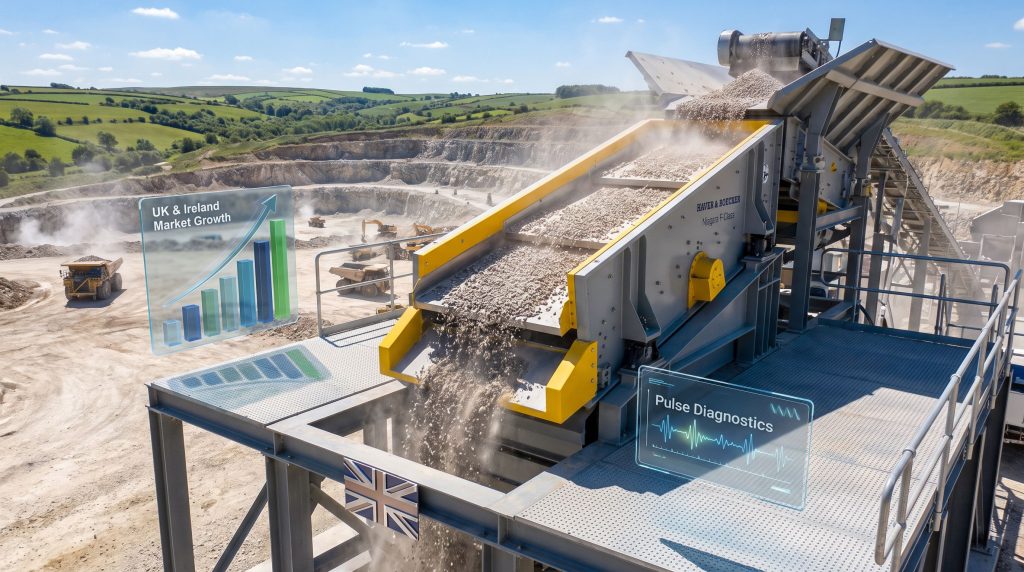
The company used the event to showcase its F-Class low-vibration screen, a flagship product whose technical characteristics align closely with the operational constraints common across British quarry infrastructure. Trade show participation at this level is not purely promotional. In the mining and aggregates sector, it functions as a credibility signal, communicating to buyers that a supplier is committed to the market for the long term rather than testing appetite from a distance.
| Strategic Signal | Detail |
|---|---|
| Regional hire | UK/Ireland Sales Manager appointed |
| Product focus | F-Class low-vibration screening technology |
| Event platform | Hillhead 2026, Buxton, UK |
| Target sectors | Aggregates, mining, mineral processing |
| Geographic scope | United Kingdom and Ireland |
| Diagnostic integration | Pulse Diagnostics condition-monitoring system |
What Is the F-Class Screen and Why Does It Matter for UK Quarry Operations?
Technical Profile: Low-Vibration Screening Technology
The F-Class screen is built around a counterbalanced, low-vibration operating principle that fundamentally alters the force profile transmitted to supporting structures during operation. Conventional inclined screens generate significant dynamic loads that, over time, contribute to structural fatigue in the steelwork, platforms, and foundations supporting elevated processing plants.
For UK quarry operations undertaking brownfield upgrades, this is not a theoretical concern. Many established quarrying sites operate processing plants constructed over decades, where the existing structural envelope was not designed to accommodate the vibration signatures of modern high-throughput screens. The F-Class design addresses this constraint directly.
Key operational advantages of the F-Class configuration include:
- Reduced transmission of dynamic forces to supporting structures, extending the serviceable life of elevated plant infrastructure
- Lower mechanical stress on screen media and frame components, extending wear intervals and reducing the frequency of planned maintenance shutdowns
- Improved material stratification across a range of aggregate gradations, supporting consistent product specification compliance
- Native compatibility with the Pulse Diagnostics condition-monitoring platform, enabling real-time health assessment without retrofitting additional instrumentation
A lesser-known technical detail about counterbalanced screening design is how it affects near-size particle behaviour. In conventional screens, high vibration amplitude can cause near-size particles to bounce rather than stratify, reducing separation efficiency and increasing the proportion of off-specification product in the finer fractions. The controlled, lower-amplitude motion characteristic of the F-Class design improves the probability of near-size particles finding apertures, which directly translates into tighter product gradation control.
Pulse Diagnostics: Embedding Intelligence Into Screening Operations
Pulse Diagnostics represents a systematic shift from reactive to predictive maintenance management in screening operations. The platform monitors vibration signatures, bearing temperatures, and key operational parameters continuously, identifying performance degradation patterns before they manifest as unplanned stoppages.
For operators managing tight production schedules and contractual delivery obligations, the financial case for predictive diagnostics is straightforward. Unplanned downtime in aggregate processing can cost operators between £5,000 and £20,000 per hour depending on plant scale and the downstream obligations attached to supply contracts. Against that cost baseline, the investment in a condition-monitoring system with a proven ability to extend the interval between failures carries a compelling return calculation.
Predictive maintenance capability is increasingly functioning as a procurement differentiator rather than a premium add-on, particularly in operations where the cost of a missed shift exceeds the annualised cost of the monitoring system itself.
A further dimension of Pulse Diagnostics that is not widely understood outside specialist circles is its role in screen media optimisation. Vibration signature analysis can identify asymmetric wear patterns developing across a screen deck before they become visible during routine inspection. Operators who act on this data can reposition or replace individual panels before uneven wear propagates into frame distortion, which is a significantly more costly repair than panel replacement alone. Furthermore, Niaflow software complements this approach by enabling operators to simulate and optimise full plant configurations before committing to physical changes.
How Does the UK Mining and Aggregates Market Compare to Other Target Regions?
UK Market Characteristics: Opportunity and Complexity
The UK aggregates market presents a specific combination of scale and structural complexity that shapes how OEMs must position themselves to win business. The Haver & Boecker Niagara UK mining and aggregates expansion reflects a considered response to these distinct market characteristics.
The market is characterised by:
- A fragmented operator base mixing major integrated producers such as CRH, Hanson, and Tarmac with a long tail of independent regional quarry operators, each with distinct procurement cultures and service expectations
- High regulatory scrutiny around planning, noise, vibration, and environmental compliance, creating an environment where the low-vibration performance credentials of the F-Class screen carry direct regulatory relevance beyond operational preference
- A deeply embedded aftermarket service culture, meaning initial capital sales are frequently conditional on demonstrated local service capability rather than product specification alone
- Strong price competition in consumables and screen media, requiring OEMs to differentiate on lifecycle value rather than competing on unit price
Ireland as a Complementary Growth Market
The decision to pair Ireland with the UK under a single regional sales structure reflects a practical clustering logic. Ireland's construction and infrastructure sector has experienced sustained expansion, driven by national housing delivery targets and multiannual capital investment programmes. Irish quarry operators share the same fundamental procurement priorities as their British counterparts: reliability, proximity of service support, and demonstrable processing efficiency gains.
From a resource allocation perspective, a single regionally based sales manager covering both markets maximises coverage efficiency at a point in the expansion cycle where the company is building initial market presence rather than managing a mature installed base.
Benchmarking Against Haver & Boecker Niagara's Broader International Expansion
| Region | Expansion Mechanism | Strategic Rationale |
|---|---|---|
| United Kingdom and Ireland | Dedicated sales hire and trade show presence | Market development in high-potential aggregates region |
| Other international markets | New dealer appointments | Distribution-led scaling in emerging processing markets |
| Manufacturing base | Capacity investment | Supporting increased global order volumes |
What Competitive Pressures Are Driving OEM Regionalisation in European Screening Markets?
The Shift From Centralised Export Models to Regional Presence
European mining and aggregates buyers have progressively recalibrated their supplier selection criteria since the supply chain disruptions of the early 2020s. Where historically a technically superior product could win business regardless of the supplier's local presence, procurement teams now weight aftermarket responsiveness and parts availability more heavily in their total cost of ownership calculations.
OEMs operating centralised export models struggle to compete on service response time against competitors with regionally embedded technical teams. Parts lead times measured in weeks rather than days translate directly into extended production losses when screens require unplanned maintenance during peak output periods. Haver & Boecker Niagara's regional hire is designed to address precisely this competitive gap.
Critical Minerals Policy as a Demand Catalyst
The UK Government's Critical Minerals Strategy identifies domestic extraction and processing capability as a national economic priority, with particular emphasis on reducing import dependency for minerals essential to battery technology, defence, and low-carbon energy infrastructure. The broader energy transition minerals agenda is consequently reshaping procurement cycles across the sector.
Increased exploration and feasibility activity around lithium, tungsten, and tin deposits in Cornwall and Wales is quietly expanding the addressable market for advanced screening and processing equipment well beyond conventional aggregates. These mineralisation types present specific processing challenges: the ore grades are typically lower than historical mining operations, making efficient liberation and separation at the fine end of the size distribution critically important for project economics.
This is technically relevant to Haver & Boecker Niagara's positioning. Fine screening and precise size classification become more economically valuable when the target mineral is disseminated through host rock at lower concentrations. The F-Class screen's controlled vibration profile and associated screen media options are well-suited to the fine-separation demands characteristic of hard rock critical mineral ores.
OEMs capable of credibly serving both conventional aggregates and critical minerals processing are positioned to capture a broadening procurement base as the UK's domestic minerals sector transitions from exploration toward production, reducing revenue concentration risk relative to single-sector specialists.
Key Considerations for UK Quarry and Mining Operators Evaluating Screening Technology
What to Assess When Selecting a Vibration-Managed Screening Solution
- Structural compatibility with existing plant infrastructure, including the dynamic load profile under the target throughput rate and material bulk density
- Screen media longevity under the specific abrasivity, moisture content, and particle shape characteristics of the material being processed
- Diagnostic integration capability with existing plant control or SCADA infrastructure, including data export formats and connectivity with third-party monitoring platforms
- Local service coverage, specifically whether a regionally based technical team can respond within commercially acceptable timeframes for unplanned maintenance events
- Total cost of ownership modelling across a realistic five to ten year operational horizon, incorporating screen media consumption, structural maintenance, and the avoidable downtime cost associated with predictive versus reactive maintenance regimes
Procurement Checklist: Evaluating OEM Regional Commitment
- Dedicated regional sales or technical representative based within the target geography
- Demonstrated trade show and industry event participation in the target market over multiple event cycles
- Parts and consumables stocked locally or with confirmed lead times short enough to prevent extended production loss
- References from comparable operations within the region covering both product performance and service responsiveness
- Clear warranty terms and service-level agreement provisions specifically structured for the local market
The next major ASX story will hit our subscribers first
Frequently Asked Questions: Haver & Boecker Niagara UK Expansion
What products is Haver & Boecker Niagara promoting in the UK market?
The company's UK market focus is centred on its F-Class low-vibration screening technology and the associated Pulse Diagnostics condition-monitoring system. These are positioned within a broader portfolio encompassing screening, washing, pelletizing, and primary crushing solutions for aggregates and mineral processing operations.
Why did Haver & Boecker Niagara choose Hillhead 2026 as its expansion platform?
Hillhead is the UK's most significant quarrying and mineral processing trade event, providing concentrated access to the aggregates and mining operator community. As a biennial event held in the heart of the UK's Peak District quarrying region, it attracts the specific buyer profile that represents Haver & Boecker Niagara's primary target customer base in the market.
Who is leading Haver & Boecker Niagara's UK and Ireland sales operations?
Martin Loughran has been appointed as Sales Manager for the United Kingdom and Ireland, with direct responsibility for customer relationship development, market growth, and brand recognition across both markets.
How does the UK critical minerals sector factor into Haver & Boecker Niagara's strategy?
The critical minerals demand surge from domestic exploration and early-stage processing activity in the UK, particularly in Cornwall and Wales, expands the addressable market for high-specification screening equipment beyond conventional aggregates. The technical demands of fine mineral liberation from lower-grade hard rock deposits align with the F-Class screen's precision separation capability.
Is Haver & Boecker Niagara expanding in other international markets simultaneously?
The Haver & Boecker Niagara UK mining and aggregates expansion forms part of a broader international growth programme that includes new dealer appointments across other markets and investment in manufacturing capacity to support increased global order volumes.
The Broader Significance: What This Expansion Signals for the UK Mining Equipment Sector
OEM Investment as a Leading Indicator of Market Confidence
When international OEMs commit to dedicated regional sales infrastructure, it reflects a considered internal assessment of market maturity, growth trajectory, and competitive white space. These decisions are typically preceded by market analysis, customer conversations, and competitor landscape reviews that are not visible publicly. The decision to hire rather than appoint a distributor carries particularly strong signal value: it indicates a belief that the market warrants direct cost exposure and that the growth opportunity is substantial enough to justify a longer payback horizon.
Haver & Boecker Niagara's UK expansion is one data point in a broader pattern of processing equipment suppliers deepening European market engagement in response to overlapping infrastructure investment cycles, critical minerals policy, and the aftermarket culture that rewards locally embedded supplier relationships. In addition, mining industry innovation continues to accelerate across the sector, further raising buyer expectations of OEM technical capability.
Implications for UK Quarry and Mining Operators
Increased OEM competition in the UK screening market carries practical benefits for operators that extend beyond product choice. Greater supplier competition tends to:
- Compress lead times on capital equipment as suppliers compete on delivery performance as well as specification
- Improve service responsiveness as regionally present technical teams compete for aftermarket business retention
- Raise the performance benchmark across the supplier landscape as internationally proven technologies enter the market and displace incumbents with weaker innovation pipelines
- Expand operators' negotiating leverage on both capital pricing and long-term service contract terms
Operators with upcoming plant upgrades, greenfield processing requirements, or ageing screening infrastructure are well-positioned to leverage expanded supplier choice to negotiate improved total cost of ownership outcomes.
As the UK's critical minerals sector moves from exploration toward processing and production over the remainder of this decade, demand for high-specification screening and separation equipment is projected to grow materially. For OEMs with relevant technical capability, 2026 represents a strategically well-timed point of entry ahead of that procurement cycle maturing.
Readers seeking additional context on UK quarrying industry trends and processing equipment innovation can explore coverage from Mining Magazine, which provides ongoing reporting on technology developments across British and international mining operations. Furthermore, the latest Haver & Boecker Niagara news offers direct updates on product developments, regional appointments, and global expansion activity from the company itself.
Want to Capitalise on the Next Major Mineral Discovery Before the Broader Market?
Discovery Alert's proprietary Discovery IQ model delivers real-time alerts on significant ASX mineral discoveries, transforming complex geological data into actionable investment insights for both short-term traders and long-term investors — explore historic discoveries and their returns to understand the scale of opportunity, then begin your 14-day free trial at Discovery Alert to position yourself ahead of the market as critical minerals demand continues to reshape the global mining sector.