July 29, 2026
When Electricity Becomes a Security Risk: Libya's Chronic Power Crisis and Its Oil Sector Consequences
Across the oil-producing world, the most persistent threats to energy infrastructure rarely originate from rival states or sophisticated cyberattacks. They emerge from something far more immediate: the frustration of ordinary people living without reliable electricity in regions that sit atop some of the world's most significant hydrocarbon reserves. The Libya Mellitah Oil Complex restarts after protester incursion serves as a stark reminder of this contradiction between resource wealth and domestic energy poverty, which is perhaps nowhere more acutely felt than in Libya's western cities, where summer temperatures regularly exceed 40 degrees Celsius and daily power cuts stretch beyond 14 hours.
That pressure reached a critical threshold overnight on July 27–28, 2026, when protesters entered the Mellitah oil and gas complex, triggering a cascade of production halts that exposed just how thinly the line between civil grievance and national energy catastrophe has become in post-2011 Libya.
When big ASX news breaks, our subscribers know first
Why Libya's Energy Infrastructure Remains Structurally Exposed to Civil Unrest
The Feedback Loop Between Power Shortages and Production Disruptions
Understanding why protesters target oil and gas infrastructure requires understanding the paradox at the heart of Libya's domestic energy economy. Mellitah is not simply an export facility. It functions as the primary gas aggregation and processing hub that feeds fuel directly into Libya's power generation network. When Mellitah operates at full capacity, gas flows to power plants and electricity reaches homes.
When protesters shut Mellitah down in response to power outages, however, they simultaneously deepen the very crisis they are protesting against. This feedback loop is the defining structural vulnerability of Libya's western energy corridor. The populations of Tripoli, Zawiya, and Misrata endure conditions during peak summer heat that would be intolerable by any standard: over 14 hours of daily blackouts, refrigeration failures, heat-related health risks, and collapsed economic activity.
For communities living under these conditions while observing the revenues generated by nearby oil infrastructure, the political calculation behind storming a facility becomes understandable, if deeply counterproductive. This dynamic shares certain characteristics with the Venezuela power crisis, where domestic energy scarcity has similarly threatened critical infrastructure and broader economic stability.
Libya's Post-2011 Governance Gap Around Critical Assets
The 2011 revolution dismantled the centralised security architecture that had previously protected Libyan energy infrastructure, and nothing has fully replaced it. The country continues to operate under a divided political structure, with competing governments each claiming legitimacy over different parts of the country. This division creates genuine ambiguity about which authority bears responsibility for protecting facilities like Mellitah, and that ambiguity translates directly into security gaps.
Since 2011, Libya's oil sector has experienced disruptions driven by three distinct but frequently overlapping mechanisms:
- Armed conflict between rival factions seeking revenue control or strategic leverage
- Technical failures resulting from underinvestment in ageing infrastructure
- Civil demonstrations driven by domestic service delivery grievances, as seen in July 2026
The convergence of these three mechanisms means that Libya's production environment carries a structural risk premium that no amount of upstream investment can fully offset without parallel political and governance progress.
What Is the Mellitah Oil and Gas Complex and Why Does It Matter?
Operational Profile: Three Assets, One Strategic Node
Mellitah operates as a joint venture between Libya's National Oil Corporation (NOC) and Italy's Eni, making it one of the most significant bilateral energy partnerships on the African continent. During the July 2026 incursion, three interconnected production assets were directly affected:
| Asset | Normal Capacity | Disruption Level |
|---|---|---|
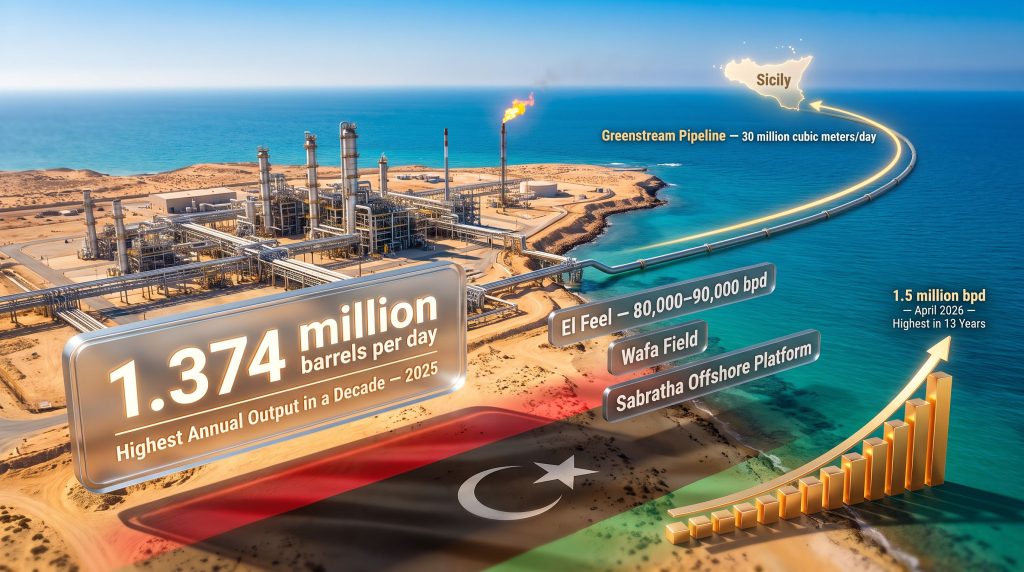
| El Feel oilfield | 80,000 to 90,000 barrels per day | Complete shutdown |
| Wafa field | Significant gas and condensate producer | Partial suspension |
| Sabratha offshore platform | Offshore gas production | Operations disrupted |
The combination of these three assets under a single operational umbrella means that any security breach at Mellitah does not affect one field in isolation. It simultaneously compromises Libya's domestic gas supply, its export commitments through the Greenstream pipeline, and the operational integrity of upstream production linked to each site.
The Greenstream Pipeline: A Subsea Energy Bridge With Mediterranean Consequences
The Greenstream pipeline is one of the most consequential pieces of underwater energy infrastructure in the central Mediterranean. Running from the Mellitah complex to Sicily, it carries approximately 30 million cubic metres of gas per day, according to data from international contractor Bonatti. For Italy, which has been actively diversifying its gas import strategy since significantly reducing dependence on Russian supplies, this pipeline represents a non-trivial component of its import portfolio.
"Any extended shutdown at Mellitah does not stay within Libyan borders. It reverberates through Italian gas import schedules, Mediterranean spot markets, and the broader European energy balance at precisely the moments when summer cooling demand places the greatest stress on grid operators across southern Europe."
The strategic implication is clear: Mellitah is simultaneously a domestic Libyan energy lifeline and a European gas security asset. That dual role amplifies the geopolitical risk landscape of every disruption event, regardless of how quickly it is resolved.
The July 2026 Incident: Sequence, Scale, and Resolution
From Protest to Production Halt: How Events Unfolded
| Timeline Phase | Event |
|---|---|
| Overnight, July 27–28, 2026 | Protesters enter Mellitah complex during extreme heat wave conditions |
| Morning, July 28, 2026 | Security forces deployed and facility secured |
| Later, July 28, 2026 | Production resumes at El Feel, Wafa, and Sabratha |
| Post-restart period | Gas deliveries to power plants gradually restored; electricity grid begins stabilising |
Before operations resumed, the NOC issued a stark warning that a prolonged continuation of the shutdown risked triggering a total national power outage. The severity of that warning reflected not just the scale of Mellitah's domestic supply role, but the fragility of a power generation system already under severe stress from extraordinary summer demand. Multiple generating units were forced offline during the disruption as fuel and gas supplies to power plants fell below minimum operating thresholds.
Political Dimensions: Energy as a Proxy for Government Legitimacy
The July 2026 demonstrations carried demands that extended well beyond electricity access. Thousands of protesters active across Tripoli, Zawiya, and Misrata were simultaneously calling for the resignation of Prime Minister Dbeibah, framing the electricity crisis as a direct indictment of his administration's performance. This political overlay transforms infrastructure protection from a purely technical security challenge into a governance legitimacy problem.
Furthermore, when energy failures become campaign platforms, oil and gas facilities become symbolic targets. Resolving the immediate incident through security deployment does not address the underlying political dynamic that made Mellitah a protest destination in the first place.
Libya's Disruption History: A Pattern That Precedes and Follows 2026
Key Infrastructure Shutdown Events Since 2011
| Year | Incident Type | Facility Affected | Impact |
|---|---|---|---|
| 2011 onward | Post-revolution security fragmentation | Nationwide | Persistent production volatility across all basins |
| January 2024 | Protest over fuel shortages | El Feel oilfield | Shutdown lasting more than two weeks |
| March 2026 | Pipeline fire | Al-Sharara field (approximately 300,000 bpd capacity) | Investigation opened; production disrupted |
| July 2026 | Protester incursion | Mellitah complex including El Feel, Wafa, and Sabratha | Hours-long shutdown; full restart achieved |
El Feel's recurrence as a protest target is not coincidental. Its relative geographic accessibility compared to Libya's more remote southern fields, combined with its high-visibility status as an NOC-Eni joint venture, makes it both a practical and symbolic focus for demonstrators seeking maximum leverage. The January 2024 shutdown, which lasted more than two weeks, demonstrated that these disruptions can extend well beyond hours when political conditions are not conducive to rapid resolution.
Libya's Production Trajectory: Record Output Against a Fragile Security Backdrop
The Contradiction Defining Libya's Oil Sector in 2025–2026
Libya's production data over the past two years presents a striking paradox. The country recorded its highest annual oil output in a decade in 2025, averaging 1.374 million barrels per day according to official figures. By April 2026, production had approached 1.5 million barrels per day, representing the highest level achieved in 13 years. Against this backdrop of record-setting performance, the underlying infrastructure enabling those records remains acutely vulnerable to the exact type of civil disruption that materialised in July 2026.
Libyan authorities have articulated a medium-term ambition to scale production to 2 million barrels per day. Achieving that target is technically plausible given Libya's reserve base, which remains one of the largest in Africa. However, the pathway to that level of sustained output requires:
- Sustained upstream investment across multiple basins simultaneously
- Robust and enforceable security frameworks around critical export and processing infrastructure
- Political stabilisation sufficient to deter both armed interference and protest-driven shutdowns
- Resolution of the domestic electricity crisis that served as the direct trigger for the July 2026 incursion
The fourth requirement is perhaps the most underappreciated. Libya cannot produce 2 million barrels per day from infrastructure that communities view as an instrument of their own deprivation. The social licence to operate — a concept more commonly discussed in the context of mining projects in emerging markets — applies with equal force to oil and gas facilities in politically fragile states.
The next major ASX story will hit our subscribers first
International Market Implications: European Gas and OPEC+ Dynamics
European Energy Exposure Through Greenstream
Italy's post-Russia gas diversification strategy has increased rather than decreased its sensitivity to North African pipeline supply reliability. Greenstream volumes represent a category of gas supply that is structurally different from LNG: it cannot be quickly rerouted or substituted through spot market purchases without meaningful cost and logistical consequences.
Short-duration Mellitah shutdowns create immediate spot pricing pressure in Mediterranean gas markets, a dynamic that becomes more pronounced during peak summer demand periods when storage injection programmes are competing with real-time consumption needs. The broader European context matters here. North African pipeline gas functions as a baseload buffer against LNG price volatility, and any sustained erosion of that buffer would shift more European demand toward spot LNG markets.
Libya's OPEC+ Exemption and Its Market Significance
Libya holds a conflict-affected exemption from OPEC+ production quotas, a status that distinguishes it from virtually every other significant member of the group. This exemption means that Libyan production fluctuations carry direct and unhedged market weight. When Libya loses 80,000 to 90,000 barrels per day from El Feel alone, that volume is not offset by quota adjustments elsewhere within the group.
The July 2026 incident occurred against a backdrop of active OPEC production decisions regarding a potential pause in production increases after September 2026. Libyan production volatility introduces unpredictability into those supply projections, complicating the group's ability to calibrate market management decisions with confidence. Consequently, OPEC global market influence becomes harder to exercise precisely when coordinated responses to supply disruptions are most needed.
Investment Risk Signals for the Libyan Upstream Sector
For international operators and project financiers evaluating Libyan upstream exposure, the July 2026 incident adds another data point to an already well-documented risk profile. Eni's long-term strategic position through the Mellitah joint venture reflects a calculated tolerance for operational disruption risk that smaller or less strategically motivated investors may not share.
Attracting the additional foreign direct investment required to reach 2 million barrels per day will require either a meaningfully improved security environment or a risk premium structure that compensates investors for the volatility they are accepting. In addition, the oil geopolitical pressures that shape global pricing expectations make that risk premium calculation increasingly complex for prospective Libyan upstream entrants.
Breaking the Disruption Cycle: What Structural Change Would Actually Require
Addressing Root Causes Rather Than Symptoms
Security deployment resolves individual incidents. It does not resolve the conditions that generate them. A durable reduction in infrastructure disruption risk in western Libya would require progress across several interconnected dimensions:
- Domestic power generation investment: expanding Libya's electricity generation capacity to reduce the grievance conditions that motivate infrastructure protests in the first place
- Dedicated infrastructure security architecture: professionally managed protection frameworks for critical oil and gas facilities that operate independently of shifting political alignments
- Political reconciliation progress: reducing the dual-government dynamic that creates ambiguity in security responsibility and political accountability
- Community benefit frameworks: ensuring that populations in oil-producing regions receive tangible economic returns from nearby production, reducing the incentive for protest-based disruption
Comparative Frameworks From Other Fragile-State Producers
Libya is not the only country to have wrestled with the challenge of protecting energy infrastructure in politically fractured environments. Nigeria's Niger Delta experience generated a body of practice around community development funds tied to oil-producing regions, though implementation outcomes have been mixed. Iraq has deployed international security contractors alongside national forces to protect critical facilities, a model that raises its own sovereignty and cost questions.
Algeria's integrated military-civil security model for its southern energy infrastructure has delivered greater operational continuity, though it operates within a political context significantly different from Libya's fragmented authority structure. None of these comparators offers a direct template, but they collectively illustrate that infrastructure security in fragile states is ultimately a social and political problem with a security component, not a security problem with occasional social dimensions.
Frequently Asked Questions: Libya's Mellitah Complex and Energy Security
What is the Mellitah oil and gas complex?
Mellitah is a major Libyan energy facility jointly operated by the National Oil Corporation and Italy's Eni. It processes and exports oil and gas from multiple fields including El Feel and Wafa, and connects to European markets via the Greenstream subsea pipeline running to Sicily, Italy.
Why was Mellitah shut down in July 2026?
Protesters entered the complex in response to electricity shortages affecting western Libyan cities during an extreme heat wave, with daily power cuts exceeding 14 hours. Security forces regained control within hours and full production was subsequently restored.
How much oil does El Feel produce under normal conditions?
El Feel operates at a rated capacity of approximately 80,000 to 90,000 barrels per day, making its complete shutdown a significant near-term production loss.
What is the Greenstream pipeline and who does it serve?
Greenstream is a subsea gas export infrastructure link running from the Mellitah complex to Sicily, with a throughput capacity of approximately 30 million cubic metres of gas per day. It serves as a primary import route for Italian gas consumers and contributes to broader European supply diversification.
What is Libya's current production level and medium-term target?
Libya averaged 1.374 million barrels per day in 2025, its highest annual output in a decade, with production approaching 1.5 million barrels per day in April 2026. Libyan authorities have stated an ambition to reach 2 million barrels per day in the coming years, contingent on sustained investment and security stability.
Why does El Feel appear repeatedly as a protest target?
El Feel's geographic accessibility, its high-visibility joint venture status between the NOC and Eni, and its history of community grievances in the surrounding region make it a recurring focal point for demonstrators seeking maximum operational and political leverage.
Key Takeaways: The Mellitah Incident in Strategic Perspective
- The Libya Mellitah Oil Complex restarts after protester incursion were achieved within hours, but the rapidity of resolution should not be mistaken for structural improvement in the underlying risk environment
- Domestic electricity access failure, not geopolitical rivalry, has become the primary proximate trigger for infrastructure disruption in western Libya
- Libya's record production gains in 2025 and early 2026 remain contingent on governance and security conditions that have not yet stabilised
- European gas markets retain meaningful real-time exposure to Mellitah operational continuity through the Greenstream pipeline
- The path to 2 million barrels per day is ultimately inseparable from resolving the domestic energy crisis that transforms oil infrastructure into protest destinations
Readers seeking broader context on North African energy geopolitics and Libya's evolving oil sector dynamics can find additional perspective through Ecofin Agency's energy coverage at ecofinagency.com/ea-energy, which provides ongoing reporting on African energy markets.
Want to Stay Ahead of Significant Mineral Discoveries Before the Broader Market Reacts?
While Libya's energy sector illustrates how rapidly resource-driven opportunities and disruptions can unfold, Discovery Alert's proprietary Discovery IQ model delivers real-time alerts on significant ASX mineral discoveries — instantly translating complex data across more than 30 commodities into actionable investment insights for both short-term traders and long-term investors. Start your 14-day free trial with Discovery Alert today, or explore the historic returns major mineral discoveries have generated to understand the scale of opportunity these alerts are designed to capture.