July 30, 2026
The Hidden Energy Crisis Driving a Fundamental Shift in Mineral Processing
Every tonne of ore that passes through a conventional grinding circuit carries an invisible cost that rarely appears on the project summary slide but dominates the operating budget: energy. Comminution, the process of crushing and grinding ore to liberate valuable minerals, consumes an estimated 35 to 50% of a mine's total electricity demand, making it the single largest contributor to operational energy expenditure across the industry. Within that figure, grinding alone, and specifically ball mill grinding, accounts for the overwhelming majority of that consumption.
What makes this figure particularly difficult to accept is the staggering inefficiency behind it. Ball mills, which have anchored grinding circuits for well over a century, convert as little as 1 to 5% of their input energy into actual particle size reduction. The remainder is dissipated as heat, sound, and media wear. Put simply, for every 100 kilowatt-hours fed into a conventional ball mill circuit, fewer than five kilowatt-hours are doing the work the circuit was designed to perform.
This inefficiency was tolerable when ore grades were high, electricity was cheap, and environmental reporting was minimal. None of those conditions hold today. The case for Weir vertical stirred mills replacing ball mills is no longer theoretical; it is being driven by hard economic and environmental arithmetic that mine operators can no longer avoid.
When big ASX news breaks, our subscribers know first
Why Ball Mills Have Reached a Structural Efficiency Ceiling
The Physics Problem That Cannot Be Engineered Away
Ball mills operate through a tumbling action in which a rotating cylindrical drum lifts and cascades large steel balls, allowing them to impact and abrade ore particles as they fall. This mechanism is inherently imprecise. Energy is distributed across the entire charge rather than targeted at particle-to-particle contact points, and the coarser the media, the less relevant its kinetic energy becomes as target grind sizes shrink below 100 microns.
The industry has spent decades optimising ball mill design, adjusting charge volumes, liner profiles, and media sizing to extract marginal efficiency gains. However, the physics of the tumbling drum places a hard ceiling on what those optimisations can achieve, particularly as ore mineralogy becomes more complex and liberation sizes continue to trend finer.
Global average copper ore grades, for instance, have declined from roughly 2% in the 1900s to below 0.5% in many operating mines today, according to data compiled by the International Council on Mining and Metals (ICMM). Furthermore, declining ore grades mean processing lower-grade ore at equivalent output volumes requires grinding more material to finer sizes, which amplifies every inefficiency in the comminution circuit.
The Compounding Cost of Conventional Grinding
Beyond raw energy consumption, ball mill operations carry a substantial secondary cost burden that is often underestimated at the project evaluation stage:
-
Grinding media consumption: Large steel balls wear continuously during operation, and media replacement is a recurring cost that scales directly with throughput and hardness of the ore being processed.
-
Liner replacement cycles: Ball mill liners absorb enormous impact loads and require regular replacement, generating significant maintenance downtime and material cost.
-
Motor and drive maintenance: The mechanical stresses of the tumbling drum translate into elevated wear on drive components, adding to both capital replacement cost and unplanned downtime risk.
-
Environmental compliance costs: Dust, noise, and vibration emissions from ball mill circuits create ongoing environmental management obligations that are increasingly scrutinised under modern mine permitting frameworks.
When these secondary costs are added to the primary energy burden, the true total cost of ownership for a conventional ball mill circuit substantially exceeds its nameplate operating cost, and the gap widens as ore grades fall and grind targets become finer.
How Vertical Stirred Mills Solve the Efficiency Problem
The Mechanical Principle That Changes Everything
Vertical stirred mills work on a fundamentally different mechanical principle. Rather than relying on a rotating drum to cascade a heavy charge, a vertical stirred mill uses a central rotating screw or agitator to impart energy directly into a stationary grinding chamber packed with fine media, typically steel or ceramic beads significantly smaller than conventional ball mill media.
This stirring action creates a high-intensity, high-shear grinding environment where energy is delivered precisely at the contact point between media and ore particle. The result is a far more efficient transfer of mechanical energy into particle breakage, particularly effective at grind sizes below 100 microns where ball mills become progressively less viable. For a detailed technical overview of coarse vertical stirred mill applications, extensive resources are available through the Coalition for Energy Efficient Comminution.
The key components of a modern vertical stirred mill include:
-
Vertical grinding chamber: A cylindrical, enclosed vessel designed to contain fine grinding media under controlled pressure and shear conditions.
-
Rotating agitator or screw: The primary driver of media movement, creating the high-shear environment that distinguishes stirred mills from tumbling mills.
-
Variable-speed drive system: Allows operators to precisely control the specific energy input to the grinding chamber, optimising performance for varying feed characteristics.
-
Classification system: Integrated or external hydrocyclone classification separates on-size product from material requiring further grinding, maintaining circuit efficiency.
Weir Vertical Stirred Mills: Performance Benchmarks Against Ball Mills
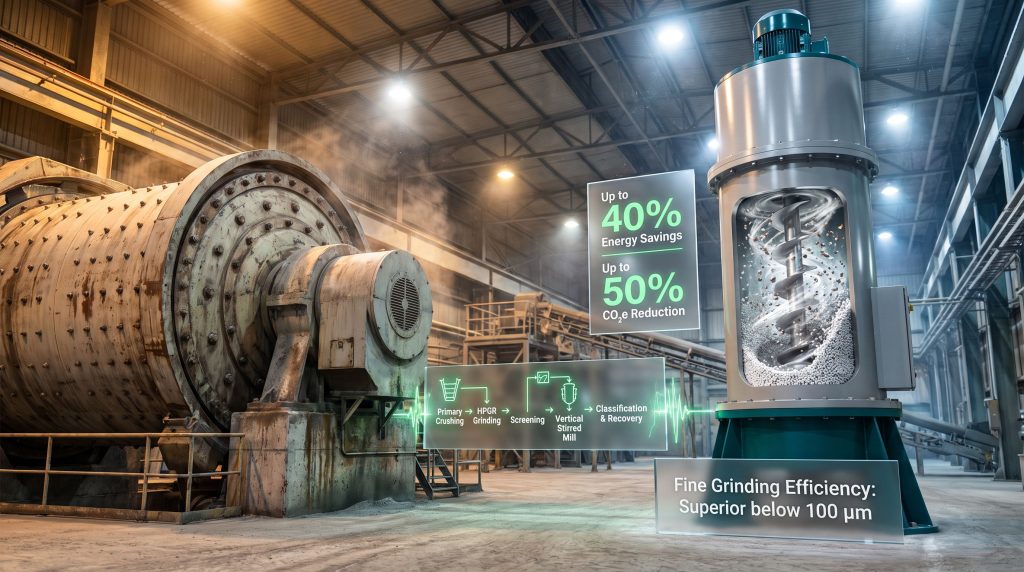
When Weir's vertical stirred mills are deployed in combination with high-pressure grinding rolls (HPGR) as part of an optimised comminution circuit, the energy savings relative to a conventional SAG mill and ball mill configuration are substantial and well-documented.
| Performance Metric | Ball Mill | Weir Vertical Stirred Mill |
|---|---|---|
| Energy efficiency (fine grinding) | 1 to 5% mechanical conversion | Up to 30 to 40% energy savings at system level |
| Grinding media consumption | High, large steel balls with rapid wear | Substantially lower per tonne processed |
| Physical footprint | Large horizontal plant area required | Compact vertical design |
| Maintenance intensity | High, frequent liner and media changes | Reduced wear components, simpler servicing |
| Optimal grind size range | Coarse to medium, above 100 µm | Fine to ultrafine, below 100 µm |
| CO₂e emissions profile | Higher, energy-intensive operation | Up to 50% CO₂e reduction in optimised circuits |
| Suitability for brownfield retrofit | Limited by footprint | Compact design well-suited to brownfield upgrades |
In the most advanced circuit configuration, incorporating HPGR, vertical stirred mill, and coarse particle flotation (CPF), energy reductions of approximately 40% and carbon dioxide equivalent emission avoidance of up to 50% have been documented in sustainability case studies published by Weir. These are not marginal improvements; they represent a step-change in the economics and environmental performance of mineral processing.
To place the 40% energy saving in operational context: a processing facility grinding 50,000 tonnes per day with a circuit drawing 30 megawatts could theoretically reduce grinding energy demand by around 12 megawatts, eliminating the power draw equivalent of several large ball mill installations entirely. At industrial electricity tariffs, that translates into millions of dollars in annual savings.
The HPGR and Vertical Stirred Mill Circuit: A Step-by-Step Breakdown
Why the Combination Outperforms Either Technology Alone
The transformational efficiency gains associated with Weir vertical stirred mills replacing ball mills are most fully realised when the stirred mill is paired with HPGR upstream in the circuit. The reason for this lies in a phenomenon known as micro-cracking.
When ore passes between the counter-rotating rolls of an HPGR under intense compressive force, the resulting product is not simply smaller; it is structurally weakened at the particle level. Micro-fractures propagate through the ore particles during HPGR compression, significantly reducing the energy required to break those particles further downstream. The vertical stirred mill then exploits these pre-existing weaknesses to achieve target grind size with measurably less energy than it would require on un-pre-treated feed.
The combined effect produces an efficiency gain that is multiplicative rather than additive, which explains why the 40% system-level saving exceeds what HPGR or vertical stirred mills achieve independently.
The full HPGR and vertical stirred mill comminution flowsheet operates as follows:
-
Primary crushing: Run-of-mine ore is crushed to a suitable feed size for HPGR processing, typically below 30 to 50 millimetres.
-
HPGR compression grinding: High-pressure grinding rolls apply intense compressive force across the crushed feed, generating a finer, micro-cracked product that dramatically reduces downstream grinding energy requirements.
-
HPGR product screening: The HPGR discharge is screened to separate fine material, which may bypass the stirred mill or proceed directly to classification, from coarser material requiring further size reduction.
-
Vertical stirred mill grinding: Screened HPGR product feeds the vertical stirred mill, where the high-shear, fine-media environment efficiently reduces particle size to the target liberation grind.
-
Classification and recirculation: Hydrocyclones separate on-size product from oversize material, which is returned to the stirred mill for further grinding.
-
Downstream recovery: The well-liberated, product-sized material feeds flotation, leaching, or other recovery circuits with improved metallurgical performance relative to conventionally ground feed.
A particularly noteworthy circuit design insight is that screening the HPGR discharge product before feeding the vertical stirred mill can reduce the entire grinding circuit to a single vertical stirred mill stage, eliminating multiple ball mill units and substantially simplifying circuit complexity, capital cost, and ongoing maintenance obligations.
Structural Industry Drivers Accelerating the Transition
Decarbonisation Pressure Is No Longer Optional
For major mining companies with published net-zero commitments or interim carbon reduction targets, grinding circuits are not merely an operational concern; they are the most material single source of Scope 2 emissions within the processing plant. Transitioning from energy-intensive ball mill circuits to efficient vertical stirred mill configurations directly supports decarbonisation in mining, reducing the carbon intensity of ore processing and supporting both internal ESG targets and the increasingly rigorous external reporting frameworks now standard across the ASX, LSE, and TSX listed mining sector.
Mining Magazine's own research coverage has noted the growing pressure on mining companies to decarbonise processing operations as part of broader emissions reduction strategies, with grinding circuit upgrades identified as a high-priority intervention point given the scale of electricity consumption involved. Indeed, slashing energy consumption in comminution circuits has become one of the most commercially compelling arguments for adopting vertical stirred mill technology.
The Finer Grinding Imperative Will Only Intensify
The structural decline in global ore grades creates a self-reinforcing demand signal for fine grinding technology. As liberation sizes become progressively finer, the energy penalty of ball mill grinding increases disproportionately, while the efficiency advantage of vertical stirred mills becomes more pronounced.
This dynamic is not cyclical. It is structural. The following trends are all directionally consistent and compounding:
-
Average ore grades for copper, gold, nickel, and lithium continue to decline as high-grade deposits are depleted.
-
Flotation feed quality requirements are becoming more demanding as processing engineers push recovery rates higher on more complex ore types.
-
Refractory gold deposits, which require ultrafine grinding to achieve adequate leach recovery, represent a growing proportion of the global development pipeline.
-
The critical minerals energy transition imposes strict particle size and purity specifications for battery-grade lithium, nickel, and cobalt that demand precise, energy-efficient fine grinding.
Processing Economics of Marginal Deposits
One less-discussed implication of the vertical stirred mill transition deserves specific attention: the technology may directly affect the economic viability of marginal deposits that would be uneconomic under conventional ball mill processing costs.
When grinding energy costs are reduced by 30 to 40% at the circuit level, the operating cost threshold at which a deposit transitions from marginal to economically viable shifts meaningfully. Understanding cut-off grade economics in this context reveals how, for critical mineral projects processing low-grade, fine-grained, or refractory ores, this shift in the cost curve could prove decisive in determining whether a project proceeds to development at all. This represents a less commonly appreciated but commercially significant dimension of the Weir vertical stirred mills replacing ball mills narrative.
Where Vertical Stirred Mills Excel and Where Ball Mills Retain an Edge
Applications Where Vertical Stirred Mills Deliver Maximum Value
-
Fine and ultrafine grinding: Any application targeting a P80 grind size below 75 to 100 microns, where ball mill efficiency deteriorates rapidly.
-
Regrinding duties: Intermediate regrind stages in sulphide flotation circuits, where additional fine grinding after primary separation improves mineral liberation and recovery.
-
Brownfield circuit upgrades: The compact vertical footprint makes stirred mill installations far more practical for retrofitting into existing plant infrastructure than horizontal ball mill expansions.
-
Greenfield circuit design: Projects designed from the outset around the HPGR and vertical stirred mill configuration can engineer maximum energy efficiency into the processing plant before a single dollar of construction capital is committed.
Applications Where Ball Mills Retain a Competitive Position
Ball mills are not universally obsolete, and the most credible analysis of this technology transition acknowledges where conventional mills remain appropriate:
-
Coarse primary grinding: For large feed sizes and relatively coarse target grind sizes above 150 to 200 microns, ball mills remain effective and cost-competitive.
-
Very high-throughput primary circuits: At the highest production scales, where capital cost minimisation and throughput capacity dominate circuit design decisions, large SAG and ball mill combinations may still represent the most practical solution.
-
Specific ore hardness and mineralogy profiles: Certain ore types may not respond optimally to the stirred mill grinding mechanism, and metallurgical testwork must always inform circuit selection decisions.
Critical caveat for process engineers and project developers: Vertical stirred mills are not a universal drop-in replacement for ball mills. Feed particle size distribution, target product size, ore hardness, mineralogy, and overall circuit architecture all influence suitability. Comprehensive testwork and detailed circuit modelling are non-negotiable prerequisites before any capital commitment is made.
The next major ASX story will hit our subscribers first
Frequently Asked Questions: Vertical Stirred Mills vs Ball Mills
Can a vertical stirred mill replace a ball mill without modifying the existing circuit?
Not typically. Vertical stirred mills generally require a finer feed preparation than ball mills, which means most replacement projects involve upstream circuit modifications, such as the addition of HPGR stages or additional crushing capacity, to deliver correctly sized feed. Process testwork and circuit simulation should precede any replacement decision.
What ore types respond best to vertical stirred mill grinding?
Stirred mills perform most effectively on ores requiring a P80 grind size below approximately 100 microns. Sulphide ores requiring fine liberation for flotation, refractory gold ores where ultrafine grinding improves leach kinetics, and complex polymetallic ores where tight liberation sizes are needed to separate valuable minerals all represent strong candidates. Hard, highly abrasive ores require careful media selection to manage wear rates and operating costs.
Are vertical stirred mills commercially proven at large scale?
Yes. Stirred mills have operated commercially in regrinding applications for several decades. Their application as direct replacements for ball mills in primary fine grinding duties represents a more recent development, with the HPGR and vertical stirred mill circuit now being actively specified for both greenfield and major brownfield projects globally. The commercial track record at production scale is no longer a barrier to adoption.
What is the total cost of ownership comparison between the two technologies?
Capital costs for vertical stirred mill installations vary with mill size, upstream circuit modifications, and site-specific requirements. However, when total cost of ownership is assessed, incorporating energy savings, reduced grinding media consumption, lower maintenance labour and parts costs, and improved metallurgical performance, the economic case for vertical stirred mills is compelling in applications where they are appropriately matched to the processing task.
Summary: The Case for Weir Vertical Stirred Mills Replacing Ball Mills
| Benefit Category | Quantified Outcome |
|---|---|
| Energy savings at system level | Up to 40% versus conventional ball mill circuits |
| CO₂e emission reduction | Up to 50% in optimised HPGR, VSM, and CPF circuits |
| Grinding media consumption | Substantially lower per tonne processed |
| Plant footprint | Significantly smaller, enabling brownfield upgrades |
| Maintenance complexity | Reduced, fewer wear components and simpler servicing |
| Fine grinding efficiency | Superior to ball mills below 100 µm target grind size |
The structural forces driving adoption of vertical stirred mill technology, declining ore grades, finer liberation requirements, rising electricity costs, Scope 2 decarbonisation mandates, and critical mineral processing demands, are all intensifying in the same direction. As greenfield projects increasingly specify HPGR and vertical stirred mill circuits from the design stage, and as brownfield operators validate the technology through staged retrofit programmes, the mining sustainability transformation argument for continuing to operate conventional ball mill circuits in fine grinding duties becomes progressively harder to sustain.
For operations targeting fine grind sizes, managing high energy costs, or working toward meaningful carbon reduction objectives, the central question surrounding Weir vertical stirred mills replacing ball mills is no longer whether the technology works. It is how quickly the engineering, testwork, and capital planning can be mobilised to implement it. Furthermore, transforming flowsheets with innovative technologies remains an ongoing priority for operators seeking to remain competitive as the economics of conventional grinding continue to deteriorate.
Readers seeking further technical context on comminution circuit design and processing equipment innovation may find value in exploring the ongoing coverage published by Mining Magazine, which provides detailed analysis of energy efficiency advances in mineral processing technology.
This article contains references to energy efficiency estimates, cost savings projections, and operational performance data that are based on published industry case studies and publicly available technical literature. Outcomes in specific mining operations will vary depending on ore characteristics, circuit design, electricity tariffs, and operational parameters. This content does not constitute financial advice.
Want to Be First When the Next Major Mineral Discovery Hits the ASX?
Discovery Alert's proprietary Discovery IQ model scans ASX announcements in real time, instantly identifying significant mineral discoveries across more than 30 commodities and converting complex data into clear, actionable investment insights — whether you're a short-term trader or a long-term investor. Explore historic discovery returns on Discovery Alert's dedicated discoveries page and begin your 14-day free trial to position yourself ahead of the broader market.