July 31, 2026
The Hidden Architecture of Brazil's Power Vulnerability
Across the global energy landscape, few national grids carry as concentrated a climate dependency as Brazil's. While most large economies distribute their generation risk across a diverse mix of fuel sources, Brazil has constructed its electricity system on a foundation of falling water. That architectural choice delivered decades of low-cost, low-carbon power, but it also embedded a vulnerability that intensifies whenever rainfall deviates from historical norms. El Nino to push Brazil thermal output into 2027 is not simply a weather headline — it signals a fundamental reshaping of the probability distribution of hydrological outcomes across Brazil's most critical storage regions, compressing the range of favourable scenarios while widening the tail risk of prolonged fossil fuel dependence.
Understanding how this plays out requires moving beyond weather headlines and into the structural mechanics of the Brazilian grid, the geographic specifics of El Niño's regional impact, and the cascading consequences for gas infrastructure, LNG import flows, and the country's decarbonisation ambitions.
When big ASX news breaks, our subscribers know first
Why Hydropower Concentration Creates Systemic Grid Risk
Approximately 55% of Brazil's total electricity generation derives from hydroelectric facilities, according to Brazil's Energy Research Bureau (EPE). This is not merely a statistical footnote. It means that when the hydrological cycle underperforms, the entire generation stack must rebalance toward significantly more expensive and carbon-intensive alternatives. Gas-fired thermoelectric plants absorb the bulk of this compensatory burden, and the economics of that shift ripple through spot power prices, LNG import volumes, pipeline utilisation rates, and Brazil's carbon intensity metrics simultaneously.
The dry season typically runs from April through October, a predictable annual stress period that grid operators have learned to manage. What El Niño introduces is not a new stress but a distortion of the established recovery mechanism. The summer rainy season, which normally restores reservoir levels between November and March, becomes unreliable precisely when the system needs it most. The result is a grid that enters what should be its recovery window without the hydrological conditions necessary to support that recovery.
The PLD Mechanism: How Hydrology Becomes Electricity Pricing
A detail not widely understood outside Brazil's energy sector is the role of the PLD (Preço de Liquidação das Diferenças), the settlement price for Brazil's electricity spot market. This price is directly linked to the marginal cost of generation at any given time. When hydropower reservoirs are healthy, the marginal generator is cheap hydropower and PLD remains low. As reservoirs deplete and thermal dispatch increases, the marginal cost shifts toward gas-fired generation, pushing PLD materially higher. Extended El Niño conditions therefore transmit directly into power market pricing through this mechanism, affecting every energy-intensive industrial operator exposed to spot market settlements. Furthermore, understanding natural gas price trends helps contextualise how these domestic pricing shifts interact with broader global gas market movements.
El Niño's Asymmetric Impact Across Brazilian Geography
One of the most analytically important features of El Niño in a Brazilian context is that it does not affect the country uniformly. Its regional differentiation is what makes it so consequential for grid security. According to The Guardian, a record El Niño is forecast to make 2027 the hottest year on record, adding further urgency to Brazil's grid resilience planning.
| Region | Typical El Niño Effect | Hydropower Significance |
|---|---|---|
| Northeast and North | Severe drought conditions | Moderate hydro capacity |
| Southeast and Center-West | Irregular rainfall, elevated temperatures, extended dry periods | ~70% of national hydroelectric storage and generation capacity |
| South | Extreme rainfall and flood risk | Secondary hydro capacity |
The concentration of roughly 70% of Brazil's total hydroelectric storage and generation capacity in the Southeast and Center-West regions, as documented by climate analysis firm Climatempo, is the central vulnerability. El Niño's characteristic effect in these zones is not simply reduced rainfall but irregular rainfall: shorter, less predictable wet periods interspersed with extended dry stretches and elevated temperatures. This pattern is far harder to model and manage than a uniform precipitation reduction would be.
NOAA's formal declaration of El Niño conditions on 11 June 2026 added a critical dimension to the planning calculus. The agency's forecast anticipated the pattern strengthening through the remainder of 2026, converging with the period when Brazil's rainy season is expected to commence. As NOAA's own framing makes clear, stronger El Niño conditions do not guarantee worse regional outcomes, but they significantly increase the probability weighting toward adverse scenarios. The distinction matters: this is a risk shift, not a certainty.
Reservoir Levels Entering the Risk Window: What the ONS Data Actually Tells Us
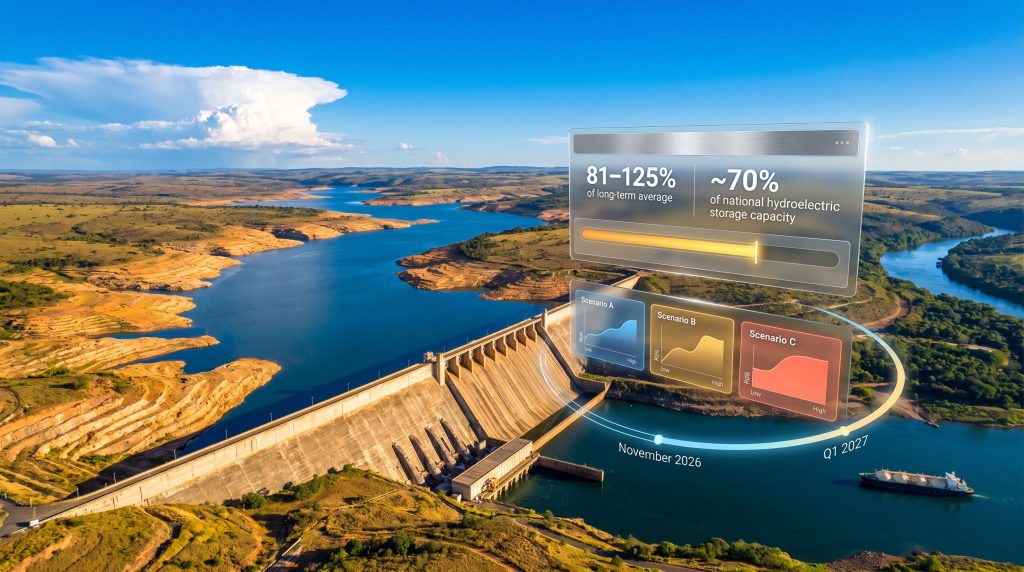
Grid operator ONS has projected total hydropower reservoir levels to reach 81 to 125% of the long-term average by November 2026, which is 5.9 to 14.5 percentage points above the equivalent period in the prior year. On its face, this suggests the system is entering the El Niño risk window from a position of relative strength. However, three dynamics complicate that apparent buffer.
Critical Context: The width of the ONS forecast range itself (a spread of 44 percentage points between the lower and upper bounds) signals meaningful uncertainty in hydrological modelling. A forecast range this wide reflects genuine epistemic limitations, not a minor planning variable.
Why the buffer may prove insufficient under stress conditions:
- Heatwave-driven electricity demand can draw down reservoirs at rates that outpace seasonal depletion models
- A delayed onset of the summer rainy season compresses the replenishment window, potentially leaving reservoirs unable to recover before the next dry cycle begins
- Abrace's power director Victor Iocca has noted that El Niño could push the resumption of meaningful summer rainfall patterns into 2027 rather than the standard November-December window, meaning the system may need to sustain elevated thermal dispatch across two consecutive vulnerable periods rather than one
Scenario Modelling: Three Trajectories for the 2026-2027 Window
Scenario A (Base Case): Reservoir levels track toward the upper ONS forecast bound. The rainy season arrives broadly on schedule. Thermal dispatch remains elevated through Q4 2026 but normalises in Q1 2027 as inflows recover. LNG import volumes increase seasonally but do not reach infrastructure stress thresholds.
Scenario B (Moderate Stress): El Niño delays rainfall onset by four to six weeks. Heatwaves push demand 8 to 12% above seasonal norms. Reservoir levels drift toward the lower ONS forecast bound by late 2026. Thermal dispatch requirements increase materially from November onward, sustaining elevated LNG import demand through Q1 2027.
Scenario C (Severe Stress): Meaningful rainfall is delayed into February 2027. Reservoir levels breach historical low-water benchmarks in multiple subsystems. Full preventive and emergency thermal dispatch is activated. LNG import volumes spike to levels that test FSRU regasification capacity. Gas pipeline infrastructure approaches throughput limits under sustained on-spot generation requests.
The Thermoelectric Backup System and Its Structural Limitations
Natural gas-fired thermoelectric plants form the principal dispatchable backup layer in Brazil's generation architecture. Their activation follows a tiered protocol: preventive dispatch is triggered when reservoir levels or inflow forecasts fall below defined ONS thresholds, while emergency dispatch represents a more aggressive intervention reserved for acute system stress.
A figure that rarely receives sufficient analytical attention is the 0.4 percentage point reservoir recovery contribution attributable to current preventive thermal dispatch criteria, as identified in analysis from Grupo Delta Energia. This number reveals something fundamental about the design philosophy of Brazil's preventive dispatch framework: it is calibrated to marginally protect reservoir levels, not to substantially restore them. Under a moderate-to-severe El Niño stress scenario, this recovery contribution is materially insufficient to offset accelerated depletion driven by heatwave demand and delayed rainfall.
The implication is that reactive emergency dispatch protocols may need to be activated well before the system reaches its most critical thresholds, effectively compressing the decision timeline for grid operators and creating upstream demand pressures on gas supply infrastructure with limited advance notice.
Operational Reality: Anticipatory forecasting of thermoelectric output volumes at the early stages of an El Niño cycle carries significant uncertainty. However, the procurement and infrastructure decisions required to respond to elevated dispatch needs carry lead times measured in weeks to months, making early scenario analysis operationally necessary regardless of forecast confidence levels.
LNG Import Dynamics and the Gas Pipeline Stress Scenario
Brazil's domestic natural gas production and pipeline network face known capacity constraints that limit the system's flexibility when gas-to-power demand increases rapidly. Floating storage and regasification units (FSRUs) supplement domestic pipeline supply during dry seasons, and LNG import volumes have historically tracked the intensity of thermal dispatch requirements. The LNG supply outlook for 2025 and beyond provides important context for understanding how global supply dynamics could either ease or exacerbate Brazil's import requirements during sustained stress periods.
What distinguishes the El Nino to push Brazil thermal output into 2027 scenario from a typical dry season is the duration of potential elevated demand. A standard dry season creates a defined, bounded import requirement. A scenario in which meaningful rainfall is delayed into February 2027 transforms what would normally be a seasonal LNG demand spike into a sustained multi-quarter import requirement, placing continuous pressure on FSRU utilisation, regas capacity, and supply contracting pipelines simultaneously.
Key infrastructure stress points to monitor:
- Pipeline throughput capacity: Large on-spot thermal dispatch requests can exceed the throughput capacity of Brazil's gas transmission network, particularly in the context of auction-committed thermal capacity obligations following recent power reserve capacity auctions
- FSRU utilisation rates: Sustained rather than seasonal LNG demand will test regasification infrastructure that was sized for cyclical, not chronic, import requirements
- Spot LNG procurement costs: Prolonged import demand during a period when global LNG markets may face competing seasonal demand elevates the cost risk for thermal generation economics
An underappreciated nuance here is the distinction between aggregate national LNG availability and localized pipeline distribution capacity. Even in a scenario where Brazil's total LNG import volumes are technically sufficient to meet aggregate thermal dispatch requirements, localised pipeline bottlenecks could create regional gas supply constraints that affect specific thermal plants regardless of national import levels.
The next major ASX story will hit our subscribers first
Renewable Energy as a Partial Offset: The Solar and Wind Dimension
El Niño's atmospheric and temperature effects are not uniformly adverse for Brazil's total energy balance. Elevated temperatures and altered circulation patterns associated with El Niño can increase solar irradiance in certain regions and modify wind generation patterns in others, providing a partial offset to reduced hydropower output. In addition, renewable energy solutions developed for other energy-intensive sectors demonstrate how rapidly deployable distributed generation can serve as a meaningful buffer during grid stress periods.
This offset effect is real but bounded. The fundamental constraint is the dispatchable nature of gas-fired thermal generation, which can be activated on demand to meet instantaneous load peaks regardless of weather conditions. Solar and wind generation, by contrast, follow their own availability curves that may or may not align with the timing of peak demand events driven by heatwaves. Renewable generation can reduce the average level of thermal dispatch required during an El Niño period, but it cannot replace the on-demand security function that gas-fired plants provide during demand peaks.
The Energy Transition Tension: Fossil Dependence vs. Decarbonisation Ambition
Brazil has articulated a clear policy direction toward a less fossil fuel-dependent power grid, reducing the operational and economic centrality of gas-fired generation over time. El Niño introduces a structural tension with this trajectory that extends beyond the immediate 2026-2027 window. The decarbonisation benefits that have been carefully modelled across other high-emission sectors underscore the financial and reputational costs of allowing thermal dependence to persist beyond its planned operational window.
Every extended period of elevated thermal dispatch reinforces the operational and financial case for maintaining gas-fired capacity in service and potentially investing in new capacity to meet security-of-supply requirements. This creates a stranded asset risk dynamic: thermal capacity expanded or retained to manage El Niño-driven demand may become economically marginal as renewable penetration increases and hydropower risk management tools mature post-2027.
The design of power reserve capacity auctions will play a significant role in managing this tension. Auction frameworks that over-commit thermal capacity to meet near-term security objectives risk locking in fossil fuel dependence for the duration of contract periods that extend well beyond the current El Niño cycle. Consequently, energy transition security considerations must be integrated into Brazil's near-term capacity planning decisions rather than deferred until after the El Niño risk window has passed.
Key Indicators to Track Through the 2026-2027 Risk Cycle
For energy market participants, infrastructure operators, and analysts monitoring Brazil's grid trajectory, the following indicators provide the most actionable early signals of scenario direction:
- ONS weekly reservoir reports for the Southeast and Center-West subsystems, which represent approximately 70% of national storage capacity
- NOAA and INMET monthly El Niño intensity assessments, particularly whether the pattern is strengthening or plateauing ahead of the November-December rainy season onset
- LNG import tender volumes and FSRU utilisation rates, which function as leading indicators of anticipated thermal dispatch requirements
- Gas pipeline throughput data, particularly during periods of elevated on-spot dispatch requests, as an early warning signal for infrastructure bottlenecks
- PLD spot price movements, which encode the market's implied probability assessment of system tightness and the marginal cost of generation at any given time
- Rainfall anomaly data for Southeast and Center-West Brazil, the most direct measure of El Niño's hydrological impact on the reservoirs that matter most for national grid security
Monitoring Insight: If actual November 2026 reservoir levels track toward the lower bound of ONS's 81-125% forecast range rather than the upper bound, the probability weighting across the three scenarios shifts materially toward Scenario B or C. This trajectory will become discernible from August-October reservoir trend data, providing a critical early warning window.
Frequently Asked Questions: El Niño and Brazil's Thermal Power Outlook
What does sustained thermal output into 2027 mean for Brazil's power market?
It refers to a scenario where gas-fired thermoelectric plants remain in active dispatch well beyond their typical seasonal window. Rather than ramping down as the summer rainy season replenishes reservoirs, thermal plants would sustain elevated output through Q1 2027 if El Niño suppresses or delays the rainfall recovery that normally restores hydropower's generation dominance. Analysis from Argus Media confirms that this is precisely the trajectory that market observers are tracking most closely heading into the second half of 2026.
Is Brazil facing an immediate supply crisis in 2026?
Current reservoir levels sit above the prior year's equivalent and within ONS's projected range, which does not indicate an immediate supply emergency. The material risk is not a 2026 crisis but a sustained depletion trajectory that becomes acute if rainfall delays persist into early 2027, leaving reservoirs without a meaningful recovery window before the following dry season commences. El Nino to push Brazil thermal output into 2027 captures this precise concern: the stress is sequential, not singular.
Why is the 0.4% preventive dispatch reservoir recovery figure significant?
This figure illustrates that Brazil's preventive thermal dispatch protocol is designed for marginal reservoir protection rather than meaningful volume recovery. Under a scenario where El Niño-driven demand acceleration and delayed rainfall combine to accelerate depletion, this mechanism provides insufficient buffer, implying that emergency dispatch protocols and extraordinary LNG procurement may be required earlier in the stress cycle than standard planning models anticipate.
How do power consumers and industrial operators manage this price risk?
Large industrial power consumers in Brazil typically manage PLD exposure through energy contracting in the regulated and free market environments, using forward contracts and bilateral agreements to hedge against spot price volatility. Extended thermal dispatch periods that elevate PLD significantly increase the cost of uncontracted exposure and incentivise more active hedging strategies among large free-market consumers.
Disclaimer: This article contains forward-looking analysis based on publicly available data, forecast scenarios, and industry commentary. Scenario projections involve inherent uncertainty and should not be interpreted as definitive predictions of future outcomes. Readers should conduct independent analysis before making any commercial or investment decisions based on the information presented here.
Want to Stay Ahead of the Next Major Resource Discovery Driving Energy Security?
Discovery Alert's proprietary Discovery IQ model delivers real-time alerts on significant ASX mineral discoveries — including critical minerals central to energy transition and grid resilience — instantly translating complex data into actionable investment insights. Explore how historic discoveries have generated substantial returns and begin your 14-day free trial today to position yourself ahead of the broader market.