July 31, 2026
The Metallurgical Proof That Changes the Licensing Conversation for Titanium Processing
Critical mineral processing technologies face a fundamental credibility barrier: demonstrating that bench-scale chemistry translates into repeatable, commercially relevant performance across diverse feedstock types. This is not merely a technical requirement. It is the gatekeeping challenge that separates proprietary processing concepts from licensable industrial platforms. Temas SAGA titanium recovery using RCL technology has now cleared this bar in a manner that fundamentally reshapes the licensing conversation.
Most technologies that perform well on a developer's own deposit fail to replicate those results when applied to mineralisation from external sources with different geochemical profiles, grain sizes, and impurity suites. When a technology clears this hurdle independently and on third-party material, the commercial conversation shifts fundamentally. The broader context of critical minerals demand in 2025 makes these milestones all the more significant.
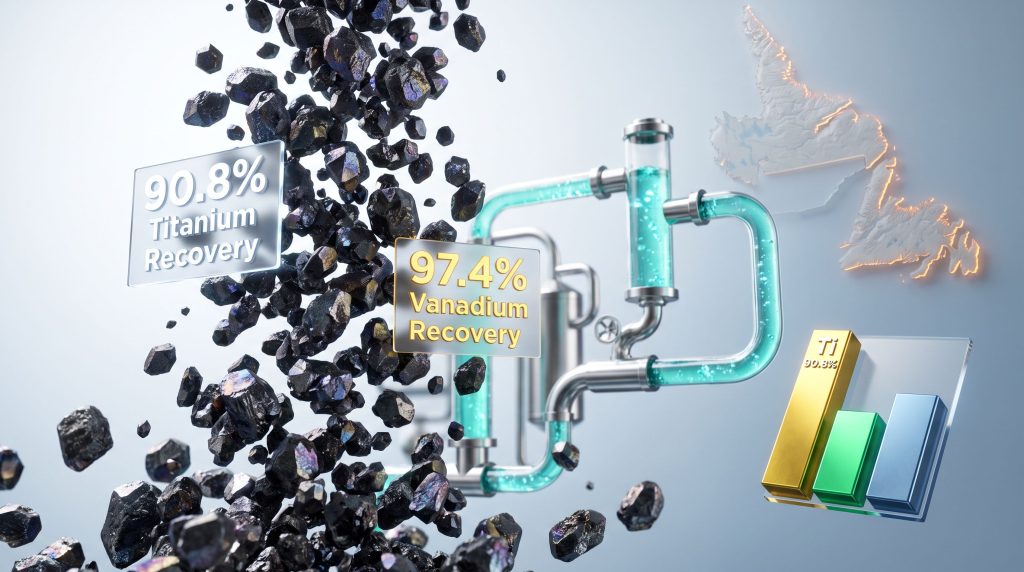
The recently completed Stage 1 independent metallurgical validation conducted by Temas Resources using SAGA Metals' titanium-vanadium-iron mineral samples has done exactly that. Results peaking at 90.8% from ilmenite concentrate feedstock under standardised conditions represent the highest publicly reported titanium recovery figure for the Regenerative Chloride Leach (RCL) Platform to date, and the first externally verified demonstration of RCL performance on third-party mineralisation.
When big ASX news breaks, our subscribers know first
What the RCL Platform Actually Does Differently
To appreciate why these results matter, it is necessary to understand how conventional titanium processing works and where the RCL Platform diverges structurally from established industrial routes.
The dominant pathway for producing high-purity titanium metal is the Kroll Process, a pyrometallurgical method developed in the 1940s that converts titanium tetrachloride into titanium sponge through magnesium reduction at extremely high temperatures. While the Kroll Process reliably produces titanium metal of exceptional purity, it is energy-intensive, batch-based rather than continuous, and poorly suited to co-recovering vanadium or iron from polymetallic feedstocks.
The sulfate process, the other widely used commercial route for titanium dioxide pigment production, dissolves ilmenite or titanium slag in concentrated sulfuric acid. It generates substantial volumes of acidic waste, has limited feedstock flexibility, and produces co-products that are often difficult to valorise economically.
The RCL Platform operates on a fundamentally different design philosophy. It is a hydrometallurgical system built around mixed chloride chemistry, meaning titanium, vanadium, and iron are selectively dissolved and separated at temperatures significantly lower than those required by pyrometallurgical methods. Critically, the reagents within the leach circuit are regenerated and recycled rather than consumed and discarded, which has direct implications for operating cost structure and environmental footprint.
| Processing Route | Operating Environment | Reagent Recyclability | Multi-Metal Co-Recovery | Feedstock Flexibility |
|---|---|---|---|---|
| Kroll Process | Pyrometallurgical | Low | Limited | Narrow |
| Sulfate Process | Hydrometallurgical (H₂SO₄) | Low | Limited | Moderate |
| RCL Platform | Hydrometallurgical (Cl⁻ mixed) | High (regenerative) | Yes (Ti, V, Fe) | Broad |
The design goal of the RCL system is to function as a feedstock-agnostic platform, capable of processing run-of-mine material, concentrates, and third-party mineralisation without requiring fundamental chemistry modifications between applications. The Stage 1 SAGA validation was specifically structured to stress-test this claim.
Breaking Down the Stage 1 Validation Numbers
The validation programme processed three distinct material categories sourced from SAGA Metals' mineral samples, each presenting a different geochemical starting point for the RCL circuit:
- Run-of-mine massive oxide representing bulk, unprocessed feed with a heterogeneous mineralogical composition.
- Vanadiferous titanomagnetite concentrate produced by magnetic separation, enriched in vanadium and iron relative to the run-of-mine feed.
- Ilmenite concentrate representing the highest titanium-grade fraction of the ore suite, with a composition dominated by iron-titanium oxide mineralogy.
All testing was conducted under standardised two-stage RCL operating conditions to ensure that results were reproducible and directly comparable across the three material types. An independent technical review panel assessed the outcomes against pre-defined Stage 1 benchmarks.
Stage 1 Recovery Performance Summary
| Target Element | Peak Recovery Achieved | Material Type Producing Peak Result |
|---|---|---|
| Titanium (Ti) | 90.8% | Ilmenite concentrate |
| Vanadium (V) | 97.4% | Across all material types |
| Iron (Fe) | 91.5% | Across all material types |
The vanadium recovery figure is particularly significant from a market context perspective. Vanadium redox flow batteries (VRFBs) are gaining meaningful commercial traction in grid-scale energy storage applications, where their long cycle life and capacity to deliver sustained discharge over hours makes them technically superior to lithium-ion systems for certain use cases. The ability to co-recover vanadium at 97.4% across all three feedstock types positions RCL as a dual critical mineral platform, not merely a titanium processing solution.
Furthermore, critical mineral supply chains globally are under increasing scrutiny, and technologies capable of delivering high multi-element recovery rates are attracting considerable attention from industrial offtake partners and government-backed financing bodies alike.
The independently verified nature of these results matters as much as the numbers themselves. Validating performance on external mineralisation removes the primary objection that investors, offtake counterparties, and project lenders raise when evaluating proprietary processing technologies: that results are an artefact of deposit-specific chemistry rather than platform capability.
Comparing SAGA Results to Earlier La Blache Pilot Data
Temas' own La Blache deposit in Quebec has served as the primary proving ground for RCL Platform development. Earlier pilot-scale operations on La Blache mineralisation recorded titanium recovery in the 75 to 85 percent range during operational testing phases. That pilot programme produced 88 kilograms of TiO₂ from approximately 830 kilograms of feed material, establishing a real-world mass balance reference point for the circuit.
Downstream processing of La Blache-sourced material has separately achieved 99.8% TiO₂ purity in product output, a specification that meets or exceeds the threshold for premium pigment-grade and specialty titanium dioxide applications in aerospace, coatings, and advanced ceramics.
The Temas SAGA titanium recovery figure of 90.8% on ilmenite concentrate therefore represents a meaningful step-change above the La Blache pilot range. Two factors likely contribute to this improvement:
- Feedstock composition effects: Ilmenite concentrates present a higher inherent TiO₂ grade and a more amenable mineralogical structure compared to run-of-mine massive oxide, making selective leach extraction more efficient.
- Process optimisation learning: The cumulative body of operational data from La Blache pilot work has informed refinements to leach chemistry parameters that improve performance across feedstock types.
Neither factor diminishes the significance of the result. Together, they suggest that as feedstock selection and process parameters are further refined in Stage 2, recovery rates could push higher still. You can review the full validation announcement for additional technical detail on the Stage 1 programme.
What SAGA's Radar Project Gains from This Outcome
SAGA Metals holds the Radar Project in Newfoundland and Labrador, a Canadian jurisdiction with established mining infrastructure and a regulatory framework relevant to mineral project development. The project hosts titanium-vanadium-iron mineralisation, a polymetallic profile that aligns directly with the multi-element recovery architecture of the RCL Platform.
The Stage 1 validation results create several forms of tangible value for SAGA's project development trajectory:
- Processing route optionality: SAGA now holds independently verified performance data for an alternative processing pathway to conventional smelting or sulfate-route hydrometallurgy, enabling a genuine technical and economic comparison at the feasibility study level.
- Financing credibility: Project lenders and streaming counterparties increasingly require demonstrated metallurgical performance before committing capital. Independently validated processing data substantially de-risks SAGA's asset from a financier's perspective.
- PEA and PFS inputs: The recovery rates, reagent consumption profiles, and mass balance data generated in Stage 1 form the foundation of processing circuit cost assumptions in any Preliminary Economic Assessment or Pre-Feasibility Study for the Radar Project.
- Vanadium revenue contribution: The 97.4% vanadium recovery rate adds a secondary revenue line to any future processing economics model, improving overall project economics relative to a titanium-only processing scenario.
In addition, advancing through a definitive feasibility study will require robust metallurgical data of precisely the kind that Stage 1 has now produced, making this validation a critical upstream input for SAGA's development pathway.
The Stage 2 Programme: What Comes Next
The independent technical review panel formally recommended immediate advancement to a Stage 2 bench optimisation programme following completion of Stage 1. The scope of Stage 2 is structured around three interconnected technical workstreams:
- Recovery maximisation: Systematic testing across a matrix of leach chemistry variables to push titanium, vanadium, and iron recoveries toward theoretical maxima.
- Process parameter refinement: Detailed investigation of reagent concentration ratios, temperature profiles, residence times, and solid-liquid separation methods to identify optimal operating envelopes.
- Engineering dataset generation: Production of quantitative process data including mass balances, reagent consumption rates, and circuit configuration models required for pilot-scale plant design.
The engineering data generated in Stage 2 is the critical bridge between bench-scale proof-of-concept and pilot-scale demonstration. Pilot plant design requires inputs that cannot simply be extrapolated from early-stage results alone: reactor sizing assumptions, reagent management infrastructure requirements, and product recovery circuit configurations all depend on detailed parameter characterisation that Stage 2 is specifically designed to deliver.
However, it is worth noting that permitting challenges remain a feature of the broader project development landscape, and early-stage metallurgical validation is one component of a longer pathway to commercial production.
The next major ASX story will hit our subscribers first
Technology Licensing and the Commercial Architecture Temas Is Building
The broader significance of the SAGA validation extends beyond the two companies directly involved. Temas has been developing the RCL Platform with an explicit commercial model that goes beyond using the technology on its own deposit inventory. The company is positioning RCL as a licensable processing platform applicable to titanium-vanadium-iron feedstocks globally, with commercial structures potentially including technology licensing agreements, toll processing arrangements, and joint venture processing partnerships.
The SAGA collaboration represents the first publicly documented third-party application of the RCL Platform, which carries considerable strategic weight for the licensing model. Before this validation, a potential licensing counterparty could reasonably question whether RCL's demonstrated results were specific to the geochemistry of Temas' own Quebec deposits. That objection is now materially weakened.
Temas' leadership has described the SAGA validation as among the most commercially significant milestones in the company's history since acquiring the RCL Platform, framing successful third-party validation as a foundational step toward building a globally applicable critical minerals processing business. For further background on the RCL Platform's technical architecture, Temas' own overview provides useful context.
Why Titanium and Vanadium Supply Chains Are Under Structural Pressure
The commercial logic behind RCL Platform development is grounded in a supply chain context that is rapidly intensifying. Global titanium supply chains remain geographically concentrated, with Russia and China together accounting for a substantial proportion of titanium sponge production capacity. Western industrial economies have identified this concentration as a strategic vulnerability, particularly given titanium's role in aerospace structural components, defence applications, and advanced medical devices.
Consequently, the US titanium supply chain has become a policy priority, with government-backed financing mechanisms increasingly being deployed to support domestic and allied-nation processing capacity. Temas SAGA titanium recovery results land squarely within this strategic context, offering a credible, domestically viable processing pathway for North American feedstocks.
Vanadium supply is similarly concentrated, with China producing approximately 57% of global vanadium output according to the United States Geological Survey. The growing commercial deployment of vanadium redox flow batteries for grid-scale storage is creating incremental demand that the existing supply base may struggle to meet without new project development in geopolitically stable jurisdictions.
Canada's position as host to both Temas' La Blache property and SAGA's Radar Project places both assets within a jurisdiction that Western offtake partners and project financiers regard as low sovereign risk. Processing technologies capable of converting Canadian titanium-vanadium mineralisation into high-purity products domestically align with broader supply chain resilience objectives held by North American and allied industrial economies.
Disclaimer: This article contains forward-looking statements and analysis based on publicly available information and independent research. Statements relating to future performance, commercial outcomes, and market projections involve material uncertainty. Readers should conduct their own independent due diligence before making any investment decisions. Past metallurgical performance does not guarantee future results.
Want to Spot the Next Major Critical Mineral Discovery Before the Market Does?
Discovery Alert's proprietary Discovery IQ model scans ASX announcements in real time, delivering instant alerts on significant mineral discoveries across titanium, vanadium, and more than 30 other commodities — turning complex data into actionable investment insights. Explore historic discoveries and the returns they generated, then start your 14-day free trial to position yourself ahead of the broader market.