
August 1, 2026
Understanding the Architecture of Trade Protection: How Industrial Policy Shapes Construction Material Markets
Across Sub-Saharan Africa, governments have increasingly turned to managed trade instruments as a mechanism for accelerating domestic industrial development. Rather than relying solely on tariff structures, a growing number of economies are deploying sector-specific import restrictions that preserve a controlled pathway for foreign goods while directing the bulk of consumer demand toward locally manufactured alternatives. This approach reflects a deliberate tension at the heart of African industrial policy: the need to build competitive domestic industries while simultaneously keeping construction materials accessible and affordable enough to support broader economic development.
The Democratic Republic of Congo's ongoing management of its DR Congo cement and lime import restrictions offers one of the most instructive case studies in this category. The policy is neither a blanket prohibition nor a passive tariff adjustment. It is a dynamically administered framework built around ministerial authority, documentary compliance, and a structured exemption mechanism that forces buyers to justify every import transaction that bypasses a domestic supplier.
When big ASX news breaks, our subscribers know first
What the DR Congo Cement and Lime Import Restrictions Actually Cover
Defining the Scope: Products, Regions, and Regulatory Specificity
The phrase DR Congo cement and lime import restrictions requires careful unpacking, because the regulatory architecture is more granular than a national-level trade ban. Three distinct product categories are subject to control, and their geographic reach is not identical.
| Product | Restricted Region(s) |
|---|---|
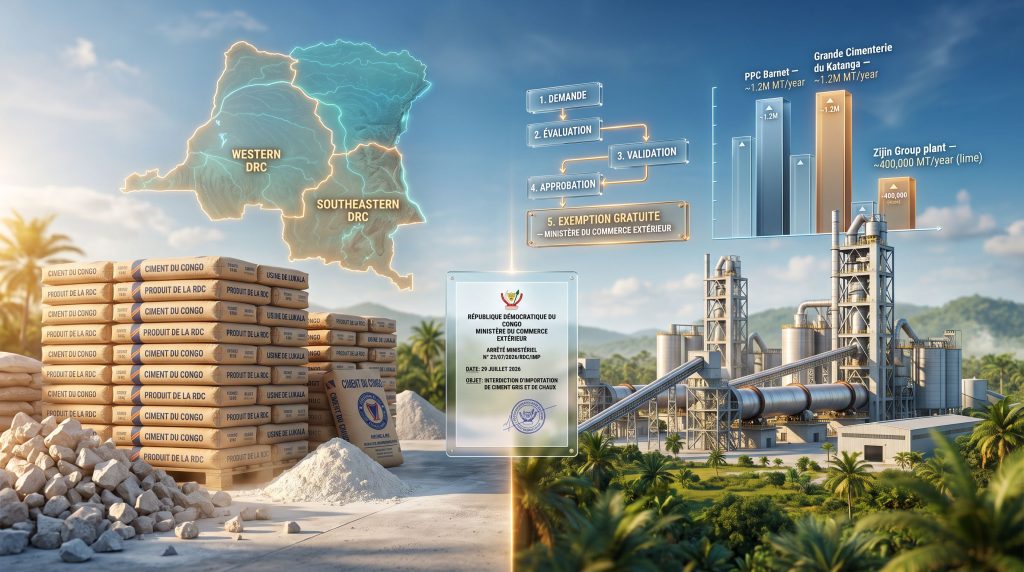
| Gray cement | Western DRC + Southeastern DRC |
| Clinker | Western DRC + Southeastern DRC |
| Hydrated and industrial lime | Southeastern DRC only |
This geographic differentiation is deliberate. It reflects where domestic production capacity actually exists and where import competition poses the most direct threat to local manufacturers. The southeastern region carries the heaviest restriction burden because it hosts cement and lime production, making both categories competitively vulnerable to lower-cost regional imports.
Clinker, often overlooked in public discussion of cement trade, is the calcium silicate intermediate produced by firing limestone and clay at extreme temperatures in a rotary kiln. It is the primary input in finished cement manufacturing. Restricting clinker imports alongside finished cement closes a potential regulatory gap that importers could otherwise exploit by importing the intermediate product and processing it locally to avoid finished-goods controls.
The Legal Instruments and Their Continuity
Two ministerial orders signed on 29 July 2026 by the Ministry of Foreign Trade provide the current legal basis for the restrictions. Critically, these orders are not novel policy interventions. They renew and extend a framework first enacted in July 2024 through two sequential orders:
- 5 July 2024: Restrictions on gray cement and clinker imports into western and southeastern DRC
- 20 July 2024: Restrictions on lime imports into southeastern DRC
The 2026 renewal signals that Kinshasa views these controls as a medium-term structural policy instrument rather than a crisis-response measure. A government that intended only short-term protection would have allowed the framework to lapse or replaced it with a different tool. The decision to renew through identical ministerial authority, with the same product scope and geographic boundaries, communicates policy continuity with clear intent.
SEGUCE-RDC, the country's centralised one-stop foreign trade platform, functions as the documentation validation layer within the system. Its role is not merely administrative. By requiring that all exemption applications carry SEGUCE-RDC validation, the ministry creates a single chokepoint through which all import authorisation flows, enabling centralised oversight of trade flows into restricted regions.
The Industrial Policy Rationale: Why These Restrictions Exist
Protecting Capital-Intensive Domestic Producers from Regional Competition
The economic logic underpinning the DR Congo cement and lime import restrictions is a classic example of defensive industrial policy. Cement manufacturing is among the most capital-intensive industries in any economy. A modern integrated cement plant requires hundreds of millions of dollars in upfront investment, years of construction, and sustained demand volumes to achieve viable operating economics.
When cheaper imports from regional competitors undercut domestic producers on price, the threat is not simply to profit margins. It is to the long-term viability of an entire asset class that took years to develop and that the domestic economy depends on for construction material supply chain independence. Furthermore, the DRC natural resources base — spanning minerals, energy, and raw materials — makes domestic industrial capacity all the more strategically important to protect.
The distinction between infant industry protection and mature industry support matters here. Some of the DRC's domestic cement facilities have operated for decades and cannot credibly claim nascent status. The policy is better understood as a competitiveness maintenance measure, protecting producers whose cost structures are disadvantaged by regional logistics asymmetries and import pricing.
Mapping the Domestic Production Landscape
Western DRC: Key Cement Producers
| Producer | Location | Estimated Annual Cement Capacity |
|---|---|---|
| PPC Barnet | Kimpese, Kongo Central Province | ~1.2 million metric tons |
| Cimenterie de Lukala | Lukala, Kongo Central Province | Not publicly disclosed |
| CIMKO | Western DRC | Not publicly disclosed |
| CINAT | Western DRC | Not publicly disclosed |
Southeastern DRC: Key Cement and Lime Producers
| Producer | Location | Products | Estimated Annual Capacity |
|---|---|---|---|
| Grande Cimenterie du Katanga | Likasi | Cement + Lime | ~1.2 million MT (cement) |
| Zijin Group-linked plant | Lualaba Province | Cement + Lime | ~800,000 MT (cement); ~400,000 MT (lime) |
The Zijin Group-linked facility in Lualaba Province is particularly relevant from an industrial supply perspective. When it was commissioned, it represented a significant addition to southeastern DRC's lime production capacity, a product in heavy demand from the province's copper and cobalt processing operations. Zijin's global expansion strategy has made the company a major force in DRC industrial supply, and the existence of this plant partially explains why lime restrictions are concentrated in the southeast and not applied nationally.
The Infrastructure Tension: Construction Needs vs. Supply Capacity
The DRC carries one of the largest infrastructure deficits of any economy on the African continent. A country of approximately 2.3 million square kilometres with a population exceeding 100 million people requires enormous volumes of construction materials simply to maintain, let alone expand, its physical infrastructure.
This creates a structural tension that the import restriction framework must navigate carefully. Protecting domestic producers is rational if those producers can reliably supply the market. It becomes economically harmful if supply constraints translate into price spikes, project delays, or material shortages that slow infrastructure development. Gray cement has historically been classified as a strategically sensitive product under DRC national trade regulations, reflecting its dual importance as both an industrial input and a basic construction commodity.
How the Exemption Mechanism Functions in Practice
Step-by-Step: Navigating the Import Authorisation Process
Companies operating in restricted regions of the DRC who require cement, clinker, or lime imports must work through a structured exemption pathway. The process is free of charge, but its administrative requirements are non-trivial.
-
Establish substantive grounds for the exemption by demonstrating that locally manufactured products are unavailable, insufficient in volume, or inaccessible in the relevant destination area.
-
Assemble the application dossier, which must include the specific destination of the intended shipment and the cargo lot number associated with the import transaction.
-
Obtain SEGUCE-RDC validation for all supporting documentation before submitting the application package to the Ministry of Foreign Trade.
-
Submit the complete application to the Ministry of Foreign Trade for ministerial review.
-
Await a decision prior to proceeding with any import transaction. Applications that are incomplete or lack required SEGUCE-RDC validation are rejected at the initial screening stage without further appeal.
Companies that treat the exemption process as a formality risk costly supply chain disruptions. The ministerial review is substantive, not administrative, and the Kamoto Copper Company precedent from 2024 demonstrates that even large industrial operators cannot assume automatic approval.
The Kamoto Copper Company Precedent: A Revealing Case Study
In 2024, Kamoto Copper Company, one of the DRC's significant copper mining operations located in Lualaba Province, sought authorisation to import hydrated lime from Zambia to meet its mineral processing requirements. The Ministry of Foreign Trade did not approve the request outright. Instead, the ministry directed the company to source a defined portion of its lime requirements from domestic Congolese producers before any import authorisation would be considered.
This outcome reveals something important about how the exemption mechanism actually operates in practice. It is not a simple binary approval or rejection system. It functions as a managed procurement steering tool, capable of imposing partial domestication requirements on large industrial buyers even when those buyers have demonstrated a genuine supply gap. The implication for any operator in the copper, cobalt, or gold processing sectors is significant: engaging proactively with the ministry before procurement cycles begin is not optional — it is a strategic necessity.
Key Challenges Limiting the Policy's Real-World Effectiveness
The Logistics Gap: Capacity on Paper vs. Supply in Practice
Perhaps the most underappreciated structural weakness in the DRC's import restriction framework is the disconnect between installed production capacity and actual market accessibility. A cement plant producing 1.2 million metric tons annually in Kongo Central Province does not automatically supply competitive material to construction sites in Kasai, Maniema, or North Kivu.
| Challenge Factor | Impact on Policy Effectiveness |
|---|---|
| Long transport distances between plants and end markets | Increases delivered cost of domestic cement |
| Poor road and rail infrastructure in interior provinces | Creates chronic supply gaps in remote areas |
| High freight costs relative to material value | Reduces domestic price competitiveness vs. imports |
| Limited warehousing and distribution infrastructure | Causes stock shortages during peak construction periods |
| Exemption processing delays | Disrupts industrial procurement timelines |
These logistics constraints mean that the DR Congo cement and lime import restrictions are, in effect, more permissive in practice than they appear on paper. The exemption mechanism exists precisely because the government recognises that domestic production capacity cannot yet guarantee consistent supply coverage across all of the restricted regions.
Price Effects and Consumer-Side Risks
When import restrictions bind, and domestic supply is insufficient to fill the resulting gap, the predictable economic outcome is localised price premiums. Reported price increases in some areas of the DRC following the introduction of the original 2024 restrictions highlight this risk. For construction contractors and infrastructure project operators, cement price volatility creates budgeting uncertainty that can affect project feasibility assessments.
The policy framework implicitly assumes that domestic producers will respond to protected market access by increasing supply volumes, improving distribution reach, and maintaining competitive pricing. Whether this assumption holds over the medium term is the central variable determining whether the restrictions serve development objectives or impose a net cost on construction-dependent sectors. Consequently, the broader context of metals and mining geopolitics adds further complexity, as external pressures can influence domestic pricing and supply chain resilience.
Regional Benchmarking: How the DRC's Approach Compares
Sub-Saharan African Models for Domestic Cement Protection
The DRC's managed exemption approach sits within a broader regional pattern of industrial protection strategies, though its specific design is distinct from most peer economies. In addition, the evolving pressures of trade wars and supply chains globally have made these regional protection models increasingly relevant as governments seek to insulate domestic industries.
-
Nigeria has historically deployed periodic cement import bans combined with high tariff walls to protect large domestic producers. This approach is more blunt than the DRC's, offering less flexibility for industrial users with genuine supply gaps.
-
Ethiopia has combined investment incentives for domestic cement producers with selective import controls, focusing policy energy on expanding domestic capacity rather than restricting competing supply.
-
Tanzania has relied more heavily on local content requirements in public construction procurement as an alternative to direct import restrictions, steering demand toward domestic producers through purchasing rules rather than trade controls.
The DRC's hybrid model preserves more flexibility than a hard ban while maintaining stronger demand steering than a pure tariff mechanism. Its weakness relative to tariff-based systems is administrative opacity: the discretionary nature of ministerial review creates uncertainty that structured tariff schedules do not.
WTO Compatibility Considerations
The DRC's obligations under World Trade Organization rules include the general prohibition on quantitative restrictions set out in GATT Article XI. However, the policy's temporary and renewable structure, combined with the availability of a free exemption pathway, may position it within the permissible space provided by GATT Article XVIII, which extends greater flexibility to developing country members implementing measures in support of economic development programmes.
Whether the current framework would withstand formal WTO scrutiny is a question requiring detailed legal analysis. Businesses with significant import exposure in affected regions should treat this as an unresolved compliance risk variable rather than a settled regulatory safe harbour. Furthermore, trends in mining industry consolidation may alter the competitive dynamics that underpin the policy's rationale over time.
The next major ASX story will hit our subscribers first
Practical Implications for Businesses in Affected Regions
Construction and Infrastructure Contractors
-
Budget for price risk buffers on cement and clinker procurement in western and southeastern project locations.
-
Establish verified relationships with approved domestic suppliers in advance of project mobilisation to reduce lead time exposure.
-
Build exemption application timelines into project procurement schedules when imported materials may be required.
-
Conduct scenario planning for supply disruptions during peak construction seasons when domestic stocks are most likely to be constrained.
Mining and Mineral Processing Operators
-
Industrial lime users in copper, cobalt, and gold processing face the highest compliance exposure under the southeastern DRC restriction framework.
-
Conduct supply chain audits to identify reliance on imported lime in processing operations located within the restricted zone.
-
Initiate proactive engagement with the Ministry of Foreign Trade to understand pre-qualification pathways for ongoing operational lime requirements, using the Kamoto Copper Company case as a reference framework.
-
Maintain documented evidence of domestic procurement efforts to support any future exemption applications.
Cement Importers and Trading Companies
-
Restructure DRC market entry strategies to distinguish between restricted and unrestricted regions, with different sourcing and compliance approaches for each.
-
Build institutional knowledge of SEGUCE-RDC documentation requirements as a baseline operational capability.
-
Monitor ministerial renewal cycles, noting that the policy has now been extended twice and that further renewals in 2028 should be anticipated absent a major shift in domestic production adequacy.
Frequently Asked Questions: DR Congo Cement and Lime Import Restrictions
Are these restrictions a permanent import ban?
No. The measures are temporary, renewable trade controls. They have been extended twice since their original introduction in July 2024, most recently through ministerial orders signed on 29 July 2026.
Which regions face cement and clinker import restrictions?
The western and southeastern regions of the DRC are subject to restrictions on gray cement and clinker imports.
Where do lime restrictions apply?
Only the southeastern region of the DRC is subject to lime import controls.
Can companies still import restricted materials?
Yes, through a free exemption application to the Ministry of Foreign Trade. Approval requires documentation validated by SEGUCE-RDC and is subject to ministerial discretion.
What happens if an application is incomplete?
Incomplete applications, or those lacking SEGUCE-RDC validation, are rejected at the initial screening stage without further appeal opportunity.
Does the policy cover all cement types?
The current restrictions specifically target gray cement and clinker. White cement and specialty cement products are not referenced in the available regulatory instruments.
Policy Summary: Key Metrics at a Glance
| Metric | Detail |
|---|---|
| Policy first enacted | July 2024 |
| Most recent renewal | 29 July 2026 |
| Products restricted | Gray cement, clinker, hydrated and industrial lime |
| Restricted regions | West DRC (cement/clinker); Southeast DRC (cement/clinker/lime) |
| Exemption cost | Free |
| Exemption authority | Ministry of Foreign Trade |
| Documentation validator | SEGUCE-RDC |
| Largest cement plant capacity (west) | ~1.2 million MT/year (PPC Barnet) |
| Largest cement plant capacity (southeast) | ~1.2 million MT/year (Grande Cimenterie du Katanga) |
| Lime production capacity (southeast) | ~400,000 MT/year (Zijin Group-linked plant) |
The DRC's renewable import restriction framework represents a calculated approach to industrial demand management: one that prioritises domestic manufacturing development while preserving a structured route for imports when local supply genuinely falls short. Its long-term effectiveness will be shaped not by the legal text of the ministerial orders themselves, but by three operational variables: whether domestic producers expand supply volumes to match protected demand, whether competitive pricing and adequate product quality follow from protected market conditions, and whether the exemption system operates with sufficient speed and transparency to prevent chronic supply chain disruption for industrial users who depend on these materials to keep their operations running.
Readers seeking ongoing coverage of Central African trade policy and economic governance can follow reporting from Ecofin Agency, which tracks public policy, industrial developments, and market dynamics across African economies.
Want to Stay Ahead of Major Mineral Discoveries Shaping Africa's Resource Sector?
While trade policy frameworks like the DRC's cement and lime restrictions highlight the strategic importance of domestic resource development across Sub-Saharan Africa, Discovery Alert's proprietary Discovery IQ model delivers real-time alerts on significant ASX mineral discoveries — instantly translating complex data into actionable investment opportunities for traders and long-term investors alike. Explore how historic discoveries have generated substantial returns on Discovery Alert's dedicated discoveries page, and begin your 14-day free trial today to position yourself ahead of the broader market.