
August 1, 2026
India's Coal Supply Machine: Why the July 2026 Milestone Is More Than a Monthly Statistic
When analysts assess the health of a nation's energy system, they rarely look first at power plant capacity or renewable targets. They look at fuel security. For a country where thermal coal underpins more than 70% of electricity generation, Coal India's July production rises and supplies hit record 64.2 MT is the kind of headline that signals whether the logistical machinery moving coal from pithead to power plant is keeping pace with demand. Understanding how that machinery performed requires stepping back from the headline numbers and examining the structural forces that made those numbers possible.
India's per-capita electricity consumption has been on a sustained upward trajectory for over a decade, driven by industrial expansion, rapid urbanisation, and rising household appliance penetration across tier-2 and tier-3 cities. Against that backdrop, the performance of Coal India Ltd (CIL), the world's largest coal-producing enterprise by output volume, functions as a real-time indicator of whether domestic supply infrastructure is keeping pace with demand growth.
When big ASX news breaks, our subscribers know first
Understanding the Three Metrics That Define Coal India's Performance
Before interpreting CIL's July 2026 figures, it is worth clarifying the distinct but interrelated metrics that define the company's operational reporting. Conflating them leads to misreading the data.
- Production refers to the raw tonnage extracted from active mine faces during a defined period. It reflects mining operational capacity.
- Offtake or Supplies captures total coal dispatched to end consumers, which can include drawdowns from existing stockpiles. This figure can exceed production in any given month if inventory is being released.
- Power Sector Dispatch is a subset of total offtake, representing volumes directed exclusively to thermal power plants. It is the most direct measure of grid fuel security.
The distinction matters because a company can post strong supply numbers even during a production-constrained period by drawing down pithead stockpiles. Conversely, strong production with weak dispatch signals logistics bottlenecks rather than genuine operational health. July 2026 showed strength across all three metrics simultaneously, which is what makes the performance analytically significant.
Breaking Down the July 2026 Numbers
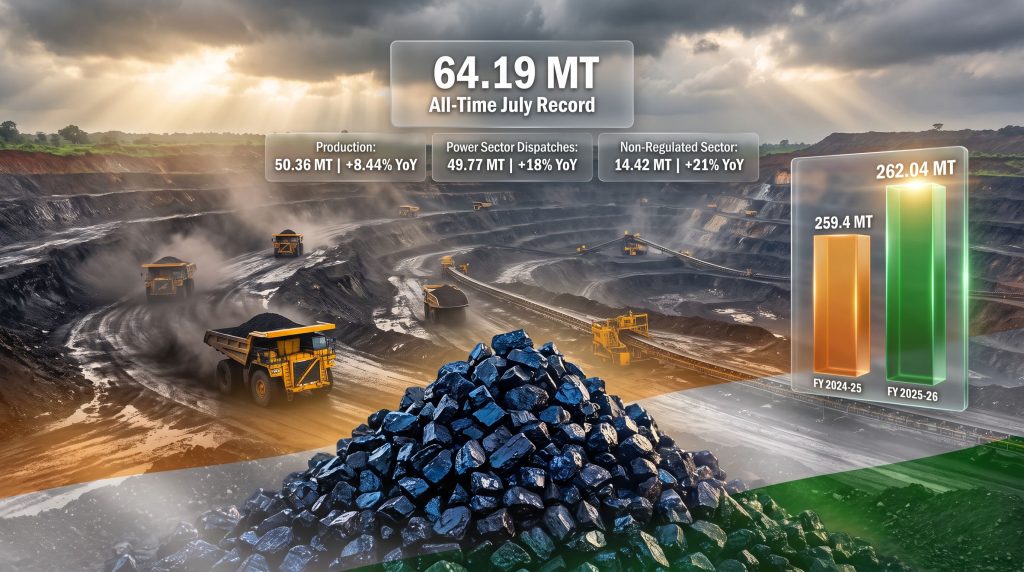
Coal India's July 2026 production reached 50.36 million tonnes (MT), reflecting an 8.44% year-on-year increase. Achieving this growth rate during the June-to-September monsoon window, when open-cast mining operations face their most severe seasonal constraints, carries particular operational significance.
Total coal supplies during the month surged to 64.19 MT, a rise of 18.38% compared to the same period in the prior year. This figure represents the highest-ever coal offtake volume recorded for the month of July across any financial year in the company's operational history.
| Metric | July 2026 | July 2025 (Prior Year) | Year-on-Year Change |
|---|---|---|---|
| Total Coal Supplies | 64.19 MT | ~54.2 MT (est.) | +18.38% |
| Power Sector Dispatches | 49.77 MT | 42.35 MT | +18.0% |
| Non-Regulated Sector | 14.42 MT | 11.89 MT | +21.3% |
| Production Volume | 50.36 MT | ~46.4 MT (est.) | +8.44% |
The previous record for July offtake stood at 60.5 MT, set during FY 2024-25. The July 2026 result of 64.19 MT exceeded that prior benchmark by approximately 3.69 MT, representing a roughly 6.1% improvement over what had itself been a record-setting month.
Coal India's July 2026 total supply figure of 64.19 MT marks the single highest monthly offtake ever recorded for July in the company's history, surpassing the prior FY 2024-25 record of 60.5 MT by approximately 3.69 MT.
The Monsoon Factor: Why Summer Output Records Are Harder to Achieve
A critical contextual layer that aggregate statistics tend to obscure is the operational environment in which these figures were produced. India's monsoon season, which runs from approximately June through September, creates compounding challenges for open-cast mining operations, which account for the dominant share of CIL's total output. Furthermore, these coal supply challenges are well-documented across the industry.
The specific challenges include:
- Waterlogging of mine floors, which can halt heavy equipment operations and require emergency pumping before extraction resumes.
- Haul road degradation, as unpaved internal mine roads deteriorate under sustained rainfall, slowing the movement of overburden and coal-laden dump trucks.
- Equipment downtime, with electrical systems, conveyor belts, and mechanical components requiring protective measures during heavy precipitation events.
- Reduced working hours per shift as safety protocols restrict certain operations during active rainfall periods.
The fact that CIL achieved both production growth of 8.44% and record supply volumes during this seasonally constrained period points to meaningful improvements in mine drainage infrastructure, mechanisation levels, and operational scheduling rather than simply favourable weather conditions.
Back-to-Back Records: June and July Form a Pattern
One month of record performance can reflect an inventory release event or a statistical quirk in comparison base effects. Two consecutive months is structurally more meaningful.
In June 2026, CIL had already recorded 65.95 MT in total supplies, its highest-ever volume for that month. July's 64.19 MT followed directly, creating back-to-back monthly records across consecutive high-monsoon months. This sequential pattern suggests the performance is not driven by a single stock drawdown event but reflects genuine improvements in logistics throughput and supply chain coordination.
Cumulative April-July Performance: A Four-Month Record
Examining single-month data in isolation risks overstating or understating trends. The cumulative picture for the first four months of FY 2025-26 adds important confirmation.
| Period | FY 2025-26 | FY 2024-25 (Prior Record) | YoY Growth |
|---|---|---|---|
| April-July Cumulative Supplies | 262.04 MT | 259.4 MT | +6.9% |
The 262.04 MT delivered between April and July 2026 represents the highest volume ever supplied during this four-month opening stretch of any financial year in CIL's history. The margin over the prior record is approximately 2.64 MT, which may appear modest in percentage terms but is significant at this scale given the baseline already represented a record.
A cumulative supply growth rate of 6.9% across the opening four months of FY 2025-26 indicates that the performance is sustained and systematic rather than episodic, reflecting consistent operational throughput improvement rather than a one-time inventory event.
The next major ASX story will hit our subscribers first
Power Sector Dispatch: The Grid Reliability Dimension
The power sector absorbed 49.77 MT of CIL's July 2026 supplies, up from 42.35 MT in the corresponding month of the prior year, an absolute gain of approximately 7.42 MT within a single month. At 77.5% of total supply volume, the power sector remains the overwhelming dominant consumer of CIL's output.
Higher dispatch volumes translate directly into improved coal stockpile levels at thermal power stations. This matters for grid operators because plant-level inventory acts as a buffer against supply disruptions, price volatility in the spot market, and logistics delays during extreme weather events.
India's Central Electricity Authority tracks coal stock days at individual power plants, and when inventories fall below critical thresholds, emergency procurement at elevated prices becomes necessary, creating cost pressures that ultimately pass through to electricity tariffs. Sustained dispatch growth through the monsoon period, historically the highest-risk window for supply chain disruptions, provides power plants with the inventory headroom needed to navigate the transition into the high-demand winter quarter without emergency sourcing.
The Non-Regulated Sector: An Underappreciated Growth Signal
Why Industrial Demand Is Accelerating
While power sector growth dominated the headline narrative, the non-regulated sector's performance arguably carries greater strategic significance from an industrial demand perspective. Dispatches to this segment expanded 21% year-on-year, rising from 11.89 MT to 14.42 MT, outpacing even the power sector's strong 18% growth rate.
The non-regulated sector encompasses:
- Steel production, where coking and thermal coal feed blast furnaces and sponge iron facilities
- Cement manufacturing, which relies on coal for kiln firing
- Aluminium smelting, an electricity and coal-intensive process
- Paper and textile manufacturing with embedded thermal energy requirements
- Chemical and fertiliser production with coal-based feedstock requirements
A 21% acceleration across this diversified industrial base suggests the demand driver is not sector-specific but reflects broad-based manufacturing momentum. This aligns with India's elevated infrastructure capital expenditure cycle, where construction activity generates simultaneous demand across steel, cement, and related heavy industries. Indeed, Indian steel demand continues to be a key driver of coal consumption growth across the non-regulated segment.
For CIL, this demand diversification reduces revenue concentration risk in the regulated power sector and strengthens the commercial justification for continued production investment.
CIL's Demand-Responsive Inventory Strategy: What It Actually Means
Traditional coal dispatch operations in India were historically characterised by relatively static production schedules, with offtake volumes following production rather than being proactively matched to downstream demand signals. The result was periodic mismatches between mine-mouth stockpile accumulation and power plant requirements, creating simultaneous scenarios of oversupply at one location and shortfall at another.
A demand-responsive approach inverts this logic. It uses real-time and near-term demand signals, including power plant stock levels, railway rake availability, and sectoral demand forecasts, to calibrate how much coal is moved from stockpiles versus freshly mined output at any point in time. The practical result is more consistent delivery to end consumers and reduced volatility in plant-level inventories, which is precisely what the July 2026 supply surge reflects in operational terms.
Historical Supply Trajectory: Contextualising the Records
| Financial Year | Approx. April-July Supplies | Context |
|---|---|---|
| FY 2022-23 | ~230 MT (est.) | Post-pandemic demand recovery phase |
| FY 2023-24 | ~245 MT (est.) | Capacity expansion ramp-up |
| FY 2024-25 | 259.4 MT | Previous April-July record |
| FY 2025-26 | 262.04 MT | New April-July all-time record |
The consistent upward staircase in four-month cumulative supply figures reflects multi-year capital investment in mine expansion, mechanised equipment fleets, and railway logistics capacity rather than any single year's operational decision. CIL's Maharatna corporate status grants it significant financial and operational autonomy, enabling faster capital deployment cycles than typical public sector enterprises face.
Import Substitution: The Foreign Exchange Dimension
How Domestic Production Eases the Import Bill
Beyond grid reliability, record domestic coal production carries material macroeconomic significance through its impact on India's energy import bill. Seaborne thermal coal prices, benchmarked against indices such as the Newcastle FOB price, have historically exhibited significant volatility. When domestic supply falls short of demand, Indian utilities and industrial consumers turn to imports at prevailing international prices, creating foreign exchange outflows.
A sustained 6-8% annual increase in domestic supply reduces this pressure meaningfully. However, as strong Indian coal burn data illustrates, elevated domestic consumption does not always translate directly into reduced import dependency. At volumes in the range of 260-plus MT over four months, even modest per-tonne import displacement carries balance-of-payments implications that compound over a full financial year.
For context, India was importing tens of millions of tonnes of thermal coal annually in recent years; every additional MT of domestically produced coal that displaces an equivalent import represents a direct improvement in the current account position. Furthermore, the energy export challenges facing key supplier nations could create additional pressure on India to maximise domestic output.
Key Takeaways: What the July 2026 Data Signals for FY 2025-26
| Indicator | Value | Significance |
|---|---|---|
| July 2026 Total Supplies | 64.19 MT | All-time July record |
| July 2026 Production | 50.36 MT | +8.44% year-on-year |
| Power Sector Dispatches | 49.77 MT | +18% year-on-year |
| Non-Regulated Dispatches | 14.42 MT | +21% year-on-year |
| April-July FY26 Cumulative | 262.04 MT | All-time April-July record |
| Previous April-July Record | 259.4 MT | FY 2024-25 |
Three structural signals emerge from this dataset:
- Monsoon resilience is improving. Back-to-back records across June and July, the two most operationally challenging monsoon months, indicate that infrastructure and logistics investments are delivering measurable results under adverse conditions.
- Demand alignment is broadening. The non-regulated sector's 21% growth outpacing the power sector's 18% expansion reflects diversifying industrial demand that extends CIL's commercial growth runway beyond its traditional power utility customer base. In addition, the global steel outlook suggests continued downstream demand for industrial coal across major consuming sectors.
- Cumulative momentum is building. With the opening four months of FY 2025-26 already establishing an all-time supply record, the full-year trajectory positions CIL to potentially register new annual supply benchmarks, with compounding implications for domestic energy security and import substitution across the remainder of the financial year. Consequently, the India coal trading exchange proposal gains greater relevance as production scale expands.
This article presents operational and market data for informational purposes. It does not constitute financial advice. Past production records and supply growth rates are not guarantees of future performance. Readers should conduct independent analysis before making investment or commercial decisions related to coal markets or related sectors.
For ongoing coverage of India's coal sector, power markets, and energy supply chain dynamics, ET EnergyWorld provides regularly updated reporting and analysis across India's energy landscape.
Want to Track the Next Major Commodity Discovery Before the Market Does?
Discovery Alert's proprietary Discovery IQ model delivers real-time alerts on significant ASX mineral discoveries across more than 30 commodities — turning complex data into clear, actionable insights for both traders and long-term investors. Explore how historic discoveries have generated substantial returns and begin your 14-day free trial today to position yourself ahead of the broader market.