August 2, 2026
The Monsoon Quarter Test: Why India's July Coal Numbers Matter More Than They Appear
There is a well-understood seasonal rhythm to open-cast coal mining in South Asia. The monsoon months, running roughly from June through September, bring waterlogged pit floors, reduced blasting windows, haul road degradation, and constrained equipment availability. For decades, this climatic reality has meant that India's coal output figures for the July quarter have been treated as the sector's weakest data point, a trough to be endured before the stronger dry-quarter numbers arrive.
That context makes the latest provisional data from the Ministry of Coal considerably more significant than a headline percentage might initially suggest. When India coal production grows 7.51% in July against the same monsoon-affected baseline from the prior year, it is not simply a favourable comparison. It reflects a sector that has structurally raised its operational floor, even during its historically most constrained period.
When big ASX news breaks, our subscribers know first
What the July 2026 Production and Dispatch Figures Actually Show
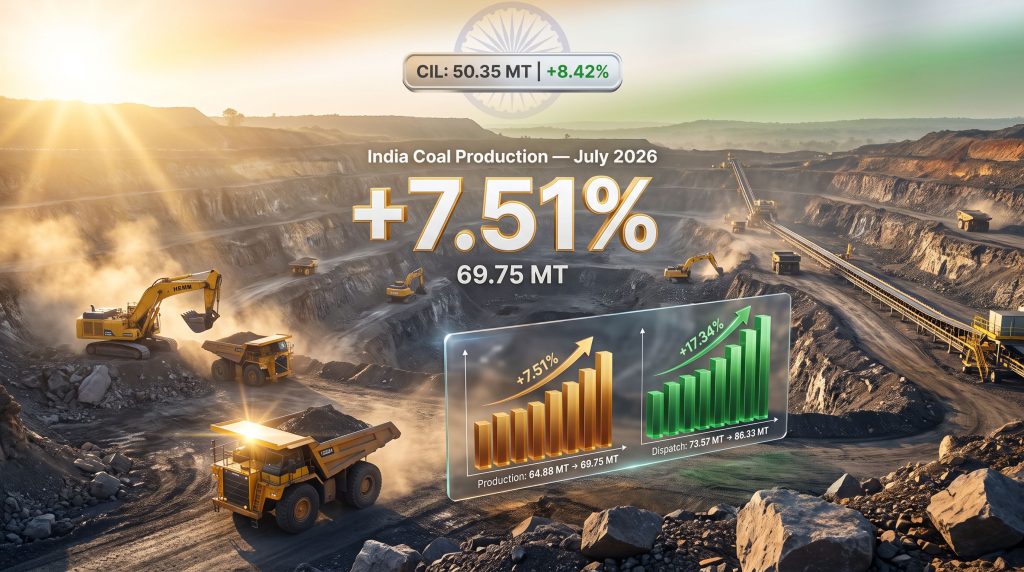
India's total coal output for July 2026 reached 69.75 million tonnes (MT) on a provisional basis, up from 64.88 MT in July 2025. That 4.87 MT absolute gain over a single month, year-on-year, during the monsoon season, points to something beyond a temporary operational uplift. According to figures reported by Business Standard, this is one of the stronger monsoon-quarter performances India's sector has recorded in recent years.
More revealing, however, is the dispatch figure. Coal delivered to end-users in July 2026 reached 86.33 MT, representing a 17.34% year-on-year surge from 73.57 MT in July 2025. The gap between what was produced and what was dispatched, approximately 16.58 MT in a single month, tells a story about inventory management that deserves closer attention.
| Metric | July 2025 | July 2026 | YoY Change |
|---|---|---|---|
| Total Coal Production | 64.88 MT | 69.75 MT | +7.51% |
| Total Coal Dispatch | 73.57 MT | 86.33 MT | +17.34% |
| CIL Production | ~46.44 MT (est.) | 50.35 MT | +8.42% |
| CIL Dispatch | ~54.23 MT (est.) | 63.67 MT | +17.43% |
All figures are provisional as reported by the Ministry of Coal, Government of India.
The divergence between production and dispatch is a technically important distinction that often gets flattened in headline reporting. Production measures extraction at the mine face. Dispatch measures coal physically loaded and transported to buyers, power plants, and industrial consumers. When dispatch consistently exceeds production, it indicates that pre-built stockpiles at pithead and rail-linked storage facilities are being actively drawn down to meet demand.
This is not a sign of supply stress. Rather, it reflects deliberate inventory strategy: building stocks during lower-demand periods and releasing them when consumption peaks. Furthermore, this pattern aligns with broader coal supply challenges that have shaped India's logistics planning over recent years.
"A dispatch-to-production ratio exceeding 1.26 in a single month means that for every tonne mined, more than 1.26 tonnes were delivered to end-users. This kind of ratio, sustained during the monsoon quarter, signals that India's coal logistics chain is functioning at a materially higher throughput than in prior years."
Coal India Limited: The Structural Anchor of National Output
Coal India Limited (CIL) remains the dominant force in India's coal economy. In July 2026, CIL contributed 50.35 MT of production, accounting for approximately 72.2% of total national output, and dispatched 63.67 MT, representing around 73.7% of total national dispatch.
CIL's production growth of 8.42% year-on-year slightly outpaced the national average of 7.51%, reflecting operational improvements across its subsidiary structure. CIL operates through a network of regional subsidiaries, each responsible for distinct coalfield geographies:
- South Eastern Coalfields Limited (SECL): Operating in Chhattisgarh and Madhya Pradesh, one of CIL's highest-volume producers
- Mahanadi Coalfields Limited (MCL): Concentrated in Odisha, a key growth driver given the state's extensive Gondwana coal deposits
- Western Coalfields Limited (WCL): Operating in Maharashtra and Madhya Pradesh, historically constrained by geological complexity
- Bharat Coking Coal Limited (BCCL): Focused on the Jharia coalfield in Jharkhand, managing ageing underground mines with ongoing fire-zone challenges
- Central Coalfields Limited (CCL): Operating in Jharkhand's Damodar Valley, a significant contributor to thermal grade output
CIL's cumulative dispatch growth of 6.81% over the April to July period in FY 2026-27, compared to the same period in the prior financial year, confirms that the July performance is not an isolated monthly anomaly but part of a sustained trajectory.
The Geology Behind India's Coal Growth Capacity
A factor rarely discussed in mainstream coverage is the geological character of India's coal reserves and how it shapes production potential. The vast majority of India's mineable coal sits within Gondwana-age sedimentary basins, primarily in the states of Jharkhand, Odisha, Chhattisgarh, West Bengal, and Madhya Pradesh. These Permian-age deposits, formed approximately 250 to 300 million years ago, tend to be thick-seamed and relatively shallow in the more productive fields, making them well-suited to large-scale open-cast extraction.
However, Indian coal grades present a nuanced picture for energy planners:
- Non-coking thermal coal dominates India's output, typically graded from G1 (highest) through G17 (lowest) under the Coal India grading system, with most power station coal falling in the G9 to G14 range
- Calorific values for domestic thermal coal often range from approximately 3,500 to 5,500 kcal/kg on a gross calorific value (GCV) basis, compared to the 6,000+ kcal/kg typical of premium Indonesian or Australian thermal coal
- High ash content in Indian coal, often ranging from 30% to 45%, requires power plants to be designed for lower-quality fuel and limits the substitutability with imported coal
- Coking coal, critical for steel production, is found in limited quantities and quality within India, with the Jharia coalfield producing the country's only significant reserves of prime coking coal. This structural deficiency is why India continues to import coking coal regardless of domestic production growth
This geological reality explains why India's import substitution strategy is achievable for thermal coal but faces inherent limits for metallurgical-grade material. In addition, metallurgical coal prices continue to influence procurement decisions for Indian steelmakers who depend on imports for quality coking coal.
The Cumulative Picture: Four Months of FY 2026-27
Looking beyond the monthly snapshot, the April to July FY 2026-27 cumulative figures reinforce a sector-wide improvement.
| Metric | Cumulative April-July FY 2026-27 | YoY Growth |
|---|---|---|
| National Coal Production | 302.24 MT (Provisional) | Positive trajectory vs. prior year |
| National Coal Dispatch | 354.70 MT (Provisional) | +5.87% |
| CIL Cumulative Dispatch | Proportional contributor | +6.81% |
Source: Ministry of Coal, Government of India. All figures provisional.
An annualised run-rate derived from 302.24 MT in four months implies full-year production potentially exceeding 900 MT at the current pace, though this would need to be adjusted upward if Q3 and Q4 dry-quarter performance follows historical seasonal improvement patterns.
India's multi-year production trajectory provides useful context:
| Financial Year | Annual Production (Approx.) | YoY Growth |
|---|---|---|
| FY 2022-23 | ~893 MT | ~14.8% |
| FY 2023-24 | ~997 MT | ~11.6% |
| FY 2024-25 | ~1,040 MT (est.) | ~4.3% |
| FY 2025-26 | ~1,080 MT (est.) | ~3.8% |
| FY 2026-27 (trajectory) | Projected >1,130 MT | ~4.6%+ |
Note: Historical figures are approximate based on Ministry of Coal annual reports. FY 2026-27 projection is indicative.
The growth rate moderation from the double-digit gains of FY 2022-23 and FY 2023-24 into the 4-8% range reflects a maturing expansion. The easy volume gains from reopening idled capacity have been captured and incremental growth now requires genuine capital investment, infrastructure development, and operational sophistication.
Infrastructure: The Underappreciated Growth Enabler
The physical infrastructure connecting mines to consumers deserves more analytical attention than it typically receives. India's coal supply chain has historically been constrained not by reserves in the ground but by the ability to move extracted coal to where it is needed. Consequently, improvements in this area have compounding effects on both production and dispatch performance.
First Mile Connectivity: Removing the Trucking Bottleneck
One of the least-discussed but operationally significant initiatives reshaping CIL's logistics capability is the First Mile Connectivity (FMC) programme. Traditional coal dispatch in India relied heavily on trucks to move coal from the mine pit to the nearest rail loading point, a process that introduced cost, time delays, road damage, dust pollution, and capacity constraints.
FMC projects replace this truck dependency with mechanised conveyor systems and rail sidings built directly adjacent to mining operations. The practical effects include:
- Faster pit-to-wagon transfer, reducing loading cycle times
- Higher throughput capacity at loading points, enabling more rakes per day
- Reduced pilferages and weighbridge discrepancies that historically inflated transit losses
- Lower per-tonne logistics costs, improving the economic viability of lower-grade seams
When dispatch growth outpaces production growth by nearly 10 percentage points in a single month, FMC infrastructure improvements and enhanced rail rake availability are likely contributing factors alongside stockpile drawdowns.
Commercial Mining Reform: The Private Sector Wildcard
India's coal sector was opened to commercial mining by private companies in 2020, ending the decades-long effective monopoly of CIL and a small number of captive producers. The pipeline of privately operated coal blocks that received auction allocations in FY 2021 through FY 2024 is now progressively entering production ramp-up phases.
This represents an incremental volume source that sits outside CIL's production figures but contributes to the national total. As more commercially mined blocks reach steady-state output in FY 2026-27 and beyond, the national production base widens in a way that reduces the sector's concentration risk around CIL's operational performance.
Dispatch Growth as an Energy Security Metric
India's thermal power sector depends on coal for approximately 70-75% of its electricity generation. Fuel shortages at power stations, which were a recurring crisis point in FY 2021-22 and portions of FY 2022-23, have significant downstream effects:
- Reduced plant load factors at coal-based generating stations
- Increased reliance on expensive short-term electricity market purchases
- Voltage and frequency management challenges on the grid
- Increased spot import purchases at elevated seaborne prices
A dispatch volume of 86.33 MT in a single July month suggests that pithead and plant-side coal inventories are being actively replenished, reducing the probability of the kind of low-stock situations that previously forced power utilities into emergency procurement.
"The strategic logic is straightforward: building coal stocks at power plants during the monsoon season, when electricity demand is moderated by cooler temperatures and industrial activity in some sectors slows, creates a buffer for the peak demand surge that typically arrives with the post-monsoon industrial acceleration in Q3."
The next major ASX story will hit our subscribers first
Import Substitution: Progress, Limits, and the Coking Coal Constraint
India's Ministry of Coal has articulated a clear strategic objective of reducing import dependence. Domestic dispatch growth of 17.34% in July 2026 is directionally consistent with this goal for the thermal coal segment. However, several structural constraints prevent complete import substitution:
- Coking coal quality: India's domestic coking coal reserves, primarily from the Jharia coalfield, are insufficient in volume and often inconsistent in quality to meet the requirements of India's expanding steel industry. Imports from Australia and the United States will likely remain a structural feature of India's coal trade
- Regional distribution imbalances: Coal deposits are geographically concentrated in eastern and central India. Southern and western industrial consumers often find it economically competitive to import coal through coastal ports rather than bear long-haul rail freight costs from inland mines
- Monsoon logistics disruptions: Even with FMC improvements, rail network congestion during agricultural harvest transport seasons creates periodic supply chain friction
- Grade mismatches: As domestic coal is predominantly lower calorific value material, some power plants and industrial consumers designed for higher-grade imported coal cannot easily substitute without blending strategies or efficiency trade-offs
Furthermore, the steel demand outlook in Asia remains a key variable influencing how much coking coal India will need to import regardless of domestic production trends.
The Renewable Transition Paradox
India's stated goal of reaching 500 GW of non-fossil power capacity by 2030 coexists with continued growth in coal production. This apparent contradiction resolves when viewed through the lens of absolute demand growth. India's electricity consumption is expanding rapidly, driven by industrial growth, urbanisation, cooling demand, and electrification of transport and cooking.
Even a scenario where renewables account for a growing share of the electricity mix still implies significant absolute coal consumption if total demand grows faster than renewable capacity can be added. Coal's role is therefore shifting from dominant to foundational, providing grid stability and firm power that variable renewables cannot yet consistently deliver at scale without adequate storage.
The question for long-term planning is not whether India will use less coal eventually, but how long the transition period lasts and at what production volumes the plateau occurs. Current trajectory modelling by energy policy analysts suggests India's peak coal demand may not arrive until the early-to-mid 2030s at the earliest, with production volumes remaining elevated through the decade. India's resource and energy exports landscape will also be shaped by how quickly this domestic transition unfolds.
Frequently Asked Questions: India Coal Production July 2026
How much coal did India produce in July 2026?
India produced 69.75 million tonnes of coal in July 2026 on a provisional basis, a 7.51% increase compared to the 64.88 MT recorded in July 2025, according to Ministry of Coal data.
What was India's coal dispatch figure for July 2026?
Coal dispatch reached 86.33 million tonnes in July 2026, representing a 17.34% year-on-year increase from 73.57 MT in July 2025.
How much coal did Coal India Limited produce in July 2026?
Coal India Limited produced 50.35 million tonnes in July 2026, an increase of 8.42% over the same month in the prior year, accounting for approximately 72.2% of national output.
What is India's cumulative coal production for FY 2026-27 up to July?
Cumulative coal production from April to July FY 2026-27 reached 302.24 million tonnes on a provisional basis.
Why is coal dispatch higher than coal production in July 2026?
The dispatch figure exceeds production because power utilities and industrial consumers are drawing from existing stockpiles in addition to freshly extracted coal, reflecting both strong end-user demand and active inventory management by producers and logistics operators.
Is India reducing its coal imports due to higher domestic production?
The Ministry of Coal has stated a strategic objective of reducing import dependency through domestic supply growth. Sustained production and dispatch increases are directionally consistent with this goal for thermal coal. However, full import substitution for coking coal remains a structurally constrained longer-term objective given the quality and volume limitations of domestic reserves. The proposed India coal trading exchange could, furthermore, play a role in improving pricing transparency as domestic volumes grow.
Key Takeaways
-
Monsoon-quarter growth is the real signal: India coal production grows 7.51% in July during India's historically most constrained operational season, reflecting structural, not cyclical, improvement
-
Dispatch is the sharper metric: At 17.34% growth, dispatch outpaces production by nearly 10 percentage points, indicating logistics gains and strong demand alignment
-
CIL anchors the sector: Contributing over 72% of national output, Coal India Limited's 8.42% production growth and 17.43% dispatch growth are the foundational drivers of the national figures
-
Geology shapes the ceiling: High ash content, lower calorific values, and limited coking coal reserves mean domestic growth solves the thermal supply problem but cannot eliminate import dependency entirely
-
Infrastructure investment is compounding: First Mile Connectivity projects, commercial mining reform, and mine mechanisation are collectively raising the operational throughput of a sector that was previously bottlenecked by logistics rather than reserve availability
-
The renewable paradox is real but manageable: Coal growth and renewable expansion are occurring simultaneously because absolute electricity demand is expanding faster than clean capacity can be deployed, a dynamic likely to persist through the 2020s
Readers seeking ongoing coverage of India's coal sector, Ministry of Coal data releases, and broader energy policy developments can follow reporting from ETEnergyWorld at energy.economictimes.indiatimes.com. Additional production data and official announcements can also be found via the Ministry of Coal on X (formerly Twitter).
Want to Track the Next Major ASX Mineral Discovery Before the Market Moves?
Discovery Alert's proprietary Discovery IQ model delivers real-time alerts on significant ASX mineral discoveries, transforming complex commodity data into actionable investment insights for both short-term traders and long-term investors — explore the historic returns major discoveries have generated and begin your 14-day free trial today to position yourself ahead of the market.