
July 16, 2026
The Silent Drain: Why Operational Blindness Is Costing Mexican Businesses Hundreds of Millions
Across global logistics and industrial operations, the assets most likely to disappear are rarely the ones that generate headlines. Heavy equipment theft makes news. The slow haemorrhage of hand tools, portable generators, electronic sensors, and specialised spare parts does not. Yet it is precisely this category of loss, repeated daily across thousands of sites, that inflicts the most damage on mid-sized businesses operating in high-risk environments. Nowhere is this dynamic more consequential than in Mexico, where a convergence of structural, geographic, and security-related pressures has produced conditions that no other major economy currently replicates.
Understanding Mexico asset theft and asset tracking as interconnected operational challenges, rather than separate compliance concerns, is rapidly becoming a prerequisite for sustained commercial viability in the country.
When big ASX news breaks, our subscribers know first
Why Mexico Has Become the World's Most Challenging Environment for Asset Security
The Structural Conditions Amplifying Exposure
Mexico's vulnerability to asset loss is not simply a product of organised crime, though that is a significant factor. It is the outcome of several structural realities colliding simultaneously.
The country's logistics sector is heavily road-freight dependent, with approximately 185,000 operating firms, the majority of which still manage equipment inventories through analogue or rudimentary digital systems. This creates persistent traceability gaps that theft readily exploits. When an asset goes missing, many operators lack the technical infrastructure to detect the loss quickly, let alone locate the item before it enters informal resale networks.
The nearshoring trend has further complicated this picture. As Mexico absorbs a growing share of manufacturing capacity displaced from Asia, the density and value of assets in circulation has increased substantially. More equipment, more sites, and more cross-border supply chain participation means higher aggregate exposure for businesses that have not yet modernised their asset management practices.
Informal secondary markets for tools and equipment remain highly liquid in many Mexican states. Once a small-value asset is absorbed into these channels, recovery becomes statistically unlikely. The window between theft and absorption is short, often measured in hours rather than days for portable items.
Furthermore, Mexican mining disruptions have demonstrated how quickly operational continuity can unravel when asset security and broader site stability are compromised simultaneously.
Quantifying the Problem: What the Research Actually Reveals
The 2026 State of Connected Operations report, produced using data gathered by independent research firm Wakefield Research, provides the most granular picture yet of what operational blindness costs Mexican businesses in concrete financial terms.
The methodology behind the findings involved surveying 1,500 finance executives across seven countries: the United States, Mexico, the United Kingdom, Ireland, France, Germany, and Canada. Data collection took place during the first half of February 2026. Respondents were drawn from mid-market organisations with annual revenues ranging from approximately MX$4.3 billion to MX$17 billion, operating across construction, logistics, field services, and utilities.
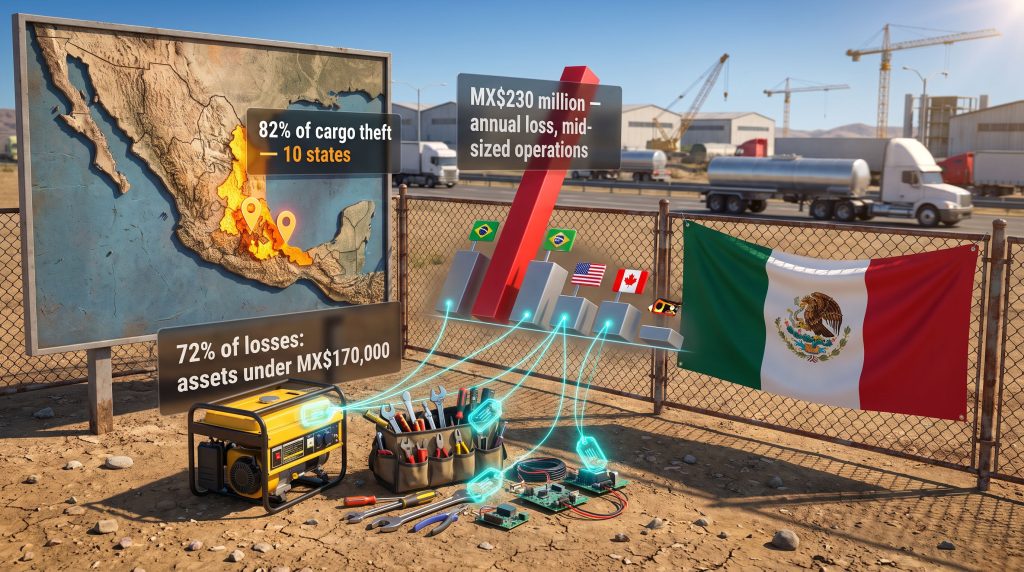
The aggregate annual cost of asset loss for mid-sized Mexican operations without real-time visibility reaches an estimated MX$230 million once direct replacement, project delays, emergency rentals, staff time, and insurance penalties are all factored in.
What makes this figure consistently surprising to finance executives is that internal accounting typically captures only the replacement invoice. The downstream costs, including idle crews, penalty clauses for delayed project delivery, unplanned rental expenditure, and the administrative burden of insurance claims, rarely appear in the same ledger. When aggregated, they frequently dwarf the face value of the stolen or lost equipment itself.
How Does Mexico Compare Globally on Asset Theft Acceleration?
Mexico's Ranking Among Seven Major Economies
Among all countries included in the 2026 research, Mexico registers the fastest acceleration in high-value asset theft. This distinction is meaningful: the metric being measured is not absolute theft volume but the rate of increase over the preceding five years, which is a more operationally relevant indicator for risk planning.
| Country | % Reporting Increased High-Value Asset Theft (Past 5 Years) |
|---|---|
| Mexico | 62% |
| Global Average | 49% |
| United States | Below global average |
| United Kingdom | Below global average |
| France | Below global average |
| Germany | Below global average |
| Canada | Below global average |
Mexico's 62% figure sits 13 percentage points above the global average and represents the highest reading of any nation surveyed. Several factors drive this outlier position: gaps in infrastructure and monitoring technology, the scale of organised criminal activity intersecting with commercial logistics, and the limited adoption of real-time tracking across mid-market operations.
The acceleration metric also matters for insurance underwriting. Insurers pricing risk exposure in Mexico are increasingly factoring the trajectory of loss frequency into premium calculations, not merely historical averages. Businesses that cannot demonstrate active mitigation through tracking technology face growing pressure on coverage terms.
The Sectors Bearing the Greatest Exposure
Asset vulnerability is not evenly distributed across industries. Four sectors carry disproportionate risk profiles:
-
Construction: High asset mobility across multiple concurrent sites creates traceability blind spots. Equipment rotates between locations frequently, and inventory reconciliation is often periodic rather than continuous.
-
Road logistics and freight: High-value cargo in transit through vulnerable corridors, particularly along key manufacturing-to-border routes, is exposed to both opportunistic and organised interception.
-
Field services and utilities: Dispersed equipment inventories across remote locations make centralised monitoring technically challenging without purpose-built tracking infrastructure.
-
Mining: The combination of geographic isolation, high-value machinery, organised security threats, and the physical difficulty of access road monitoring creates a compounded risk environment unlike any other sector. Broader mining industry trends suggest that this exposure is intensifying as asset values and site complexity continue to grow.
The Counterintuitive Economics of Equipment Loss
Why Small Assets Cause the Biggest Losses
One of the most practically significant findings from the 2026 research is the asset value distribution of operational losses. Intuitively, most finance executives assume that large-scale theft of heavy machinery constitutes the primary financial risk. The data contradicts this assumption decisively.
72% of the total operational cost associated with lost or stolen equipment in Mexico is attributable to assets valued under MX$170,000, including hand tools, portable generators, electronic sensors, and specialised spare parts.
The explanation for this counterintuitive pattern lies in frequency, detectability, and recovery dynamics. Small assets are stolen repeatedly. They are replaced informally, often without a formal purchase order or insurance claim. They are rarely tagged or tracked. And because no single incident crosses the threshold that triggers a formal investigation, the cumulative pattern remains invisible to management reporting systems.
Heavy equipment theft, by contrast, generates an immediate, visible response. The loss is detected quickly, insurance is notified, and law enforcement may be engaged. The financial impact is acute but bounded. Small asset loss is chronic and unbounded precisely because it operates below the detection threshold of most accounting and operations management systems.
The Hidden Labor Cost: Staff Time as a Loss Multiplier
The research reveals a labour cost dimension that rarely appears in loss calculations but is substantial in aggregate:
- 98% of surveyed organisations report that locating equipment consumes staff time on a daily or weekly basis.
- In organisations without real-time asset visibility, more than one in four report staff spending over 10 hours per week searching for assets.
- Annualised, this is equivalent to a full-time employee spending three months per year exclusively on equipment location, producing no revenue-generating output during that period.
The opportunity cost of this labour, redirected toward project delivery, client engagement, or preventive maintenance, represents a meaningful financial return that tracking technology can unlock without requiring direct revenue growth.
Operational Disruption: Shutdowns, Delays, and Emergency Procurement
The downstream operational consequences of asset loss in Mexico substantially exceed the global baseline:
| Metric | Mexico | Global Average |
|---|---|---|
| Organisations reporting project shutdown due to missing critical asset (past 12 months) | 93% | 77% |
| Firms that declined contract bids due to unconfirmed asset availability | 36% | Not specified |
| Firms using emergency rentals or unplanned purchases to maintain continuity | 47% | Not specified |
| Firms recovering less than half of stolen high-value equipment | 54% | Not specified |
The 36% of Mexican firms that have declined contract bids due to missing assets represent a direct, quantifiable revenue loss that is entirely preventable through tracking adoption. This figure reframes asset visibility from a cost management tool into a revenue enablement capability.
What Is the Legal Framework for Asset Recovery in Mexico?
Civil and Criminal Mechanisms Available to Affected Businesses
Businesses that suffer asset theft in Mexico have access to several legal pathways, though the practical effectiveness of each varies considerably depending on the nature of the theft and the assets involved.
Precautionary and Provisional Measures
Under the Código de Comercio (Commercial Code), Mexican courts hold authority to freeze bank accounts, real estate, and movable assets prior to final judgement. This provisional measure is designed to prevent asset dissipation during litigation. Under Article 138 of the Código Nacional de Procedimientos Penales, judges may also order asset seizure or account freezing in criminal proceedings, including ex parte orders in urgent cases where concealment risk is high and delay would undermine the remedy.
Asset Forfeiture: The Extinction of Domain Framework
The Ley Nacional de Extinción de Dominio, enacted in 2019, provides one of Mexico's most powerful tools for addressing criminally acquired assets. This law enables government seizure of assets connected to illicit activity, including corruption, drug trafficking, and vehicle theft, without requiring a criminal conviction against a specific individual.
International Asset Recovery
For businesses with cross-border operations or assets transferred abroad, Mexico's Central Authority, housed within the Prosecutor General's Office, can facilitate formal international cooperation requests. The GAFILAT Asset Recovery Network provides an additional channel for cross-border information exchange between regional financial intelligence units.
Summary Table: Legal Recovery Pathways for Asset Victims
| Objective | Legal Mechanism |
|---|---|
| Locate hidden or transferred assets | Forensic accounting combined with public and private registry access |
| Freeze assets before judgement | Ex parte provisional orders under the Commercial Code |
| Seize criminally linked assets | Extinction of Domain proceedings under the 2019 national law |
| Recover assets held abroad | Formal request through Mexico's Central Authority |
| Prevent physical theft in transit | GPS/RFID real-time tracking and IoT monitoring systems |
| Report stolen cargo | Immediate law enforcement notification and CargoNet network contact |
Systemic Weaknesses in Government Asset Management
A critical but underreported dimension of Mexico's asset recovery environment is the institutional gap in government-held inventory management. Internal audits have revealed approximately 58,000 seized items, including four aircraft, 47 vehicles, and a vessel, with no confirmed location after more than 14 years in custody.
Mexico currently lacks a centralised auditing system capable of tracking the status and disposition of goods seized from criminal organisations. This governance gap creates a secondary risk: even when assets are legally recovered and transferred to government custody, institutional handling may not guarantee their return or preservation.
Where Is Cargo Theft Most Concentrated in Mexico?
Geographic Hotspots Across the National Territory
82% of recorded cargo theft incidents in Q1 2026 were concentrated in just ten states, with the State of Mexico accounting for 19% of incidents and Puebla for 13%, together representing nearly one-third of all recorded cases nationally.
This geographic concentration reflects the intersection of high freight volume, major highway networks, and proximity to informal resale markets. The corridors connecting manufacturing hubs in the Bajio region and central Mexico to northern border crossings and Pacific ports consistently produce the highest interception rates. Organised criminal groups in these corridors have progressively shifted from opportunistic theft toward structured interception operations, including false checkpoint incidents and coordinated driver confrontations.
The January 2026 abduction of workers at a silver mining project in Sinaloa illustrates how physical asset stripping and broader security threats often occur simultaneously along remote access roads. Miners reported being stopped at unauthorised checkpoints and stripped of tools and personal items, a pattern that demonstrates how the theft of small assets and the escalation of physical security risks are not separate phenomena in Mexico's highest-risk regions.
The Mining Sector's Compounded Security Burden
Mexico's mining industry, which contributes approximately 4.7% of national GDP and supports more than three million jobs, faces a security cost structure that is substantially more severe than most other sectors. In addition, the adoption of data-driven mining operations is increasingly being recognised as essential to closing the visibility gaps that organised theft exploits.
- Security-related overheads consume an estimated up to 5% of total operating expenditure, according to the national mining chamber CAMIMEX, with material losses adding a further up to 2% in high-risk regions.
- Private security spending across the mining industry reached US$105.7 million in 2024, with further increases projected into 2025 and beyond.
- Some operators, when accounting for training costs, guard payrolls, and protective infrastructure, estimate the total security drag exceeds 20% of operating costs in the most exposed jurisdictions.
- The 25-day average asset recovery window identified in connected operations research translates directly into a vulnerability period during which machinery, generators, and fuel can be absorbed into informal channels before detection.
At the scale of the mining sector's economic contribution, even a marginal percentage-point reduction in operational efficiency generates large absolute financial consequences for the national economy.
The next major ASX story will hit our subscribers first
How Does Real-Time Asset Tracking Technology Solve the Visibility Gap?
The Technology Stack: From GPS to IoT-Enabled Monitoring
The technology architecture for effective Mexico asset theft and asset tracking spans several complementary layers, each suited to different asset types and operational contexts:
- GPS-enabled trackers form the foundational layer for vehicles, trailers, and containers, providing continuous location data with geofence alerting capabilities.
- BeiDou Navigation Satellite System (BDS) and Location-Based Services (LBS) integration provide multi-system redundancy in remote or signal-degraded environments, particularly relevant for mining and rural infrastructure operations where GPS signal reliability can be inconsistent.
- RFID tagging enables high-frequency small-asset inventory management at site level, making it the most practical solution for hand tools, sensors, and spare parts that move frequently between storage and active use.
- IoT sensor networks extend tracking beyond location to condition monitoring, enabling alerts for unauthorised movement, fuel siphoning, temperature excursions on sensitive equipment, and vibration anomalies that may indicate tampering.
The multi-layer approach is particularly important for addressing the small-asset loss problem. GPS alone cannot cost-effectively track items valued at MX$5,000. RFID and compact IoT tags close this gap, enabling the same visibility principles to apply across the full asset inventory. Consequently, the rise of mining automation technology is making it increasingly feasible to deploy these systems at scale across even the most remote sites.
Measurable Outcomes for Organisations That Have Adopted Tracking
| Outcome | % of Mexican Organisations Reporting This Benefit |
|---|---|
| Fewer operational shutdowns and project delays | 56% |
| Successfully negotiated lower insurance premiums | 36% |
| Improved asset utilisation and deployment planning | Reported across construction and field services sectors |
The insurance premium reduction pathway deserves particular attention. Underwriters in Mexico's mining and logistics sectors have begun repricing risk exposure based on documented tracking adoption. For operators facing already elevated security costs, a measurable reduction in insurance premiums represents a direct, recurring financial return on tracking investment that compounds over time.
Step-by-Step: Implementing an Asset Tracking Programme for Mid-Market Operations
- Conduct a full asset inventory audit categorising every item by value tier, mobility level, and theft risk profile across all active sites.
- Prioritise tracking deployment on assets below MX$170,000 first, given their disproportionate contribution to total operational loss.
- Select an appropriate technology layer for each asset category: GPS for vehicles and heavy equipment, RFID or compact IoT tags for portable tools, sensors, and spare parts.
- Integrate tracking data into existing operations management platforms to enable real-time alerts, automated exception reporting, and historical audit trails.
- Establish documented recovery protocols defining escalation paths for missing asset alerts, including law enforcement notification timelines and cargo theft network contact procedures.
- Negotiate insurance terms using tracking adoption as documented evidence of reduced risk exposure, referencing industry benchmark data on loss frequency reduction.
- Conduct quarterly system audits, updating asset registries as equipment is added, retired, or relocated between sites.
Frequently Asked Questions: Mexico Asset Theft and Asset Tracking
What types of assets are most commonly stolen from businesses in Mexico?
The majority of operational losses by financial cost, approximately 72%, stem from assets valued under MX$170,000. This includes hand tools, portable generators, electronic sensors, and specialised spare parts. While heavy machinery theft receives more attention, the cumulative financial impact of smaller asset losses is significantly larger due to their frequency and the difficulty of tracking and recovering them through informal replacement channels.
Which industries face the highest asset theft risk in Mexico?
Construction, road logistics, field services, utilities, and mining carry the greatest exposure. Mining operations face a compounded risk profile due to geographic isolation, the high value of machinery, organised security threats in certain states, and the convergence of false checkpoint incidents with physical asset stripping on remote access roads.
What legal options does a business have when assets are stolen in Mexico?
Businesses can pursue provisional asset freezing orders through civil courts under the Commercial Code, request criminal provisional measures under the Código Nacional de Procedimientos Penales, or engage forensic accounting specialists to trace assets through financial records and public registries. For cross-border asset recovery, Mexico's Central Authority facilitates international cooperation requests, with the GAFILAT network providing regional intelligence-sharing support.
How effective is GPS tracking for preventing cargo theft in Mexico?
Real-time GPS tracking is widely recognised as one of the most effective deterrents and recovery tools available. Among Mexican organisations that have implemented asset tracking, 56% report measurable reductions in shutdowns and delays, and 36% have achieved lower insurance premiums as a direct result of documented tracking adoption. Furthermore, mining efficiency tools are increasingly being integrated alongside GPS systems to provide a more comprehensive operational picture.
What are the highest-risk states for cargo theft in Mexico?
The State of Mexico and Puebla together account for approximately one-third of all recorded cargo theft incidents, with 82% of Q1 2026 incidents concentrated across just ten states. These regions intersect major highway corridors connecting manufacturing zones to border crossings and Pacific ports.
How long does it typically take to recover a missing asset in Mexico?
Research indicates an average recovery window of 25 days for missing assets in organisations without real-time tracking. During this period, equipment is highly vulnerable to absorption into informal resale channels. Rapid detection through IoT or GPS systems is critical to improving recovery rates before this window closes.
From Cost Centre to Competitive Differentiator: The Strategic Case for Tracking Investment
Reframing Asset Visibility as a Revenue Enabler
The conventional framing of asset tracking as a risk management expense understates its strategic value. The 36% of Mexican firms that have declined contract bids because critical assets could not be confirmed as available represent a direct, quantifiable revenue loss that tracking adoption can reverse. In competitive tendering environments, the ability to provide clients with documented proof of asset availability and operational continuity capability is increasingly a differentiating factor rather than a baseline expectation.
Organisations that can demonstrate asset visibility are also better positioned in insurance negotiations, better protected against the compounding costs of emergency procurement, and better able to optimise equipment utilisation across multiple concurrent sites. These benefits accumulate over time and reinforce each other.
The Broader Outlook: Nearshoring, Policy Pressure, and Infrastructure Investment
Several macro forces are likely to intensify both the urgency and the opportunity associated with Mexico asset theft and asset tracking over the medium term:
- Nearshoring-driven investment growth is placing more high-value industrial assets into circulation across logistics, construction, and manufacturing sectors, raising the aggregate cost of inadequate visibility.
- Growing pressure on Mexico's government to address the centralised auditing gap in seized asset management may eventually produce regulatory requirements for documented asset tracking in certain licensed industries.
- International trade frameworks are beginning to establish minimum asset security standards for cross-border supply chain participants, creating compliance incentives for tracking adoption that go beyond purely financial calculations. For instance, the FreightWaves CargoNet theft tracking platform provides a useful reference point for how industry-wide data sharing can complement on-site tracking systems.
For operators in construction, logistics, and mining, the trajectory is clear. The cost of operational blindness in Mexico is not static. As asset values in circulation rise with nearshoring activity, and as informal resale networks become more sophisticated, the financial case for real-time asset visibility will only strengthen.
This article contains forward-looking analysis based on third-party research data. Readers should treat projections and cost estimates as indicative rather than precise forecasts, and conduct independent due diligence before making operational or investment decisions.
Want to Identify the Next Major ASX Mineral Discovery Before the Market Does?
Discovery Alert's proprietary Discovery IQ model delivers real-time alerts the moment significant mineral discoveries are announced on the ASX, transforming complex geological data into actionable insights for both short-term traders and long-term investors — explore historic discovery returns to understand the scale of opportunity, and begin your 14-day free trial today to position yourself ahead of the market.