July 17, 2026
The Hidden Cost of Losing Mid-Stream Capability in Critical Minerals
When nations assess their industrial strength, the tendency is to focus on what lies beneath the ground. Ore reserves, resource tonnages, and export volumes dominate the conversation. Yet the most strategically consequential layer of any mineral supply chain is rarely the extraction phase. It is the processing step, where raw ore becomes a functional industrial material, that determines whether a country participates in global value creation or merely supplies the inputs for others to benefit from.
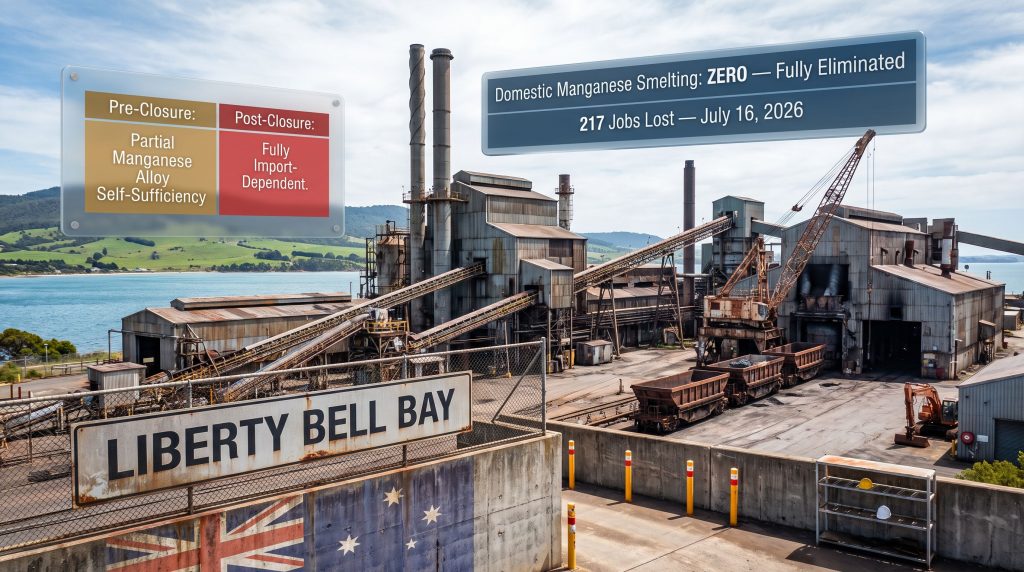
Australia finds itself confronting this reality sharply following the confirmed Liberty Bell Bay smelter closure in July 2026. The permanent shutdown of the George Town facility, located in northern Tasmania roughly 50 kilometres north of Launceston, removes what was the country's only onshore manganese smelting operation. The implications extend well beyond the immediate loss of 217 jobs in a region that had limited alternatives for displaced industrial workers.
Understanding what this closure actually means requires stepping back from the immediate news cycle and examining the deeper structural dynamics that made this outcome almost inevitable once the facility's business model began to crack.
When big ASX news breaks, our subscribers know first
What Made the Liberty Bell Bay Facility Strategically Irreplaceable
More Than a Regional Employer
Established in 1960, the Liberty Bell Bay smelter spent more than six decades as the sole facility in Australia capable of converting manganese ore into ferromanganese and silicomanganese alloys. These alloys are not peripheral industrial materials. They are non-substitutable inputs in the production of high-strength, low-alloy steel, commonly referred to in the industry as HSLA steel.
HSLA steel is the backbone of defence platforms, heavy infrastructure, and precision manufacturing supply chains. Manganese acts as a deoxidiser and desulphuriser during steelmaking, and without adequate manganese content, steel becomes brittle and structurally compromised. Every tonne of structural steel that meets engineering-grade specifications relies on a manganese alloy addition at some point in the furnace process.
The table below illustrates the before-and-after picture of Australia's manganese processing capability:
| Processing Capability | Pre-Closure Status | Post-Closure Status |
|---|---|---|
| Domestic manganese smelting | Operational (limited capacity) | Zero, fully eliminated |
| Manganese alloy self-sufficiency | Partial | Fully import-dependent |
| Sovereign steel input security | Maintained | Compromised |
| Direct industrial employment (George Town) | Approximately 217 jobs | Effectively nil |
The Value Chain Inversion Problem
Australia is a globally significant producer of manganese ore, with the Groote Eylandt deposit in the Northern Territory ranking among the highest-grade manganese ore bodies in the world, containing ore grades that can exceed 40% manganese. Yet ore grade at the mine mouth tells only part of the story. The economic value of manganese is overwhelmingly captured in the alloy conversion step, not in raw ore export.
By losing the Liberty Bell Bay facility, Australia now ships manganese ore offshore, pays for it to be processed in lower-cost jurisdictions such as South Africa, China, and parts of Southeast Asia, and then reimports the finished alloy product at a significant price premium. This is the value chain inversion that resource economists have long warned about, and it now applies to one of Australia's most strategically important industrial minerals. The energy security implications of this dependency cannot be overstated.
The closure crystallises a structural paradox: Australia holds world-class manganese resources but can no longer convert them into the alloy products its own steel industry and defence supply chains depend upon.
A Timeline of Structural Deterioration
The Liberty Bell Bay smelter closure was not a sudden event. It was the endpoint of a multi-year deterioration process that accelerated once ore supply constraints began limiting operational throughput.
| Milestone | Date |
|---|---|
| Smelter ceases full production due to ore shortages | Mid-2025 |
| Tasmanian Government provides A$20 million ore procurement loan | 2025 |
| GFG Alliance defaults on state loan obligations | Early 2026 |
| EY Parthenon appointed as voluntary administrators | March 2026 |
| Key financial backer withdraws from acquisition consortium | June 2026 |
| Adroit Capital and White Oak consortium withdraws entirely | July 2026 |
| Closure confirmed; 217 redundancies announced | 16 July 2026 |
The ore supply shortage that preceded the formal administration process is a detail that deserves closer scrutiny. Manganese smelters are heavily dependent on consistent, high-grade feedstock. When input ore quality declines or supply volumes become erratic, the energy-intensive smelting process becomes economically unviable because the cost per tonne of usable alloy output rises sharply.
The Liberty Bell Bay facility was operating at reduced capacity well before its financial troubles became public, which is a strong indicator that the input-side economics were structurally challenged independently of its ownership situation. Furthermore, the broader critical minerals demand surge makes this timing particularly damaging for Australia's industrial positioning.
Why the Sale Process Failed to Attract a Viable Buyer
The Anatomy of a Collapsed Acquisition
The consortium that had been engaged in negotiations with EY Parthenon, which initially included Adroit Capital and White Oak, ultimately withdrew from the transaction after one of its primary financial backers exited the arrangement in the weeks prior to the final decision. Administrators subsequently confirmed that no alternative transaction could be structured under prevailing market conditions.
The factors that deterred private capital from committing to the facility are instructive for anyone seeking to understand the broader economics of manganese smelting in high-cost jurisdictions:
-
Global manganese alloy price volatility made it impossible for prospective buyers to model bankable project economics over a meaningful investment horizon.
-
Ore supply insecurity remained the most fundamental unresolved risk. Without a contracted feedstock arrangement at competitive cost, no smelter can achieve the utilisation rates required for commercial viability.
-
Energy costs in Tasmania, while lower than in some Australian states due to hydroelectric generation, still represent a substantial operating cost in a sector where South African and Chinese competitors benefit from significantly lower power tariffs.
-
Capital expenditure requirements for operational restart following a period of reduced throughput were substantial and difficult to justify without long-term offtake agreements from steel producers.
-
The proposed ten-year power supply agreement offered by the Tasmanian Government as a buyer incentive, while commercially meaningful, could not offset the combination of these structural risks in isolation.
When legacy industrial assets in high-cost jurisdictions require sustained government underwriting to remain commercially competitive, the absence of a credible private sector business case becomes the defining constraint, not the availability of government support mechanisms.
What the Failed Sale Reveals About Investor Risk Appetite
The collapse of the acquisition process reflects a broader pattern that is observable across ageing heavy industrial infrastructure in developed economies. Private capital will not commit to long-dated industrial assets where the operating cost structure is fundamentally misaligned with global market pricing, regardless of the strategic importance those assets may hold for the host nation.
This creates a structural dilemma that no single intervention tool can easily resolve. Governments can offer concessional loans, power agreements, and co-investment structures, but unless the underlying economics of the asset are viable across a commercial cycle, these measures tend to delay rather than prevent closure.
Government Interventions and Why Reactive Policy Has Limits
The Full Scope of Support Deployed
Both state and federal authorities deployed a meaningful package of interventions during the administration process:
| Intervention | Amount or Detail |
|---|---|
| Tasmanian Government ore procurement loan | A$20 million (approximately US$14 million) |
| Joint state and federal staff payment contribution | A$9.6 million |
| Proposed power supply agreement | 10-year term offered to prospective buyers |
| Federal Fair Entitlement Guarantee Scheme | Covers unpaid worker entitlements post-closure |
The joint statement issued by Tasmanian Premier Jeremy Rockliff and Federal Industry Minister Tim Ayres acknowledged the closure as a significant loss for communities that had relied on the smelter for decades, with both governments committing to immediate assistance for affected workers.
The Timing Problem in Industrial Policy
The core weakness in the government response was not the scale of the interventions but their timing. Each measure addressed a symptom of deterioration at the moment it became acute rather than preventing the deterioration in the first place.
The A$20 million ore procurement loan resolved a near-term feedstock shortage but did not establish a durable supply pathway. The staff payment contribution preserved employment during the sale process but could not substitute for a commercially viable acquirer. Consequently, the power agreement, while forward-looking, arrived at a point where the facility's broader structural challenges had already eroded buyer confidence beyond recovery.
This sequencing problem is not unique to Tasmania. It reflects a systemic gap in how governments across the developed world assess and protect strategically significant industrial assets. Indeed, government intervention in mining and processing sectors requires a pre-emptive sovereign capability framework — one capable of identifying nationally critical facilities and intervening before commercial distress becomes irreversible.
Immediate Consequences for Workers and the Northern Tasmanian Economy
The Fair Entitlement Guarantee Pathway
Approximately 217 workers face immediate redundancy following the confirmed closure. The Australian Workers Union's Tasmania branch confirmed that formal employment terminations were expected to be issued at a scheduled workforce meeting following the announcement, with workers continuing to receive pay until that point.
For those with outstanding entitlements, the Federal Government's Fair Entitlement Guarantee Scheme represents the primary safety net. Key parameters of the scheme as they apply to this situation include:
-
Coverage: Unpaid wages, annual leave, long service leave, and redundancy entitlements up to statutory caps.
-
Processing timeline: The AWU indicated the claims process may take between 8 and 12 weeks from lodgement to payment.
-
Eligibility: Workers must have been employed under an Australian employment contract and satisfy residency criteria.
Affected workers are strongly encouraged to lodge FEG applications promptly following formal termination and to seek independent legal or union guidance before executing any settlement documentation.
Regional Multiplier Effects Beyond Direct Employment
The George Town area has historically depended on heavy industrial employment, and the smelter functioned as a significant anchor employer for the surrounding community. The economic multiplier effect of losing 217 direct jobs in a regionally concentrated area is typically estimated at between 1.5 and 2.5 indirect jobs lost for each direct position eliminated, through reduced spending in local businesses, services, and supply chains.
A small number of workers will be retained temporarily to manage site demobilisation, environmental compliance activities, and asset liquidation, but this represents a marginal fraction of the displaced workforce and does not constitute a sustainable employment outcome for the region.
The next major ASX story will hit our subscribers first
Can the Liberty Bell Bay Site Be Revived?
The Case for Patience Over Pessimism
Tasmanian government officials have acknowledged that the physical site retains latent value. Existing infrastructure, established grid connections, and environmental approvals represent assets that would cost considerably more to replicate from a greenfield position than to reactivate from a care-and-maintenance status.
A sustained recovery in global ferromanganese and silicomanganese alloy prices, combined with a secured long-term ore supply arrangement, could alter the investment calculus for a well-capitalised future operator. The global steel industry's increasing focus on lower-emissions steelmaking pathways may also eventually create demand premiums for domestically processed alloys with traceable supply chains. In addition, projects such as the Butcherbird manganese expansion and development of a strategic manganese deposit in Europe signal that the global industry is actively repositioning around supply security — a trend that could ultimately benefit a revived Australian processing sector.
The Barriers That Must Be Resolved First
Reactivation faces several significant hurdles that cannot be wished away by optimism alone:
-
Asset deterioration during demobilisation may result in the disposal or degradation of critical smelting equipment, substantially increasing restart costs for any future operator.
-
Environmental rehabilitation obligations may impose significant remediation liability on a new operator, creating a financial contingency that complicates investment modelling.
-
Feedstock security remains the most structurally critical barrier. Without a bankable ore supply agreement, no project finance model can be constructed around smelter restart economics.
-
Global competition from South African, Chinese, and Southeast Asian manganese processors, operating with structurally lower energy, labour, and logistics costs, will continue to constrain the achievable margin for Australian onshore smelting.
Frequently Asked Questions: Liberty Bell Bay Smelter Closure
What caused the Liberty Bell Bay smelter to close permanently?
The closure followed the collapse of a sale process after the Adroit Capital and White Oak consortium withdrew from negotiations. Administrators EY Parthenon determined that no commercially viable transaction could be completed, leaving the facility without the funding required to resume operations.
How many workers are affected by the Liberty Bell Bay smelter closure?
Approximately 217 workers are directly affected, with formal redundancy notifications expected to follow a scheduled workforce meeting held after the 16 July 2026 confirmation.
Is there any other manganese smelter operating in Australia?
No. The Liberty Bell Bay facility was Australia's only onshore manganese smelter. Its closure leaves the country with zero domestic capacity to produce manganese alloys, making Australia fully dependent on imported product.
What support is available to affected workers?
Workers with outstanding entitlements are directed to the Federal Government's Fair Entitlement Guarantee Scheme, which covers unpaid wages, leave entitlements, and redundancy payments. The claims process is estimated to take between 8 and 12 weeks from lodgement.
Could the Liberty Bell Bay site reopen under new ownership in future?
While the site retains infrastructure value, no credible buyer has emerged and near-term reactivation is considered commercially unviable under current market conditions. A meaningful improvement in global alloy prices and secured ore supply would be prerequisites for any future revival.
What role did GFG Alliance play in the smelter's decline?
GFG Alliance, the former owner of the Liberty Bell Bay facility, defaulted on a A$20 million state government loan that had been extended for ore procurement purposes, which was a key trigger for the voluntary administration process that commenced in March 2026.
Key Takeaways: What This Closure Tells Australia About Industrial Sovereignty
The Liberty Bell Bay smelter closure is not merely a corporate insolvency story. It is a case study in what happens when sovereign industrial capability is allowed to deteriorate through commercial cycles without a proactive policy architecture designed to preserve it.
Several conclusions emerge with clarity:
-
Australia's ambition to build a world-class critical minerals processing sector is structurally undermined when the country cannot sustain its only domestic manganese smelting operation through a market downturn.
-
Reactive subsidisation, while valuable as a short-term stabiliser, cannot substitute for the structural reforms needed to make domestic processing economically competitive across a full commodity cycle.
-
The loss of mid-stream processing capability creates a value chain dependency that is far harder to reverse than it was to allow in the first place, as infrastructure must be rebuilt and market relationships re-established from a position of weakness.
-
The 8 to 12 week FEG processing timeline represents a meaningful financial hardship period for affected workers, highlighting the importance of early application and independent entitlements advice.
-
Future industrial policy frameworks must embed strategic asset assessments that identify nationally critical processing facilities before they enter financial distress, enabling proactive rather than crisis-driven responses.
The Liberty Bell Bay smelter closure marks the end of more than six decades of domestic manganese processing in Australia. Whether it also marks a turning point in how the nation approaches sovereign industrial capability is a question that policymakers, industry, and investors will be answering for years to come.
Want to Stay Ahead of the Next Major ASX Mineral Discovery?
As Australia's critical minerals processing landscape shifts, Discovery Alert's proprietary Discovery IQ model delivers real-time alerts on significant ASX mineral discoveries — transforming complex data across 30-plus commodities into clear, actionable insights for investors at every level. Explore historic examples of exceptional discovery returns and begin your 14-day free trial today to position yourself ahead of the market.