July 17, 2026
The Geological and Political Gamble Behind Industrial-Scale Carbon Capture
Few engineering challenges in the modern era reveal the complexity of decarbonising deeply embedded industrial systems quite like carbon capture and storage applied to oil sands extraction. Unlike renewable energy transitions, where new technologies can be layered onto existing grids, heavy oil processing requires the physical capture of emissions at their point of origin, the transport of compressed CO₂ across vast distances, and the permanent geological burial of a gas that must remain sequestered for centuries. The physics, logistics, and economics of achieving this at the scale required to meaningfully shift Canada's national emissions profile represent a genuinely novel frontier in industrial climate management.
The Pathways carbon capture project sits at the centre of this challenge. Driven by a consortium of five major oil sands producers operating under the Oil Sands Alliance, the initiative encompasses Canadian Natural Resources, Imperial Oil, Suncor, Cenovus Energy, and ConocoPhillips. Collectively, these companies account for the overwhelming majority of Alberta's bitumen output and a significant share of Canada's total greenhouse gas emissions. Understanding what the Pathways carbon capture project proposes, how it works technically, what it costs, and what stands in its way is essential context for anyone tracking Canadian resource sector developments in 2026 and beyond.
When big ASX news breaks, our subscribers know first
How the Pathways Carbon Capture Project Actually Works
The Capture-Transport-Storage Value Chain
At its core, the Pathways carbon capture project functions as a vertically integrated CO₂ management system. Emissions are captured at individual oil sands facilities scattered across the Fort McMurray corridor in northern Alberta, compressed into a supercritical state, and then fed into a dedicated trunk pipeline network stretching more than 650 kilometres. This network connects between 13 and 20 separate processing facilities, consolidating their CO₂ streams into a single arterial system designed to transport emissions to a permanent underground storage site near Cold Lake, Alberta.
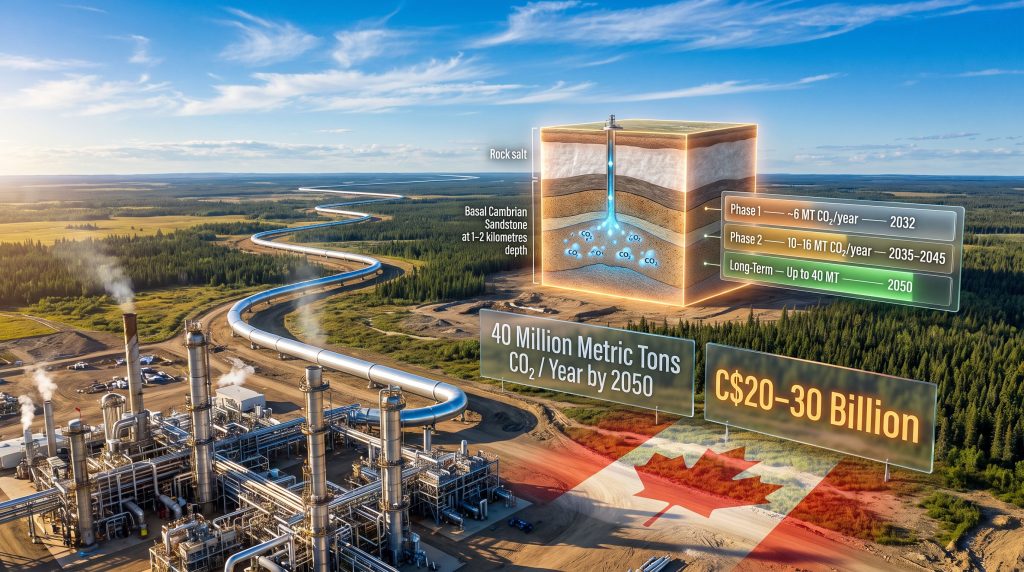
The geology of the chosen storage formation is critical to understanding why this location was selected. The target reservoir is the Basal Cambrian Sandstone, a porous sedimentary layer sitting between one and two kilometres underground. What makes this formation particularly attractive for long-term sequestration is the presence of a dense, non-porous rock salt layer above it, acting as a natural containment cap that prevents upward migration of injected CO₂. Geologists assess this type of caprockConfiguration as among the most reliable available for permanent sequestration, offering containment integrity over geological timescales rather than merely human-scale monitoring horizons.
Staged Rollout and Capacity Targets
The project is designed for phased construction, which distributes capital expenditure over time and reduces the risk of concentration in a single large build cycle.
| Project Phase | CO₂ Capture Target | Operational Timeline |
|---|---|---|
| Phase 1 | ~6 million metric tons/year | 2032 |
| Phase 2 | 10 to 16 million metric tons/year | 2035 to 2045 |
| Long-Term Vision | Up to 40 million metric tons/year | By 2050 |
Construction mobilisation is targeted as early as September 2027, with Phase 1 infrastructure scheduled to enter service by January 1, 2032. If fully realised, the long-term ambition of sequestering up to 40 million metric tons of CO₂ annually by 2050 would make the Pathways carbon capture project the largest operational CCS network anywhere on Earth by a substantial margin.
The Non-Binding Agreement That Shifted the Political Landscape
What the 2026 Tripartite Agreement Establishes
In mid-2026, Alberta's provincial government, the federal government of Canada, and the five Oil Sands Alliance producers reached a non-binding agreement that formally advanced the Pathways initiative and simultaneously created a framework for expanded oil sands production, including support for a new West Coast export pipeline corridor. As reported by The Globe and Mail, this agreement represents a structured coupling of production expansion with emissions reduction commitments, a political architecture that had previously eluded negotiators for several years.
The linkage to pipeline approvals is not incidental. Increased export access through a West Coast corridor generates additional revenue for oil sands producers, and that revenue is understood to underpin the capital investment required for CCS infrastructure. However, critics argue that locking in expanded production capacity is fundamentally incompatible with a credible pathway to limiting global warming to 1.5 degrees Celsius. These concerns are closely tied to Canada's energy transition challenges, which continue to shape debate around the country's long-term climate commitments.
"It is essential to note that the 2026 agreement is non-binding. Final investment decisions remain contingent on resolving cost-sharing arrangements, securing applicable tax credits, and completing regulatory and environmental consultation processes."
The Fiscal Architecture: Tax Credits and Public-Private Risk Distribution
The economic viability of the Pathways carbon capture project depends substantially on a blended public-private financing model:
- A 50% federal investment tax credit applies to CO₂ capture equipment.
- A 37.5% tax credit tier covers transport and storage infrastructure.
- These incentives are designed to reduce the effective private capital burden on the consortium, making a C$20 to C$30 billion project more commercially viable.
For comparison, the United States offers analogous support through the Inflation Reduction Act's 45Q tax credit, which provides per-tonne payments for permanently sequestered CO₂. The European Union has pursued similar mechanisms through its Innovation Fund and carbon pricing infrastructure. Canada's blended model is broadly competitive with these international frameworks, though the precise effective subsidy rate depends on project phasing and tax credit utilisation timelines.
Cost Profile and Unresolved Risk Allocation
A Budget That Has Already Expanded Significantly
The original cost estimate for the Pathways carbon capture project was placed at C$16.5 billion. Revised projections now range between C$20 billion and C$30 billion, driven by phased scope expansion, inflationary pressures on large-scale infrastructure, rising costs for pipeline right-of-way acquisition, compression equipment, geological characterisation work, and long-term monitoring obligations. This cost trajectory is consistent with the broader pattern seen across major CCS infrastructure globally, where complexity and regulatory requirements consistently push budgets beyond initial estimates.
The Consortium Cost-Sharing Problem
Distributing capital obligations across five independent commercial entities with differing emissions profiles, production volumes, and corporate capital allocation priorities is structurally complex. Companies with higher per-barrel emissions intensity have a stronger economic incentive to participate, but may also face greater financial strain from contributing larger shares of the capital cost. The asymmetry between producers has not been publicly resolved as of mid-2026.
| Risk Category | Description | Mitigation Status |
|---|---|---|
| Cost Escalation | C$16.5B to C$20-30B range | Partially addressed via phased delivery |
| Stakeholder Allocation | Uneven burden distribution across five producers | Unresolved as of mid-2026 |
| Regulatory Approval | Environmental and permitting requirements | Ongoing |
| Policy Continuity | Government support over a 25+ year horizon | Non-binding agreement in place |
A particularly underappreciated risk concerns what happens to project economics if one or more consortium members undergo corporate restructuring or divest their oil sands positions. The departure of a significant contributor could materially alter the cost-sharing model, potentially triggering renegotiation or delay during critical construction windows. Furthermore, financial risks associated with carbon capture in Canada have been documented by energy finance analysts, adding another layer of scrutiny to the project's long-term commercial assumptions.
Environmental and Community Opposition
First Nations, Landowners, and the Missing Federal Assessment
The Pathways carbon capture project faces meaningful social licence challenges that extend beyond regulatory checklists. A coalition of First Nations groups, rural landowners, and farming communities along the proposed pipeline corridor has called for a mandatory federal environmental assessment, arguing that the scale and duration of the infrastructure warrants a more rigorous review process than currently required.
A 2024 regulatory ruling determined that a formal federal environmental assessment was not required for the project. Critics contend that this determination fails to account for the cumulative impact of a 650-kilometre pipeline network crossing Indigenous territories, agricultural land, and sensitive water catchments. The absence of a mandated review creates ongoing social licence risk that could complicate land access negotiations and construction timelines.
Key concerns raised by affected communities include:
- Potential groundwater interaction along pipeline corridors.
- Long-term liability for CO₂ storage, particularly in the event of unexpected geological migration.
- The adequacy of consultation processes for a project with a 25-plus year operational footprint.
- Economic benefit distribution to Indigenous communities along the infrastructure corridor.
Meaningful consultation frameworks for multi-decade infrastructure projects require early engagement, revenue-sharing structures, and co-management provisions, elements that are still being developed for the Pathways initiative.
How the Pathways Project Compares Globally
Benchmarking Against the World's Existing CCS Facilities
To appreciate the ambition embedded in the Pathways carbon capture project, it is instructive to compare it against the global landscape of operational CCS facilities.
| Project | Location | Target Capacity (MT CO₂/year) | Estimated Cost | Status |
|---|---|---|---|---|
| Pathways CCS | Alberta, Canada | Up to 40 MT by 2050 | C$20 to C$30B | Non-binding agreement, 2026 |
| Northern Lights | Norway | 1.5 MT (Phase 1) | ~US$2.6B | Operational since 2024 |
| Quest CCS | Alberta, Canada | ~1 MT | ~C$1.35B | Operational since 2015 |
| Boundary Dam | Saskatchewan, Canada | ~1 MT | ~C$1.5B | Operational (underperforming) |
| Sleipner | Norway | ~1 MT | Undisclosed | Operational since 1996 |
The Boundary Dam project in Saskatchewan is a particularly instructive precedent. Despite being one of the first commercial-scale CCS facilities applied to coal power generation, it has consistently fallen short of its designed capture rate targets, highlighting the gap between engineering projections and operational reality at scale. The Pathways consortium must account for these lessons in its technical design and performance modelling.
"At its long-term ambition, the Pathways carbon capture project targets sequestration volumes roughly 27 times larger than any single currently operational CCS facility in the world. Whether the underlying capture and compression technology is sufficiently proven at that scale remains an open technical question."
The next major ASX story will hit our subscribers first
Canada's Net-Zero Strategy and the Role of CCS as a Bridging Technology
Oil Sands Emissions and the National Accounting Challenge
The oil sands sector represents one of the largest single sources of greenhouse gas emissions within Canada's national inventory. Achieving the country's legislated net-zero by 2050 target requires absolute emissions reductions from this sector, not merely intensity improvements. The Pathways carbon capture project, if Phase 1 delivers its targeted 6 million metric tons per year, would contribute meaningfully toward the 10 to 12 million metric ton reduction targeted for the 2030 interim milestone, though it would not achieve that goal alone.
Most federal climate frameworks position CCS as a transitional technology rather than a permanent solution, intended to manage emissions during the period before lower-carbon production methods or alternative energy systems can be fully deployed. This framing matters for investors, because it implies that CCS-reliant business models may face increasing scrutiny as the energy transition matures. In addition, the broader relationship between critical minerals and energy security is reshaping how governments and investors assess long-term resource sector strategies across Canada.
Key Milestones and Decision Points Ahead
The Critical Path From Agreement to Operations
Several non-negotiable prerequisites must be satisfied before the Pathways carbon capture project can advance to construction:
- Cost-sharing resolution among the five consortium members, establishing binding capital contribution obligations.
- Tax credit confirmation through federal budget legislation, ensuring the 50% and 37.5% credits are available as structured.
- Regulatory approval from provincial and federal agencies, including environmental and land-use permits.
- Social licence development through Indigenous and community consultation processes along the pipeline corridor.
- Final Investment Decision (FID), expected to follow satisfaction of the above conditions.
Construction mobilisation is targeted for September 2027 at the earliest, with a hard operational target of January 1, 2032 for Phase 1 infrastructure. Any slippage in the regulatory or cost-sharing timelines compresses the construction window considerably, given the complexity of a 650-kilometre pipeline build in northern Alberta's climate.
Factors That Could Delay or Derail the Project
- Federal and provincial election cycles introducing policy uncertainty over a 25-plus year horizon.
- Carbon price trajectory changes reducing the economic return on CCS investment.
- Sustained low crude oil prices constraining consortium members' capital budgets.
- Escalating construction costs in a tight labour and materials environment.
- Legal challenges from First Nations groups asserting inadequate consultation.
Frequently Asked Questions About the Pathways Carbon Capture Project
What is the Pathways Carbon Capture and Storage project?
The Pathways CCS project is a large-scale industrial decarbonisation initiative in northern Alberta, Canada, led by a consortium of five major oil sands producers. It is designed to capture CO₂ from oil sands operations, transport it via a 650-plus kilometre pipeline network, and permanently store it underground near Cold Lake, Alberta.
Who is behind the Pathways project?
The project is led by the Oil Sands Alliance, comprising Canadian Natural Resources, Imperial Oil, Suncor, Cenovus Energy, and ConocoPhillips.
When will the Pathways project begin operations?
Phase 1 infrastructure is targeted to be in service by January 1, 2032, with construction potentially commencing as early as September 2027.
How much CO₂ will the Pathways project capture?
Phase 1 targets approximately 6 million metric tons of CO₂ per year. Long-term ambitions extend to 40 million metric tons annually by 2050.
How much does the Pathways project cost?
Initial estimates placed the cost at C$16.5 billion, but revised projections now range between C$20 billion and C$30 billion due to phased scaling and inflationary pressures.
Is the Pathways project approved?
As of mid-2026, a non-binding agreement has been reached between Alberta, the federal government, and the five consortium producers. Full regulatory approval and a final investment decision have not yet been confirmed.
What are the main concerns about the Pathways project?
Key concerns include unresolved cost-sharing among consortium members, opposition from First Nations and rural communities along the pipeline corridor, the absence of a mandatory federal environmental assessment, and long-term policy continuity risk across a multi-decade project horizon.
The Broader Canadian Resource Sector: Other Major Developments in 2026
Critical Minerals Supply Chains Under Intensifying Pressure
Beyond the Pathways carbon capture project, Canada's broader resource sector is navigating a set of structural shifts with significant long-term implications. The International Energy Agency's Global Critical Minerals Outlook 2026 documented how supply risks intensified throughout 2025 and into 2026, driven by rising commodity prices and the expansion of export controls by dominant producing nations. The critical minerals demand surge observed over recent years has further complicated supply chain planning for industries globally, with China's continued dominance in refining most key energy transition minerals remaining a systemic vulnerability.
The IEA's analysis found that if China's expanded rare-earth export controls were fully enforced, industries outside China producing an estimated US$6.5 trillion worth of goods annually could face material supply disruptions. This figure underscores why governments are being urged to invest in more diversified and resilient supply chains, a policy imperative that has direct relevance for Canadian mining and processing capacity.
Mine Closures, Mergers, and New Approvals Reshaping the Landscape
Several other significant developments are reshaping Canada's resource sector in parallel with the Pathways initiative:
-
Ekati diamond mine closure: Burgundy Diamond Mines' Ekati operation in the Northwest Territories entered court-supervised receivership, with PricewaterhouseCoopers appointed to manage operations, maintenance, reclamation, and closure. The mine had been expected to operate until 2029, but structurally falling diamond prices rendered the subsidiary Arctic Canadian Diamond Co. unable to service its financial obligations, despite a C$115 million federal loan extended in late 2025. This closure underscores the vulnerability of single-commodity mining operations to sustained price deterioration.
-
Sugar Zone gold mine potential restart: Australian miner Genesis Minerals is set to acquire Vault Minerals, gaining control of the Sugar Zone gold mine near White River, Ontario. The proposed merger, valued at approximately A$12.3 billion, would create a combined producer with annual gold output potential of up to 700,000 ounces. Rival bidder Regis Resources withdrew its competing offer after declining to match Genesis's terms. The Sugar Zone had been shuttered since 2023, and its potential restart signals renewed international appetite for Canadian gold assets.
-
Angus silica sand project approved: British Columbia granted environmental assessment approval for Vitreo Minerals' proposed C$300 million Angus silica sand mine near Bear Lake. The project is designed to supply domestically produced fracking sand to oil and gas operations, reducing dependence on U.S. imports. It will operate under 19 legally binding conditions covering air quality and Indigenous community impacts, and is initially permitted for a 20-year operating life.
-
Cigar Lake uranium mine resumption: Cameco's Cigar Lake mine in Saskatchewan resumed production following a temporary shutdown caused by an expansion joint failure at Orano's McClean Lake sulfuric acid plant, which processes the mine's ore. Both Cameco and Orano confirmed their 2026 production forecasts remain unchanged, suggesting the interruption was operationally contained.
Consequently, these developments collectively reflect broader resource and energy export challenges that extend well beyond Canada's borders, as nations globally grapple with balancing production growth against decarbonisation commitments. Furthermore, the adoption of renewable energy in mining continues to gain momentum as operators seek to reduce both emissions and operating costs across their asset portfolios.
Readers seeking ongoing professional coverage of Canadian mining, metallurgy, and petroleum sector developments can explore CIM Magazine at magazine.cim.org, published by the Canadian Institute of Mining, Metallurgy and Petroleum.
This article contains forward-looking statements, cost projections, and timeline estimates that are subject to change. The Pathways carbon capture project has not yet received a final investment decision or full regulatory approval as of mid-2026. Readers should not interpret any information in this article as financial or investment advice.
Want to Track the Next Major Resource Discovery Before the Market Does?
Discovery Alert's proprietary Discovery IQ model scans ASX announcements in real time, delivering instant alerts on significant mineral discoveries — from critical minerals driving the energy transition to gold and beyond — so subscribers can act on actionable opportunities ahead of the broader market. Explore historic discoveries and the returns they generated, then begin a 14-day free trial at Discovery Alert to position yourself at the forefront of the next major find.