July 18, 2026
The Materials Bottleneck That Has Quietly Constrained Aerospace Engineering for Decades
Every incremental leap in jet engine efficiency, nuclear reactor output, and advanced power generation has ultimately collided with the same invisible ceiling: the physical limits of the metals holding these systems together. Superalloys — the high-performance metal formulations engineered to survive where conventional materials fail — have long represented both the enabler and the constraint of extreme-environment engineering. Developing them through traditional methods has been one of the most resource-intensive undertakings in applied materials science, consuming years of laboratory work and enormous capital investment for incremental gains.
That dynamic is now shifting in a fundamental way. When an AI lab creates superalloys capable of outperforming decade-old aerospace benchmarks within a matter of weeks, it signals something more significant than a single research milestone. It points toward a structural change in how humanity develops the materials its most demanding industries depend on.
When big ASX news breaks, our subscribers know first
Why Traditional Superalloy Development Has Hit a Wall
The challenge of designing high-performance alloys is not primarily a chemistry problem. It is a combinatorial mathematics problem wrapped inside an experimental logistics crisis.
Modern nickel- and cobalt-based superalloys routinely incorporate up to ten distinct elemental additions. Chromium, aluminum, titanium, molybdenum, rhenium, and tungsten are common contributors, each serving specific functions from grain boundary strengthening to oxidation protection. Understanding nickel properties and uses is, furthermore, essential context for appreciating why even marginal changes in elemental proportion can alter an alloy's creep resistance, thermal fatigue behaviour, or printability in ways that are not predictable without physical testing.
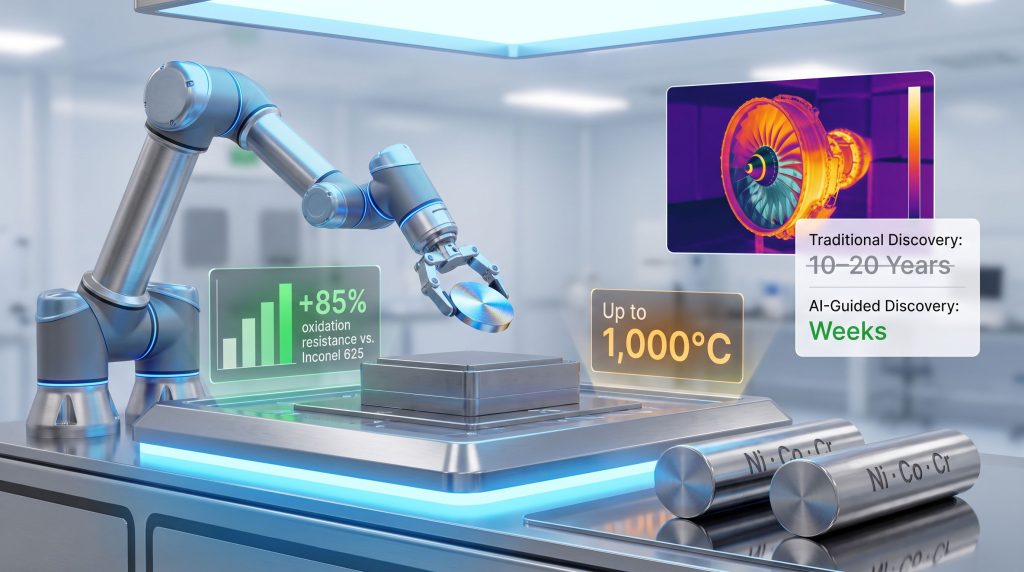
When researchers map out the full compositional design space across ten or more elements, the number of theoretically viable formulations runs into the tens of thousands. Testing each candidate sequentially, through conventional fabrication and characterisation methods, produces development timelines that historically span 10 to 20 years from initial concept to deployable material.
For aerospace certification purposes, that timeline is compounded further. A material that performs excellently in laboratory hardness tests must subsequently survive fatigue cycling, thermal shock, high-cycle mechanical loading, and oxidation exposure before it qualifies for flight-critical components. The discovery phase alone has consumed decades of research investment for alloys that are now considered standard.
The materials discovery bottleneck is not fundamentally a chemistry problem. It is a data-throughput problem, and artificial intelligence changes the core economics of that equation.
What a Self-Driving Lab Actually Does — and Why It Is Different
The concept of a self-driving or autonomous laboratory is frequently discussed in general terms, but understanding why it produces such dramatically different outcomes from conventional research requires examining its architecture in detail.
The Three Interconnected Systems
A properly constructed self-driving materials lab integrates three functional layers that conventional research keeps separate:
- Computational modelling selects candidate elemental compositions based on predicted performance outcomes derived from prior experimental results and physical metallurgical principles.
- Robotic fabrication manufactures physical alloy samples from those computationally selected compositions, eliminating the human preparation bottleneck between prediction cycles.
- Automated characterisation measures key performance metrics including hardness retention at elevated temperature, oxidation resistance, and printability without requiring manual intervention between experimental rounds.
The critical distinction is what happens after each cycle. In a conventional laboratory, a researcher reviews results, applies expert judgement, formulates a new hypothesis, and initiates the next experimental batch. In a closed-loop autonomous system, however, the experimental results flow directly back into the machine learning model, which immediately recalibrates its probabilistic understanding of the design space and selects the next batch of compositions to test.
Active Learning: Operating Without a Map
The specific AI methodology underpinning the University of Toronto platform is active learning — a class of machine learning architecture designed to function effectively in data-sparse environments. This is a critically important distinction from standard machine learning approaches.
Most materials informatics models require extensive historical datasets to generate reliable predictions. When a research team wants to explore a compositional region with little or no prior experimental data, conventional machine learning models have no foundation from which to extrapolate. As doctoral researcher Ajay Talbot explained in describing the challenge, working in unexplored regions of the alloy design space leaves a model essentially without guidance, since the data needed to learn simply does not yet exist.
Active learning resolves this by continuously selecting the experiments most likely to reduce model uncertainty, regardless of whether a large prior dataset exists. Each experimental cycle generates new information, which narrows the effective search space and improves predictive confidence. The system consequently converges on high-performing formulations with far fewer physical iterations than brute-force screening would require.
The numbered sequence of a single discovery cycle operates as follows:
- The AI model selects candidate elemental compositions based on current uncertainty mapping.
- Robotic systems fabricate physical alloy samples from those compositions.
- Automated testing measures hardness, oxidation resistance, and printability.
- Results re-enter the machine learning model as new training data.
- The model updates its predictions and selects the next experimental batch.
- The cycle repeats until high-performing formulations are reliably identified.
How an AI Lab Creates Superalloys: The University of Toronto Results
Researchers from the University of Toronto Engineering faculty, working under Professor Yu Zou — Canada Research Chair in Materials and Manufacturing for Extreme Environments — developed the active learning platform in collaboration with materials science Professor Jason Hattrick-Simpers. The project received support from the University of Toronto's Acceleration Consortium, a global partnership connecting academic institutions, governments, and industry partners around AI-driven materials discovery.
The team focused its initial demonstration on compositionally complex alloys constructed from three principal metals: nickel (Ni), cobalt (Co), and chromium (Cr). These three elements form the chemical backbone of most aerospace-grade superalloys due to their complementary contributions to heat resistance, mechanical strength, and corrosion protection. In addition, global cobalt production trends are directly relevant here, as cobalt's availability underpins the scalability of these alloy systems.
Within weeks of initiating the closed-loop platform, the system identified six new 3D-printable superalloy formulations — a result that would have required years of sequential laboratory work using conventional discovery methods.
Performance Against the Aerospace Benchmark: Inconel 625
The research team benchmarked its discoveries against Inconel 625, the prevailing industry standard in aerospace superalloy applications. Inconel 625 is a nickel-based alloy containing more than ten distinct elemental additions, engineered over decades of incremental refinement.
Two specific AI-identified formulations demonstrated measurable performance advantages:
| Alloy Composition | Primary Performance Target | Result vs. Inconel 625 | Temperature Zone |
|---|---|---|---|
| 12% Ni / 62% Co / 26% Cr | High-temperature hardness retention | +4.5% improvement | Up to 600°C (1,112°F) |
| 36% Ni / 14% Co / 50% Cr | High-temperature oxidation resistance | +85% improvement | Up to 1,000°C (1,830°F) |
The oxidation-resistance result is particularly striking. At temperatures approaching 1,000°C, metallic surfaces develop oxide scale through sustained reaction with atmospheric oxygen. This scale gradually consumes and structurally degrades the underlying material — a primary failure mechanism in turbine rear stages. An 85% improvement in oxidation resistance over a multi-decade industry benchmark, achieved using only three elemental components compared to Inconel 625's ten-plus, represents a material step change in compositional efficiency.
It is worth noting that Professor Zou has emphasised the substantial unmet demand for materials capable of surviving extreme temperature and pressure swings — a demand that current alloy development pipelines are structurally unable to satisfy at pace. The self-driving lab platform represents a direct architectural response to that gap. For broader context, tungsten's strategic importance as a refractory addition in next-generation superalloy systems further underscores the complexity of the compositional design challenge.
Why 3D Printability Is Not an Afterthought
The decision to engineer specifically for additive manufacturing compatibility reflects a deeper understanding of where aerospace manufacturing is heading. Laser powder bed fusion and directed energy deposition — the primary metal 3D printing methods for structural components — subject alloys to extraordinarily rapid and repeated thermal cycling during the build process.
Alloys optimised for traditional casting or forging routinely develop cracks, porosity, or residual stress concentrations when printed layer by layer, because their solidification behaviour was never designed for that thermal profile. Alloys purposefully engineered for printability, however, unlock a fundamentally different set of manufacturing capabilities:
- Gradient material properties within a single component, where composition and microstructure vary continuously to optimise local performance.
- Complex internal geometries such as conformal cooling channels in turbine blades that are geometrically impossible to cast.
- Near-zero tooling constraints, enabling rapid design iteration without costly mould or die investments.
- Component consolidation, where multiple traditionally separate parts are printed as a single integrated structure, reducing assembly complexity and potential failure points.
A single printed turbine component could, in principle, incorporate a chromium-rich oxidation-resistant outer surface and a cobalt-forward hardness-optimised core — tailored to the distinct thermal environments each region actually experiences during operation.
How This Compares to AI Metallurgy Advances Globally
The University of Toronto platform is one node in a rapidly expanding global research effort applying AI to materials discovery. A comparative view illustrates both the breadth of the movement and the specific advantages of the closed-loop active learning approach:
| Institution | AI Methodology | Key Achievement | Performance Metric |
|---|---|---|---|
| University of Toronto | Active learning + closed-loop robotics | 6 new 3D-printable Ni-Co-Cr superalloys | Up to 85% better oxidation resistance vs. Inconel 625 |
| NASA | Computational simulation | GRX-810 oxide dispersion strengthened alloy | 1,000x greater creep rupture life vs. Inconel 718 in 30 simulations |
| Virginia Tech | Explainable AI + supercomputing | New class of multiple principal element alloys (MPEAs) | Superior strength-to-weight ratios at extreme temperatures |
| A*STAR (Singapore) | Moment tensor potential ML model | Structure-property mapping in high-entropy alloys | Accelerated MPEA design for high-temperature applications |
| NIMS and Nagoya University | AI-guided two-step thermal aging | Nickel-aluminum alloys with enhanced high-temperature strength | Outperforms conventionally processed equivalents |
What distinguishes the Toronto approach from most competing methodologies is its capacity to operate from a near-zero data baseline. NASA's GRX-810 breakthrough, while extraordinary in its performance gains, relied on pre-existing computational frameworks and simulation databases. The Toronto active learning platform, by contrast, is specifically architected to explore territory where no prior data exists — a capability that becomes increasingly valuable as researchers push toward more complex compositional systems. Furthermore, AI in mineral discovery is advancing in parallel, reinforcing how broadly transformative these algorithmic approaches are becoming across materials-related fields.
Industrial Applications: Where AI-Designed Superalloys Will Matter Most
Aerospace Turbine Systems
The thermal gradient within a modern jet engine is extreme and non-uniform. Compressor stages near the engine intake operate in the 500 to 700°C range, while combustor exit and turbine inlet temperatures in advanced engines can exceed 1,700°C — above the melting point of the nickel superalloys used in blade construction, which survive only through sophisticated internal cooling. The two newly identified alloy formulations were explicitly benchmarked against these distinct thermal zones, suggesting that AI-guided compositional optimisation could eventually enable zone-specific alloy selection within a single engine architecture.
Nuclear Energy Infrastructure
Superalloy qualification for nuclear applications involves an additional layer of complexity beyond standard aerospace requirements. Radiation embrittlement progressively alters mechanical properties over years of reactor operation, and coolant chemistry creates corrosive environments that demand sustained oxidation resistance. Both Generation IV fission reactor designs and emerging commercial fusion concepts require structural materials capable of surviving sustained high-temperature, high-radiation, chemically aggressive environments — a performance envelope that AI-accelerated discovery could help populate much faster than traditional methods.
Power Generation and Defence
Industrial gas turbines for power generation face similar thermal challenges to aerospace engines but operate continuously for extended periods rather than intermittently. The economic case for materials with superior oxidation resistance is measured not just in performance but in maintenance intervals and component lifecycle cost. Defence applications — including hypersonic vehicle thermal protection and advanced propulsion systems — represent an additional demand vector where the speed of AI-guided discovery carries strategic significance. Consequently, the intersection of these industrial needs with rising critical minerals demand creates a powerful structural case for accelerating AI-driven alloy development pipelines.
The next major ASX story will hit our subscribers first
The Roadmap: What Comes After Three Elements
The nickel-cobalt-chromium system explored in the University of Toronto research is, as Talbot himself acknowledged, a relatively simple compositional platform in the broader context of superalloy metallurgy. Its value lies in demonstrating that the closed-loop discovery architecture functions reliably even when starting from minimal prior knowledge — a proof of concept that validates the methodology itself.
The research team's planned development trajectory involves two parallel expansions:
Temperature ceiling extension: Current validated benchmarks reach 1,000°C. The next target threshold is 1,200°C (2,192°F), which would position AI-designed alloys within the performance range required for the most thermally demanding aerospace and energy applications currently under development.
Compositional complexity expansion: Future platform iterations are planned to incorporate 10 to 12 principal elements, introducing additional strengthening mechanisms including oxide dispersion strengthening, solid solution hardening from refractory additions, and gamma-prime precipitation hardening. The combinatorial space for a 12-element system is exponentially larger than a 3-element system — precisely the condition where AI guidance becomes not merely helpful but computationally necessary.
Independent reporting from Interesting Engineering has further highlighted how AI-designed superalloys are attracting attention across multiple research communities, reinforcing the significance of what this approach represents for the field.
Timeline Compression in Context:
- Traditional alloy discovery phase: 10 to 20 years
- AI-guided active learning discovery phase: Weeks to months
- NASA's GRX-810 achieved breakthrough performance results in 30 computational simulations
- Net effect: Development resources shift from the discovery phase toward validation and regulatory qualification
It is critical to understand that current laboratory results represent materials discovery outcomes, not flight-qualified components. The pathway from identified formulation to certified aerospace application still requires extensive mechanical characterisation, fatigue testing, oxidation exposure trials, and regulatory qualification under aviation authority frameworks. The significance of the AI breakthrough is, however, in compressing the front end of that pipeline, freeing engineering resources to focus on the validation work that actually places materials into service.
Frequently Asked Questions: AI Lab Creates Superalloys
What makes a superalloy different from a standard high-strength metal?
A superalloy is specifically engineered to maintain structural integrity, mechanical strength, and oxidation resistance at temperatures where conventional metals would soften, oxidise, or creep under load. The defining characteristic is performance retention at elevated temperature — typically above 600°C — rather than simply high room-temperature strength.
What is active learning and why does it matter for materials discovery?
Active learning is a machine learning methodology that selects its own training data by identifying which experiments will most reduce its current uncertainty. Unlike standard supervised learning, it does not require a large pre-existing dataset. In materials discovery, this means the system can explore chemically uncharted territory from a standing start, making it particularly suited to identifying formulations that no one has previously studied.
Are these new alloys ready for jet engine deployment?
Not yet. The current results represent laboratory-stage materials discovery. Certifying a material for flight-critical aerospace applications requires a separate, extensive qualification process involving fatigue analysis, environmental exposure testing, and regulatory approval. The importance of this breakthrough is in accelerating the discovery phase, not bypassing the validation requirements that follow.
Why does chromium content vary so dramatically between the two benchmark formulations?
Chromium serves a dual function in nickel-cobalt-chromium alloys. At moderate concentrations, it contributes to solid solution strengthening and general corrosion resistance. At higher concentrations, chromium becomes the primary mechanism for oxidation protection through the formation of a stable, adherent chromia (Cr₂O₃) scale on exposed surfaces. The high-chromium formulation (50% Cr) is specifically optimised for the rear turbine environment where sustained oxidation resistance at 1,000°C is the dominant performance requirement.
How does additive manufacturing change what superalloys need to do?
Metal 3D printing subjects alloys to thermal conditions fundamentally different from casting or forging. Laser-based processes create localised melt pools that solidify in milliseconds, generating steep thermal gradients and rapid cooling rates. Alloys not designed for this thermal profile develop microstructural defects during printing. Purpose-designed printable superalloys avoid these failure modes and simultaneously unlock manufacturing geometries — including complex internal cooling structures and gradient-property components — that conventional fabrication methods cannot produce. Recent academic coverage in ScienceDirect has further detailed the microstructural considerations underpinning printable alloy design, providing additional technical grounding for these findings.
Readers interested in further coverage of AI-driven materials science, critical mineral supply chains, and advanced manufacturing technology can explore additional reporting through Metal Tech News.
Want To Stay Ahead of the Next Major Materials and Minerals Breakthrough?
Discovery Alert's proprietary Discovery IQ model delivers real-time alerts on significant ASX mineral discoveries — including the critical metals like nickel, cobalt, and chromium underpinning next-generation superalloy development — ensuring subscribers can identify actionable opportunities the moment they emerge. Explore historic discoveries and their remarkable returns, then begin your 14-day free trial to position yourself ahead of the broader market.