July 15, 2026
Deepwater Africa at an Inflection Point: Why Integrated Subsea Contracts Are Reshaping Offshore Development
The economics of deepwater oil and gas development have undergone a quiet but profound transformation over the past decade. Where once a major offshore field expansion might involve a patchwork of specialist vendors, separate installation contractors, and fragmented project management structures, the industry is increasingly converging on a different model: unified, integrated execution delivered by joint ventures that combine engineering design, hardware manufacturing, and offshore installation under a single contractual umbrella.
This shift is not accidental. It reflects hard lessons learned from cost overruns, interface failures, and scheduling delays on complex multi-well systems operating at depths where every additional mobilisation costs tens of millions of dollars. Furthermore, commodity trading giants have taken note of how this integrated model reduces project risk and improves capital efficiency across the deepwater sector.
Nowhere is this evolution more visible right now than off the coast of West Africa, where Eni awards SLB OneSubsea contract for Baleine field phase 3 marks a watershed moment for Côte d'Ivoire's deepwater ambitions and for the regional offshore industry more broadly.
When big ASX news breaks, our subscribers know first
Baleine Phase 3: A Transformation in Scale, Not Just an Expansion
To appreciate what Phase 3 represents, it helps to understand just how dramatically the numbers change. The Baleine field, located on offshore blocks CI-101 and CI-802 at approximately 1,200 metres of water depth, has already delivered two successful production phases. Phase 1 came online in August 2023, with Phase 2 following in late 2024. Together, those two phases established a combined oil output of around 60,000 barrels per day and gas production of roughly 80 million cubic feet per day.
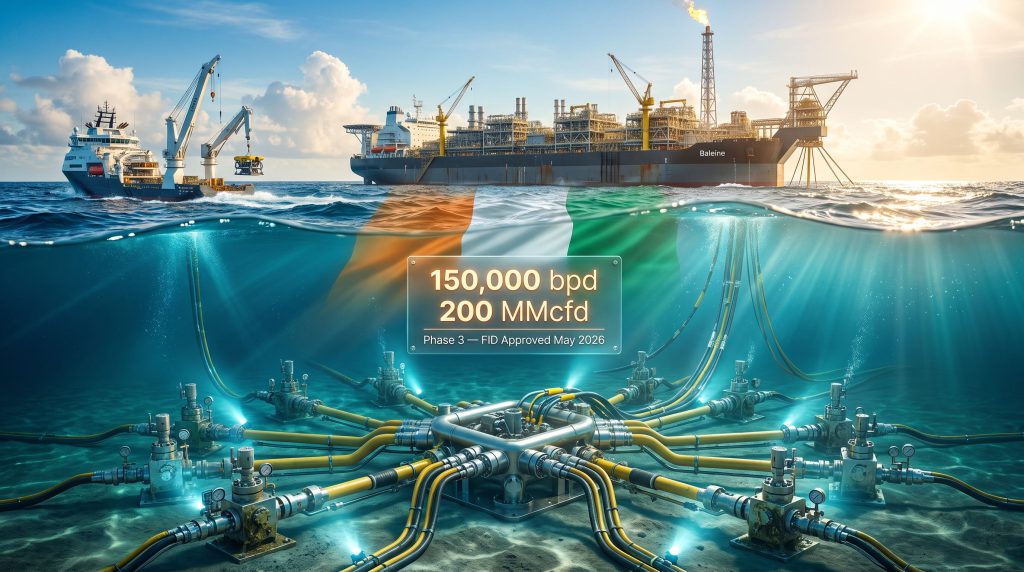
Phase 3, for which Final Investment Decision was sanctioned in May 2026 by Eni and its field partners Petroci and Vitol, targets a step-change rather than a marginal improvement.
| Development Phase | Oil Output (bpd) | Gas Output (MMcfd) | Status |
|---|---|---|---|
| Phase 1 | ~60,000 | ~80 | Online (Aug 2023) |
| Phase 2 | ~60,000 | ~80 | Online (Late 2024) |
| Phase 3 (Target) | 150,000 | 200 | FID Approved May 2026 |
The planned uplift to 150,000 barrels per day represents a 150% increase from the current combined output base. Gas volumes are targeted to reach 200 million cubic feet per day, a 2.5x multiplier on existing production. These are not incremental engineering adjustments. They require a fundamentally different subsea architecture, a new floating production, storage and offloading vessel, and a level of capital commitment that places Baleine among the most consequential deepwater investment decisions in West Africa in years.
The commodity price impact on project economics cannot be overstated here. What makes the Phase 3 FID particularly significant from an industry perspective is the speed at which it followed Phase 1 and Phase 2 execution. Eni's willingness to commit to a third major capital phase while earlier phases were still ramping up signals exceptional confidence in both reservoir performance and the operational execution model being employed.
What Is SLB OneSubsea and Why Does Its Selection Matter?
The Tripartite Joint Venture Structure
SLB OneSubsea is not a conventional oilfield services contractor. It operates as a tripartite joint venture bringing together three distinct but complementary competencies: SLB (formerly Schlumberger) contributes technology development, subsea control systems, and global project management infrastructure; Aker Solutions brings deep engineering capability in subsea production systems and hardware fabrication; and Subsea7 provides marine installation and offshore construction expertise.
The combination matters enormously in practice. Most deepwater developments have historically suffered from what the industry calls interface risk — the point where responsibility transitions between one contractor and another. When the company designing the subsea tree is different from the one manufacturing it, and different again from the company installing it, each handover creates potential for schedule slippage, technical incompatibility, and contractual disputes.
SLB OneSubsea's integrated structure eliminates several of these interfaces by design. The same organisational entity that engineers the system also procures the components and installs them at the seabed. For a project operating at 1,200 metres water depth, where a single vessel day-rate can exceed $500,000, this coordination advantage has direct and measurable financial value. According to SLB OneSubsea's official announcement, the contract scope reflects the full breadth of this integrated capability.
Local Presence as a Competitive Differentiator
A less widely discussed advantage in the SLB OneSubsea selection is the joint venture's existing operational footprint in Côte d'Ivoire. In deepwater project execution, mobilising equipment and personnel from scratch into a new country involves customs clearance, local content compliance, crew logistics, and supply chain establishment timelines that can add months to a project schedule. An operator already embedded in the country's offshore supply chain bypasses much of this friction.
For a Phase 3 development that Eni appears intent on executing on an accelerated timeline, that pre-existing local infrastructure is not a minor advantage. It is a scheduling enabler with tangible capital efficiency implications.
SLB OneSubsea's chief executive Mads Hjelmeland described the project as combining scale with certainty of execution, a formulation that captures precisely what integrated contracting is designed to deliver at this level of field complexity.
The Subsea Production System: Engineering 13 Wells at Depth
Core Equipment Scope
The Engineering, Procurement and Construction contract awarded to SLB OneSubsea covers the full subsea production system for 13 development wells. Each piece of equipment in this scope performs a specific and non-substitutable function within the overall production architecture:
- Subsea trees act as the primary wellhead control interface at the seabed, managing flow rates, pressure regulation, and emergency shut-in capability for individual wells. In deepwater contexts, these are remotely operated units that must function reliably at pressures and temperatures that would destroy conventional surface equipment.
- Manifolds serve as the gathering infrastructure of the subsea network, consolidating production streams from multiple wells into a single export pathway toward the FPSO. Their design must account for flow assurance challenges including hydrate formation and wax deposition at cold deepwater temperatures.
- Umbilicals are the communication and control lifelines of the entire system, carrying hydraulic fluid for valve actuation, electrical power for instrumentation and controls, and fibre-optic data channels for real-time monitoring. Routing these bundles across 1,200 metres of water column introduces significant engineering complexity around bend radius, tension management, and corrosion protection.
- Multiphase flowmeters measure the simultaneous flow of oil, gas, and water within a single production stream without requiring physical separation. This technology eliminates the need for test separator infrastructure at the wellhead level, reducing topside weight on the FPSO and dramatically improving real-time reservoir management accuracy.
- Control systems integrate all subsea electronics, managing valve states, monitoring sensor outputs, and executing safety responses across the entire well array from the surface control room.
Why 13 Wells Creates a Different Order of Complexity
A single-well subsea tieback is a relatively straightforward engineering exercise. However, thirteen wells operating as an interconnected production network at 1,200 metres depth is categorically different. Manifold design must account for the simultaneous pressure contributions of wells at different stages of their production decline. Control system architecture must provide redundancy pathways so that a single component failure does not compromise multiple wells.
Technical Note: Multiphase flowmeters are among the less-discussed but strategically important technologies in modern deepwater development. By removing the requirement for physical test separators at each wellhead cluster, they reduce the complexity and weight burden on floating production facilities while providing more granular real-time data for reservoir management decisions. At 150,000 bpd target throughput, the accuracy of these measurements directly influences allocation calculations between partners and reservoir modelling for future infill drilling decisions.
Dual-Contractor Strategy: SLB OneSubsea and TechnipFMC
Complementary Scopes, Specialist Contractors
Phase 3 is being executed under a dual-contractor model that reflects the technical specialisation now standard at this scale of deepwater development. Alongside the SLB OneSubsea award for subsea production systems, Eni has separately contracted TechnipFMC to supply flexible flowlines and risers for the project, with that contract valued in the range of $75 million to $250 million.
The logic of this split is worth understanding. Flexible flowlines and risers occupy a fundamentally different engineering and manufacturing domain from subsea production trees and control systems. Flexible pipe technology involves proprietary multilayer composite designs, dynamic fatigue analysis for the riser sections that must accommodate FPSO vessel motion, and thermal insulation engineering to manage hydrate risk over long flowline distances. TechnipFMC is among a very small number of companies globally with the manufacturing capacity and technical track record to supply these systems at this scale. As Hart Energy's upstream reporting confirms, the dual-contractor approach reflects deliberate technical boundary-setting by Eni's project team.
| Metric | Baleine Phase 3 | Typical West African Deepwater |
|---|---|---|
| Water Depth | ~1,200 metres | 800–2,000 metres |
| Well Count (Phase 3) | 13 wells | 8–20 wells per phase |
| Target Oil Output | 150,000 bpd | 100,000–200,000 bpd |
| FID to Production Timeline | Fast-track | 3–5 years typical |
| New FPSO Required | Yes | Common at this scale |
The New FPSO: Why Phase 3 Requires Dedicated Surface Infrastructure
Function and Necessity of a New Floating Facility
A floating production, storage and offloading vessel functions as the central processing hub for an offshore field, receiving raw wellstream fluids from the seabed, separating oil, gas, and water, treating each stream to export specification, storing crude until offtake tanker arrival, and continuously offloading to maintain production continuity.
The decision to commission an entirely new FPSO for Phase 3 rather than expanding processing capacity on existing infrastructure reflects the scale discontinuity involved. Increasing throughput by 150% while simultaneously doubling gas output exceeds what process modifications to existing vessels could practically accommodate.
Beyond raw processing capacity, the new vessel's design incorporates upgraded safety systems and improved environmental performance specifications — areas where regulatory expectations and operational best practice have advanced considerably since the Phase 1 FPSO was specified. The sequencing of subsea installation relative to FPSO hookup follows a well-established deepwater project logic, allowing parallel workstreams and reducing overall time to first oil.
The next major ASX story will hit our subscribers first
Baleine's Broader Significance for Côte d'Ivoire's Energy Economy
Gas as a Domestic Energy Multiplier
The conversation around Eni awards SLB OneSubsea contract for Baleine field phase 3 is frequently framed in terms of oil production volumes, but the gas dimension may ultimately prove equally consequential for Côte d'Ivoire's economic development trajectory. The country relies heavily on natural gas-fired power generation to meet domestic electricity demand, and its industrial growth ambitions are directly constrained by the reliability and cost of that electricity supply.
Scaling gas output from 80 to 200 MMcfd creates significant headroom for both industrial electricity consumption and for expanding gas supply to neighbouring countries within the West African regional grid framework. In this context, monitoring natural gas price trends becomes increasingly relevant to understanding the commercial returns Eni and its partners can expect from this expanded gas production profile. Reliable domestic gas supply reduces dependence on imported energy, stabilises electricity pricing for manufacturers, and creates the conditions for energy-intensive industries to establish operations in the country.
A 20-Year Discovery Gap Closed
Baleine holds a specific and historically significant position in Côte d'Ivoire's upstream story. Eni's 2021 discovery was the country's first commercial hydrocarbon find since 2001, closing a two-decade gap in its exploration success record. That gap had a measurable effect on investor sentiment toward the country's offshore prospectivity, and the speed with which Eni moved from discovery through Phase 1 production, Phase 2, and now FID on Phase 3 has fundamentally reset that perception.
Furthermore, WTI and Brent futures markets have registered the significance of West African deepwater commitments of this scale, with investors tracking how projects like Baleine influence global supply expectations. The phased development model employed here, moving systematically from initial production through sequential expansion phases, offers a template increasingly relevant for frontier deepwater basins across Africa where capital discipline and risk management are as important as resource size.
For the broader West African deepwater investment cycle, Phase 3 approval signals that Côte d'Ivoire can attract and retain tier-one service contractors for technically complex, large-scale offshore work. That reputational capital has value well beyond Baleine itself, influencing how exploration companies assess the country's remaining offshore acreage. Additionally, monitoring crude oil prices will remain critical to understanding how Baleine Phase 3's production economics evolve over its operational life.
Frequently Asked Questions: Baleine Phase 3 and the SLB OneSubsea Contract
What does the SLB OneSubsea contract for Baleine Phase 3 cover?
The contract is structured as a full Engineering, Procurement and Construction agreement covering the subsea production system for 13 wells. The scope encompasses subsea trees, umbilicals, manifolds, multiphase flowmeters, and integrated control systems, along with offshore installation, commissioning, and life-of-field support services. The contract value was not publicly disclosed.
Who are the partners in the Baleine field?
Eni operates the field and led its discovery in 2021. Partners include Petroci, the Ivorian national oil company, and Vitol, the energy trading and investment group.
When was the Phase 3 Final Investment Decision made?
The FID for Phase 3 was sanctioned in May 2026.
What production targets does Phase 3 aim to reach?
- Oil production: from approximately 60,000 bpd to 150,000 bpd
- Gas production: from approximately 80 MMcfd to 200 MMcfd
What is the TechnipFMC contract for Phase 3?
TechnipFMC was separately awarded the contract to supply flexible flowlines and risers for Phase 3. That contract is valued between $75 million and $250 million.
How deep is the Baleine field?
The field sits at approximately 1,200 metres water depth on offshore blocks CI-101 and CI-802.
Key Signals from the Baleine Phase 3 Contract Award
What the Contracting Structure Reveals
- The integrated EPC model is becoming the default structure for complex multi-well deepwater developments across West Africa, reflecting industry-wide lessons about interface risk and schedule management.
- SLB OneSubsea's in-country presence in Côte d'Ivoire demonstrates that local operational infrastructure is now a genuine competitive differentiator in major contract awards, not simply a compliance consideration.
- The parallel award to TechnipFMC for flexible pipe systems shows that even within an integrated contracting philosophy, operators maintain technical specialisation boundaries where the complexity demands it.
Macro Implications for the Region
- Baleine Phase 3's 150,000 bpd target positions it as a material contributor to West African production volumes at a time when the region is competing for global capital against other deepwater frontiers.
- The gas output expansion to 200 MMcfd directly supports Côte d'Ivoire's industrialisation agenda and reduces structural dependence on imported energy.
- The rapid progression from Phase 1 first oil in August 2023 to Phase 3 FID in May 2026 represents one of the fastest phased deepwater development timelines seen in the region — a data point that other operators and governments will study closely. Consequently, Eni awards SLB OneSubsea contract for Baleine field phase 3 sets a new benchmark for execution speed in West African deepwater project delivery.
Disclaimer: This article is intended for informational purposes only and does not constitute financial or investment advice. Production targets, timelines, and contract values referenced herein are based on publicly available information as of the date of publication. Forward-looking statements involve inherent uncertainty, and actual outcomes may differ materially from current projections.
For ongoing coverage of West African energy sector developments and deepwater project updates, Ecofin Agency provides comprehensive reporting at ecofinagency.com.
Want to Position Yourself Ahead of the Next Major Resource Discovery?
Discovery Alert's proprietary Discovery IQ model delivers real-time alerts the moment significant mineral discoveries are announced on the ASX, turning complex resource data into actionable investment insights for both short-term traders and long-term investors — explore Discovery Alert's discoveries page to see how historic finds have generated substantial returns, and begin your 14-day free trial today to secure your market-leading edge.