
August 1, 2026
When Central Bank Balance Sheets Become Climate Policy Tools
For most of financial history, central banks operated under a doctrine of market neutrality, treating collateral eligibility as a technical question of credit quality and liquidity rather than a proxy for environmental judgment. That orthodoxy is now fracturing. Across Europe and the United Kingdom, monetary authorities are increasingly recognising that the assets sitting on their balance sheets carry not just credit risk and duration risk, but transition risk — a category of financial exposure tied directly to how fast economies move away from fossil fuels.
This shift is not purely ideological. It reflects a growing body of evidence suggesting that thermal coal, in particular, faces an irreversible demand trajectory. As renewable electricity generation costs continue to fall and carbon pricing mechanisms mature in multiple jurisdictions, the long-duration value of coal-linked financial instruments becomes structurally questionable. Central banks, whose mandate includes protecting public money and managing systemic financial risk, are beginning to treat this as a balance sheet problem, not just a political one. The Bank of England coal bonds policy is the clearest expression of this shift in any major Western monetary institution to date.
When big ASX news breaks, our subscribers know first
What the Bank of England's Coal Collateral Policy Actually Changes
Collateral Eligibility and the Sterling Monetary Framework Explained
The Sterling Monetary Framework (SMF) is the operational backbone of how the Bank of England extends liquidity to the UK financial system. Under this framework, commercial banks — including major institutions such as Barclays, Lloyds, NatWest, and HSBC — can access short-term and long-term lending facilities by pledging eligible assets as collateral. These assets act as a guarantee against default, and their quality directly determines how much liquidity a commercial bank can access and at what cost.
In June 2026, the Bank of England published a quiet but consequential update to its SMF collateral eligibility criteria, without a formal press conference or major public announcement. The policy change, published directly on the Bank's website, established that bonds issued by companies deriving revenue from thermal coal mining would no longer qualify as eligible collateral within this framework.
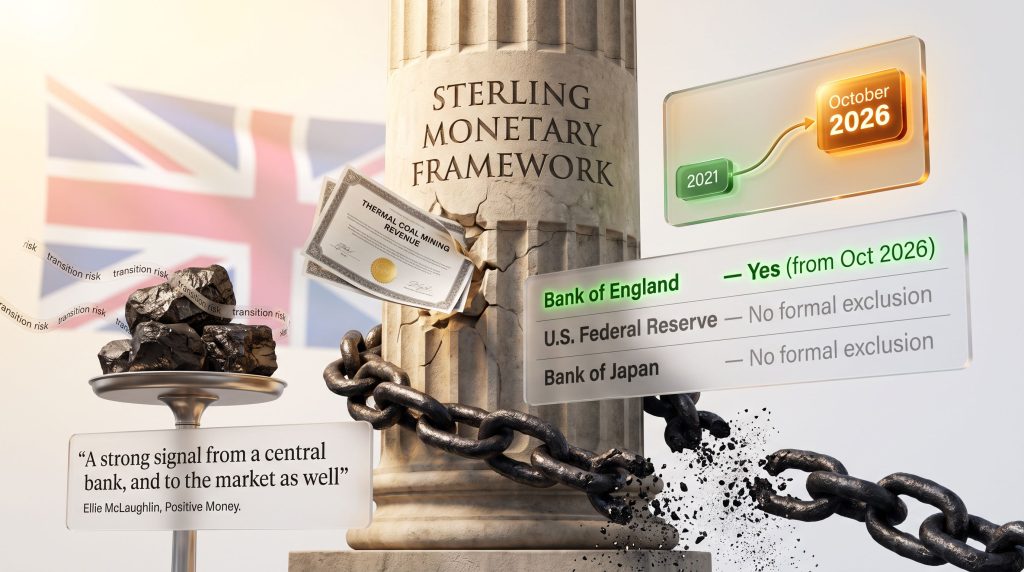
Policy Snapshot: From October 2026, bonds linked to thermal coal mining revenue are excluded from the Sterling Monetary Framework's collateral pool, the primary mechanism through which UK commercial banks access central bank liquidity.
The October 2026 Implementation and Its Scope
The exclusion takes effect in October 2026 and applies specifically to thermal coal — the form of coal burned primarily for electricity generation — as distinct from metallurgical coal used in steel production. The distinction matters because the transition risk calculus is fundamentally different between these two categories. Thermal coal faces accelerating substitution from wind, solar, and battery storage, while metallurgical coal retains structural demand tied to industrial processes with fewer near-term alternatives.
Beyond the outright exclusion of thermal coal bonds, the Bank also signalled its intention to apply additional valuation discounts, known in financial terminology as haircuts, to corporate bonds carrying significant net-zero transition risk exposure. This means that even assets which retain formal eligibility may be assigned a lower collateral value if they are assessed as carrying material exposure to high-emission sectors.
Key Insight: A collateral haircut is effectively a risk discount applied to an asset's face value when it is pledged as security. If a bond worth £100 million carries a 10% haircut, it only provides £90 million in collateral capacity. Applying haircuts to transition-exposed assets is a subtle but powerful mechanism for adjusting the effective cost of holding such instruments.
How This Exclusion Flows Through the Financial System
Understanding the downstream impact of the Bank of England coal bonds policy requires tracing how collateral rules translate into real-world credit conditions for coal operators. Furthermore, understanding the broader geopolitical mining landscape helps contextualise why Western financial institutions are tightening these rules now.
-
The Bank of England sets revised eligibility criteria, removing thermal coal bonds from the approved collateral list under the SMF.
-
Commercial banks reassess their bond portfolios, recognising that thermal coal-linked instruments no longer serve a strategic function as central bank collateral.
-
Institutional demand for coal-related bonds narrows, as the practical utility of holding these instruments diminishes within UK-regulated financial institutions.
-
Pricing pressure on coal bonds increases, with reduced demand pushing yields higher and effective funding costs upward for thermal coal operators.
-
Coal companies face tighter credit conditions, as bond markets respond to shrinking institutional appetite and elevated risk premiums.
-
Broader market signalling occurs, with other lenders, asset managers, and insurers recalibrating their own internal risk thresholds in response to a central bank's formal position on transition risk.
This transmission mechanism is significant precisely because it does not require regulatory mandates to flow outward. Once a central bank makes a formal eligibility determination, the market internalises that signal far beyond the direct counterparties of the SMF.
How the Bank of England Compares to Other Major Central Banks
The Bank of England's position on thermal coal collateral is notably more advanced than most of its global peers, though meaningful gaps remain even within this policy.
| Institution | Thermal Coal Bond Exclusion | Transition Risk Haircuts | Formal Net Zero Commitment |
|---|---|---|---|
| Bank of England | Yes (from Oct 2026) | Yes | Partial |
| European Central Bank | Partial restrictions | Under review | Stated ambition |
| U.S. Federal Reserve | No formal exclusion | No | Not adopted |
| Bank of Japan | No formal exclusion | No | Limited |
The European Central Bank has moved toward incorporating climate considerations into its own collateral and asset purchase frameworks, but has not yet adopted thermal coal exclusions at the same level of specificity as the Bank of England. The U.S. Federal Reserve has largely resisted any formal climate-linked adjustments to its monetary operations, reflecting a very different political and regulatory environment.
Why Was the Policy Released Without Fanfare?
The subdued manner in which this policy change was communicated — published on the Bank's website without a formal press statement — is itself revealing. Multiple observers have noted that central banks operating in the current political climate face pressure from fossil fuel-aligned governments, particularly from Washington, where the current administration has actively opposed climate-related financial regulation.
For the Bank of England, low-profile implementation may reflect a pragmatic approach to advancing climate finance policy without inviting the level of political backlash that a high-profile announcement would generate.
The Bank of England's Climate Collateral Journey Since 2021
This October 2026 exclusion does not represent a sudden pivot. It is the latest step in a progressive tightening of climate-linked collateral and asset purchase criteria that began five years earlier.
| Year | Policy Action |
|---|---|
| 2021 | Thermal coal mining firms excluded from further Corporate Bond Purchase Scheme (CBPS) acquisitions |
| 2021 | CBPS adjusted to support an economy-wide net zero transition |
| June 2026 | Sterling Monetary Framework policy update published (no formal press announcement) |
| October 2026 | Thermal coal bond collateral exclusion takes full effect |
The 2021 exclusion from the CBPS was the first time the Bank used an active asset purchase programme to express a climate preference. The move to the SMF is a qualitative escalation, because it touches the core liquidity infrastructure of UK banking rather than a discretionary bond-buying programme. The mining decarbonisation benefits that flow from such institutional pressure are increasingly measurable across the broader extractive sector.
The Scale of Global Financial Institution Coal Divestment
The Bank of England's policy did not emerge in isolation. It reflects a growing institutional consensus that has been building across the global financial system over the past decade.
According to data compiled by the Institute for Energy Economics and Financial Analysis, more than 200 globally significant financial institutions have now adopted formal policies restricting investment in thermal coal mining and/or coal-fired power infrastructure. This group spans asset managers, pension funds, international banks, and insurance groups.
Despite this scale of voluntary commitment, the picture remains incomplete. A study published in October 2025 by the TPI Global Climate Transition Centre at the London School of Economics and Political Science, which examined the climate policies of 36 of the world's largest banks by market capitalisation and total assets, found a troubling pattern:
- Most institutions had weakened their climate disclosures rather than strengthened them, replacing firm commitments with softer language such as "ambition" or "aspiration."
- No major bank had committed to fully ending financing for new oil, gas, and coal projects.
- Decarbonisation targets covered only a limited subset of sectors and business activities within each institution's broader financing portfolio.
This gap between headline divestment policies and the granular reality of financing activity is precisely why central bank-level intervention through collateral policy carries particular weight. Unlike voluntary commitments, collateral eligibility rules carry operational consequences.
The next major ASX story will hit our subscribers first
Why Thermal Coal Faces the Steepest Transition Risk Curve
One of the less commonly understood aspects of the Bank of England coal bonds policy is why thermal coal has been singled out while oil and gas bonds remain outside the current exclusion framework. The accelerating critical minerals transition also plays a role here, as the shift toward renewables intensifies demand for alternative commodities while simultaneously undermining the economic case for coal.
Analytical Frame: Thermal coal occupies a distinct position in the transition risk hierarchy. Unlike oil and gas, which retain significant demand across petrochemicals, transport, and industrial applications, thermal coal's primary use case — electricity generation — faces direct substitution from renewables at an accelerating pace. This makes coal-linked financial instruments particularly vulnerable to long-duration value erosion.
The concept of stranded asset risk is central to this distinction. A stranded asset is one whose economic value declines significantly before the end of its expected useful life, typically because of external factors such as regulatory change, technological disruption, or demand collapse. Thermal coal-fired power plants and the coal mines supplying them face all three simultaneously.
Crucially, thermal coal's demand profile is also geographically concentrated. While China and India continue to consume large volumes of thermal coal, even China's own energy transition is accelerating, with coal falling below 50% of China's power mix for the first time on record in 2026. This trajectory undermines the assumption that Asian demand provides an indefinite floor for coal valuations.
Implications for UK Commercial Banks and Their Coal Exposure
For UK-regulated banks, the SMF change creates a practical portfolio management question. Institutions that hold thermal coal bonds as part of their broader collateral pools must now evaluate whether retaining these instruments makes operational sense, given their diminished utility within the central bank liquidity system.
- Barclays, Lloyds, NatWest, and HSBC are the primary domestic counterparties of the SMF and are therefore most directly affected by any shift in collateral eligibility rules.
- The exclusion creates an indirect incentive to reduce coal sector lending more broadly, since institutions with less coal exposure face fewer portfolio adjustment costs.
- The haircut mechanism adds a further layer of discouragement for holding transition-exposed bonds, even outside the explicit thermal coal exclusion category.
What makes this dynamic particularly interesting is that the Bank of England has not ordered commercial banks to divest from coal. It has simply altered the conditions under which coal-linked instruments can be used within its own operations. The resulting behavioural change across the commercial banking sector is driven by rational portfolio management rather than regulatory compulsion.
In addition, considerations around natural capital in mining are increasingly influencing how institutional investors evaluate the long-term viability of fossil fuel assets, reinforcing the direction of travel established by the Bank's collateral reforms.
Three Scenarios for Thermal Coal Bond Markets Through 2030
Looking forward, the trajectory of thermal coal bond markets will depend heavily on how other major financial and regulatory institutions respond to the Bank of England's position.
Scenario 1: Accelerated Divestment
Other major central banks, particularly the European Central Bank, adopt comparable collateral exclusions within 24 months, creating a coordinated tightening of coal finance access across Western financial systems. In this scenario, coal bond markets face compounding pricing pressure and liquidity deterioration, accelerating the stranded asset timeline.
Scenario 2: Fragmented Adoption
Policy divergence between Western central banks and major Asian financial institutions preserves meaningful coal financing channels in key demand markets such as India, China, and Southeast Asia. In this scenario, thermal coal operators shift their financing relationships toward Asian lenders, partially offsetting the impact of Western exclusions.
Scenario 3: Political Reversal
Sustained political pressure, particularly from fossil fuel-aligned governments, slows or reverses climate collateral reforms at major Western institutions. The Bank of England's policy remains in force but becomes increasingly isolated, limiting its systemic impact to a reputational and signalling function rather than a structural market intervention.
Disclaimer: These scenarios represent analytical projections based on current policy trajectories and are not investment advice. Actual outcomes will depend on a wide range of political, economic, and regulatory variables that cannot be predicted with certainty.
Frequently Asked Questions: Bank of England Coal Bonds Policy
What types of bonds are now excluded under the new policy?
Bonds issued by companies that derive revenue from thermal coal mining are excluded from eligibility as collateral under the Sterling Monetary Framework from October 2026.
Does this policy affect all fossil fuels, or only thermal coal?
The current exclusion is specific to thermal coal mining. Oil, gas, and metallurgical coal bonds are not subject to the same formal exclusion, though transition risk haircuts may apply to bonds with broader high-emission sector exposure.
Which commercial banks are most directly affected?
UK commercial banks that use the SMF to access central bank liquidity — including Barclays, Lloyds, NatWest, and HSBC — are the primary institutions affected by the collateral eligibility change.
What is a collateral haircut in this context?
A haircut is a percentage reduction applied to an asset's market value when it is used as collateral. If a bond worth £100 million carries a 15% haircut, it provides only £85 million in borrowing capacity. The Bank of England has indicated it will apply additional haircuts to bonds with significant transition risk exposure.
Could the Bank of England extend similar restrictions to oil and gas bonds?
The Bank has not signalled any immediate intention to extend formal exclusions to oil or gas bonds, but the haircut mechanism provides a flexible tool for adjusting the effective cost of holding such instruments without a formal exclusion decision.
When exactly does the thermal coal bond exclusion come into force?
The policy was published in June 2026 and takes full effect in October 2026.
The Gap Between Signal and Systemic Change
Ellie McLaughlin, Senior Policy and Advocacy Manager at Positive Money, characterised the Bank of England's action as carrying genuine weight as a market signal while acknowledging that the institution has considerably more scope to deepen its climate finance commitments. That tension between incremental progress and the full scale of decarbonisation required across the financial system is not unique to the Bank of England. It defines the entire landscape of institutional climate finance in 2026.
What distinguishes central bank collateral policy as a tool, however, is its operational specificity. Voluntary commitments made by commercial banks can be softened, reworded, or quietly unwound — as the October 2025 LSE research documented in uncomfortable detail. Collateral eligibility rules, by contrast, have immediate operational consequences every time a bank seeks liquidity. They cannot be replaced with aspirational language.
The green transition materials debate further illustrates why central banks cannot remain passive: as economies restructure their energy systems, the financial infrastructure supporting that transition must also evolve. The Bank of England coal bonds policy is therefore best understood not as a finalised position, but as a proof of concept — evidence that central bank balance sheet management can be deployed as a meaningful lever in the broader architecture of climate transition finance. Whether other institutions follow, and how quickly, will determine whether that proof of concept becomes a systemic shift or remains an important but isolated precedent.
Furthermore, the Carbon Tracker Initiative has consistently highlighted how stranded asset risk in thermal coal is materialising faster than most financial models anticipated, lending further urgency to the Bank of England's direction of travel.
Want To Know Which Mineral Discoveries Could Benefit From The Accelerating Energy Transition?
As central banks like the Bank of England reshape financial systems away from thermal coal, capital is increasingly flowing toward the critical minerals and exploration companies driving the green transition — and Discovery Alert's proprietary Discovery IQ model delivers real-time ASX alerts the moment significant mineral discoveries are announced, helping investors position ahead of the broader market. Explore historic discovery returns on Discovery Alert's dedicated discoveries page and begin your 14-day free trial today to gain an immediate market edge.