August 1, 2026
The Structural Shift From Volume to Value in Global Aluminium Markets
For most of the twentieth century, dominance in the aluminium industry was synonymous with scale. The nations and companies that controlled the largest smelting capacity, the cheapest hydroelectric power, and the most accessible bauxite deposits set the terms of competition. That paradigm is now dissolving at an accelerating pace. In 2026, the most consequential capital allocation tool shaping the sector is the downstream aluminium investment map, which tracks where raw commodity value is being multiplied into aerospace-grade sheet, battery foil, beverage cans, and electrical conductors.
The downstream aluminium investment map is being redrawn not by a single policy change or market event, but by the convergence of five structural forces simultaneously: the electrification of transport, lightweighting mandates across aerospace and automotive supply chains, surging demand for aluminium in electrical grid infrastructure, a global consumer preference shift toward recyclable metal packaging, and an institutional investor base that is increasingly penalising the carbon intensity of primary smelting.
Together, these forces have created a new hierarchy of regional winners and laggards. Understanding where capital is concentrating, and why, is now one of the more consequential questions in industrial investment.
When big ASX news breaks, our subscribers know first
Defining the Downstream Aluminium Value Chain
Downstream aluminium refers to every manufacturing stage that transforms primary or recycled metal into semi-finished or finished industrial and consumer products. This segment encompasses a wide range of product categories, each with distinct demand drivers, margin profiles, and geographic concentrations.
- Rolled products: Flat-rolled sheet and coil for automotive body panels, aerospace fuselage structures, and food and beverage packaging
- Extrusions: Structural profiles for building and construction, transport frames, and industrial components
- Foil: Thin-gauge rolled aluminium for food packaging, pharmaceutical blister packs, and lithium-ion battery current collectors
- Wire rod and conductors: Electrical transmission cables and electric vehicle wiring harnesses
- Castings and forgings: Precision components for automotive powertrains, defence systems, and aerospace assemblies
- Metal packaging: Beverage cans, aerosol containers, and food tins
The critical distinction between primary and downstream aluminium from an investor's perspective is not simply one of product complexity. It is a difference in margin stability, energy intensity, ESG profile, and end-market alignment.
| Investment Dimension | Primary Aluminium | Downstream Aluminium |
|---|---|---|
| Margin profile | Commodity-linked and highly cyclical | Value-added with more stable through-cycle margins |
| Energy intensity | Extremely high per tonne of output | Moderate, especially with recycled feedstock |
| ESG exposure | High due to carbon-intensive smelting | Materially lower, particularly with secondary input |
| Demand growth alignment | General industrial cycles | EVs, aerospace, packaging, grid infrastructure |
| Geopolitical sensitivity | High, bauxite and energy dependency | Moderate, supply chain more diversifiable |
| Institutional investor appetite | Declining | Rising rapidly |
Key Insight: The uniform direction of institutional capital flows in 2026 reflects a broader re-rating of the aluminium sector. Downstream producers are being valued less as commodity processors and more as advanced manufacturers with durable end-market exposure.
Financial Performance Benchmarks: What the Numbers Reveal
The financial results emerging from leading downstream producers in 2026 are not merely strong in isolation. They represent a sector-wide earnings inflection that is drawing institutional capital at scale, and the consistency of upgraded guidance across different product categories is particularly telling.
| Producer or Sector | Key Metric | Reported Performance |
|---|---|---|
| Constellium (European rolled products) | Quarterly revenue | USD 2.7 billion, up 31% year-on-year |
| Constellium | Quarterly net income | USD 148 million |
| Constellium | 2026 full-year guidance | Raised; 2028 targets brought within reach ahead of schedule |
| ElvalHalcor (rolling mill expansion) | Capital program | €855 million through 2030, funded by completed equity raise |
| Crown Holdings (aluminium beverage cans) | Q2 revenue | USD 3.668 billion |
| Crown Holdings | 2026 earnings outlook | Upgraded following strengthening global can demand |
| Ardagh Metal Packaging | Q2 revenue growth | 18% quarter-on-quarter |
| Ardagh Metal Packaging | Q2 EBITDA growth | 14%, with 2026 EBITDA outlook raised |
| Sonoco (diversified packaging) | Q2 total sales | USD 1.9 billion, supported by metal and industrial packaging |
| Kaiser Aluminum (North America) | Institutional ownership | 99.3% of shares held by institutional investors |
Constellium's record quarterly result is especially instructive. A 31% revenue increase to USD 2.7 billion, combined with a net income of USD 148 million and a decision to raise full-year guidance, signals that European downstream demand is not merely recovering from post-pandemic disruption. It is entering a structurally higher demand environment driven by aerospace and automotive lightweighting contracts.
The company's 2028 financial targets are now described as being within reach ahead of schedule, an outcome that reflects both operational leverage and the quality of its end-market positioning. Furthermore, Kaiser Aluminum's institutional ownership reaching 99.3% of outstanding shares signals a high degree of conviction that the sector's value-creation story is durable rather than cyclical.
India: The Emerging Downstream Powerhouse
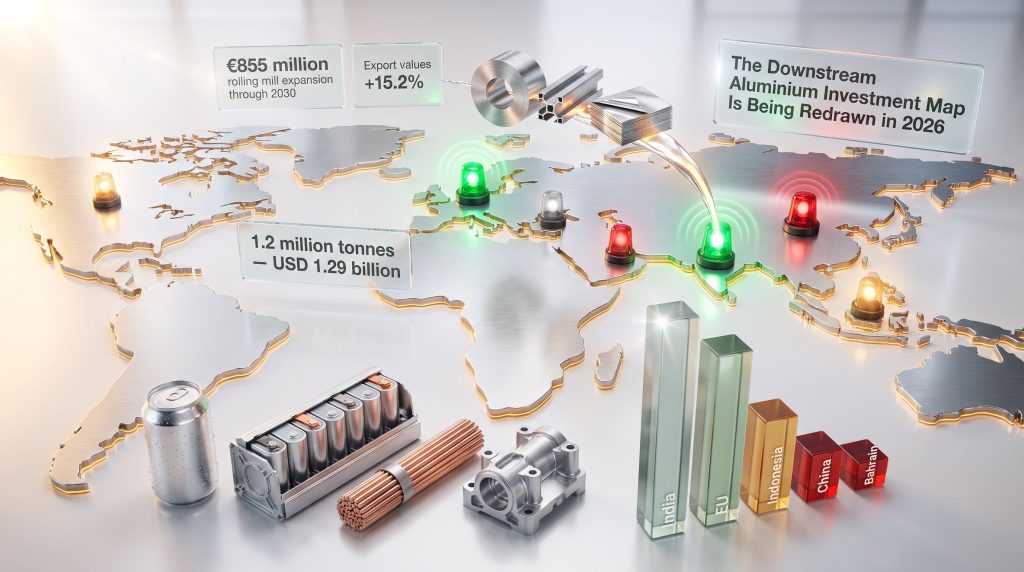
Among the geographic themes shaping the downstream aluminium investment map in 2026, India stands out as the most compelling emerging market story. The country exported 1.2 million tonnes of aluminium alloy products valued at USD 1.29 billion in the most recent reporting period, demonstrating not just production scale but a maturing value-added manufacturing ecosystem capable of competing in global markets.
The geographic concentration of India's downstream investment is particularly notable. The Odisha corridor, centred on Angul and Jharsuguda, has emerged as the most active downstream investment zone in any developing economy. The presence of major integrated producers in this corridor has created a natural gravitational pull for downstream and ancillary manufacturing investment.
Project types active or in advanced planning stages within the Odisha corridor include:
- Die casting and precision casting facilities
- Wire rod investment and electrical conductor manufacturing
- Aluminium extrusion plants
- Forging operations for automotive and industrial applications
- Anodising and advanced surface treatment facilities
What distinguishes the Indian downstream story from other emerging market narratives is the combination of scale, integration, and export orientation. India is not simply building domestic consumption capacity. It is positioning itself as a global supplier of value-added aluminium products to fast-growing Asian end markets and, increasingly, to European and North American buyers seeking supply chain diversification away from Chinese sources.
Investment Signal for India: POSITIVE. Record alloy export volumes, an expanding integrated manufacturing base in Odisha, and strategic proximity to high-growth Asian markets position India as a long-term structural beneficiary of the downstream aluminium investment cycle.
The European Union: Resilient Capital Flows in a Complex Macro Environment
The European Union's downstream aluminium sector demonstrated a degree of resilience in 2026 that many market observers did not fully anticipate. Export volumes expanded 6.8% in the most recent comparable period, while export values grew by a notably faster 15.2%. This divergence between volume growth and value growth is analytically significant: it reflects rising product complexity and higher per-unit pricing in processed aluminium goods.
Simultaneously, import volumes contracted by 8.7%, indicating that European downstream manufacturers are increasingly satisfying domestic demand from internal capacity rather than imported semi-finished products. This combination of rising exports and falling imports represents an improving trade balance in processed aluminium, reinforcing the EU's position as a high-quality downstream manufacturing hub.
The most significant capital investment signal from within the EU is ElvalHalcor's €855 million rolling mill expansion program extending through 2030, funded by a completed equity capital raise. This is not a speculative capacity bet. It is a multi-year, equity-funded commitment to expanding European rolled product capacity in anticipation of sustained demand from automotive, aerospace, and packaging customers.
In addition, Airbus's decision to sign a long-term aluminium supply agreement with SeAH Aerospace and Defense reflects a broader trend of geographic diversification in aerospace aluminium sourcing. This is creating investment opportunities in supplier markets that were not previously connected to the European aerospace supply chain. Several top aluminium producers are now actively repositioning to capture a share of this expanding European opportunity.
Investment Signal for the EU: POSITIVE. Strong downstream export performance, active multi-year capital investment in rolling capacity, and aerospace supply chain diversification reinforce the EU's position as a high-quality downstream aluminium manufacturing region with durable demand drivers.
Indonesia: A Significant Long-Term Opportunity Requiring Patience
Indonesia represents one of the largest quantum investment opportunities in the downstream aluminium sector globally, though it occupies a materially earlier stage of development than India or the European Union. The investment pipeline figures are striking in their scale.
- Realised investment across active downstream and upstream-linked projects: USD 5.5 to 6 billion
- Committed pipeline expected to exceed USD 30 billion by 2030
- Investment is geographically concentrated around bauxite-rich provinces
- Current project mix is weighted toward alumina refining and primary smelting rather than downstream conversion
The critical analytical distinction for investors considering Indonesian exposure is that the majority of committed capital is upstream-to-midstream rather than downstream in the value-added sense. Alumina refining capacity and primary smelting represent the current investment frontier. Early-stage downstream conversion, including extrusions, rolled products, and wire rod, is in development but not yet the dominant investment theme.
This distinction matters because the margin and return profiles of upstream and downstream investment are fundamentally different. The long-term opportunity to develop a fully integrated Indonesian aluminium value chain is genuine, but the timeline for realising downstream returns is extended, and execution risk associated with infrastructure constraints in resource-rich provinces is real and should be explicitly priced into investment models.
Investment Signal for Indonesia: SPECULATIVE/LONG-TERM POSITIVE. The scale of committed investment is globally significant, but investors should apply a longer horizon and account for execution risk, infrastructure constraints, and the early-stage nature of downstream as opposed to upstream capacity.
The next major ASX story will hit our subscribers first
China, Bahrain, and Türkiye: Where the Investment Signal Has Weakened
Not every region on the downstream aluminium investment map is generating positive signals in 2026. Three markets, in particular, warrant a more cautious analytical posture.
China remains the world's largest aluminium producer and downstream manufacturer by volume, however the investment signal for new downstream capital deployment has weakened materially. Reflecting broader China industrial demand pressures, the aluminium rod market is under sustained pressure from weak export orders and excess domestic supply, while processing fees are declining and compressing margins. Destocking is occurring more slowly than anticipated, extending the period of market imbalance.
Bahrain's aluminium export performance deteriorated sharply, with total exports declining 14% during the January to May 2026 period across multiple product categories. This broad-based decline reflects weakening international demand for Bahraini aluminium products and raises questions about whether the country is experiencing a cyclical correction or a more structural erosion of competitive positioning.
Türkiye presents a mixed picture. Downstream import volumes declined 8.0% during the year-to-date 2026 period, pointing to softer domestic industrial demand. However, import values rose 11.5%, reflecting higher per-unit pricing rather than demand recovery. The net investment signal is neutral: the market is not contracting in value terms, but the absence of volume-driven demand growth limits near-term investment conviction.
| Region | Volume Trend | Value Trend | Investment Signal |
|---|---|---|---|
| China (aluminium rod) | Declining | Compressing | Cautious |
| Bahrain (exports) | -14% | Deteriorating | Cautious |
| Türkiye (imports) | -8.0% | +11.5% | Neutral |
The Five Structural Demand Engines for Downstream Aluminium
Understanding which end markets are driving downstream aluminium investment is essential for assessing where capital is likely to generate the most durable returns. Five demand engines are operating simultaneously in 2026 and are likely to remain structurally significant through the decade.
1. Electric Vehicle Manufacturing and Battery Technology
EV production creates simultaneous demand across multiple downstream aluminium categories. Body sheet, battery enclosures, thermal management components, and battery current collector foil are all aluminium-intensive applications. Primetals Technologies securing an order to supply rolling mill technology for Lidao New Energy's battery aluminium foil project in China illustrates how EV-linked demand is already translating into discrete capital investment decisions in downstream infrastructure. Furthermore, an aluminium joint venture model is increasingly being used to share capital risk across these large-scale battery-related projects.
2. Aerospace and Defence Supply Chain Integration
Aerospace-grade aluminium alloys represent the highest-margin segment of the downstream value chain. Long-term supply agreements, such as the Airbus-SeAH arrangement, are extending the geographic footprint of aerospace aluminium sourcing into markets not previously integrated into major aircraft manufacturers' supply networks. According to the International Aluminium Institute, ongoing material innovations are further enhancing aluminium's competitive position within aerospace applications.
3. Aluminium Beverage Cans and Sustainable Metal Packaging
Crown Holdings reporting Q2 revenue of USD 3.668 billion with an upgraded 2026 earnings outlook, Ardagh Metal Packaging delivering 18% revenue growth and 14% EBITDA growth, and Sonoco generating USD 1.9 billion in Q2 sales all point to a packaging sector benefiting from the structural substitution of plastic by recyclable aluminium in consumer markets globally.
4. Electrical Grid Infrastructure and Conductor Manufacturing
The energy transition requires massive expansion of electrical transmission infrastructure. Aluminium conductors are lighter than copper and cost-competitive for long-distance transmission applications. Wire rod and conductor manufacturing is among the most active project types in downstream investment pipelines, particularly within India's Odisha corridor.
5. Construction and Industrial Extrusions in Urbanising Markets
Structural aluminium extrusions for building, construction, and urban transport infrastructure remain a large-volume downstream segment. Demand is supported by ongoing urbanisation in emerging markets and renovation cycles in developed economies.
Geopolitical Risk and the Middle East Supply Chain Disruption
Beyond the regional trade and investment signals, the broader Middle East geopolitical environment is generating a category of risk that is not fully captured in standard market analysis. Regional conflict has created measurable supply chain disruptions that have propagated through to consumer markets well beyond the conflict zone.
Aluminium can shortages linked to Middle Eastern supply chain disruption have already affected packaging costs and retail pricing in India, illustrating how geopolitical instability can create non-linear and geographically distant downstream consequences. This dynamic represents an underappreciated risk factor for downstream investors with exposure to Middle East-linked supply chains.
Standard scenario planning typically models conflict risk as a localised disruption. However, the Indian packaging market example demonstrates that downstream aluminium supply chains are sufficiently interconnected that regional disruption can create ripple effects across multiple continents. Consequently, US aluminium tariffs and Middle Eastern instability together form a compounding geopolitical risk layer that investors must stress-test in their models.
Investment Signal for the Middle East: RISK WATCH. Investors with supply chain exposure to the region should stress-test their logistics and sourcing strategies against scenarios involving sustained disruption rather than temporary dislocation.
Governance Risk: An Underweighted Factor in Emerging Market Downstream Investment
One analytical dimension that is frequently underweighted in downstream aluminium investment analysis is governance and regulatory compliance risk within emerging market producers. The suspension of Nigeria's Aluminium Extrusion Plc shares on the Nigerian Exchange, following the company's failure to submit its FY2025 audited financial statements within the regulatory deadline, is a concrete illustration of this risk category.
Delayed financial reporting, regulatory non-compliance, and inadequate disclosure practices are not isolated events in emerging market manufacturing sectors. They represent a systematic risk that should inform the due diligence framework applied to downstream aluminium producers in markets with less mature regulatory environments.
Investors should explicitly evaluate the quality and timeliness of financial disclosure, the robustness of local exchange enforcement mechanisms, and the governance track record of management teams. The Australian Aluminium Council's expanded downstream membership initiative offers one instructive model of how industry bodies can raise governance standards across the sector.
Regional Investment Signal Dashboard: 2026 Summary
| Region | Signal | Key Strength | Primary Risk |
|---|---|---|---|
| India (Odisha corridor) | Positive | USD 1.29B in alloy exports; integrated hub development | Infrastructure and execution |
| European Union | Positive | Rolling mill expansion; aerospace supply chain growth | Macro softness in select markets |
| Indonesia | Long-term Positive | USD 30B+ committed investment pipeline | Execution risk; upstream-weighted pipeline |
| North America | Positive | Near-total institutional ownership; packaging demand strength | Trade policy uncertainty |
| Türkiye | Neutral | Stable import values | Weak domestic demand volumes |
| China | Cautious | Manufacturing scale and depth | Overcapacity; export market headwinds |
| Bahrain | Cautious | Established smelting base | Export volume decline of 14% |
| Middle East (broader) | Risk Watch | Strategic trade location | Geopolitical disruption risk |
Frequently Asked Questions About the Downstream Aluminium Investment Map
What differentiates downstream from primary aluminium investment?
Primary aluminium investment involves capital deployed in smelting and refining operations that produce raw metal. These investments are highly energy-intensive, commodity-price sensitive, and carry significant ESG exposure due to the carbon intensity of the smelting process.
Downstream aluminium investment involves capital deployed in manufacturing operations that transform primary or recycled metal into industrial and consumer products. Downstream investments typically generate higher and more stable margins, are more closely aligned with durable structural demand themes such as EV adoption and aerospace production, and are increasingly favoured by institutional capital over primary smelting assets.
Which regions represent the strongest downstream aluminium investment opportunities in 2026?
India and the European Union represent the strongest current-cycle downstream investment opportunities based on trade performance, capital investment activity, and financial results from major producers. India's Odisha corridor is the most active emerging market hub, while the EU's rolling mill expansion programmes and aerospace supply chain integration reinforce its position as a high-quality downstream manufacturing region.
Indonesia represents the largest long-term potential opportunity but requires a longer investment horizon and tolerance for execution risk.
What end markets are generating the most durable downstream aluminium demand growth?
The five primary demand engines are electric vehicle manufacturing and battery technology, aerospace and defence supply chain integration, aluminium beverage cans and sustainable metal packaging, electrical grid infrastructure and conductor manufacturing, and construction and industrial extrusions in urbanising emerging markets. Of these, EV battery foil and aerospace-grade rolled products represent the highest-margin growth categories within the current investment cycle.
Disclaimer: This article is intended for informational purposes only and does not constitute financial advice, investment recommendations, or a solicitation to buy or sell any security or financial product. Forward-looking statements, financial projections, and investment signals presented in this article are based on publicly available data and analytical frameworks and are subject to change without notice. Past performance of companies or sectors mentioned is not indicative of future results. Readers should conduct their own independent research and consult qualified financial advisers before making investment decisions.
Want to Capitalise on the Next Major Mineral Discovery Before the Market Moves?
Discovery Alert's proprietary Discovery IQ model delivers real-time alerts on significant ASX mineral discoveries, transforming complex data across more than 30 commodities into clear, actionable investment insights — ideal for investors seeking to position ahead of the broader market in high-growth sectors like aluminium and beyond. Explore Discovery Alert's dedicated discoveries page to understand how historic mineral discoveries have generated substantial returns, and begin your 14-day free trial today to secure your market-leading advantage.