
June 22, 2026
The Geology Behind the Gold: Why Nevada's Underground Frontier Is Driving Record Contract Activity
Few geological environments on Earth produce gold with the consistency and grade profile of Nevada's Carlin Trend. The sediment-hosted disseminated gold deposits that characterise this region have been mined continuously for decades, yet the deeper structural zones beneath existing workings continue to surprise even the most experienced exploration geologists. It is this geological persistence, combined with the technical complexity of accessing deep orebodies, that is reshaping how major gold producers allocate capital, and why underground mining services contractors are now winning contracts measured in hundreds of millions of dollars.
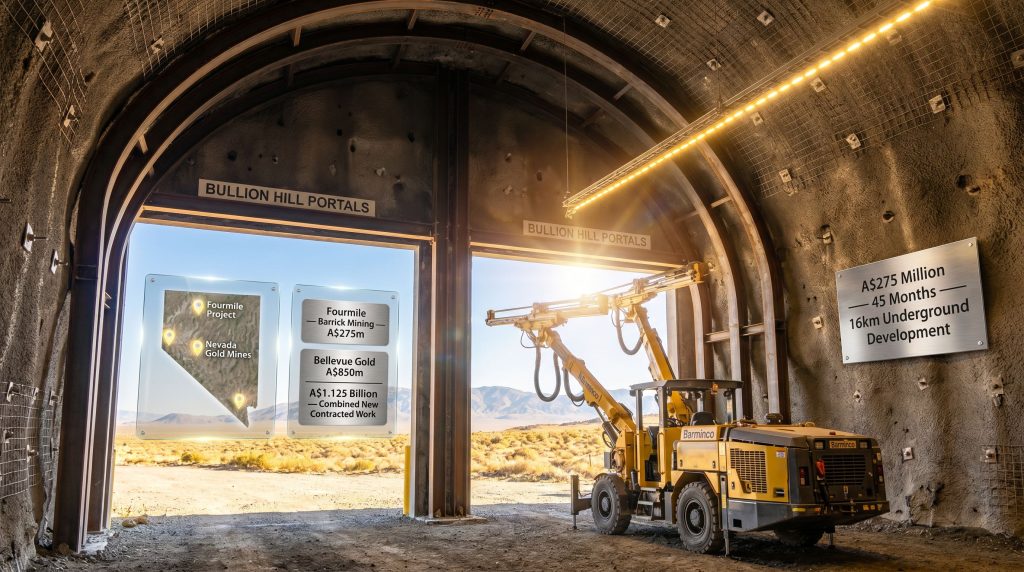
The Barminco contract for Barrick's Fourmile Project, announced in June 2026 and valued at A$275 million (approximately US$192 million), sits at the intersection of these trends. It represents not just a single contract award, but a window into how the global underground mining services sector is evolving, and why Nevada has become the most contested battleground for specialist hard-rock contractors worldwide. Furthermore, current gold exploration trends suggest this type of deep-access investment will only accelerate.
When big ASX news breaks, our subscribers know first
Understanding the Fourmile Project's Geological Setting
What Makes Fourmile Geologically Distinct?
Fourmile occupies a position within the broader Battle Mountain-Eureka Trend in Nevada, in geographic proximity to the Goldrush deposit, which itself sits within the Nevada Gold Mines complex. Carlin-type gold deposits, which dominate this region, are characterised by fine-grained, often microscopic gold particles hosted within carbonaceous and silty limestone formations. Unlike epithermal or porphyry systems, Carlin-type deposits are typically not visible to the naked eye, making grade determination heavily reliant on systematic drilling programs and assay analysis.
What distinguishes Fourmile from many neighbouring deposits is the combination of high-grade intercepts reported during exploration drilling and the structural controls that appear to concentrate mineralisation at depth. Barrick's decision to accelerate underground access, rather than continuing exclusively with surface drilling, signals a geological conviction that the orebody's highest-value zones are most efficiently and accurately characterised from underground drill platforms.
Underground development drilling platforms allow geologists to drill at angles and proximities impossible from surface, dramatically improving resource confidence in complex structural settings. This is a key reason major gold producers advance underground development before feasibility studies are fully complete.
The Role of Underground Access in Resource Definition
This approach, known in the industry as development-ahead-of-study, carries both risks and rewards. On the risk side, capital is committed before the full economic case is established. On the reward side, underground drilling programs dramatically reduce resource estimation uncertainty, often upgrading inferred resources to the indicated or measured categories required for bankable feasibility studies. For Barrick, which holds 100% ownership of Fourmile, the risk-reward calculation is uncomplicated by joint venture partner approval processes.
Contract Structure and Scope: Breaking Down the A$275 Million Agreement
Key Contract Parameters at a Glance
| Contract Element | Detail |
|---|---|
| Contracting Party | Barminco (underground mining division of Perenti Group) |
| Client | Barrick Mining Corporation |
| Contract Value | A$275 million (~US$192 million) |
| Contract Term | 45 months |
| Commencement Date | July 2026 |
| Primary Scope | Twin Bullion Hill portal development, 16km underground drives |
| Additional Services | Ground support, surface facilities construction, associated mining services |
| Project Location | Nevada, United States |
The Engineering Significance of Twin Portal Development
The decision to construct twin portals at Bullion Hill is an engineering choice with significant productivity implications. In underground hard-rock mining, a twin portal configuration allows simultaneous development headings to advance from two independent access points. This means two separate crews, two sets of equipment, and two active development faces operating concurrently rather than sequentially.
For a 16-kilometre underground development program, the practical effect of twin portals is measurable. Advance rates in hard-rock underground development typically range from 150 to 300 metres per month per heading depending on ground conditions, equipment capacity, and ground support requirements. With twin development headings operating simultaneously, Barrick compresses its timeline to achieve the underground drill platforms needed for resource definition drilling.
Portal development is also the critical-path activity in any underground mine construction. Until portals are established and supported, no other underground work can proceed. Barminco, as the portal contractor, sits at the heart of Fourmile's development schedule, giving it significant influence over the project's overall timeline.
Ground Support: The Invisible Engineering Priority
One aspect of the Barminco scope that deserves more attention than it typically receives is ground support. In Nevada's geological environment, where faulting, alteration, and fractured rock mass conditions are common, ground support is not a peripheral activity but a primary engineering challenge. Modern underground ground support systems integrate rock bolts, cable bolts, shotcrete, and mesh in combinations determined by detailed geotechnical assessments conducted ahead of and during development.
The quality and speed of ground support installation directly determines safe advance rates. Contractors with strong ground support capabilities, as Barminco has demonstrated across multiple continents, can sustain higher advance rates without compromising safety or structural integrity.
Why Barminco Won the Fourmile Contract: Incumbency, Track Record, and Regional Positioning
The Competitive Advantage of Operational Clustering
Barminco's existing presence at the adjacent Goldrush Project, operated under the Nevada Gold Mines joint venture between Barrick (61.5% stake) and Newmont (38.5% stake), created a powerful incumbency dynamic in the Fourmile contract process. Operational clustering, where a contractor operates multiple projects within the same geographic region, generates compounding advantages that are difficult for competing bidders to match.
These advantages include:
- Shared workforce pools that reduce mobilisation costs and timelines
- Established supply chain relationships with regional equipment and consumable suppliers
- Existing familiarity with Nevada's regulatory environment and permitting requirements
- Demonstrated safety and productivity track records visible to the client from adjacent operations
- Reduced overhead costs that can translate into more competitive contract pricing
From Barrick's perspective, awarding the Fourmile contract to a contractor already delivering results on the neighbouring Goldrush Project reduces transition risk and accelerates the operational ramp-up timeline.
Perenti's North American Growth Thesis
The strategic logic underpinning the Fourmile award extends well beyond a single project. Perenti's leadership has consistently articulated a targeted growth strategy in North America, deploying both Barminco for underground mining services and Swick, its specialist drilling subsidiary, to create a multi-service platform in the region. Perenti's Contract Mining president identified North America as the world's largest hard-rock underground mining market globally, a characterisation supported by the concentration of major gold, copper, and base metals assets across Nevada, Ontario, Quebec, and the western United States.
The Barminco contract for Barrick Fourmile Project represents a deepening of Barminco's Nevada presence from a single joint venture engagement to a dual-project footprint, increasing its competitive moat for future regional contract renewals and new project opportunities.
Barminco's Contract Pipeline: Contextualising the Fourmile Win
Comparing Recent Major Contract Awards
| Project | Client | Contract Value | Duration | Location | Commencement |
|---|---|---|---|---|---|
| Fourmile Project | Barrick Mining | A$275m (~US$192m) | 45 months | Nevada, USA | July 2026 |
| Bellevue Gold Project | Bellevue Gold | A$850m | 4 years (+1 yr option) | Western Australia | 2026 |
| Goldrush Project | Nevada Gold Mines (Barrick/Newmont JV) | Undisclosed | Ongoing | Nevada, USA | Pre-existing |
The combined value of the Bellevue Gold and Fourmile contracts, both secured within weeks of each other in mid-2026, represents A$1.125 billion in new contracted work. For context, this scale of contracted revenue backlog growth within a single quarter is a material indicator of Barminco's competitive positioning and its ability to price and execute at the tier-one end of the underground mining services market.
The rapid accumulation of A$1.125 billion in new contracted work within a single quarter signals more than business momentum. It reflects a structural shift in how major mining companies are thinking about underground development timelines and contractor relationships.
Structural Dynamics Driving the Underground Mining Services Market
Why Long-Duration Contracts Are Becoming the Industry Standard
The shift toward 45-month and multi-year underground mining services contracts reflects a broader evolution in how mining companies manage project risk. Shorter contracts historically allowed companies to renegotiate pricing in response to commodity cycles. However, as underground development programs grow in complexity and capital intensity, continuity of contractor performance has become a higher priority than short-term cost flexibility.
Several structural forces are reinforcing this trend:
- Open-pit reserves at major gold operations are depleting, pushing production into underground settings with higher unit development costs
- Underground mine construction requires sustained specialist workforce and equipment deployments that are difficult to restart after interruptions
- Major gold producers are under pressure from shareholders to demonstrate production growth, incentivising faster development timelines
- Long-duration contracts transfer mobilisation and ramp-up costs to a single contract cycle rather than repeating them across multiple shorter agreements
Nevada's Position as a Tier-One Mining Jurisdiction
Nevada consistently ranks among the world's most attractive mining jurisdictions in independent assessments of political risk, regulatory transparency, and infrastructure quality. The Fraser Institute's annual survey of mining company executives has repeatedly placed Nevada in the top tier globally for investment attractiveness, a designation informed by the state's established regulatory frameworks, skilled labour availability, and the density of existing mining infrastructure.
For underground mining services contractors, operating in a tier-one jurisdiction carries specific competitive advantages. Permitting timelines are more predictable, workforce attraction and retention is stronger, and the contractual enforceability of long-term agreements is legally robust. These characteristics reduce execution risk on large, capital-intensive contracts like the Barminco contract for Barrick Fourmile Project.
The next major ASX story will hit our subscribers first
Development Timeline and Key Milestones to Monitor
Fourmile's Critical Path to Production
The sequence of activities from contract commencement to potential production decision at Fourmile follows a logical but capital-intensive progression:
- July 2026: Barminco mobilises; site establishment and preliminary works begin
- Late 2026: Twin Bullion Hill portals commence construction; first underground access established
- 2027: Underground development headings advance; underground drill platforms become available
- 2027-2028: Barrick's geologists deploy underground drilling programs to improve resource classification and reduce estimation uncertainty
- 2028-2029: A definitive feasibility study outcome incorporates underground drilling data; the production decision framework becomes clearer
- Post-Contract: Barrick's 100% ownership enables unilateral decisions on production commencement, further development, or strategic reconfiguration
The parallel advancement of underground access and feasibility study work is the defining strategic choice Barrick has made at Fourmile. This compress-and-define approach, increasingly common among major gold producers with high conviction in specific orebodies, carries capital risk but potentially shortens the time between resource definition and first production by several years compared to conventional sequential approaches.
What Investors and Industry Observers Should Watch
For those monitoring the Fourmile project's progress, several leading indicators will provide early signals about how the underground program is tracking against expectations. In addition, understanding how to approach interpreting drill results and the distinction between true width vs apparent width can meaningfully sharpen how investors assess future resource disclosures from the project.
- Quarterly advance rate disclosures, if Barrick incorporates them into project reporting
- Resource estimation updates as underground drilling data accumulates
- Any revisions to the feasibility study timeline, which would reflect either acceleration or complication of the underground program
- Barrick's capital allocation commentary in quarterly earnings calls, where any increase in Fourmile-related spending would signal growing confidence in the project's economics
This article contains forward-looking information and analysis based on publicly available data as of the date of publication. Readers should conduct their own due diligence and consider independent financial advice before making investment decisions. Mining project timelines and economics are subject to change based on geological, operational, regulatory, and market conditions.
For further context on Barrick's Nevada operations and the Fourmile Project's development history, Mining Technology provides ongoing coverage of mining company deals and project developments across the global sector.
Want to Know When the Next Major Underground Discovery Hits the ASX?
Discovery Alert's proprietary Discovery IQ model scans ASX announcements in real time, instantly identifying significant mineral discoveries — from high-grade gold intercepts to deep structural plays — and delivering actionable alerts before the broader market has a chance to react. Explore historic discoveries and the returns they generated, then begin your 14-day free trial at Discovery Alert to position yourself ahead of the next major find.