June 22, 2026
When Diplomacy Moves Markets: Understanding Gold's Dual Identity
Precious metals traders have long understood that gold does not respond to a single variable. It sits at the intersection of monetary policy, currency dynamics, inflationary cycles, and geopolitical sentiment. When any one of these forces shifts sharply, the price of bullion moves. When two or more shift simultaneously in opposite directions, the result is exactly the kind of volatile, difficult-to-read trading environment that unfolded during the Asian session on Monday, June 23, 2026. Gold rebounds as Iran cites progress in peace talks became the headline, but the underlying story is considerably more layered than a simple diplomatic boost to commodity prices.
Understanding why gold moved the way it did requires examining the transmission mechanisms connecting geopolitics, oil markets, inflation expectations, and central bank signals. Each of these elements acted as a counterweight to the other during the session, producing a partial recovery that left more questions than answers for investors watching from the sidelines. Furthermore, the gold price outlook heading into this period had already factored in significant geopolitical risk premiums.
When big ASX news breaks, our subscribers know first
The Mechanics Behind Oil, Inflation, and Gold Pricing
Gold does not exist in a vacuum. Its pricing is fundamentally shaped by what economists call the real yield environment, which is the return on bonds and other fixed-income instruments after accounting for inflation. When oil prices decline, they carry disinflationary implications across the broader economy. Lower energy costs reduce input costs for goods and services, easing headline inflation readings and, in turn, reducing the urgency for central banks to raise interest rates aggressively.
This chain of reasoning explains why falling oil prices created breathing room for gold during Monday's session. After Iran's foreign ministry spokesperson indicated that meaningful headway had been made in the first round of Switzerland-based discussions with U.S. officials, Brent crude futures declined by more than 1%. This drop carried immediate read-through implications:
- Lower oil prices soften near-term inflation expectations
- Reduced inflation pressure eases the case for aggressive rate hikes
- A less hawkish rate environment reduces the opportunity cost of holding gold
- Decreased geopolitical risk premium releases prior safe-haven buying pressure, but simultaneously removes a support floor
This last point is crucial and often misunderstood. Geopolitical de-escalation is not straightforwardly bullish for gold. It simultaneously removes a fear-driven demand pillar while also easing inflationary pressures through oil. The net result is frequently a short-lived, technically driven bounce rather than a sustained directional move.
Gold's Positioning Before the Rebound
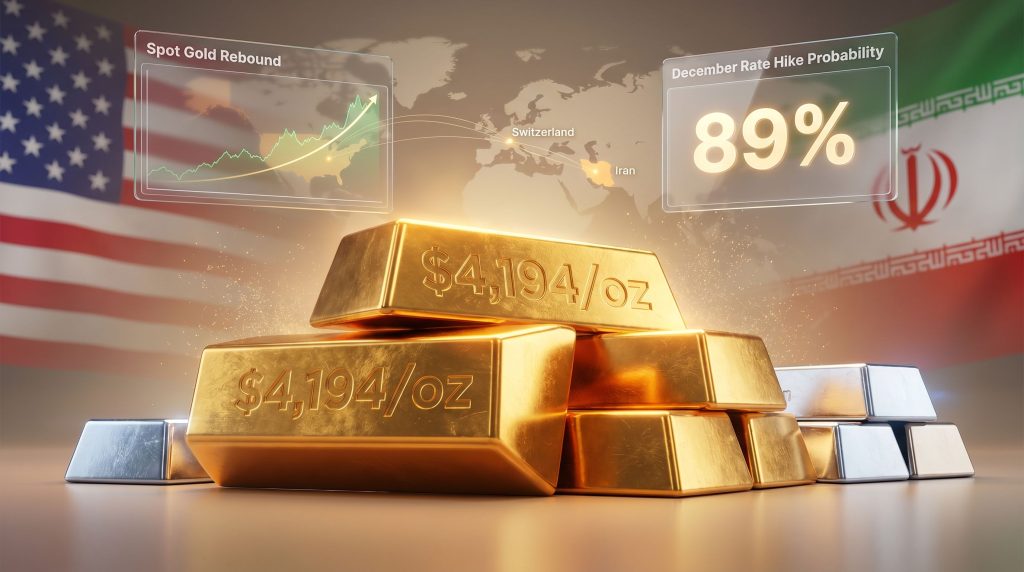
To properly contextualise the recovery, it helps to understand where gold stood before the session opened. Spot gold had declined to its lowest level since June 11, 2026, during Friday's session, before staging its recovery. The rebound during Monday's Asian trading hours brought prices back to approximately $4,197 per ounce, representing a gain of roughly 0.9% from the prior session's trough.
U.S. gold futures for August delivery, however, told a slightly different story, sitting at approximately $4,215.90, a divergence from spot pricing that reflected the market's uncertainty about whether diplomatic momentum would hold through the coming sessions.
The broader precious metals complex also moved higher, though at varying magnitudes:
| Metal | Price | Session Change |
|---|---|---|
| Spot Gold | ~$4,197/oz | +0.9% |
| U.S. Gold Futures (August) | ~$4,215.90/oz | -0.7% on futures |
| Silver | $66.10/oz | +1.8% |
| Platinum | $1,667.97/oz | +0.2% |
| Palladium | $1,270.41/oz | +1.0% |
Silver's outperformance relative to gold during this session is worth noting separately. Silver's dual role as both a monetary metal and an industrial input gives it a different risk profile than gold, and its 1.8% gain suggested that broader commodity sentiment was recovering alongside the geopolitical repricing.
The Federal Reserve Counterweight: Why Rate Expectations Cap the Rally
Any analysis of gold's recovery during this period that ignores the Federal Reserve's role is fundamentally incomplete. Federal Reserve Chair Kevin Warsh delivered a press conference in the days preceding this session that markets interpreted as unambiguously hawkish. His emphasis on inflation management, without providing nuanced commentary about the specific conditions that would need to be met before a rate adjustment could be justified, led traders to conclude that a rate increase was approaching more rapidly than previously anticipated.
The consequences for gold were significant and measurable:
| Rate Hike Signal | Before Fed Meeting | After Fed Meeting |
|---|---|---|
| CME FedWatch December Rate Hike Probability | 61% | 89% |
| Fed Policymakers Expecting a Rate Rise This Year | N/A | 9 of 19 |
This shift matters enormously for gold. As a non-yielding asset, bullion carries an implicit opportunity cost. Every percentage point increase in benchmark interest rates makes yield-bearing alternatives, including government bonds and money market instruments, comparatively more attractive. When the probability of a December rate hike jumps from 61% to 89% within a single meeting cycle, the structural ceiling for gold prices tightens considerably. In addition, the interplay between gold and bond dynamics becomes especially pronounced during such hawkish signalling periods.
Gold generates no income stream. Rising rate expectations increase the relative attractiveness of fixed-income alternatives, compressing the price upside for bullion regardless of short-term geopolitical tailwinds.
The analyst perspective circulating in markets during this period reflected this tension precisely. Market commentary from Marex noted that the situation remained highly fluid and that a watchful, non-aggressive positioning stance was appropriate given the rapidly shifting diplomatic environment. This is consistent with how sophisticated commodity traders approach high-volatility geopolitical events: gathering information before committing capital, rather than chasing short-term price movements.
A Framework for Interpreting Diplomatic Events and Their Gold Price Impact
Investors who approach geopolitical events with a structured analytical framework are better positioned to avoid reactive, sentiment-driven decision-making. The transmission mechanism from diplomatic development to gold price moves through several distinct stages:
- Risk premium compression as fear-driven buying dissipates, reducing speculative long positions accumulated during peak uncertainty
- Oil price adjustment as supply expectations are revised based on diplomatic outcomes
- Inflation expectation revision flowing from the oil price move, feeding into bond market pricing
- Central bank rate expectation recalibration as the inflation narrative evolves
- Net institutional repositioning in gold futures and ETF markets, reflecting the updated macro picture
Each of these steps operates on a different time horizon. Risk premium compression can occur within hours of a headline. Central bank expectation shifts take days or weeks to fully reprice. This temporal mismatch is why gold rebounds as Iran cites progress in peace talks can produce sharp, short-lived price recoveries, only to consolidate or retreat as longer-duration forces reassert dominance.
Three Scenarios: What Diplomacy's Outcome Means for Gold's Next Move
Following the announcement that Qatar and Pakistan, serving as mediating nations, had confirmed a 60-day roadmap toward a final agreement between the U.S. and Iran, three plausible market scenarios emerged for precious metals investors to monitor:
Scenario A: Full Agreement Within the 60-Day Window
- Iranian oil supply expectations increase materially
- Brent crude prices fall further, easing energy-driven inflationary pressure
- Reduced inflation expectations reinforce the Federal Reserve's rate-hiking case
- Gold faces sustained downward pressure as both inflation hedge demand and geopolitical safe-haven demand diminish simultaneously
Scenario B: Talks Stall or Break Down After Switzerland
- Geopolitical risk premium re-enters commodity markets rapidly
- Oil prices spike, reigniting inflation concerns
- Safe-haven gold demand recovers, potentially exceeding prior session highs
- Silver and palladium also benefit from broader commodity risk re-pricing
Scenario C: Prolonged Negotiation Without Clear Resolution
- Markets price in continued uncertainty, supporting range-bound gold trading
- Federal Reserve policy signals become the dominant directional driver
- Gold's performance increasingly decouples from geopolitical headlines and tracks bond yield movements more closely
In every scenario, the Federal Reserve's rate trajectory carries greater long-run weight than geopolitical outcomes. Diplomatic events create volatility windows, but monetary policy determines the directional trend.
The next major ASX story will hit our subscribers first
Silver's Structural Case Versus Gold's Macro Headwinds
Silver's 1.8% gain during the same session that saw gold recover by less than 1% is not simply a random divergence. Silver has increasingly attracted attention from investors who want exposure to both monetary and industrial demand cycles. Its use in photovoltaic solar panels, electric vehicle components, and high-conductivity electronics gives it a demand base that extends well beyond traditional precious metals investing.
During periods of geopolitical de-escalation that also coincide with falling oil prices and improving risk sentiment, silver can outperform gold because the industrial demand component of its pricing recovers alongside the broader commodity complex. Gold, by contrast, is almost entirely driven by monetary and safe-haven considerations, making it more sensitive to rate expectations and less responsive to industrial demand recovery. This dynamic is particularly relevant for investors attempting to navigate a precious metals portfolio through diplomatic volatility.
What Historical Patterns Suggest About Rebound Durability
Market history provides a useful, if imperfect, guide for assessing how long geopolitically driven gold rebounds tend to last. The consistent pattern across prior diplomatic de-escalation events is that initial price recoveries in gold are frequently partially or fully reversed within 48 to 72 hours. This occurs because:
- Speculative traders who accumulated long positions during peak geopolitical stress unwind those positions as risk recedes
- Algorithmic trading systems respond to headline sentiment shifts faster than fundamental repricing can stabilise
- Institutional positioning in gold futures often overshoots on both the upside and downside relative to underlying fundamentals
- The underlying monetary policy environment reasserts its influence as the diplomatic news cycle fades
None of this means diplomatic developments are irrelevant to gold pricing. They create windows of opportunity and vulnerability. However, for investors with a medium to long-term time horizon, they represent noise superimposed on the more durable signal of central bank policy direction. Consequently, central bank gold demand remains one of the most structurally significant forces acting on bullion prices, irrespective of short-term geopolitical headlines.
Key Variables for Precious Metals Investors to Monitor
Given the competing forces at play, investors following gold rebounds as Iran cites progress in peace talks should focus on several specific indicators to guide their positioning:
- CME FedWatch Tool probability shifts for the December Federal Reserve meeting, as these represent the market's collective judgment on the rate trajectory
- Brent crude price movements following each round of U.S.-Iran negotiations, as oil remains the primary transmission channel between diplomacy and gold
- U.S. Treasury real yield movements, which capture the opportunity cost of holding gold more directly than nominal rates alone
- Silver's relative performance versus gold as a leading indicator of whether commodity sentiment is genuinely improving or simply experiencing a temporary bounce
- CFTC Commitment of Traders reports on speculative positioning in gold futures, which can reveal whether institutional traders are genuinely repositioning or simply covering short-term hedges
For broader context on how these diplomatic developments are being interpreted across financial markets, recent coverage of U.S.-Iran peace talk progress provides useful background on the market reaction as events unfolded.
This article is intended for informational purposes only and does not constitute financial advice. Commodity and precious metals markets involve significant risk, and past price patterns are not indicative of future performance. Investors should conduct independent research and consult qualified financial advisors before making investment decisions.
Want to Stay Ahead of the Next Major Mineral Discovery on the ASX?
While gold's price action is shaped by macroeconomic forces and diplomatic headlines, Discovery Alert's proprietary Discovery IQ model scans ASX announcements in real time — instantly identifying significant mineral discoveries and translating complex data into actionable insights for both short-term traders and long-term investors. Explore historic discoveries and the substantial returns they generated, then begin your 14-day free trial to position yourself ahead of the broader market.