
June 21, 2026
The Hidden Economics Behind Africa's Push to Keep Gold Value at Home
Across mineral-rich nations, a quiet but consequential shift has been building for more than a decade. Governments that once accepted raw commodity exports as the default model of resource extraction are increasingly questioning why the most profitable stages of the value chain happen elsewhere. Refining margins, certification fees, assaying revenues, and the employment that comes with processing infrastructure have long flowed to facilities in Switzerland, the UAE, and elsewhere in Europe rather than to the countries where gold physically comes out of the ground. Guinea's ban on raw gold exports is the latest, and arguably one of the most structurally significant, expressions of this continent-wide reckoning.
Understanding why this matters requires looking beyond the headline announcement and examining the policy architecture, the economic logic, and the very real implementation risks that will determine whether this becomes a genuine turning point or another resource nationalism gesture that quietly fades under pressure.
When big ASX news breaks, our subscribers know first
Guinea's Strategic Weight in West Africa's Gold Economy
Guinea is not a marginal player in African gold production. According to the World Gold Council, Guinea ranks as Africa's sixth-largest gold producer, a position that gives its regulatory decisions genuine market relevance. The country holds the second-largest gold reserves in West Africa, a geological endowment that underpins its leverage in negotiations with international operators.
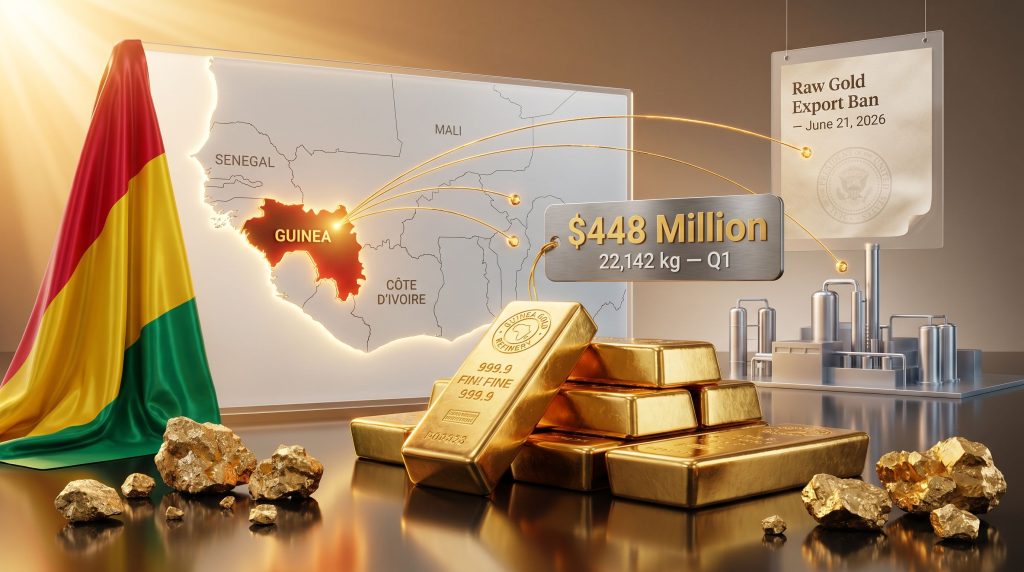
The scale of current production makes the policy stakes concrete. Guinea's Ministry of Mines and Geology reported that combined gold exports from industrial and artisanal operators reached 22,142 kilograms in the first quarter of the current year alone. In full-year terms, Guinea exported approximately $448 million worth of gold in 2024, a figure that illustrates just how significant a disruption to raw export flows could be, both for the domestic economy and for the international buyers who source from this market. The broader gold market outlook for 2025 and beyond adds further context to why this policy shift carries such weight.
What makes Guinea's gold sector particularly complex from a governance perspective is its structural diversity. The sector spans three distinct operator tiers:
- Industrial producers such as Société Aurifère de Guinée (SAG), a subsidiary of AngloGold Ashanti, operating large-scale mechanised mines with established export infrastructure
- Semi-industrial operators, of which two are currently active, sitting between formal industrial production and informal artisanal activity
- Artisanal and small-scale gold mining (ASGM) producers, numbering in the hundreds, operating with minimal formal compliance infrastructure
This diversity is not incidental. It is the central reason why a uniform export restriction carries such different implications depending on which part of the sector you examine.
What the Guinea Ban on Raw Gold Exports Actually Prohibits
The announcement made by President Mamadi Doumbouya on June 21, 2026 establishes that all gold produced in Guinea must be processed into ingots at a newly constructed refinery in Conakry before it can be legally exported to international markets. In practical terms, this means that raw gold in any form, whether alluvial concentrates from artisanal operations or unrefined doré bars from industrial mines, can no longer be shipped directly to overseas refineries.
The stated enforcement mechanism is straightforward but severe. Operators who continue exporting unprocessed material face suspension of their mining licences and termination of their mining agreements. Gold buying offices, which function as the commercial intermediaries between small-scale producers and export markets, are also implicated in the compliance chain.
| Violation | Stated Consequence |
|---|---|
| Export of unprocessed gold | Mining licence suspension |
| Breach of mining agreement terms | Mining agreement termination |
| Non-compliance by buying offices | Implied regulatory action |
The term raw gold in this regulatory context typically encompasses unrefined material that has not been smelted and certified to a defined purity standard. What constitutes a compliant processed product under Guinea's emerging framework, specifically whether doré that meets a minimum fineness threshold would qualify or whether full refinery-grade ingot production is required, remains a critical technical question that the current announcement does not fully resolve.
The Conakry Refinery Constraint
The entire architecture of the policy hinges on a single facility in the capital. This creates an immediate and practically urgent question: can one refinery absorb the full output of Guinea's gold sector?
Processing 22,142 kilograms per quarter from hundreds of geographically dispersed operators, many of them in remote mining regions far from Conakry, requires not just refinery capacity but logistics infrastructure, secure transport corridors, chain-of-custody documentation systems, and reliable power supply at the processing facility. These are not trivial requirements. Gold refining at commercial scale demands consistent feedstock quality, sophisticated assaying equipment, and trained technical personnel, none of which can be assumed to be immediately available at a newly built facility.
The Conakry refinery mandate creates an infrastructure dependency at the heart of the policy. If throughput capacity cannot match production volumes, the ban does not reduce raw gold flows so much as redirect them into informal channels.
Comparing the Guinea Gold Export Ban to Global Resource Nationalism Precedents
Guinea's move is not without precedent, and examining analogous policies elsewhere provides a more textured understanding of probable outcomes.
Indonesia's nickel ore export ban, implemented in 2020, is the most frequently cited structural analogue. Jakarta's prohibition forced international buyers to invest in domestic smelting and processing capacity, successfully catalysing a downstream nickel industry. However, it also triggered a WTO dispute initiated by the European Union, and the transition period was marked by significant supply disruption and informal export activity before the new processing ecosystem matured.
Zimbabwe's restrictions on lithium concentrate exports, introduced more recently, reflect a similar logic applied to battery-critical minerals. Zimbabwe mining policy has been complicated by the same infrastructure deficit that Guinea now faces, reinforcing how difficult these transitions are in practice.
What differentiates Guinea's context from these cases is its dual commodity identity. Guinea is simultaneously the world's largest bauxite producer and a significant gold producer. This combination gives Conakry unusual negotiating leverage with international mining companies, many of whom have substantial bauxite interests in the country that they would be reluctant to jeopardise through protracted disputes over gold policy.
The political economy dimension also matters. Guinea is governed by a military-led transitional administration, a governance structure that has become increasingly common across the Sahel and West Africa following a series of coups in Mali, Burkina Faso, and Niger. These governments have shown a consistent pattern of accelerating resource sovereignty agendas, partly as a legitimacy-building exercise domestically and partly as a renegotiation of the terms under which foreign capital accesses national mineral wealth.
Furthermore, this political context shapes both the speed of policy announcements and the complexity of enforcement, since transitional governments may lack the deep institutional capacity required to administer a sector-wide compliance transformation.
Economic Upside and Structural Risk: A Balanced Assessment
The Value-Addition Argument
The economic rationale for retaining refining activity domestically is well-established in the resource economics literature. The gap between the price of raw gold and the price of refined, certified gold ingots represents a refining margin that currently accrues to processors in other jurisdictions. Consequently, by capturing this margin domestically through domestic mineral processing, Guinea's government could:
- Increase total government revenue per kilogram of gold produced
- Create formal employment in refining, assaying, and certification roles
- Develop technical expertise and industrial infrastructure that has long-term economic spillover effects
- Improve traceability and reduce the leakage of undeclared artisanal production into informal cross-border flows
Structural Risks That Cannot Be Overlooked
The implementation risks are significant and historically well-documented in comparable cases.
Artisanal miner vulnerability is perhaps the most acute near-term concern. ASGM operators work with limited capital, no formal logistics infrastructure, and often operate in areas where transport to Conakry is costly and unreliable. A centralised refinery mandate effectively imposes compliance costs that are disproportionately burdensome for the smallest producers, creating strong economic incentives to route gold through informal cross-border channels into neighbouring Guinea-Bissau, Senegal, Sierra Leone, or Mali instead.
Across West Africa, informal gold flows have historically responded rapidly to formal export restrictions. Ghana's experience, alongside Mali and Burkina Faso, demonstrates how tightened formal sector regulations can coincide with documented increases in untracked artisanal gold crossing borders without declaration.
Foreign direct investment uncertainty is the second major risk category. Industrial operators with existing mining agreements negotiated under the previous regulatory framework may face contractual conflicts if the new policy overrides previously agreed export rights. AngloGold Ashanti, through its SAG subsidiary, is the most directly exposed major operator. How the company responds, whether through legal challenge, diplomatic engagement, or negotiated transition arrangements, will set an important precedent.
Refinery infrastructure paradox represents the deepest structural contradiction in the policy. Building the domestic processing capacity that makes an export ban viable typically requires foreign capital and technical expertise. Yet a Guinea ban on raw gold exports sends a signal of regulatory unpredictability that can deter precisely the investment needed to make the ban work. Botswana navigated a version of this paradox in diamonds through its long-term partnership with De Beers, which brought sorting and valuation activities onshore over decades of structured negotiation rather than abrupt prohibition.
Three Scenarios for Guinea's Gold Export Volumes
Scenario A: Full Enforcement
The Conakry refinery becomes the sole legal export gateway. Raw gold shipments halt immediately. If refinery capacity is insufficient to process the equivalent of 22,142 kilograms per quarter, bottlenecks emerge rapidly. International buyers face supply gaps and Guinea's gold temporarily exits global spot market flows. This scenario maximises short-term disruption and revenue risk for both operators and the government.
Scenario B: Phased Compliance
Industrial operators receive a defined transition window while the refinery scales up throughput. Artisanal producers face a longer adjustment curve with targeted formalisation support. Export volumes decline modestly in the near term but recover as processing capacity expands. This represents the most economically rational implementation path and the one most consistent with the precedents set by Indonesia and Botswana.
Scenario C: Partial Enforcement with Informal Leakage
Formal export volumes fall. Informal cross-border flows to neighbouring countries increase. Government gold revenue declines in the short term despite the policy's intent to increase it. Enforcement pressure mounts and the government faces a choice between scaling back the policy or investing heavily in border monitoring and ASGM formalisation programmes.
The next major ASX story will hit our subscribers first
Key Policy Facts at a Glance
| Dimension | Detail |
|---|---|
| Policy Type | Raw mineral export restriction and domestic refining mandate |
| Announced By | President Mamadi Doumbouya |
| Announcement Date | June 21, 2026 |
| Guinea's Gold Rank | 6th largest producer in Africa |
| Q1 Gold Export Volume | 22,142 kg (industrial and artisanal combined) |
| 2024 Gold Export Value | Approximately $448 million |
| Processing Location | Newly built refinery in Conakry |
| Primary Industrial Operator | Société Aurifère de Guinée (AngloGold Ashanti subsidiary) |
| Non-Compliance Penalty | Licence suspension and mining agreement termination |
| Regional Analogues | Indonesia nickel ban (2020), Zimbabwe lithium restrictions |
What This Signals for West Africa's Mineral Governance Trajectory
Guinea's announcement will be watched closely in Bamako, Ouagadougou, Abidjan, and Dakar. Mali and Burkina Faso, both under military-led administrations, have already signalled stronger resource sovereignty orientations. Côte d'Ivoire, which hosts significant artisanal and industrial gold activity, has so far maintained a more investor-friendly posture but will be watching the enforcement outcomes in Guinea carefully.
The broader mining geopolitical landscape adds another layer of complexity, as international buyers and investors recalibrate their supply chain strategies in response to tightening export controls across multiple jurisdictions. In addition, shifts in global gold production patterns mean that Guinea's policy could have ripple effects well beyond its own borders.
The deeper question for the region is whether Guinea's policy accelerates a West African convergence toward mandatory beneficiation requirements or whether implementation difficulties create a cautionary tale that moderates similar impulses elsewhere. The answer will depend less on the strength of the presidential announcement and more on three practical variables:
- The speed at which the Conakry refinery can credibly demonstrate throughput capacity at the scale required
- The quality and timeliness of transition frameworks offered to artisanal producers
- The government's success in attracting the foreign technical expertise and capital that domestic refining infrastructure requires, without creating new forms of dependency that undermine the policy's underlying rationale
The long-term viability of Guinea's ban on raw gold exports will ultimately be measured not by its declaration, but by the institutional architecture built around it in the months that follow.
This article is intended for informational purposes only and does not constitute financial or investment advice. Projections and scenario analyses represent analytical frameworks, not confirmed outcomes. Investors and operators should conduct independent due diligence and seek professional advice before making decisions based on regulatory developments in Guinea's mining sector.
Want to Stay Ahead of Major Mineral Discoveries Reshaping Global Supply Chains?
As resource nationalism reshapes gold and mineral flows across Africa and beyond, Discovery Alert's proprietary Discovery IQ model instantly notifies subscribers of significant ASX mineral discoveries — turning complex sector shifts into actionable investment opportunities. Explore historic examples of exceptional discovery returns and begin your 14-day free trial at Discovery Alert to position yourself ahead of the market.