
June 15, 2026
The Hidden Economics Behind Underground Fleet Standardisation
Every major underground mining contract carries two parallel procurement stories. The first is the headline contract itself. The second, often less examined, is the equipment strategy that determines whether the production targets embedded in that contract are ever actually achieved. When Barminco chooses Sandvik for Bellevue Gold mining fleet operations, it is not simply placing an equipment order. It is making a calculated bet on operational continuity, cycle time compression, and total cost management across a four-year production horizon where performance variability has direct financial consequences.
Understanding why that bet was placed, and what it reveals about the direction of underground mining in Australia, requires looking beyond the order value and examining the operational logic underneath it.
When big ASX news breaks, our subscribers know first
Bellevue Gold: An Operating Asset Entering Its Most Consequential Phase
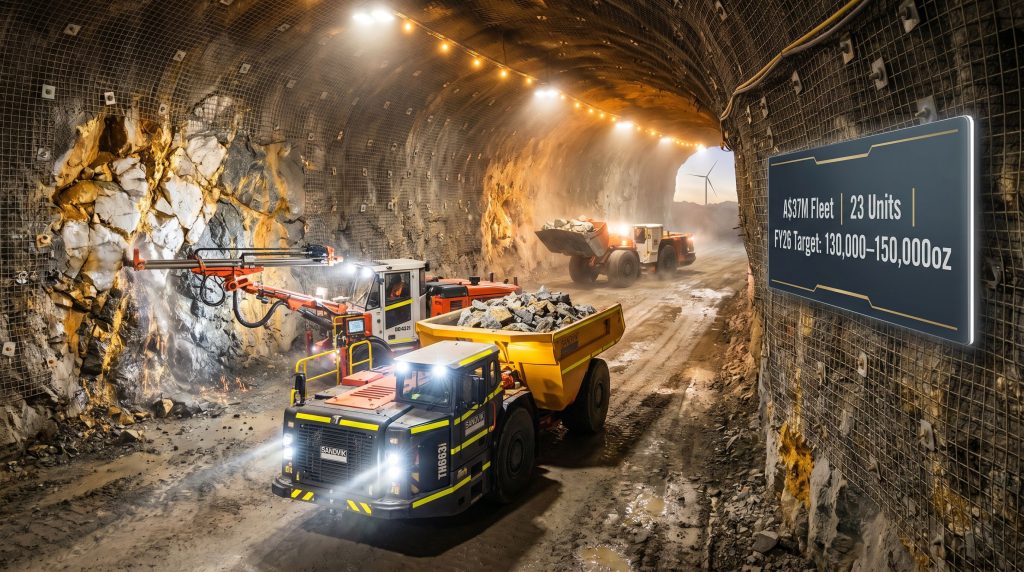
Situated roughly 400 kilometres north-west of Kalgoorlie in Western Australia, the Bellevue Gold Project occupies a particularly interesting position in the Australian gold sector. It is no longer a development story. Commercial production commenced in 2024, and the operation is now in active ramp-up toward nameplate capacity, with FY26 production guidance set at 130,000 to 150,000 ounces.
What distinguishes Bellevue from many of its regional peers is its grade profile. The project is widely recognised as one of Australia's highest-grade operating gold mines, which creates a specific set of operational priorities that differ substantially from bulk, lower-grade operations. The Bellevue Gold production issues encountered during ramp-up have only reinforced how critical equipment reliability is to this site's performance trajectory.
"In high-grade underground gold mining, the value per tonne of ore is so significant that any interruption to development or production drilling schedules has an outsized financial impact compared to equivalent downtime at a lower-grade operation."
This economic sensitivity is precisely why equipment selection at Bellevue carries strategic weight. The mine also integrates four wind turbines and a solar farm into its energy infrastructure, with approximately 90% of total site energy requirements sourced from renewables. That sustainability profile is not cosmetic. It shapes the operational philosophy of the entire site, and equipment procurement decisions are expected to align with it rather than contradict it.
The Barminco Mandate and the Scale of the Commitment
Barminco, the underground contract mining arm of the broader Perenti Group, was awarded a four-year underground mining services contract at Bellevue Gold, with operations scheduled to commence in August 2026. The reported contract value sits at approximately A$850 million, making it one of the more substantial underground services commitments in Western Australia's near-term gold sector pipeline.
The scope covers the full range of underground mining services, from development through to production drilling and material movement. To execute at that scale and duration, Barminco needed a fleet capable of performing consistently across multiple concurrent mining fronts.
| Contract Parameter | Detail |
|---|---|
| Contract Duration | Four years |
| Reported Contract Value | A$850 million |
| Commencement Date | August 2026 |
| Scope | Full underground mining services |
| Fleet Units Ordered | 23 (Sandvik-supplied) |
The fleet procurement decision, valued at approximately Skr350m (around A$37 million), was not made in isolation. It reflects an existing multi-project relationship between Barminco and Sandvik, and a deliberate choice to standardise on a single original equipment manufacturer (OEM) rather than assemble a mixed fleet from multiple vendors.
Breaking Down the 23-Unit Sandvik Fleet
The equipment order spans four distinct machine categories, each selected for a specific operational function within the Bellevue underground environment.
| Equipment Type | Model | Quantity | Primary Function |
|---|---|---|---|
| Underground Trucks | Toro TH663i | 7 | Material haulage through underground drives |
| Underground Loaders | Toro LH517i | 6 | Load-haul-dump (LHD) ore and waste movement |
| Longhole Drills | Sandvik DL432i | 5 | Production drilling for stope extraction |
| Development Drills | Sandvik DD422i | 5 | Face advancement, ground support, meshing |
| Total | 23 |
The agreement also includes rock tools, ancillary parts, and ongoing services components.
Why the Toro Series Makes Sense for High-Intensity Underground Haulage
The Toro TH663i trucks and LH517i loaders are engineered for demanding underground conditions where tight turning radii, gradient performance, and payload consistency are non-negotiable. Both machine types incorporate built-in connectivity as a standard specification, feeding real-time machine health data to operations teams.
This matters more than it might appear. Condition-based maintenance, enabled by live telematics, allows maintenance scheduling to respond to actual machine wear rather than fixed calendar intervals. The result is a measurable reduction in both over-servicing costs and the risk of unexpected failures during active production cycles.
In practical terms, a single unplanned loader breakdown on a high-grade stope can delay an entire ore movement sequence. When the ore being moved grades at the levels Bellevue produces, that delay has an immediate dollar consequence.
The DD422i Dual-Controls Configuration: A Closer Look
Perhaps the most technically interesting element of this fleet order is the Sandvik DD422i development drills equipped with Sandvik's dual-controls package. This configuration allows a single machine to perform three distinct underground development functions:
- Boring – advancing development headings through face drilling
- Bolting – installing ground support systems to stabilise newly developed drives
- Meshing – applying safety screening and rock reinforcement layers
In a conventional underground development setup, these three tasks would typically require either separate specialist machines or significant reconfiguration time between functions. The dual-controls architecture compresses that into a single deployment, reducing the number of machines required per active heading, simplifying traffic management in narrow drives, and directly improving development cycle times.
"Faster development cycle times in a high-grade underground mine translate almost directly into earlier access to ore. When that ore carries the grade profile of Bellevue, the revenue implications of shaving even a few weeks off a development heading timeline are material."
This is a nuance that often goes unexamined in fleet announcements. The headline is the number of machines and the order value. The operational reality is that machine versatility at the heading level can quietly determine whether a mine hits or misses its quarterly development targets.
OEM Standardisation: The Strategic Logic That Goes Beyond Brand Preference
A less-discussed aspect of large underground fleet decisions is the systemic advantage of committing to a single OEM across an entire operation. Mixed-fleet environments introduce compounding complexity:
- Parts inventory proliferation: Different OEMs require separate spare parts supply chains, increasing warehousing costs and procurement overhead.
- Technician certification fragmentation: Underground maintenance crews require certification for specific machine platforms. Mixed fleets multiply training requirements.
- Warranty and service structure complexity: Managing service agreements across multiple manufacturers adds administrative burden and can create accountability gaps during equipment failures.
- Operator familiarity gaps: In high-pressure underground environments, operators perform better on machines they know deeply. Fleet standardisation reduces the cognitive load of transitioning between different control systems.
By consolidating the Bellevue fleet under Sandvik, Barminco creates a streamlined maintenance ecosystem where parts, service technicians, warranty frameworks, and operator training all operate within a single system architecture. Over a four-year contract, those efficiency gains accumulate into a meaningful reduction in total cost of ownership.
Barminco's vice-president of Australian operations noted that the investment is designed to support accelerated underground development, improved material movement efficiency, and greater operational flexibility as additional mining areas are progressively opened. That objective requires not just capable machines, but a maintenance and support structure that can sustain them at high availability rates across concurrent active fronts.
What the Bellevue Fleet Order Reveals About Underground Mining Equipment Trends
The Barminco-Sandvik agreement at Bellevue is a useful lens through which to examine several converging trends reshaping underground mining equipment strategy in Australia and globally.
Connectivity Has Moved From Premium Feature to Baseline Requirement
Five years ago, real-time machine analytics and remote health monitoring were positioned as premium add-ons for operators willing to pay for advanced capability. Today, the Toro TH663i and LH517i ship with connectivity as standard. This reflects a broader market shift in which telematics infrastructure is now considered a baseline operational requirement rather than an optional upgrade.
Furthermore, AI-powered mining efficiency tools are increasingly being integrated alongside these telematics systems, allowing Australian underground gold operations to treat fleet data as a core productivity input. Machine performance metrics now feed into shift planning, maintenance rostering, and development scheduling in ways that were not operationally feasible even a decade ago.
Multi-Function Drill Rigs Are Compressing Development Timelines
The DD422i's dual-controls capability reflects an industry-wide move toward multi-task drill rigs that consolidate what were traditionally separate machine roles into a single deployment. For mine planners, this changes the resource allocation model at the heading level. Fewer machines per heading means less traffic congestion in underground drives, simpler logistics coordination, and faster cycle times from blast to next-cycle initiation.
This trend is particularly consequential at high-grade operations where the speed of development directly determines when ore becomes accessible. The faster development advances, the sooner stopes can be drilled, blasted, and drawn, which moves the revenue recognition timeline forward. Indeed, broader mining automation trends are accelerating this shift toward machine versatility across the sector.
Renewable Energy Integration Is Quietly Influencing Equipment Procurement Philosophy
Bellevue's approximately 90% renewable energy supply from on-site wind and solar infrastructure is one of the more significant ESG credentials in the Australian underground gold sector. What is less commonly discussed is how that energy profile creates downstream preferences in equipment selection.
In addition, operations with strong emissions reduction commitments increasingly favour equipment platforms that can integrate with electrification roadmaps. The growing uptake of renewable energy in mining reflects a sector-wide acknowledgement that energy strategy and equipment procurement can no longer be treated as separate conversations. While the current Sandvik fleet order covers diesel-powered equipment, Sandvik's broader product development trajectory toward battery-electric underground vehicles means the vendor relationship established at Bellevue has the potential to evolve alongside the site's long-term energy strategy.
The next major ASX story will hit our subscribers first
Delivery Logistics and the Production Ramp-Up Critical Path
With Barminco's contract commencing in August 2026, the sequencing of fleet delivery, site commissioning, and operator training becomes a genuine critical path variable for Bellevue's production ramp-up. A 23-unit fleet mobilisation at an operating mine site requires coordinated execution across multiple workstreams:
- Equipment manufacturing completion and pre-delivery quality assurance at Sandvik's production facilities
- Freight and logistics to a site located roughly 400 kilometres from Kalgoorlie
- Underground infrastructure readiness to accommodate the incoming fleet
- Operator induction, machine familiarisation, and commissioning sign-off
Any delays in this sequence carry the risk of pushing back Barminco's ability to deliver on the accelerated development objectives that underpin Bellevue's FY26 production guidance of 130,000 to 150,000 ounces. This is not a speculative risk so much as a standard critical path dependency that mine planners will be managing closely in the months leading to contract commencement. The scale of this challenge is comparable to what is being attempted through the underground gold mine expansion at Tanami, where logistics and sequencing are equally consequential.
Sandvik's Positioning in Long-Duration Underground Contracts Globally
The fact that Barminco chooses Sandvik for Bellevue Gold mining fleet operations sits within a broader pattern of large-scale underground equipment awards for Sandvik. The company recently secured a separate contract to supply underground mining equipment for the Khoemacau Copper Mine in Botswana, awarded through JCHX Mining Management. Taken together, these contracts reflect Sandvik's strategic positioning as a preferred OEM partner for high-value, long-duration underground operations across multiple geographies.
For Australia specifically, the underground gold sector remains a core demand driver for Sandvik's Toro and DD-series product lines. Western Australia's concentration of high-grade underground gold operations, combined with the contracting model that dominates Australian underground mining, creates a recurring procurement cycle in which relationships like the Barminco-Sandvik partnership become self-reinforcing over time. It is precisely this dynamic that makes decisions like Barminco chooses Sandvik for Bellevue Gold mining fleet so consequential — not just for this contract, but for the competitive landscape of underground equipment supply in Australia for years to come.
Disclaimer: This article contains forward-looking statements regarding production guidance and contract timelines. These figures are based on publicly reported information and are subject to change. Nothing in this article constitutes financial or investment advice. Readers should conduct their own independent research before making any investment decisions.
Want to Track the Next Major ASX Mining Discovery Before the Market Moves?
Discovery Alert's proprietary Discovery IQ model scans ASX announcements in real time, instantly identifying significant mineral discoveries and turning complex data into actionable investment insights — visit the Discovery Alert discoveries page to see how historic finds have generated extraordinary returns, and begin your 14-day free trial to position yourself ahead of the broader market.