
June 23, 2026
When Biology Meets the Mine: Infectious Disease Risk in Central Africa's Gold Corridor
Resource extraction in sub-Saharan Africa has always carried risks that extend well beyond geology and commodity prices. In the northeastern Democratic Republic of Congo, the Barrick Kibali gold mine Ebola screening Congo outbreak situation illustrates precisely how one of the continent's most mineral-rich corridors intersects with one of its most complex epidemiological landscapes. The overlap between high-density industrial workforces and recurring hemorrhagic fever zones is not a coincidence of geography — it is a structural feature of the region's economic development.
Understanding how major gold operations navigate this reality requires looking beyond the mine fence. It means examining how disease spreads through industrial labour networks, how biosecurity systems function under real-world constraints, and what the financial consequences of a regional outbreak can be for a tier-one asset producing hundreds of thousands of ounces annually. Furthermore, the DRC mineral wealth that underpins these operations adds considerable strategic weight to every operational decision made on the ground.
When big ASX news breaks, our subscribers know first
The Disease Geography of Eastern DRC's Mining Belt
The eastern DRC has been described by epidemiologists as a near-permanent incubator for viral hemorrhagic fevers. The region's combination of tropical forest ecosystems, high wildlife-human interface zones, and dense populations with limited healthcare infrastructure creates conditions where novel pathogen spillover events occur with unusual frequency.
What makes this geography particularly consequential for industrial operators is that the provinces with the highest mineral wealth — Haut-Uele, Ituri, North Kivu, and South Kivu — are precisely those with the strongest historical association with Ebola outbreaks. Gold, cassiterite, coltan, and artisanal mining activity are concentrated in the same zones where bat and primate reservoirs of filoviruses are known to circulate.
This is not a coincidence of cartography. Logging, mining, and agricultural expansion push human populations deeper into forest margins, increasing contact rates with wildlife species that serve as natural reservoirs. The index cases in multiple past DRC outbreaks have been traced to hunters, bushmeat traders, or individuals living in communities adjacent to active mining or forest-clearance zones.
For large-scale industrial operators, consequently, this context means that outbreak proximity is a recurring and foreseeable operational variable, not a black swan event.
Understanding the 2026 Bundibugyo Outbreak: Pathogen Profile and Spread Dynamics
The Ebola outbreak confirmed in DRC's Ituri province in May 2026 involves the Bundibugyo ebolavirus, a distinct species from the Zaire strain that dominated the 2014-2016 West Africa epidemic and the 2018-2020 DRC crisis. Understanding the difference between Ebola species matters enormously for both public health response and operational risk modelling.
| Ebola Species | First Identified | Approximate Case Fatality Rate | Primary Geographic History |
|---|---|---|---|
| Zaire ebolavirus | 1976 | 60-90% | DRC, Republic of Congo, Gabon |
| Sudan ebolavirus | 1976 | 40-60% | Sudan, Uganda |
| Bundibugyo ebolavirus | 2007 | 25-36% | Uganda, DRC |
| Taï Forest ebolavirus | 1994 | Rare (1 known case) | Côte d'Ivoire |
Bundibugyo carries a meaningfully lower case fatality rate than Zaire ebolavirus, but this relative comparison should not generate complacency. The virus remains capable of sustained human-to-human transmission chains, spreads through direct contact with bodily fluids of infected individuals, and produces clinical presentations — fever, severe malaise, haemorrhagic complications — that overlap with other endemic febrile illnesses, complicating early-stage triage in resource-limited settings.
A critical operational detail: the 2026 Ituri outbreak was formally detected in early May but retrospective case analysis traced the earliest infections to late April. This approximately two-week detection lag reflects a pattern seen across multiple past DRC outbreaks. Geographical remoteness, limited laboratory capacity, and the tendency for early Ebola cases to be misclassified as malaria or typhoid delays the triggering of formal response mechanisms.
Confirmed fatalities exceeded 131 deaths as of mid-May 2026, with health authorities publicly acknowledging that actual mortality figures are almost certainly higher given systematic underreporting from conflict-affected and remote communities. The WHO declared the outbreak a Public Health Emergency of International Concern (PHEIC) on 16 May 2026, triggering binding obligations under the International Health Regulations framework for all member states, including enhanced port-of-entry screening and accelerated international response coordination.
Cross-border transmission to Uganda has been confirmed, a development that public health specialists characterise as predictable given the population mobility patterns of the Lake Albert corridor. For broader context on how mining geopolitical risks compound these health challenges, the Lake Albert region's porous borders further complicate containment efforts significantly.
The Barrick Kibali Gold Mine: Strategic Asset in a High-Risk Zone
The Barrick Kibali gold mine sits in Haut-Uele province, in northeastern DRC, directly adjacent to Ituri province where the 2026 outbreak is centred. Understanding the significance of this proximity requires appreciating the scale of what Kibali represents within the global gold production picture.
| Parameter | Detail |
|---|---|
| Location | Haut-Uele Province, northeastern DRC |
| 2025 Gold Production | approximately 673,000 ounces |
| 2026 Production Guidance | 600,000 to 688,000 ounces |
| Ownership | Barrick Mining (45%), AngloGold Ashanti (45%), SOKIMO (10%) |
| Total Workforce | approximately 7,600 employees and contractors |
| Regional Status | Among Africa's largest gold-producing operations |
Kibali's output places it firmly within the top tier of African gold producers. At recent gold prices, the mine generates revenues in the range of $1.5 billion to $1.7 billion annually at the midpoint of its production guidance, making operational continuity a matter of direct financial materiality for both Barrick and AngloGold Ashanti, two of the world's four largest gold mining companies by production.
The SOKIMO 10% stake introduces an additional governance dimension that is rarely discussed in investor analyses. Because the DRC state mining entity holds an equity interest, operational decisions at Kibali — including health emergency protocols — carry implicit political weight at the national government level. Disruptions to Kibali's output affect DRC's royalty revenues, employment statistics, and foreign investment narrative in ways that elevate the mine's significance beyond its production numbers alone.
A portion of Kibali's workforce originates from Ituri province, creating a direct demographic linkage between the mine's labour pool and the outbreak's epicentre. This detail is operationally significant: it means that even with rigorous perimeter controls, the human pathway connecting the outbreak zone to the mine site runs through the workforce itself, through routine home visits, family connections, and community engagement integral to the social licence frameworks major miners maintain in the DRC.
Kibali's Ebola Screening Response: What the Protocols Actually Involve
Are Current Measures Sufficient to Protect the Workforce?
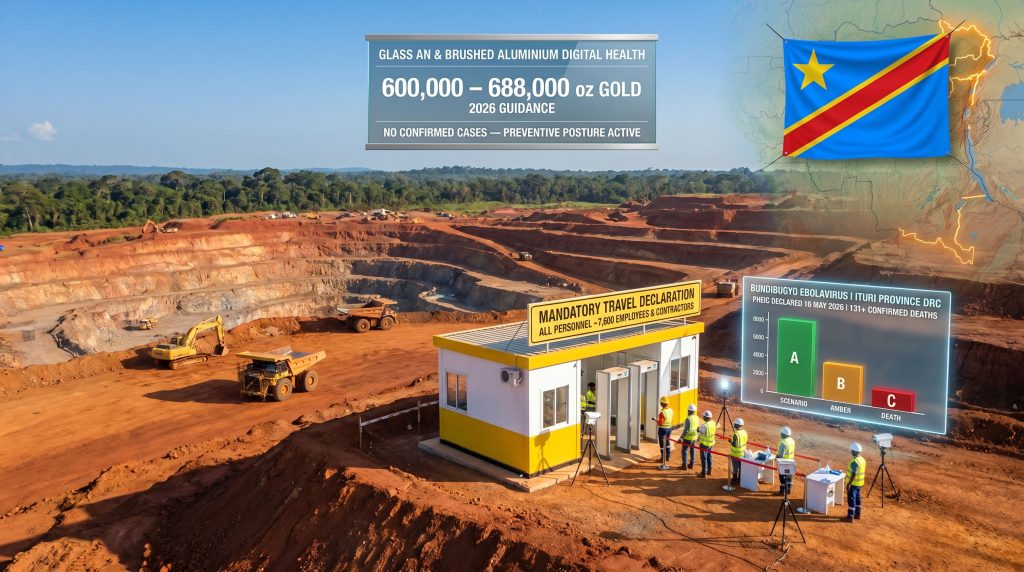
As of mid-May 2026, Barrick operational scrutiny has intensified as the company confirmed that no Ebola cases have been identified among Kibali's approximately 7,600 employees and contractors. The operation is maintaining production continuity while layering biosecurity measures onto existing site access and health monitoring infrastructure. According to reporting from Mining Weekly, the measures being implemented reflect a proportionate response calibrated to proximity risk rather than confirmed exposure.
These specific measures include:
-
Mandatory travel declaration requirements for all personnel entering the site, enabling health teams to cross-reference worker origins and recent movements against the active outbreak zone
-
Daily temperature screening at site entry points, with full implementation across all access points targeted for completion by 20 May 2026 — a timeline that reflects the logistical reality of deploying screening equipment and briefing personnel across a large, multi-entry mine site
-
A workforce-wide awareness campaign launched over the preceding weekend covering Ebola transmission pathways, symptom recognition, and the critical importance of self-reporting travel to affected areas
The 48 to 72-hour lead time from decision to full temperature screening implementation is an underappreciated operational detail. It reflects the genuine logistical complexity of scaling health interventions across a major remote mine site — not institutional inertia, but the physical reality of deploying equipment, training screeners, and establishing triage pathways across multiple entry and accommodation zones simultaneously.
"A large-scale mine in a remote African setting functions, in effect, as a self-contained municipality during a regional health emergency. It must triage, isolate, and manage potential cases before government health infrastructure can reach it — a reality that demands robust internal biosecurity capacity rather than reliance on external response timelines."
Awareness campaigns in eastern DRC's mining context carry particular operational importance because linguistic diversity across the workforce means messaging must be delivered in multiple local languages. A workforce drawing from Haut-Uele, Ituri, and broader eastern DRC will include speakers of Lingala, Swahili, Zande, and multiple other languages. Single-language campaigns risk leaving significant workforce segments without effective health information, which can drive the stigma-related symptom concealment that historically delays outbreak detection in industrial settings.
Historical Precedent: What Past Outbreaks Tell Investors About Production Risk
The economic consequences of Ebola outbreaks in Africa's mining regions are well-documented, though they are rarely modelled systematically in equity research on affected mining companies.
The 2014-2016 West Africa epidemic caused estimated GDP losses of $2.2 billion across Guinea, Liberia, and Sierra Leone, according to World Bank assessments. Mining operations in affected countries experienced workforce absenteeism driven by community fear, family obligations, and the breakdown of transport infrastructure, with some operations reporting reduced operational capacity during peak outbreak periods.
The 2018-2020 DRC Kivu outbreak — the second-largest Ebola crisis in recorded history at that point — unfolded across provinces with significant artisanal and small-scale mining activity. Its overlap with an active armed conflict zone compounded the public health response challenge, demonstrating how eastern DRC's security and health risk profiles are deeply intertwined rather than independent variables.
For investors assessing the current situation, the gold price outlook adds further context to the production risk calculus surrounding Kibali's guidance of 600,000 to 688,000 ounces. In addition, three scenarios are worth considering:
Scenario A (Most Probable): Effective containment within Ituri province. Kibali maintains full production with enhanced biosecurity in place. No revision to 2026 output guidance.
Scenario B (Moderate Probability): Outbreak spreads into Haut-Uele province. Kibali implements access restrictions and workforce density reductions. Partial production impact of 5-15% depending on duration and severity.
Scenario C (Lower Probability, Higher Impact): Sustained escalation triggers international contractor withdrawal and supply chain disruptions. Extended operational impact requiring guidance revision. This scenario has historical precedent in West Africa but would require a significantly faster geographical spread than current containment indicators suggest.
Disclaimer: These scenarios represent analytical frameworks based on historical outbreak patterns and publicly available information. They do not constitute investment advice or production forecasts. Investors should conduct independent due diligence and consult professional advisers before making investment decisions.
The next major ASX story will hit our subscribers first
The Bundibugyo Vaccine Gap: A Critical Biosecurity Complication
One dimension of the 2026 outbreak that distinguishes it from the 2018-2020 DRC crisis is the absence of an approved vaccine for Bundibugyo ebolavirus. The rVSV-ZEBOV vaccine (Ervebo), which played a significant role in limiting the spread of the Zaire-strain Kivu outbreak, is specifically designed for Zaire ebolavirus and has not demonstrated protective efficacy against Bundibugyo.
International health experts convened in May 2026 specifically to assess vaccine options for the Bundibugyo strain, a meeting that underscores a significant gap in the global biosecurity toolkit. For mining operations in the affected region, this means that the pharmaceutical backstop that existed during the 2018-2020 response is not currently available for the 2026 outbreak.
This absence, however, elevates the importance of non-pharmaceutical interventions: contact tracing, isolation infrastructure, temperature screening, and community awareness. It is precisely these measures that the Barrick Kibali gold mine Ebola screening Congo outbreak response protocol centres on, making the quality of their implementation more consequential than it would be in an outbreak where vaccine coverage was accessible.
Operational Biosecurity Tiers: A Framework for Mining Health Response
The structured approach to mine-site biosecurity during a regional outbreak can be understood as a tiered escalation framework, where each threshold triggers a defined set of additional measures.
Tier 1 — Monitoring (Outbreak in Adjacent Province)
-
Activate travel declaration protocols for all site personnel
-
Brief site medical team on pathogen-specific transmission and triage criteria
-
Establish direct communication with national health authority and WHO country office
-
Review medical evacuation capacity and isolation facility readiness
-
Launch multilingual workforce awareness campaign
Tier 2 — Elevated Alert (Cross-Border Spread Confirmed)
-
Implement temperature screening at all site entry points
-
Restrict non-essential contractor and visitor access
-
Establish dedicated isolation unit with appropriate PPE stocks
-
Move to daily health authority communication cadence
-
Review business continuity plans for reduced workforce scenarios
Tier 3 — Critical Response (Cases in Mine Province or Workforce)
-
Activate full outbreak protocol in coordination with national health authorities
-
Suspend non-essential operations and reduce workforce density
-
Engage WHO and CDC technical support for on-site guidance
-
Communicate transparently with investors, regulators, and community stakeholders
Kibali's current posture sits within a Tier 1 to Tier 2 transition — temperature screening is being implemented, travel declarations are active, and awareness campaigns are running, but full access restrictions have not been applied given the absence of confirmed cases within the workforce or the province. Reuters reporting via TradingView confirms that the Barrick Kibali gold mine Ebola screening Congo outbreak response continues to be closely monitored by industry observers and health authorities alike.
Frequently Asked Questions
Has Ebola been confirmed among Kibali workers?
As of mid-May 2026, no confirmed Ebola cases have been reported among Kibali's workforce. The mine is in Haut-Uele province, which is adjacent to but distinct from the Ituri province outbreak zone.
What is the Bundibugyo ebolavirus?
Bundibugyo ebolavirus is one of six recognised Ebola species, first identified in Uganda in 2007. Its case fatality rate of approximately 25-36% is lower than the Zaire strain's 60-90%, but it remains capable of sustained human-to-human transmission and carries no currently approved vaccine.
When was the 2026 DRC outbreak declared a PHEIC?
The WHO declared the 2026 Ituri outbreak a Public Health Emergency of International Concern on 16 May 2026.
What is Kibali's production guidance for 2026?
Kibali produced approximately 673,000 ounces of gold in 2025. Production guidance for 2026 is set at between 600,000 and 688,000 ounces, positioning it among Africa's highest-output single mining operations.
Who owns the Kibali gold mine?
Kibali is jointly owned by Barrick Mining and AngloGold Ashanti with 45% each, and DRC state miner SOKIMO with the remaining 10%.
Want to Stay Ahead of Major ASX Mineral Discoveries as They Happen?
Discovery Alert's proprietary Discovery IQ model delivers real-time alerts on significant ASX mineral discoveries, transforming complex geological and market data into clear, actionable insights for investors at every level — explore the historic returns major discoveries have generated and begin your 14-day free trial to secure a genuine market-leading edge.