May 20, 2026
When Commodity Booms Actually Change Economies: Understanding Ghana's Gold Moment
Across Sub-Saharan Africa, the history of resource booms is largely a chronicle of missed opportunities. Revenue surges arrive, fiscal positions temporarily improve, and then the cycle reverses, leaving little structural transformation behind. Understanding why Ghana's 2025 gold export performance feels categorically different requires examining not just the numbers, but the institutional architecture that has been constructed around them and the specific confluence of global forces that made this particular moment so consequential.
The Ghana gold export earnings surge of 2025 is not simply a story about rising commodity prices. It is a story about how deliberate policy choices, made years before prices moved, positioned one nation to capture a disproportionate share of a global commodity windfall, and what happens when those choices coincide with one of the most powerful gold price rallies in modern financial history.
When big ASX news breaks, our subscribers know first
Why the Global Gold Environment of 2024-2025 Was Uniquely Powerful
Gold's ascent over the 2024-2025 period was driven by a convergence of forces that analysts had theorised about for years but rarely seen operate simultaneously. Central bank gold demand across emerging markets accelerated their diversification away from dollar-denominated reserve assets, creating sustained institutional demand that differed fundamentally from speculative buying. Geopolitical risk premiums embedded in bullion prices rose as conflicts and trade tensions created persistent uncertainty across financial markets. Meanwhile, sovereign debt concerns in major Western economies reinforced gold's appeal as a store of value outside the conventional monetary system.
For gold-producing nations, this environment created an extraordinary revenue opportunity. However, not all producers were equally positioned to capitalise on it. The distinction between nations that merely extracted more gold and those that captured a structurally larger share of the value created lies in the institutional mechanisms they had built to channel production into formal, measurable, and fully taxable export flows.
Ghana sat firmly in the second category.
Dissecting the $11.1 Billion Export Performance
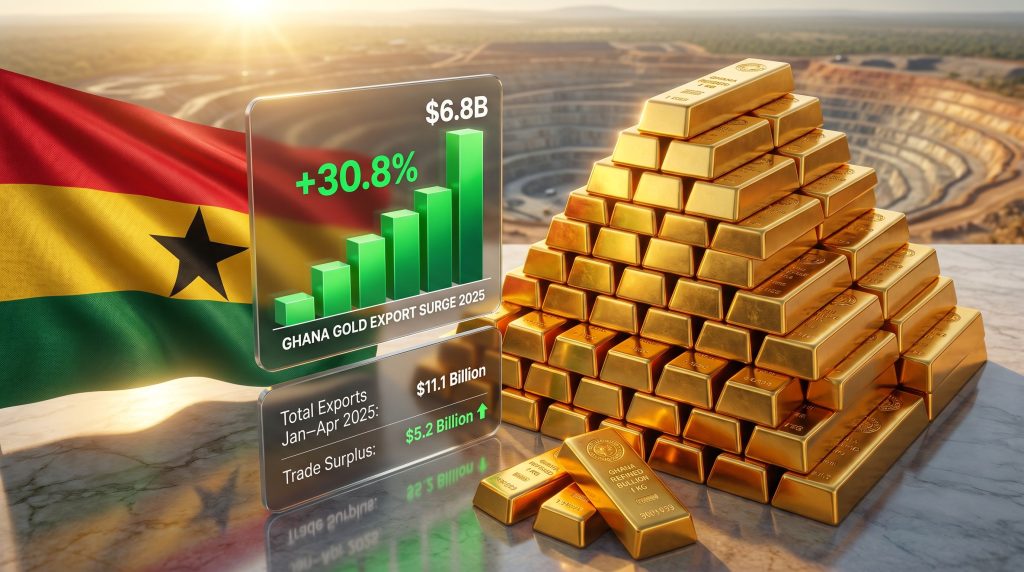
New data released by the Bank of Ghana confirmed that the country earned $11.1 billion in total export revenue between January and April 2025, compared to $9.2 billion during the same period in 2024. That represents a year-on-year increase of approximately 20.7%, a figure that would be remarkable in isolation but becomes even more significant when disaggregated by category.
| Export Category | Jan-Apr 2025 | Jan-Apr 2024 | YoY Change |
|---|---|---|---|
| Gold | $6.8 billion | $5.2 billion | +30.8% |
| Cocoa | $1.8 billion | $1.8 billion | 0% |
| Crude Oil | $1.2 billion | Not specified | – |
| Other Exports | $1.1 billion | Not specified | – |
| Total Exports | $11.1 billion | $9.2 billion | +20.7% |
Gold's 30.8% revenue increase outpaced every other export category by a significant margin, with cocoa recording zero growth and crude oil remaining a distant third contributor. The contrast between gold and cocoa is particularly instructive. Both are foundational Ghanaian export commodities with deep historical roots, yet cocoa's flat performance at $1.8 billion reflects ongoing structural challenges in agricultural export competitiveness, including disease pressures on crop yields, ageing farming infrastructure, and limited value-added processing capacity within Ghana's borders.
Crude oil's $1.2 billion contribution, while meaningful, underscores why petroleum has never displaced gold as Ghana's primary revenue engine. The country's offshore fields, while productive, operate at a scale that positions oil firmly as a supplementary rather than dominant export category. Furthermore, according to analysis from Joy Business, Ghana's gold exports in 2025 surpassed total imports for the first time in a decade, underscoring the extraordinary scale of this export moment.
The Price-Volume Question: What Actually Drove the Revenue Surge?
One of the more technically important distinctions in interpreting Ghana's 2025 export performance concerns the relative contribution of price appreciation versus production volume growth to the $1.6 billion increase in gold revenues. A revenue surge driven primarily by price is fundamentally more fragile than one underpinned by genuine volume expansion, because price-driven gains can reverse as quickly as they materialised.
Ghana's 2025 performance appears to reflect a combination of both factors, with the formalisation of artisanal and small-scale mining through the Ghana Gold Board (GoldBod) capturing previously unrecorded production volumes that were historically lost to smuggling channels. This distinction matters enormously for sustainability assessments, because volume gains tied to formalisation represent a structural improvement in revenue capture that persists even during price corrections, whereas pure price appreciation creates no lasting institutional change. Considering the 2025 gold price forecast, the combination of price strength and volume growth has proven especially powerful for Ghana's revenue position.
How Ghana's Trade Balance and Reserve Position Have Been Transformed
The downstream impact of the Ghana gold export earnings surge on Ghana's macroeconomic fundamentals has been substantial across multiple dimensions simultaneously. Despite a significant expansion in imports, Ghana maintained and modestly improved its trade surplus position, a result that reflects the scale of the gold revenue increase relative to import growth.
Total imports climbed to $5.8 billion between January and April 2025, up from $5.0 billion in the comparable 2024 period, representing a 16% increase in import expenditure. Within this, oil imports specifically rose from $1.6 billion to $2.0 billion, reflecting both higher global energy prices and rising domestic consumption driven by economic activity. This structural tension — an economy generating record export revenues while simultaneously facing an expanding energy import bill — is a dynamic that policymakers must manage carefully to prevent the external account gains from being gradually eroded.
Despite this import pressure, Ghana recorded a trade surplus of $5.2 billion for the January-April period, marginally above the $5.0 billion surplus posted during the same period in 2024.
A sustained trade surplus carries particular significance for an economy that recently navigated an IMF-supported debt restructuring programme. The relationship between external sector strength and exchange rate stability for the Ghanaian cedi is direct and consequential; foreign exchange inflows from gold exports provide the Bank of Ghana with the intervention capacity needed to manage currency volatility without depleting reserves.
The Reserve Architecture: Central Bank Strategy Embedded in the Data
The Bank of Ghana's reserve management decisions embedded within the 2025 data reveal a deliberate strategic orientation that deserves closer examination. International reserves increased to $14.4 billion in April 2025 from $13.8 billion at the end of 2024, a $0.6 billion increase that represents a meaningful strengthening of external buffers.
| Reserve Metric | April 2025 | End of 2024 | Change |
|---|---|---|---|
| International Reserves | $14.4 billion | $13.8 billion | +$0.6 billion |
| Gold Holdings (tonnes) | 22.3 tonnes | 18.6 tonnes | +3.7 tonnes |
More instructive than the headline reserve figure is the decision to increase physical gold holdings from 18.6 to 22.3 tonnes, a 19.9% increase in bullion held on the central bank's balance sheet. This move reflects the same de-dollarisation logic driving central bank gold accumulation globally, but in Ghana's case it carries an additional strategic dimension: the Bank of Ghana is accumulating gold precisely when the country is producing and exporting it at record volumes, effectively capturing a portion of the export windfall as a balance sheet asset rather than simply converting it to foreign currency.
This approach mirrors strategies employed by resource-rich central banks elsewhere, where the logic of holding a commodity you produce at scale creates a natural hedge against production-side risks while simultaneously strengthening reserve quality metrics watched closely by international creditors and rating agencies.
The GoldBod Factor: Institutional Innovation as Economic Multiplier
No serious analysis of Ghana's 2025 export performance can proceed without a detailed examination of the Ghana Gold Board, or GoldBod, which has emerged as the institutional mechanism most directly responsible for translating favourable market conditions into record revenue figures.
GoldBod's fundamental purpose is straightforward in concept but extraordinarily difficult to execute in practice: redirect gold that was previously exported through informal channels into official, taxable, and statistically measurable export flows. The scale of the organisation's achievement in 2025 is captured in a single figure. GoldBod independently exported a record 100 tonnes of gold, contributing approximately $10 billion to Ghana's projected full-year gold export total.
To appreciate the significance of this volume, consider what it implies about the historical scale of gold leaving Ghana outside official channels. The formalisation of even a fraction of previously unrecorded artisanal production at current prices translates into billions of dollars in previously invisible export revenue, explaining much of the gap between Ghana's stated export growth and what a simple price appreciation model would predict. In addition, global gold production insights highlight how formalisation programmes like GoldBod's can fundamentally reshape a nation's recorded output capacity.
Why Gold Smuggling Has Historically Been Ghana's Greatest Revenue Leak
Artisanal and small-scale mining (ASM) represents a fundamentally different economic ecosystem from large-scale industrial operations. ASM miners typically operate with minimal capital infrastructure, high labour intensity, and strong community embeddedness that creates social networks resistant to formal regulatory penetration. For decades, the path of least resistance for small-scale Ghanaian gold producers was to sell through informal aggregators who paid cash, asked no questions, and maintained connections to cross-border smuggling networks that channelled Ghanaian gold into neighbouring countries' official export statistics.
The consequence was a systematic understatement of Ghana's actual gold production capacity relative to what formal export figures implied, a discrepancy that distorted development planning, understated tax revenues, and created perverse incentives that made smuggling more financially rational than compliance.
GoldBod's intervention operates through a combination of enforcement mechanisms and positive financial incentives. By offering competitive spot-linked pricing through a network of licensed buying centres, the organisation has made formal participation financially attractive rather than merely legally required, addressing the fundamental economic logic that had sustained informal channels for years.
Comparative Failures Across the Region
Ghana's success with GoldBod stands in sharp contrast to similar attempts elsewhere in Africa that have largely failed to achieve comparable outcomes. The Democratic Republic of Congo, despite possessing vast artisanal gold production, continues to see the overwhelming majority of its small-scale output flow through informal channels due to inadequate enforcement infrastructure, pervasive institutional corruption, and the absence of credible financial incentives for formalisation. Zimbabwe's Gold Trade Act interventions have generated compliance in formal sector operations but have had limited penetration into artisanal networks. Sudan's attempts at state-led gold aggregation have been undermined by political instability and competing commercial interests with connections to government structures.
Ghana's relatively more stable institutional environment, combined with the financial resources to actually implement competitive pricing at buying centres, has created conditions for formalisation success that are genuinely difficult to replicate in more fragile state contexts.
Ghana's Position in Africa's Gold Production Hierarchy
Ghana's ranking as Africa's largest gold producer and its position among the world's top ten bullion exporters provides important context for understanding why the 2025 performance has regional and global significance beyond its domestic economic impact.
| Country | 2025 Gold Export Position | Key Structural Feature |
|---|---|---|
| Ghana | Africa's largest producer | GoldBod formalisation + price rally |
| South Africa | Declining share | Ageing deep-level mines, high costs |
| Mali | Significant but constrained | Political instability, junta governance |
| Tanzania | Growing | Evolving royalty frameworks |
| DRC | Large but informal | Smuggling dominates official figures |
South Africa's declining position in African gold production reflects structural challenges that have accumulated over decades, including the extraordinary depth of remaining ore bodies, which requires expensive ventilation and cooling infrastructure, combined with persistently high labour costs and complex operational logistics. Ghana's shallower, geologically younger ore bodies are typically amenable to open-pit and shallow underground extraction methods that keep all-in sustaining costs materially lower, providing a cost efficiency advantage that becomes most pronounced precisely when gold price record highs are recorded, as operators capture wider margins per ounce produced.
West Africa's shifting political landscape has also indirectly strengthened Ghana's competitive position. The wave of military coups across Mali, Burkina Faso, and Niger has created significant uncertainty for mining investors operating in those jurisdictions, with some international operators facing forced renegotiation of existing agreements and new entrants being effectively deterred. Ghana's comparatively stable democratic framework has become a more visible differentiator in the regional mining investment landscape.
The next major ASX story will hit our subscribers first
The Sustainability Question: Structural Transformation or Cyclical Windfall?
The most consequential analytical question surrounding Ghana's 2025 gold performance is whether it represents a genuine structural inflection point or a cyclically generated windfall that will prove temporary. The honest answer is that it contains elements of both, and the balance between them will be determined by choices that have not yet been fully made.
When a single commodity accounts for more than 60% of total export revenues, an economy becomes acutely exposed to price reversals. Ghana's gold concentration at approximately 61% of total export earnings in early 2025 mirrors the vulnerability profiles seen in other resource-dependent economies before diversification efforts took hold. The historical precedent of Ghana's economy during the 2013-2015 gold price downturn, when the cedi lost over 40% of its value and the country entered an IMF programme, provides an unambiguous reference point for what commodity concentration risk looks like when it materialises.
Gold Price Scenarios and Their Fiscal Implications
| Gold Price Scenario | Implied Annual Gold Export Revenue | Trade Surplus Outlook |
|---|---|---|
| Bull Case: $3,500/oz | ~$24-26 billion | Strongly positive |
| Base Case: $2,800-3,000/oz | ~$18-21 billion | Moderately positive |
| Bear Case: $2,000/oz | ~$12-14 billion | Narrow or neutral |
Note: These projections are illustrative scenario analyses based on volume and price assumptions and should not be interpreted as financial forecasts or investment advice. Actual outcomes will depend on multiple variables including production volumes, exchange rates, and global demand conditions.
The bear case scenario is particularly important for Ghana's IMF programme compliance metrics. An annual gold export revenue of $12-14 billion would materially reduce the trade surplus, compress foreign exchange inflows available to the Bank of Ghana, and potentially put pressure on the cedi. Whether Ghana's fiscal position has improved sufficiently during the 2025 windfall period to withstand this scenario without requiring programme modifications is a question that reserve accumulation data alone cannot fully answer. Consequently, thinking about gold as a strategic investment at both the national and institutional level has never been more relevant to Ghana's long-term planning.
The Sovereign Wealth Architecture Gap
One of the most significant structural absences in Ghana's current policy framework is the lack of a formal sovereign wealth mechanism capable of systematically capturing a portion of commodity revenue windfalls for deployment during downturns. Botswana's Pula Fund, established during that country's diamond boom, represents the regional gold standard for resource revenue management, having accumulated assets that provide meaningful counter-cyclical fiscal capacity when commodity prices fall.
Ghana's Minerals Income Investment Fund (MIIF) exists as a partial equivalent, but its capitalisation and operational mandate have not yet scaled to the point where it could provide meaningful macroeconomic stabilisation during a significant gold price correction. The 2025 windfall represents a logical moment to address this gap, given that building reserves during periods of commodity abundance is substantially easier than attempting to recapitalise them after prices have fallen.
The Transmission Mechanism: How Gold Revenue Reaches Ordinary Ghanaians
Export revenue figures reported at the national level often bear a tenuous connection to lived economic experience at the household level, and understanding the transmission mechanism between gold export earnings and domestic welfare outcomes is essential for assessing the true developmental impact of the Ghana gold export earnings surge.
The primary channels through which gold export earnings flow into the broader Ghanaian economy include:
- Corporate income tax and mineral royalties paid by large-scale mining companies to the Ghana Revenue Authority
- Foreign exchange sales by mining companies and GoldBod to the Bank of Ghana, which then supplies the interbank market
- Employment income and local procurement spending by mining operations, which create multiplier effects in mine-adjacent communities
- Infrastructure contributions and community development obligations attached to large-scale mining licences under local content regulations
- Dividend income from the government's equity stakes in major mining operations held through the Minerals Income Investment Fund
The efficiency of these transmission channels varies significantly, and the extent to which the 2025 windfall genuinely improves welfare outcomes rather than accumulating within the financial sector will depend heavily on fiscal policy choices regarding expenditure allocation and debt servicing priorities.
The Inflation Paradox of Export Success
A counterintuitive dimension of Ghana's gold boom is that sustained high export revenues can simultaneously create macroeconomic stability at the aggregate level while generating inflationary pressures at the sectoral level. Large foreign exchange inflows from gold exports increase the supply of hard currency in Ghana's financial system, potentially strengthening the cedi. A stronger cedi, while beneficial for import costs, can make Ghana's non-gold exports less competitive internationally, creating a classic Dutch Disease dynamic that has undermined economic diversification efforts in numerous resource-rich economies.
The Bank of Ghana's monetary policy challenge is therefore not simply to maintain price stability in conventional terms but to manage the distributional consequences of an export boom that concentrates foreign exchange inflows within a single sector while the broader economy continues to face structural cost pressures. Furthermore, according to reporting from Ecofin Agency, Ghana's gold export earnings are projected to double to $20.9 billion in 2025 as broader sector reforms continue to take hold.
Frequently Asked Questions: Ghana's Gold Export Surge
How much did Ghana earn from gold exports in the first four months of 2025?
Ghana generated $6.8 billion in gold export revenue between January and April 2025, compared to $5.2 billion during the same period in 2024. This 30.8% increase was the primary driver of Ghana's total export earnings reaching $11.1 billion for the period. On a full-year basis, gold exports are projected to reach approximately $20.9 billion, compared to roughly $10.3 billion in 2024, with GoldBod's 100-tonne export programme contributing an estimated $10 billion of that total.
What is GoldBod and why does it matter for Ghana's economy?
The Ghana Gold Board is a state-operated institution established to formalise gold trade flows that were previously captured by informal and often illicit export channels. By creating financial incentives for artisanal miners to sell through official licensed buying centres rather than informal aggregators, GoldBod has enabled Ghana to record and tax gold production that was historically invisible to official statistics. The organisation's 100-tonne export achievement in early 2025 demonstrates the scale of previously unrecorded production it has brought into the formal economy.
Why did Ghana's gold revenues grow faster than simple price appreciation would suggest?
Three distinct factors combined to produce the 30.8% revenue increase, operating simultaneously in the same direction. First, the global gold price rally of 2024-2025 increased the dollar value of every ounce exported. Second, GoldBod's formalisation programme captured production volumes that were previously exported unofficially, increasing measurable export quantities. Third, continued output from large-scale industrial mining operations maintained the production base from established operations. The interaction between price and volume gains is what makes 2025 distinctively different from previous periods when price increases occurred without comparable institutional improvements in revenue capture.
What are the primary risks to Ghana's gold-driven economic recovery?
The risk landscape surrounding Ghana's current export performance includes several interconnected vulnerabilities:
- Gold price reversal risk: With approximately 61% of export earnings concentrated in a single commodity, any significant decline in global gold prices would have outsized impacts on Ghana's trade balance, reserve adequacy, and cedi stability
- GoldBod governance risk: State-run commodity marketing boards have historically been vulnerable to political capture, rent-seeking behaviour, and bureaucratic inefficiency that can erode their operational effectiveness over time
- Export concentration risk: The absence of meaningful growth in cocoa, oil, and emerging mineral sectors means Ghana's economic resilience remains dependent on a narrow export base
- Sovereign wealth gap: Without a well-capitalised mechanism for saving windfall revenues, Ghana's fiscal position during a future price downturn will rely primarily on whatever buffer has been accumulated in international reserves
- Dutch Disease dynamics: Sustained foreign exchange inflows from gold could gradually undermine the competitiveness of non-gold export sectors if not carefully managed through monetary and exchange rate policy
Key Analytical Takeaways
Ghana's 2025 export performance represents a genuinely significant economic development, but one whose lasting importance will be determined by policy choices rather than market conditions. The $11.1 billion in total export earnings, $5.2 billion trade surplus, $14.4 billion in international reserves, and 22.3 tonnes of physical gold holdings collectively describe a materially stronger external sector position than Ghana has historically maintained. GoldBod's institutional contribution, evidenced by its 100-tonne export milestone, explains why this boom differs from previous commodity price cycles that produced far more modest revenue improvements.
The central challenge facing Ghanaian policymakers is converting a favourable market environment into durable institutional reforms that outlast the commodity cycle. History across Sub-Saharan Africa suggests this conversion is the exception rather than the rule. Ghana's advantage in 2025 is that the institutional groundwork, through GoldBod and reserve management improvements, was laid before the windfall arrived rather than in response to it. Whether that foundation proves sufficient to support genuine structural economic transformation remains the defining open question of this extraordinary moment in the Ghana gold export earnings surge story.
This article is intended for informational purposes only and does not constitute financial advice. All projections and scenario analyses represent analytical estimates rather than guaranteed outcomes. Readers should conduct independent research before making any investment or economic decisions based on this content.
Want to Capitalise on the Next Major Gold Discovery Before the Broader Market?
Ghana's extraordinary gold export surge demonstrates just how transformative major mineral discoveries and commodity shifts can be — and Discovery Alert's proprietary Discovery IQ model delivers real-time ASX mineral discovery alerts straight to subscribers, turning complex data across 30+ commodities into clear, actionable opportunities. Explore how historic discoveries have generated substantial returns on Discovery Alert's dedicated discoveries page, and begin your 14-day free trial today to position yourself ahead of the market.