
August 21, 2026
The Hidden Risk That Can Kill a Gold Project Before It Starts
Most investors tracking a gold development story focus on the headline numbers: resource size, grade, net present value, and production forecasts. What rarely receives the same attention is the quiet but consequential work that happens between resource delineation and construction approval. Specifically, the process of confirming that the ground chosen for permanent surface infrastructure does not conceal recoverable ore. In the world of large-scale open-pit gold development, this is not a bureaucratic formality. It is one of the most capital-critical decisions a project team will make.
The Barton Gold Tunkillia infrastructure drilling program, currently underway in South Australia's Gawler Craton region, represents precisely this kind of disciplined, engineering-grade decision-making. Understanding why this step matters, and what it signals about the project's broader development trajectory, requires stepping back from the headline economics and examining the technical architecture behind responsible mine planning.
When big ASX news breaks, our subscribers know first
What Sterilisation Drilling Actually Does and Why It Cannot Be Skipped
The term sterilisation drilling is one of those industry-specific expressions that sounds technical but describes a straightforward concept with significant financial consequences. When a project team identifies where it wants to place a processing plant, a waste rock dump, or a tailings storage facility, those locations are not chosen arbitrarily. They are selected based on topography, proximity to ore zones, hydrology, and geotechnical suitability. However, a proposed site that looks ideal on the surface may overlie mineralisation that has not yet been characterised.
If infrastructure is constructed above economically significant mineralisation, the ore beneath it becomes permanently inaccessible. This is what mine planners call stranded ore, and it represents an irreversible capital loss. Once concrete is poured, a tailings dam is lined, or a crusher is bolted down, there is no going back to recover what lies beneath.
Sterilisation drilling is fundamentally a risk-mitigation tool, not a discovery program. Its purpose is to protect the long-term capital efficiency of a project by ensuring that every major infrastructure decision is geologically informed before a single shovel of construction-grade earthwork begins.
This distinction from conventional drilling programs is critical. Resource drilling seeks to find and define mineralisation. Sterilisation drilling seeks to confirm its absence in specific locations. The two programs serve entirely different functions within the mine development lifecycle, and conflating them leads to a misunderstanding of what each actually achieves.
From a regulatory standpoint, inadequate sterilisation work can also create downstream complications. Environmental impact assessments, mine permitting applications, and pre-feasibility study engineering packages all depend on infrastructure being sited correctly. Relocating a tailings storage facility design midway through a feasibility study is the kind of costly rework that erodes investor confidence and blows out timelines.
The Gawler Craton: An Underappreciated Gold Province
Why South Australia Matters to the Australian Gold Development Story
The Gawler Craton is one of Australia's oldest and most geologically complex crustal blocks, spanning more than 440,000 square kilometres across South Australia. While Western Australia's Yilgarn and Eastern Goldfields provinces dominate the national conversation around gold production, the Gawler Craton has historically been underexplored relative to its geological potential.
The craton hosts a diverse suite of mineral systems, including iron oxide copper-gold (IOCG) deposits like Olympic Dam, as well as orogenic gold systems more comparable to those found in well-established Western Australian districts. Tunkillia sits within this broader geological context, and its location on the Gawler Craton carries a layered significance for exploration upside that the current resource estimate may not fully capture.
South Australia's land tenure and regulatory framework for mining has also continued to mature. The state's approach to mine development has become increasingly structured and predictable, which is an important consideration for developers seeking to attract institutional capital for feasibility-stage financing. A clear and navigable permitting pathway reduces sovereign risk for project economics modelling, even if it does not guarantee accelerated timelines.
Tunkillia's Resource and Production Profile at a Glance
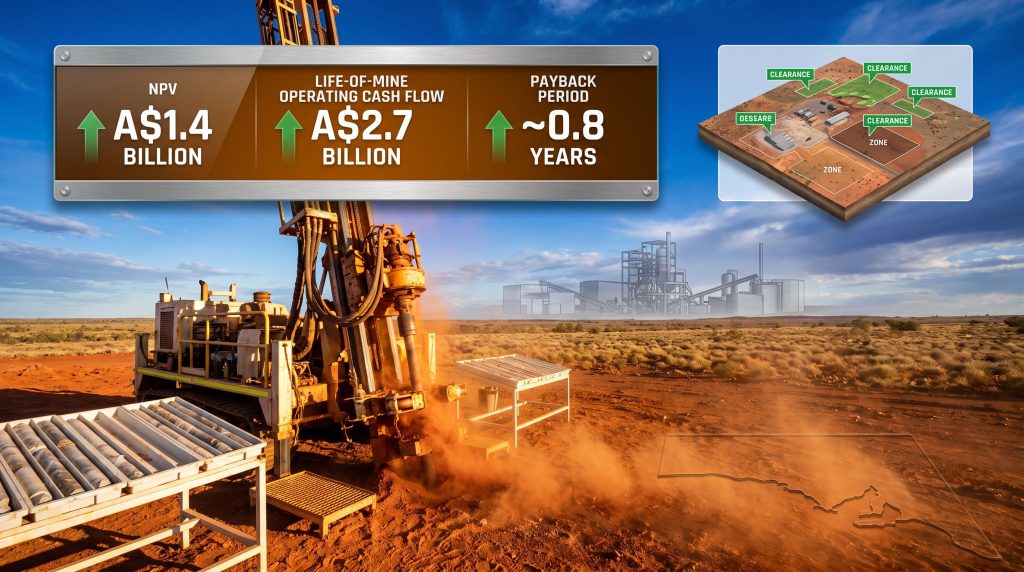
The May 2025 optimised scoping study produced a compelling set of headline numbers for a project of Tunkillia's stage. The figures below reflect modelled projections from that study and should be understood in the context of prevailing metal prices at the time of modelling. All economic projections carry inherent uncertainty and are not guarantees of future performance.
| Metric | Estimated Figure |
|---|---|
| Annual Gold Production (modelled) | ~120,000 oz |
| Annual Silver Production (modelled) | ~260,000 oz |
| Life-of-Mine Operating Cash Flow | A$2.7 billion (unlevered, pre-tax) |
| Net Present Value | A$1.4 billion |
| Estimated Payback Period | ~0.8 years |
| S1 and S2 Starter Pit Gold (first 27 months) | 365,000 oz |
| S1 and S2 Starter Pit Silver (first 27 months) | 923,000 oz |
| S1 and S2 Operating Free Cash (first 27 months) | A$1.7 billion |
A payback period of approximately 0.8 years is exceptionally short by the standards of the broader gold development sector, where three to six years is more typical. This figure reflects the high-grade character of the S1 and S2 starter pits and the front-loading of production into the early mine schedule. The practical implication is that the project could theoretically generate enough free cash flow within the first two years to fully repay development capital more than four times over, based on scoping study modelling assumptions.
What 57,653 Metres of Drilling Has Established
Phase-by-Phase Progress: Building Resource Confidence
The scale of drilling completed at Tunkillia ahead of the pre-feasibility study is substantial. The combined phase-one and phase-two resource upgrade campaign reached 57,653 metres across 520 holes, using both reverse circulation and diamond drilling methods. Phase two alone accounted for approximately 39,000 metres across 311 holes.
The primary objective of this work was to reclassify open-pit mineralisation from the lower-confidence Inferred category into the higher-confidence JORC Measured and Indicated categories. This classification distinction matters enormously in project economics. Ore reserve estimates, which form the bedrock of bankable feasibility studies and mine financing packages, can only be derived from Measured and Indicated resources. Inferred material, by definition, carries too much uncertainty to be converted directly into reserves.
By committing to a drilling program of this scale before completing the pre-feasibility study, the project team is demonstrating a level of technical diligence that institutional investors and potential financing partners expect to see at the feasibility gate.
Upside Surprises Within the Existing Program
One of the more strategically significant disclosures from the current program is that certain mineralised zones delivered gold drill results that exceeded pre-drill expectations. This kind of positive variance is meaningful at this stage of development. When resource upgrade drilling, which is designed primarily to reclassify known material rather than discover new zones, generates results that outperform geological models, it introduces the possibility that the existing resource estimate may be conservative.
Assay results and an updated mineral resource estimate are pending and represent a near-term catalyst that could materially shift the project's development economics. Until that data is released and independently assessed, speculative conclusions about resource size or grade improvements should be treated with appropriate caution.
The Technical Mechanics of Barton Gold Tunkillia Infrastructure Drilling
Step-by-Step: How a Sterilisation Program Works in Practice
For those unfamiliar with mine site engineering, the sterilisation drilling process follows a structured sequence that feeds directly into pre-feasibility study engineering and capital cost estimation:
-
Candidate Site Identification – Geotechnical and engineering teams map potential locations for waste dumps, tailings storage facilities, and the processing plant, weighing topographic, hydrological, and proximity factors.
-
Drill Pattern Design – A systematic grid is laid across each candidate corridor, with spacing determined by the level of geological confidence required and the footprint of the proposed infrastructure.
-
Drilling Execution – Reverse circulation or diamond core drilling progresses across each site to the depth needed to characterise the underlying geology and identify any subsurface mineralisation.
-
Assay Submission and Geological Logging – All drill samples are submitted for geochemical analysis, and geological logging covers lithology, structure, alteration, and any mineralised intervals intersected.
-
Clearance or Redesign – Sites where no significant mineralisation is detected are formally cleared for infrastructure planning. If mineralisation is encountered, the proposed location must be redesigned or relocated before engineering work can proceed.
-
Integration into PFS Engineering – Cleared sites feed directly into the pre-feasibility study's infrastructure layout, geotechnical design parameters, and capital cost modelling packages.
The Three Infrastructure Components Being Tested
The current Barton Gold Tunkillia infrastructure drilling program is evaluating proposed sites for three distinct categories of surface infrastructure:
-
Waste rock dumps – Long-term above-ground storage for non-mineralised material extracted during open-pit mining. These facilities can cover substantial footprints and must be sited where they will not sterilise ore or create problematic geochemical drainage pathways.
-
Tailings storage facilities (TSFs) – Among the most technically complex and heavily regulated infrastructure components on any mine site. TSFs must meet stringent engineering standards and are subject to ongoing regulatory oversight. Their siting is both a safety and an economic issue, since poorly positioned TSFs create long-term liability that can affect a project's social licence to operate.
-
Processing plant footprint – The proposed location for ore crushing, grinding, and gold-silver recovery circuits. Processing plant foundations require stable ground conditions and proximity to water and power infrastructure, making site selection a multi-disciplinary engineering exercise.
Development Timeline and Parallel Workstreams
GR Engineering Services and the Path to Pre-Feasibility
GR Engineering Services, an established Australian mining engineering firm with a track record across multiple feasibility studies for ASX-listed developers, has been appointed as the lead engineering consultant for the Tunkillia pre-feasibility study. Furthermore, the feasibility study process is targeted for publication in the first quarter of 2027, with a mining lease application expected to follow its completion.
| Milestone | Target Timing |
|---|---|
| Sterilisation drilling program | Underway (August 2026) |
| Assay results and updated MRE | Pending (near-term) |
| PFS publication | Q1 2027 |
| Mining lease application | Post-PFS |
What is particularly notable about the current development phase is the number of workstreams advancing simultaneously. Rather than completing sterilisation drilling and then moving to geotechnical studies, the project team appears to be running these programs in parallel. This kind of concurrent engineering is a deliberate strategy to compress the development timeline without sacrificing technical rigour.
The parallel workstreams currently underway include:
-
Geotechnical studies – Ground stability assessments informing pit wall design angles, slope engineering, and infrastructure foundation specifications.
-
Metallurgical test programs – Ore characterisation work to define processing parameters, confirm gold and silver recovery rates, and optimise the design of recovery circuits.
-
Infrastructure planning – Site layout design and capital cost modelling that incorporates sterilisation drilling outputs as they become available.
The next major ASX story will hit our subscribers first
What the Economics Signal for the Broader Gold Sector
Interpreting Scoping Study Numbers in Context
Scoping studies, by their nature, carry a higher degree of estimation uncertainty than pre-feasibility or definitive feasibility studies. The figures from Tunkillia's May 2025 optimised scoping study reflect a specific set of metal price assumptions, cost inputs, and geological interpretations that will be refined significantly as the PFS progresses. Investors should treat these numbers as directional indicators rather than bankable projections.
That said, the structural features of the modelled economics are worth examining in their own right. A sub-one-year payback period, driven by the high-grade character of the S1 and S2 starter pits, suggests a project design that is front-loaded with cash generation. This is a structurally meaningful feature because it reduces long-term reliance on external financing once production begins. Consequently, if the starter pits perform broadly in line with modelled expectations, the project could potentially self-fund subsequent development phases from operating cash flow.
Tunkillia Compared to Industry Development Benchmarks
| Development Metric | Tunkillia (Modelled) | Typical Mid-Tier Gold Developer |
|---|---|---|
| Annual Gold Production | ~120,000 oz | 80,000–150,000 oz |
| Payback Period | ~0.8 years | 3–6 years |
| Life-of-Mine Operating Cash Flow | A$2.7 billion | Varies widely |
| NPV | A$1.4 billion | A$200M–A$800M |
Note: Benchmark ranges are indicative and drawn from publicly available scoping and feasibility study data across comparable Australian gold development projects. They do not constitute investment advice.
The NPV figure of A$1.4 billion places Tunkillia well above the threshold that typically attracts serious feasibility-stage capital from mid-tier gold producers and infrastructure-focused mining funds. At the same time, it sits within a range that remains accessible for a range of financing structures, from streaming and royalty arrangements to project-level debt.
Frequently Asked Questions: Barton Gold Tunkillia Infrastructure Drilling
What is the purpose of sterilisation drilling at Tunkillia?
Sterilisation drilling confirms that the proposed locations for major surface infrastructure, including waste dumps, tailings storage facilities, and the processing plant, do not overlie economically recoverable mineralisation. This prevents the permanent sterilisation of gold resources beneath fixed infrastructure and protects the project's long-term ore recovery potential.
How much drilling has been completed at Tunkillia to date?
The combined phase-one and phase-two resource upgrade campaign reached 57,653 metres across 520 holes, encompassing both reverse circulation and diamond drilling techniques. Phase two alone covered approximately 39,000 metres across 311 holes.
When is the Tunkillia pre-feasibility study expected?
The PFS, led by GR Engineering Services, is targeted for publication during the first quarter of the 2027 calendar year.
What infrastructure is being assessed through sterilisation drilling?
The program is evaluating proposed sites for waste rock dumps, tailings storage facilities, and the processing plant footprint.
What does the scoping study model for annual production?
The May 2025 optimised scoping study modelled annual output of approximately 120,000 ounces of gold and 260,000 ounces of silver, with a life-of-mine operating cash flow of A$2.7 billion and an NPV of A$1.4 billion under prevailing metal price assumptions at the time.
Infrastructure Sterilisation as a Signal of Development Maturity
What This Phase Reveals About the Project's Trajectory
In the taxonomy of gold project development, there is a meaningful qualitative leap between resource delineation and engineering-grade site planning. Many exploration-stage projects never clear that hurdle. The fact that Barton Gold's Tunkillia project is now advancing infrastructure drilling in parallel with geotechnical and metallurgical workstreams signals that the project is being managed as an active development candidate, not a speculative exploration asset held in reserve for a future market cycle.
For those watching the Australian gold development pipeline, the convergence of a large and increasingly well-characterised resource base, scoping study economics that compare favourably against peer projects, and an accelerating pre-feasibility timeline positions Tunkillia as one of the more substantively advanced emerging gold development projects operating in South Australia today.
The pending assay results and updated mineral resource estimate represent the next significant information event in this story. How those numbers compare to pre-drill expectations, and what they imply for the PFS engineering parameters, will be an important test of the project's technical foundations as the 2027 publication target draws closer.
This article is intended for informational purposes only and does not constitute financial advice. All economic projections referenced are drawn from the company's May 2025 optimised scoping study and are subject to the assumptions and uncertainties inherent in early-stage development studies. Readers should conduct their own independent research before making any investment decisions.
Want to Track the Next Major ASX Gold Discovery the Moment It's Announced?
Discovery Alert's proprietary Discovery IQ model scans ASX announcements in real time, instantly identifying significant mineral discoveries and turning complex geological data into actionable investment insights — explore historic discovery returns to understand what early positioning can mean, and start your 14-day free trial at Discovery Alert to gain a market-leading edge before the broader market catches on.