August 21, 2026
The Monetary Design Question That Determines Whether Your Savings Survive
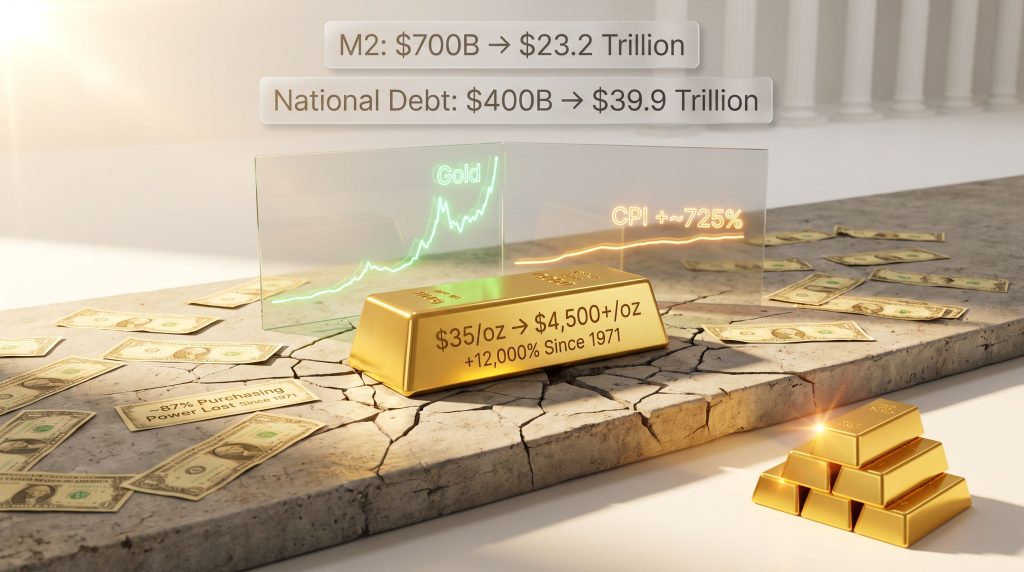
Every savings decision a person makes across a lifetime rests on an assumption so fundamental that most people never examine it: the assumption that money will hold its value. Whether that assumption proves correct or catastrophically wrong depends entirely on how the money itself was designed. Understanding what is sound money is not an abstract academic exercise. It is the single most important framework for interpreting why the dollar has lost 87% of its purchasing power since 1971, why gold has gained more than 12,000% over the same period, and why the most conservative financial institutions on earth continue accumulating a metal that governments officially abandoned more than five decades ago.
When big ASX news breaks, our subscribers know first
What Is Sound Money? Starting With First Principles
The Three Functional Tests Any Form of Money Must Pass
Before examining what makes money sound or unsound, it helps to understand what money is supposed to do. Economists and monetary historians consistently identify three core functions:
- Medium of exchange — broadly accepted across an economy for the purchase of goods and services
- Unit of account — provides a consistent, reliable measure of relative value across transactions
- Store of value — preserves purchasing power across time, so that wealth saved today retains real-world utility tomorrow
The third function is where the distinction between sound and unsound money becomes most consequential. A currency can circulate widely and price goods effectively while simultaneously eroding the real wealth of everyone who holds it. That combination describes exactly what fiat currency has done throughout the modern era.
The Six Physical Properties That Historically Defined Monetary Soundness
Sound monetary assets share a recognisable set of physical and structural characteristics. These are not arbitrary preferences. They represent centuries of trial and error across civilisations that experimented with everything from cattle to cowrie shells to cigarettes as monetary instruments. According to a comprehensive guide on sound money, these properties have remained remarkably consistent across vastly different economic systems.
| Property | Why It Matters |
|---|---|
| Scarcity / Limited Supply | Prevents arbitrary dilution of existing holdings |
| Durability | Ensures the asset survives long-term storage and use |
| Divisibility | Enables transactions at any scale |
| Portability | Allows wealth to move efficiently across distances |
| Fungibility | Makes each unit interchangeable with every other unit |
| Resistance to Debasement | Protects against counterfeiting or political manipulation |
How Authoritative Sources Define Sound Money
The Merriam-Webster dictionary defines sound money as money not liable to sudden changes in value, specifically a currency redeemable in gold. The Bank for International Settlements frames it in functional terms: money fulfils its core purposes effectively only when its value remains stable. Both definitions converge on the same structural requirement. The supply of genuinely sound money cannot be expanded by institutional decree.
Foundational Definition: Sound money is a monetary system or currency whose supply cannot be arbitrarily expanded by government or central bank authority, enabling it to preserve purchasing power across extended time horizons. Scarcity, durability, divisibility, portability, fungibility, and debasement resistance are its defining characteristics. These are properties historically associated with gold and silver, not with paper currencies backed by nothing more than sovereign promise.
Where the Concept Originated and Why It Was Always Political
The 19th-Century Monetary Debates That Shaped the Term
The phrase entered widespread usage during the 19th century, as industrialising nations adopted formal metallic monetary standards. In that context, sound money described a specific arrangement: standard coins representing a legally fixed quantity of metal, with token coins and paper currency redeemable in physical metal on demand. Each nation's currency unit represented not an abstraction but a defined weight of a specific substance that could not be created at will.
Ludwig von Mises and the Constitutional Argument
The Austrian economist Ludwig von Mises elevated sound money from a technical monetary preference to a constitutional principle. His argument was that the historical demand for monetary discipline arose directly from a recurring pattern: rulers debasing coinage to finance expenditure, effectively taxing citizens without their knowledge or consent.
Mises positioned sound money alongside written constitutions and bills of rights as a structural constraint on government overreach, not merely an economic preference but a safeguard against a specific and historically documented form of abuse. (Source: Mises Institute, The Classical Idea of Sound Money)
A Less Examined Historical Detail: The Ring Test
One account that circulates widely traces the phrase to merchants physically dropping coins to hear whether they rang true. Genuine metal produces a clear resonant tone; debased metal containing filler materials produces a dull thud. While documented usage of the phrase itself points to 19th-century monetary policy debates rather than to coin-testing practices, the underlying principle those merchants were applying is precisely what sound money theory formalises: a reliable method of distinguishing genuine monetary value from fraudulent imitation.
Sound Money vs. Fiat Currency: The Structural Divide
What Fiat Money Actually Is and Why Its Supply Has No Natural Ceiling
The word fiat derives from Latin, carrying the meaning of something willed into existence by authority. Fiat money holds value because a sovereign government declares it legal tender. No commodity backs it, no redemption obligation constrains it, and no physical supply ceiling limits how much can be created. The constraint on money creation in a fiat system is entirely political, meaning it is entirely discretionary and entirely reversible. The Cato Institute's analysis of sound money in theory and practice reinforces this structural distinction clearly.
The M2 Expansion: 55 Years of Quantified Currency Dilution
The consequences of removing physical supply constraints are not theoretical. They appear in the Federal Reserve's own data.
| Year | U.S. M2 Money Supply | Change |
|---|---|---|
| 1971 | ~$700 billion | Baseline |
| June 2026 | $23.2 trillion | +3,214% |
Source: Federal Reserve H.6 Money Stock Measures, July 28, 2026
Over the same period, real U.S. economic output grew approximately fourfold. Money supply grew more than thirty times. The gap between money creation and real output growth is not a market anomaly or a policy failure. It is the structural engine of purchasing power loss in an unconstrained fiat system. When the dollar count expands at multiples of the rate at which real goods and services are produced, each dollar necessarily represents a smaller claim on real output.
Comparison: Sound Money vs. Fiat Currency
| Characteristic | Sound Money | Fiat Currency |
|---|---|---|
| Supply Constraint | Geological or physical limit | Policy decree |
| Inflation Resistance | High by design | Low to none |
| Government Control | Constitutionally limited | Unrestricted |
| Historical Track Record | Multi-millennial | No fiat currency has survived indefinitely |
| Store of Value | Demonstrated across centuries | Degrades over time |
The Nixon Shock and 55 Years of Measurable Dollar Decline
August 15, 1971: The Day the Anchor Was Cut
The dollar's connection to gold did not disappear in a single legislative act. It eroded across the 20th century through a sequence of decisions that progressively weakened the constraint. The Federal Reserve was created in 1913. Gold was revalued and private ownership restricted during the 1930s. The Bretton Woods agreement of 1944 rebuilt a partial gold standard by fixing the dollar to gold at $35 per ounce and pegging other currencies to the dollar.
By 1971, that arrangement had become structurally unsustainable. The United States had issued more dollars than its gold reserves could cover, and foreign central banks were accelerating their redemptions of dollar reserves for physical metal. The Nixon Shock of August 15, 1971, when President Nixon suspended convertibility, severed the dollar's final link to a commodity anchor. For the first time in the modern era, the world's primary reserve currency floated freely with no physical constraint on its supply.
Purchasing Power Erosion: The Cumulative Cost to Savers
The data produced by the Bureau of Labor Statistics documents what happened next.
| Time Period | Purchasing Power Lost |
|---|---|
| Since Federal Reserve creation (1913) | ~97% |
| Since Nixon Shock (1971) | ~87% |
| Since January 2020 | ~22% |
Source: Bureau of Labor Statistics, Consumer Price Index (CPI-U) Historical Data
The Practical Reality: A dollar held since 1971 now purchases approximately twelve cents' worth of goods and services at 2026 price levels. This is not a market anomaly or an exceptional policy outcome. It is the predictable, compounding result of operating a currency system with no supply constraint across five and a half decades.
U.S. National Debt: The Fiscal Consequence of Removing the Monetary Anchor
| Year | U.S. National Debt |
|---|---|
| 1971 | ~$400 billion |
| August 2026 | $39.9 trillion |
Source: U.S. Treasury, Debt to the Penny Dataset
The relationship between an unconstrained currency and expanding sovereign debt is not coincidental. When money creation carries no physical cost, governments face reduced immediate pressure to balance spending with revenue. The long-term cost materialises instead as debt obligations that compound across generations.
Net interest outlays on federal debt reached $970 billion in fiscal year 2025, surpassing the entire U.S. defence budget for the first time in modern history. The Congressional Budget Office projects those payments will cross $1 trillion in fiscal year 2026. (Source: Congressional Budget Office)
Why Gold Has Risen More Than 12,000% Since 1971
The Measuring Stick Problem
Gold traded at $35 per ounce when Nixon closed the gold window. As of August 2026, it trades above $4,500 per ounce, representing a gain exceeding 12,000%. (Source: goldsilver.com/price-charts/)
The critical analytical distinction here is one that receives far less attention than it deserves. Gold did not become dramatically more useful between 1971 and 2026. Its industrial applications evolved only modestly across that period. What changed was the measuring stick. The dollar lost approximately 87% of its value, and gold priced in dollars recorded that change. Much of what appears as gold appreciation is more precisely dollar depreciation expressed through an asset whose supply could not be expanded by decree.
Furthermore, understanding what is sound money helps clarify why gold as a safe haven continues attracting serious institutional interest, not merely as a speculative trade but as a structural hedge against currency debasement.
CPI vs. Gold: A 55-Year Performance Comparison
| Metric | Change Since 1971 |
|---|---|
| U.S. Consumer Price Index (CPI-U) | +~725% |
| Gold Price | +~12,000%+ |
| Silver Price | Under $2 to high $60s |
Sources: Bureau of Labor Statistics CPI-U; goldsilver.com/price-charts/
Why Silver Followed a Similar Trajectory
Silver's path mirrors gold's in structural terms, though with greater price volatility. At under $2 per ounce in 1971 and trading in the high $60s by August 2026, silver has demonstrated the same core property that distinguishes both metals from fiat alternatives. Their supply is constrained by geology, not by the decisions of any monetary institution.
Mining more silver requires identifying new ore deposits, developing extraction infrastructure, and processing ore at grades that make production economically viable. No central bank can authorise a silver expansion equivalent to a quantitative easing programme. Silver also carries an additional demand dynamic that gold lacks at the same scale. Industrial consumption, particularly in solar panel manufacturing and electronics, creates a structural demand floor independent of investment sentiment.
The next major ASX story will hit our subscribers first
Central Banks and the Strategic Paradox of Gold Accumulation
The Behaviour That Contradicts the Dominant Narrative
The most instructive data point in the current monetary environment may not be gold's price level. It may be the behaviour of the institutions responsible for managing the fiat currencies that officially replaced gold as the foundation of the global monetary system. Indeed, central bank gold demand has become one of the defining features of the post-2022 monetary landscape.
Strategic Paradox: The same institutions that manage fiat currencies and have formally abandoned the gold standard continue accumulating gold at historically elevated rates. Their purchasing behaviour communicates a preference that their public communications rarely articulate with equivalent directness.
Central Bank Gold Demand: Q2 2026 Data
| Metric | Figure |
|---|---|
| Net central bank gold purchases, Q2 2026 | 289 tonnes |
| Year-over-year change (Q2) | +62% |
| Ranking | Strongest Q2 on record |
| Top buyer, Q2 2026 | Poland, 51 tonnes |
| Second-largest buyer, Q2 2026 | China, 33 tonnes |
Source: World Gold Council, Gold Demand Trends Q2 2026
Reading the Full-Year Picture Accurately
Intellectual honesty requires presenting the complete data. First-half 2026 net demand totalled 345 tonnes, the lowest since 2022, because Turkey, Russia, and Azerbaijan sold heavily in the early months of the year. The World Gold Council also revised its Q1 2026 estimate substantially downward, from 244 tonnes to 57 tonnes. (Source: World Gold Council)
These figures matter. They demonstrate that central bank behaviour is not uniformly directional in every quarter and that H1 2026 was, on a net basis, a weaker period than recent years.
What the 2026 Survey Reveals About Forward Intent
| Survey Finding | Result |
|---|---|
| Central banks expecting global official gold reserves to rise | 89% |
| Central banks planning to increase their own gold holdings | 45% (record high) |
Source: World Gold Council Central Bank Gold Reserves Survey 2026
What this data reveals, when read alongside the Q2 purchase figures, is a structural reappraisal of gold's role as a reserve asset. Central bank gold reserves are growing because gold carries no counterparty risk, cannot be defaulted on, and is not subject to the monetary policy decisions of any single nation. These are properties that become more valuable as sovereign debt levels rise and the long-term credibility of fiat currency systems faces increasing scrutiny.
Applying Sound Money Principles Without Waiting for a Policy Change
The Practical Framework for Individual Savers
Restoring a gold standard requires systemic policy transformation that individuals cannot unilaterally achieve. Applying sound money principles to personal financial decisions requires no such transformation. The approach is straightforward: diversify across assets whose supply is constrained by physical reality rather than institutional decree.
The following framework provides a structured starting point.
- Assess currency exposure — calculate what percentage of net worth is held in fiat-denominated instruments such as cash, bank deposits, bonds, and money market funds
- Quantify the inflation drag — use historical CPI data to calculate the real purchasing power erosion on cash holdings across your savings horizon
- Identify supply-constrained assets — focus on assets whose quantity cannot be expanded by government or central bank decree, with physical precious metals representing the most historically validated examples
- Determine an appropriate allocation — no universal figure applies; the goal is meaningful diversification across assets that respond differently to monetary expansion, not an all-or-nothing repositioning
- Distinguish physical ownership from financial claims — considerations around physical gold vs ETFs are structurally significant, particularly in systemic stress scenarios
- Review periodically — monetary conditions evolve; allocation decisions should be revisited in light of updated CPI data, money supply figures, sovereign debt trajectories, and central bank behaviour
Important Disclaimer: This framework is educational in nature and does not constitute financial advice. Individual financial circumstances vary significantly. Consult a qualified financial adviser before making any investment decisions.
Is Gold the Only Asset That Qualifies?
Gold and silver are the most extensively validated examples, having functioned as monetary stores of value across multiple civilisations, political systems, and centuries of currency experimentation. Other commodities have served monetary functions in specific historical contexts, but none have demonstrated the same cross-cultural, multi-millennial consistency.
Some contemporary analytical frameworks extend sound money principles to any asset with a verifiable supply ceiling and meaningful resistance to debasement. The underlying evaluative question remains consistent: can the supply of this asset be expanded by institutional decision, or is it constrained by something outside human authority?
Key Statistics Summary: Sound Money and the Fiat Era
| Data Point | Figure | Source |
|---|---|---|
| Dollar purchasing power lost since 1913 | ~97% | BLS CPI-U |
| Dollar purchasing power lost since 1971 | ~87% | BLS CPI-U |
| Dollar purchasing power lost since Jan 2020 | ~22% | BLS CPI-U |
| U.S. M2 money supply, 1971 | ~$700 billion | Federal Reserve H.6 |
| U.S. M2 money supply, June 2026 | $23.2 trillion | Federal Reserve H.6 |
| U.S. national debt, 1971 | ~$400 billion | U.S. Treasury |
| U.S. national debt, August 2026 | $39.9 trillion | U.S. Treasury |
| Net interest outlays, fiscal 2025 | $970 billion | CBO |
| Gold price, 1971 | $35/oz | goldsilver.com/price-charts/ |
| Gold price, August 2026 | $4,500+/oz | goldsilver.com/price-charts/ |
| Gold price gain since 1971 | 12,000%+ | goldsilver.com/price-charts/ |
| CPI increase since 1971 | ~725% | BLS CPI-U |
| Central bank gold purchases, Q2 2026 | 289 tonnes | World Gold Council |
| Central banks expecting reserve increases | 89% | WGC Survey 2026 |
| Central banks planning to add own holdings | 45% (record) | WGC Survey 2026 |
Frequently Asked Questions: What Is Sound Money?
What is the simplest definition of sound money?
Sound money is any currency or monetary asset whose supply cannot be arbitrarily increased by government or institutional authority, enabling it to preserve purchasing power reliably over time. It is the structural opposite of a currency that can be created in unlimited quantities by decree.
What is the difference between sound money and fiat money?
Sound money is constrained by physical or mathematical limits on supply, making inflation resistance a design feature rather than a policy aspiration. Fiat money derives its value from government authority alone, with no inherent supply ceiling. More can always be created, which progressively dilutes the purchasing power of existing holdings.
Was the U.S. dollar ever considered sound money?
Under the classical gold standard running from approximately the 1870s through World War I, and again under the Bretton Woods system from 1944 to 1971, the dollar maintained a legally defined relationship with gold. That relationship imposed a meaningful constraint on money creation. After August 15, 1971, that constraint was removed entirely and has not been formally restored.
Why do central banks hold gold if fiat currencies have replaced the gold standard?
Gold functions as a reserve asset that exists outside the fiat system. It carries no counterparty risk, cannot be defaulted on, and is unaffected by the monetary policy decisions of any single nation. The World Gold Council's 2026 survey found that 89% of central bank respondents expected global official gold reserves to increase over the following twelve months, with a record 45% planning to expand their own holdings.
Can sound money principles be applied by individual investors?
Yes. While restoring a gold standard requires systemic policy change beyond any individual's reach, the underlying principle holds. Holding gold as a safe haven asset, alongside other supply-constrained alternatives, is the most direct and historically validated application of sound money principles at the personal level.
Sources: Bureau of Labor Statistics CPI-U Historical Data; Federal Reserve H.6 Money Stock Measures; U.S. Treasury Debt to the Penny Dataset; Congressional Budget Office Fiscal Year 2025 Budget Projections; World Gold Council Gold Demand Trends Q2 2026; World Gold Council Central Bank Gold Reserves Survey 2026; Mises Institute, The Classical Idea of Sound Money; Cato Institute, Sound Money in Theory and Practice; goldsilver.com/price-charts/
This article is for informational and educational purposes only and does not constitute financial, investment, or purchasing advice of any kind. Past performance is not indicative of future results. All investments involve risk. Consult a qualified financial adviser before making any investment decisions.
Want to Know When the Next Major Mineral Discovery Hits the ASX?
Discovery Alert's proprietary Discovery IQ model scans ASX announcements in real time, instantly identifying significant mineral discoveries and turning complex data into actionable opportunities — exactly the kind of supply-constrained, real-asset insights that sound money principles point investors towards. Explore historic discoveries and their exceptional market returns, then begin your 14-day free trial at Discovery Alert to position yourself ahead of the broader market.