August 21, 2026
When Operating Leverage Meets a Gold Bull Market, the Numbers Get Interesting
In the mining industry, there exists a well-understood but frequently underestimated dynamic: the relationship between a fixed cost base and a rising commodity price. When gold prices climb while production costs remain relatively anchored, the additional revenue flows almost entirely to the bottom line. This is operating leverage, and it sits at the heart of what Genesis Minerals (ASX: GMD) delivered in FY26. Understanding this mechanism is essential before examining the headline figures, because the numbers alone do not tell the full story of why this result matters.
For a company that only commenced gold production in 2023, the pace of financial maturation has been remarkable. FY26 represents just the third full year of operations, yet the company has already reached a scale that most ASX-listed gold producers take a decade or more to achieve. More significantly, the declaration of a Genesis Minerals maiden dividend alongside record earnings signals a philosophical shift in how management is thinking about capital: no longer purely a growth vehicle, but a business capable of sustaining shareholder returns while simultaneously investing in transformational expansion.
When big ASX news breaks, our subscribers know first
FY26 Financial Results: Anatomy of a Record Year
The raw numbers from Genesis Minerals' FY26 result are striking on their own terms, but the underlying mechanics are even more instructive for investors trying to gauge the sustainability of this performance.
Key Financial Metrics: FY25 vs FY26
| Metric | FY25 | FY26 | Change |
|---|---|---|---|
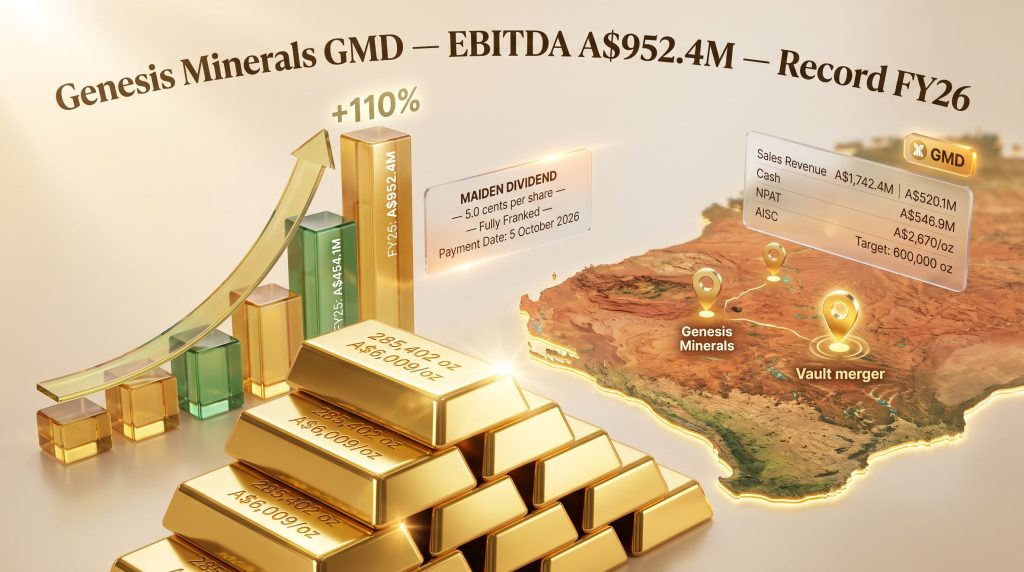
| EBITDA | A$454.1 million | A$952.4 million | +110% |
| Underlying NPAT | ~A$221 million | A$546.9 million | +147% |
| Statutory NPAT | N/A | A$601.8 million | Includes one-off tax benefit |
| Sales Revenue | ~A$922 million | A$1,742.4 million | +89% |
| Gold Production | ~214,600 oz | 285,402 oz | +33% |
| Cash and Equivalents | A$286.9 million | A$520.1 million | +81% |
| Average Realised Price | N/A | ~A$6,009/oz | N/A |
| AISC | N/A | A$2,670/oz | Within guidance |
Gold production climbed 33% to 285,402 ounces, while gold sales reached 289,328 ounces at an average realised price of approximately A$6,009 per ounce. The spread between production and sales volumes is a minor timing artefact; the more important observation is that both the volume and price variables moved favourably in the same financial year, which is an uncommon alignment in the commodities cycle.
Revenue Architecture: Decomposing the 89% Sales Jump
Breaking down the A$1,742.4 million in sales revenue requires separating the contribution from volume growth versus price realisation. Production growth of 33% accounts for a significant portion of the uplift, but the average realised gold price of approximately A$6,009 per ounce was the amplifier. Furthermore, Australian dollar gold prices averaged at elevated levels throughout the period, and because Genesis's cost base is denominated in Australian dollars, the AUD gold price is the economically relevant figure. The gold price outlook for miners reinforces why this distinction matters to investors.
All-in sustaining costs of A$2,670 per ounce remaining within guidance is a detail worth examining closely. In a year of significant capital deployment, workforce expansion, and production ramp-up, holding costs within a pre-guided range demonstrates a degree of operational discipline that lends credibility to future cost guidance. For investors, AISC within guidance functions as a management credibility signal, suggesting that cost forecasting processes are mature and reliable.
Understanding the NPAT Divergence
The A$54.9 million gap between statutory NPAT of A$601.8 million and underlying NPAT of A$546.9 million requires explanation. The statutory figure includes a one-off tax benefit that boosted reported earnings above the recurring run rate. Investors and analysts evaluating forward earnings capacity should anchor to the underlying figure of A$546.9 million, which better reflects the business's normalised earnings power. The distinction matters because valuation multiples applied to inflated statutory earnings can create misleading price-to-earnings comparisons.
Cash rising 81% to A$520.1 million alongside strong profit growth confirms that earnings quality is high. The conversion of accounting profits into tangible liquidity is the defining characteristic of a genuinely cash-generative business, as distinct from companies carrying paper profits without corresponding cash flows.
Genesis Minerals Maiden Dividend: What It Means and Why It Matters
The declaration of the Genesis Minerals maiden dividend is the most symbolically significant element of the FY26 result, even if it is not the largest number on the page.
Maiden Dividend: Full Details
| Dividend Detail | Information |
|---|---|
| Amount | A$0.05 (5.0 cents) per share |
| Franking | Fully franked (100%) |
| Record Date | 10 September 2026 |
| Payment Date | 5 October 2026 |
| Type | First dividend ever declared |
A fully franked dividend carries additional value for Australian resident shareholders that is not immediately visible in the cents-per-share figure. The franking credit attached to a 5.0 cent fully franked dividend represents a 30% corporate tax credit that shareholders can apply against their personal tax liability. For self-managed superannuation funds operating in accumulation phase, franking credits reduce the fund's taxable income. For SMSFs in pension phase, where the applicable tax rate is zero, excess franking credits become refundable, effectively increasing the total return beyond the face value of the dividend.
This franking benefit is particularly meaningful for Australian investors because it converts a nominally modest dividend into a more competitive after-tax yield. At various share price levels, the grossed-up yield — including the franking credit value — materially exceeds the headline yield implied by the cash payment alone. Consequently, understanding how gold price movement affects mining equities helps contextualise the broader investment appeal of this milestone.
The Strategic Logic Behind a Conservative Initial Payout
Executive Chairman Raleigh Finlayson has articulated a capital allocation philosophy centred on maintaining flexibility for growth while initiating returns to shareholders. The choice of 5.0 cents per share as an inaugural payout, rather than a higher initial distribution, reflects a deliberate strategy: preserve balance sheet capacity for the Vault merger and ongoing development capital while establishing a dividend track record.
This conservative approach is, paradoxically, a bullish signal. Companies that initiate dividends they cannot sustain damage their credibility and often face market punishment when dividends are later cut. By setting a modest initial payout against a backdrop of A$520.1 million in closing cash, management has created substantial headroom to grow the dividend in subsequent periods. The inaugural dividend functions as a floor, not a ceiling.
For context within the ASX gold sector, initiating a fully franked dividend program less than four years into commercial production is genuinely unusual. Most mid-tier producers at comparable production scales prioritise debt reduction and capital reinvestment over distributions, making this milestone a meaningful differentiator.
Corporate Activity: The Magnetic Resources Acquisition and What It Added
FY26 was not only a year of financial records; it was also a period of significant corporate activity that reshaped Genesis's asset portfolio. In addition, the gold M&A activity shaping the Australian market provides important backdrop for understanding the strategic rationale behind these moves.
Magnetic Resources: Strategic and Financial Breakdown
The acquisition of Magnetic Resources was completed during FY26 for consideration comprising A$447 million in cash plus 28 million Genesis shares. The primary asset acquired was the Lady Julie gold deposit, a high-grade gold system located in Western Australia's Laverton region. The Laverton district is geologically significant: it sits within the Eastern Goldfields Province of the Yilgarn Craton, one of the world's most prolific Archaean gold terranes, characterised by structurally controlled orogenic gold deposits with strong grade continuity.
Acquiring Lady Julie provides Genesis with several strategic advantages beyond the immediate resource addition:
- Geographic clustering of assets within the Laverton region reduces per-ounce infrastructure and haulage costs through shared processing and services
- High-grade deposits within an existing operational footprint carry lower marginal development costs than greenfield discoveries in new regions
- Regional consolidation creates optionality around future mine sequencing and blending strategies, which can optimise mill feed grades and extend processing facility utilisation
- A larger consolidated resource base strengthens the company's standing with debt and equity capital markets when future funding is required
Growth Capital Deployment: A$275 Million Beyond Acquisitions
Separate from the Magnetic Resources acquisition, Genesis directed A$275 million into project development and exploration activities during FY26. Key developments at Tower Hill and Ulysses represent the next generation of production sources within the portfolio. Both projects are at active development stages, with their production contributions expected to augment the output profile in coming years.
The corporate debt facility was upsized to A$300 million during the year, with earlier drawn debt repaid. This dual action — increasing facility size while reducing outstanding debt — improves financial flexibility. It means the company enters FY27 with a larger undrawn credit capacity and reduced interest obligations simultaneously, a structurally sound balance sheet outcome despite the capital-intensive year.
Despite deploying approximately A$722 million across acquisitions and growth projects in a single financial year, Genesis closed FY26 with A$520.1 million in cash. This demonstrates the exceptional cash conversion capacity of the underlying operations at current gold price levels. For further context on how EBITDA more than doubled to A$952.4 million on strong margins, the company's official announcement provides the full detail.
The Vault Merger: Transformational Scale and What Comes Next
The proposed merger with Vault represents the most consequential strategic development in Genesis's short history as a listed company, with implications that extend well beyond the FY26 result.
Transaction Overview and Production Target
The Vault merger is targeted for completion by November 2026, with the combined entity expected to produce more than 600,000 ounces of gold annually. This would effectively double Genesis's standalone FY26 output of 285,402 ounces, repositioning the company from a significant mid-tier Australian producer into a globally relevant gold mining operation by production ranking.
A formal strategic plan for the merged entity is scheduled for release in the first half of 2027, covering integrated production guidance, cost targets, and an updated capital management framework that will include revised dividend policy. The H1 2027 release date is a key catalyst for investors to monitor.
Synergy Potential: Quantifying A$2 Billion in Value
The combined entity is projected to generate approximately A$2 billion in post-tax synergies over a decade following merger completion. These synergies are expected to derive from several categories:
- Infrastructure sharing across adjacent or proximate mining operations, reducing duplicated capital expenditure on processing facilities, power, water, and road infrastructure
- Processing consolidation, where ore from multiple deposits feeds shared mill capacity at optimised throughput rates
- Overhead rationalisation, eliminating duplicated corporate, administrative, and technical functions across the combined organisation
- Exploration portfolio optimisation, directing drilling capital to the highest-priority targets across a larger combined tenement holding rather than maintaining parallel exploration programs
Hypothetical Earnings Scenario at Scale
To contextualise the potential earnings power of the merged entity, consider a simplified scenario assuming the combined group achieves the targeted 600,000 ounces annually:
| Scenario Assumption | Value |
|---|---|
| Annual production | 600,000 oz |
| Assumed AISC | ~A$2,700/oz |
| Assumed gold price | ~A$6,000/oz |
| Gross margin per ounce | ~A$3,300/oz |
| Implied pre-corporate EBITDA contribution | ~A$1.98 billion |
This scenario modelling is illustrative only and subject to significant uncertainty around gold prices, cost outcomes, production achievement, and merger integration. It does not constitute financial advice or a forward earnings guarantee.
Disclaimer: Scenario projections involve assumptions that may not be realised. Investors should conduct their own due diligence and seek professional financial advice before making investment decisions.
FY27 Standalone Outlook and Key Risk Factors
Production Guidance and Cost Expectations
Genesis has provided standalone guidance for FY27 of 270,000 to 300,000 ounces at slightly elevated all-in sustaining costs relative to FY26's A$2,670 per ounce. The modest cost increase reflects planned increases in development and exploration expenditure above sustaining capital, consistent with the company's continued reinvestment strategy during the merger transition period.
The FY27 standalone guidance represents a deliberate bridge-year framework: maintaining production and cash generation while the Vault merger integration progresses, before the combined entity's production profile and cost structure become the operative framework. However, understanding the different types of gold mining stocks helps investors appreciate where Genesis sits within the broader sector landscape.
Risk Factors Investors Should Monitor
- Gold price sensitivity: The current earnings profile is highly sensitive to AUD gold prices. A meaningful decline in the Australian dollar gold price would compress margins significantly given the fixed cost base
- Merger integration complexity: Combining two mid-tier gold operations on a compressed timeline introduces execution risk. Integration challenges in processing, workforce, and systems could delay synergy realisation
- Permitting and development timelines: Tower Hill and Ulysses remain subject to permitting and development milestones that could affect production ramp schedules
- Labour and input cost pressures: The Western Australian mining sector operates in a structurally tight labour market with elevated contractor rates, wages, and consumables costs
- Share price premium risk: Genesis shares rose approximately 88% in the 12 months to August 2026, significantly outperforming the broader All Ordinaries Index. A reversion in gold prices or a merger setback could compress the current valuation multiple rapidly
The next major ASX story will hit our subscribers first
Frequently Asked Questions: Genesis Minerals FY26 and Maiden Dividend
What was Genesis Minerals' EBITDA for FY26?
Genesis Minerals reported EBITDA of A$952.4 million for the financial year ended 30 June 2026, more than doubling the A$454.1 million recorded in FY25.
What is the Genesis Minerals maiden dividend amount and payment date?
The company declared a fully franked maiden dividend of 5.0 cents per share, with a record date of 10 September 2026 and payment on 5 October 2026.
How much gold did Genesis Minerals produce in FY26?
Genesis produced 285,402 ounces of gold in FY26, a 33% increase on the prior year, at an all-in sustaining cost of A$2,670 per ounce, which was within the company's guidance range.
What is the Genesis-Vault merger timeline?
The merger is targeted for completion by November 2026, with a combined strategic plan expected in the first half of 2027.
Why does statutory NPAT differ from underlying NPAT?
Statutory NPAT of A$601.8 million exceeded underlying NPAT of A$546.9 million due to a one-off tax benefit recognised during FY26. Underlying NPAT better reflects the recurring earnings capacity of the business.
What synergies are projected from the merger?
The combined entity is expected to generate approximately A$2 billion in post-tax synergies over a decade, supported by combined annual gold production targeting more than 600,000 ounces.
Key Takeaways for Investors
The FY26 result for Genesis Minerals represents a genuine inflection point rather than a cyclical peak. Several structural observations are worth carrying forward:
- EBITDA doubling to A$952.4 million within three years of commencing production demonstrates how rapidly operating leverage can compound when volume growth and price tailwinds align simultaneously
- The Genesis Minerals maiden dividend of 5.0 cents per share, fully franked, establishes a capital returns framework that is likely to grow as the merged entity's cash generation scales
- Closing cash of A$520.1 million after deploying approximately A$722 million in acquisitions and growth capital is the clearest evidence of underlying free cash flow strength
- The Vault merger, if completed on schedule, positions Genesis to enter the ranks of globally significant gold producers, with combined production potentially exceeding 600,000 ounces annually
- FY27 standalone guidance of 270,000 to 300,000 ounces provides a conservative baseline while the merger integration unfolds
- Key catalysts to monitor include Vault merger completion in November 2026, the H1 2027 strategic plan release, AUD gold price movements, and development progress at Tower Hill and Ulysses. Furthermore, gold prices at record highs provide broader context for evaluating the sustainability of these outcomes. Investors can also review the Genesis Minerals investor centre directly for the latest corporate disclosures and announcements.
This article is general in nature and does not constitute financial advice. Past performance is not indicative of future results. Readers should seek independent financial advice tailored to their personal circumstances before making any investment decisions.
Want to Catch the Next Major ASX Gold Discovery Before the Market Does?
Discovery Alert's proprietary Discovery IQ model delivers real-time alerts on significant ASX mineral discoveries, instantly translating complex data across 30+ commodities into actionable insights — so investors can act before the broader market catches on. Explore historic discoveries and their exceptional returns, then begin your 14-day free trial to position yourself ahead of the next major find.