August 20, 2026
The Monetary Architecture That Most Analysts Are Missing
For centuries, sovereign power and gold reserves have moved in lockstep. The nations that controlled the largest gold stocks shaped the terms of international trade, determined the credibility of their currencies, and held decisive leverage in moments of geopolitical crisis. That relationship never disappeared — it simply became less visible as fiat currency systems and dollar hegemony dominated the post-Bretton Woods era. But beneath the surface of modern finance, a slow-moving structural shift is underway, and understanding it requires looking not at what central banks say, but at what they do.
China gold accumulation strategy represents perhaps the most consequential and least-discussed development in contemporary monetary affairs. The scale, methodology, and strategic intent behind it deserves far more analytical attention than it currently receives in mainstream financial media.
When big ASX news breaks, our subscribers know first
The Strategic Logic Behind China's Gold Accumulation
Why Nations Accumulate Gold: A Monetary Power Framework
Gold occupies a unique position in international finance because it is the only major reserve asset that carries no counterparty risk. Unlike U.S. Treasury bonds, which require trust in American institutional integrity, or dollar deposits, which can be frozen or excluded from payment networks, physical gold held in domestic vaults is entirely outside the reach of foreign governments.
This distinction became operationally significant in February 2022, when Russia's foreign currency reserves held abroad were frozen in response to the invasion of Ukraine. For central banks across the developing world, that event served as a live demonstration of how dollar-denominated reserve assets can be neutralised as a geopolitical instrument. The lesson was not lost on Beijing.
"Gold held in your own vaults cannot be confiscated, cannot be excluded from settlement systems, and does not depend on any foreign counterparty's goodwill. For a nation actively planning for a multipolar financial future, this is not a minor consideration — it is the entire point."
How De-Dollarisation Is Reshaping Reserve Asset Preferences
Central bank gold demand globally hit multi-decade highs in 2022 and 2023, with emerging market institutions leading the buying. This was not coincidental timing. The sanctions architecture deployed against Russia illuminated a structural vulnerability in holding reserves denominated in the currencies of potential adversaries.
China's response has been characteristically methodical: sustained accumulation over an extended period, executed through channels that minimise public visibility, and paired with a stated reserve position that almost certainly understates the true figure. The People's Bank of China extended its official gold-buying streak to 21 consecutive months as of July 2026, adding approximately 15 tonnes in June and 20 tonnes in July of that year.
Gold as Sovereign Insurance: The Post-2022 Sanctions Precedent
The post-2022 acceleration in Chinese gold buying reflects a straightforward insurance calculation. A nation holding significant dollar assets faces a scenario in which those assets could be rendered inaccessible during a geopolitical confrontation. Physical gold, by contrast, is a claims-free asset — immune to SWIFT exclusion, immune to foreign seizure, and immune to the credit risk of any sovereign issuer.
For a country with ambitions for reserve currency status and deep structural tensions with the world's current reserve currency issuer, gold accumulation is not a speculative trade. It is foundational monetary statecraft. Furthermore, China's gold influence on the broader geopolitical landscape continues to grow in ways that most mainstream analysts are only beginning to appreciate.
How Much Gold Does China Actually Hold? A Data-Driven Estimation Framework
What Official PBoC Figures Actually Show
As of the second quarter of 2026, the People's Bank of China reported central bank gold reserves of approximately 2,346 tonnes, or roughly 75.44 million fine troy ounces, valued at approximately $303.72 billion. Gold represented around 9% of China's total foreign exchange reserves as of May 2026 — a figure that, while growing, still appears modest relative to Western central bank benchmarks.
These numbers are publicly disclosed, regularly updated, and in that sense entirely transparent. The problem is that transparency at the reporting layer does not guarantee completeness at the accumulation layer. According to China's official gold reserves data, the trajectory of declared holdings has risen steadily, yet independent analysts remain sceptical that these figures reflect the full picture.
Why Official Figures Almost Certainly Understate True Holdings
Multiple independent estimation frameworks — drawing on mine production data, exchange withdrawal records, and OTC market intelligence — point toward a dramatically larger figure for gold within China's borders. Goldman Sachs analysts have specifically flagged the London OTC market as a channel through which Chinese state purchases may be occurring outside of publicly visible reporting mechanisms, suggesting that declared reserves represent a deliberate understatement rather than a data gap.
| Metric | Official PBoC Data | Estimated True Holdings |
|---|---|---|
| Reported reserves (Q2 2026) | ~2,346 tonnes | Estimated 10,000–20,000+ tonnes |
| Reserve value (end June 2026) | ~$303.72 billion | Undisclosed |
| Buying streak (as of July 2026) | 21 consecutive months | Ongoing |
| Share of total reserves (May 2026) | ~9% | Unknown |
| Monthly addition (June 2026) | ~15 tonnes | Likely higher via OTC channels |
| Monthly addition (July 2026) | ~20 tonnes | Goldman Sachs: materially higher |
The Shanghai Gold Exchange as a Measurement Proxy
The Shanghai Gold Exchange, established in 2002 and now among the most significant physical gold trading venues in the world, provides one of the few partially observable windows into Chinese gold flows. Withdrawal data from the exchange is frequently used by analysts as a proxy for domestic gold demand.
Cumulative withdrawals since the exchange's formation have reached approximately 25,000 tonnes — a figure that, on its face, implies extraordinary volumes of gold flowing into Chinese hands. However, this number requires careful adjustment before it can be used in any estimation framework.
Understanding the 25,000-Tonne Withdrawal Figure and Its Limitations
Several factors complicate a straightforward reading of SGE withdrawal data:
- Gold sold back into the exchange and subsequently re-withdrawn creates double-counting within the cumulative total
- Some portion of withdrawals represent domestically mined Chinese gold entering the exchange system rather than imported material
- Cross-border flows involving Hong Kong introduce additional complexity, including some activity that may reflect capital movement rather than genuine bullion accumulation
A conservative analytical adjustment of approximately 5,000 tonnes for these factors yields a net withdrawal figure closer to 20,000 tonnes, which forms the core of most credible bottom-up estimates.
Why PBoC Purchases Never Appear on the Shanghai Gold Exchange
Technical Note: The People's Bank of China exclusively acquires gold in 400-troy-ounce London Good Delivery bars, the international central bank standard. The Shanghai Gold Exchange handles only kilogram bars. This structural incompatibility means all PBoC-level accumulation occurs entirely outside the exchange's visible transaction data, rendering official SGE withdrawal figures an incomplete proxy for total state acquisition.
This is a critical and under-appreciated point. It means that any estimate built primarily on SGE data is, by construction, an undercount of state-level China gold accumulation.
Building China's True Gold Balance Sheet: A Bottom-Up Estimation
Step 1 – Establishing the Pre-Century Baseline (~4,000 Tonnes)
At the turn of the twenty-first century, China's existing gold stock — distributed across jewellery holdings, state coffers, and private wealth — is estimated at roughly 4,000 tonnes. This baseline represents the starting point for any credible forward accumulation calculation.
Step 2 – Accounting for Domestic Mine Production (~8,000 Tonnes This Century)
China has been the world's largest gold-producing nation for over a decade. Geological records and production data indicate that approximately 8,000 tonnes of gold have been mined domestically since 2000. Crucially, none of this gold is permitted to leave the country. Chinese law prohibits bullion exports, meaning every ounce produced domestically remains within China's borders.
Step 3 – Measuring SGE Withdrawals with Discount Adjustments
Applying the conservative 5,000-tonne discount discussed above to the cumulative 25,000-tonne SGE withdrawal figure yields approximately 20,000 tonnes of net physical gold absorbed through exchange channels.
Step 4 – Estimating Private OTC and Bilateral Acquisitions
Gold transactions routed through Switzerland, London, and Dubai are conducted privately. There is no public registry of bilateral bullion purchases between states or between states and financial intermediaries. A conservative estimate of 5,000 tonnes of OTC and undisclosed PBoC purchases represents the lower bound of what analysts believe has flowed to China through non-exchange channels.
Step 5 – Arriving at a Probable Range: 30,000 to 40,000 Tonnes
| Component | Estimated Volume |
|---|---|
| Pre-2000 baseline holdings | ~4,000 tonnes |
| Domestic mine output (2000–2026) | ~8,000 tonnes |
| SGE withdrawals (adjusted for double-counting) | ~20,000 tonnes |
| OTC, bilateral and undisclosed PBoC purchases | ~5,000 tonnes (conservative) |
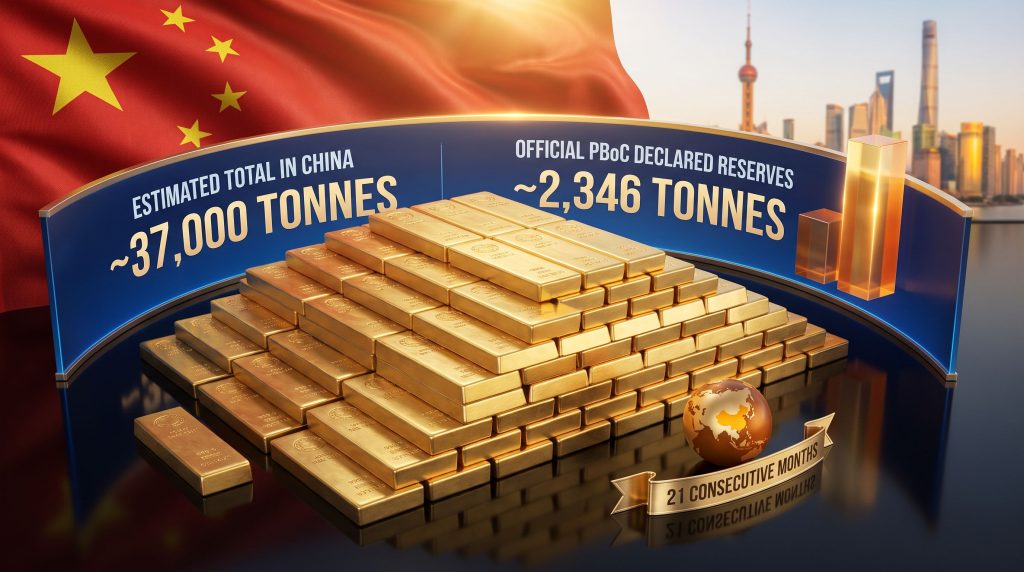
| Estimated Total in China | ~37,000 tonnes |
| Official PBoC declared reserves (Q2 2026) | ~2,346 tonnes |
The Disclosure Gap: Estimates of state-controlled gold within this total range from approximately 25% to 50% or more of total holdings, depending on the methodology applied. At 25%, China's government holds roughly 8,750 to 9,250 tonnes — already exceeding Germany's declared reserves. At 50%, the implied government holding surpasses 17,000 tonnes, more than double the 8,122 tonnes the United States officially declares. Notably, the last comprehensive audit of American gold reserves was conducted in the 1950s, raising legitimate questions about the quality and accuracy of that figure — including whether some of that gold consists of melted pre-1933 coin stock of only 90% purity rather than modern Good Delivery standard bars.
Is China's Domestic Gold Production a Strategic Advantage?
China as Both the World's Largest Gold Producer and Importer
Very few nations combine top-tier domestic production with sustained large-scale importation of the same commodity. China does exactly this with gold, creating a one-way accumulation dynamic that has no meaningful parallel among major economies. Domestic output feeds into the national gold stock while import demand simultaneously absorbs global supply. The combined effect is structural and self-reinforcing.
The Export Prohibition: Why No Chinese Gold Leaves the Country
China's prohibition on gold bullion exports is not an informal policy preference — it is legally mandated. Even within the jewellery trade, China is a net importer. This means that every tonne mined on Chinese soil, every bar refined in Chinese facilities, and every ounce purchased on international markets stays within the country's borders permanently.
For any estimation of China's gold stock, this export prohibition functions as a mathematical floor. The number can only go up.
Does the Resource Curse Apply to China's Gold Sector?
What Is the Resource Curse?
The resource curse describes the paradox in which nations with abundant natural resource endowments frequently experience weaker economic institutions, elite wealth concentration, and long-run underperformance relative to resource-poor peers. Venezuela's oil wealth and the rentier dynamics of several Gulf petrostates are the most frequently cited examples.
Why China Appears Structurally Immune:
- Gold production is state-directed rather than privately concentrated, limiting the elite capture dynamic that drives the classic curse
- Revenue flows into sovereign reserve strategy rather than extractive rents for a narrow class of beneficiaries
- China's diversified manufacturing base prevents commodity mono-dependence at the national level
- Regional disparities in mining-dependent provinces may exist, but national industrial policy insulates the macroeconomic picture
The resource curse may have limited relevance to specific Chinese regions with heavy mining exposure, but as a national-level framework it does not appear applicable to China's gold sector.
The Geopolitical Chessboard: What China's Gold Means for U.S. Dollar Supremacy
He Who Has the Gold Makes the Rules: The Reserve Currency Thesis
Throughout monetary history, reserve currency status has never been established without an underlying gold convertibility anchor. The British pound's global dominance was backed by British gold. The dollar replaced sterling partly because the United States held the majority of the world's gold reserves at the end of World War II. The pattern is consistent: sovereign monetary credibility begins with gold.
China's accumulation strategy, viewed through this historical lens, is not speculative. It is the documented playbook for reserve currency ambition, executed methodically over decades. In addition, gold's evolving role in the global monetary system reinforces why Beijing's approach carries such profound long-term implications.
Why China Is Deliberately Understating Its Holdings
China's operating monetary philosophy appears to favour quiet accumulation over public declaration. Announcing a gold position that materially exceeds U.S. declared reserves would constitute a direct monetary confrontation — effectively challenging dollar reserve status and inviting significant geopolitical friction. With approximately $3 trillion in U.S. dollar reserves, China also has a powerful structural incentive not to destabilise the dollar aggressively while it remains exposed to dollar depreciation risk through its own reserve holdings.
The strategic logic is to declare the minimum necessary to maintain credibility, accumulate continuously, and preserve the declaration as an option to be exercised at a moment of maximum strategic advantage.
The Historical Pattern: Every Reserve Currency Began With Gold Convertibility
This historical regularity is arguably the most important analytical frame for understanding why China gold accumulation matters beyond the commodity price implications. If the renminbi is ever to achieve genuine reserve currency status, a credible gold backing would be a near-essential precondition. The current accumulation phase may be exactly that preparation.
The Declaration Moment: When Might China Reveal Its True Position?
Timeline Scenario Modelling
| Scenario | Trigger | Probable Outcome |
|---|---|---|
| Status quo (5–10 years) | No major conflict | Continued quiet accumulation |
| Trade and tech decoupling escalation | Tariff war deepens | Accelerated gold buying, partial disclosure |
| Taiwan Strait crisis | Military confrontation | Gold card played as monetary weapon |
| Reserve currency bid | RMB internationalisation push | Full or partial disclosure to back currency credibility |
Strategic Scenario: A formal Chinese declaration of gold reserves materially exceeding U.S. holdings — combined with publicly raised questions about the integrity and quality of American gold stocks last audited in the 1950s — could constitute a significant challenge to dollar reserve credibility. However, China's own massive dollar reserve exposure creates a deterrent against aggressively deploying this card in the near term. The more probable scenario is continued accumulation with selective disclosure tied to RMB internationalisation milestones.
The next major ASX story will hit our subscribers first
The Global Gold Trading Hub Landscape: Is London's Dominance Under Threat?
London's Historical Role as the Centre of the Gold Universe
London's position as the gravitational centre of global gold trading is a legacy of empire. South African production, Australian output, and Californian flows all passed through London during the period of British financial and military dominance. The LBMA and COMEX markets still process the majority of institutional gold transactions globally — and in a striking statistical anomaly, gold is technically the United Kingdom's largest export category by value, despite the country operating zero active metal mines.
How the London Gold Pool's Collapse Shifted Power to Zurich
London's monopoly on global gold flows began to fracture in 1968, when the London Gold Pool collapsed under pressure from dollar convertibility strains. Following the brief closure of the London gold market, a significant share of South African gold production was redirected through Zurich, permanently diluting London's market share. That episode demonstrated that hub dominance is not permanently secured — it can be lost quickly when structural conditions shift.
The Rise of the Shanghai Gold Exchange: From Zero to Global Contender
The Shanghai Gold Exchange did not exist 22 years ago. Today, its physical gold volumes at the retail and regional level likely rival or exceed those of any other single venue globally. The trajectory from non-existence to major market infrastructure in two decades is a remarkable case study in state-directed financial development, and its continued growth is directly aligned with China's broader accumulation strategy.
Dubai, COMEX, and the Multipolar Gold Market Structure
Global Gold Hub Comparison
| Hub | Established Strength | Key Volume Type | Vulnerability |
|---|---|---|---|
| London (LBMA) | Historical dominance, OTC depth | Institutional, OTC | No domestic production base |
| COMEX (New York) | Futures liquidity | Derivatives and paper | Leverage-driven, not physical |
| Shanghai (SGE) | Rapid growth since 2002 | Physical and retail | Capital controls limit internationalisation |
| Zurich | Post-1970 South African flows | Refining, private banking | Smaller market share |
| Dubai | Emerging corridor | Trade flows, re-export | Regulatory transparency concerns |
What the Goldman Sachs Estimate Reveals About Institutional Awareness
Why Goldman Sachs Flagged the London OTC Market as a Hidden Channel
Goldman Sachs analysts have noted that Chinese gold purchases routed through the London OTC market may imply materially larger state accumulation than PBoC official disclosures suggest. This matters because Goldman Sachs represents the institutional research tier that sophisticated investors and central banks treat as a benchmark for credible analysis. Indeed, Goldman Sachs research suggests China's real gold accumulation may be more than double the officially reported numbers. When that tier begins acknowledging a structural data gap in Chinese reserve reporting, it signals that the underdisclosure hypothesis has moved from fringe commentary to mainstream analytical concern.
The Gap Between Reported and Market-Implied Chinese Buying
The discrepancy between official monthly additions and market-implied flows is not trivial. If Goldman Sachs is correct that London OTC volumes suggest materially higher Chinese accumulation than declared figures show, then the 21-month official buying streak represents the visible portion of a much larger ongoing programme — with the bulk of activity occurring in private bilateral and OTC channels that leave no public footprint.
What Institutional Analysts Are Saying That Mainstream Media Is Not
"The gap between China's declared gold reserves and its probable actual holdings is arguably the largest known discrepancy between official monetary data and estimated reality in global finance. It is a story that receives almost no mainstream coverage relative to its potential systemic implications."
A growing body of independent analysis, corroborated at the institutional level by major investment bank research, points toward China holding somewhere between 5,000 and 20,000 tonnes of state-controlled gold above and beyond its declared position. The midpoint of that range would already make China the largest government gold holder on Earth, surpassing the United States' declared but unaudited 8,122 tonnes.
Frequently Asked Questions: China Gold Accumulation
How much gold does China officially report holding?
As of Q2 2026, the People's Bank of China reported official gold reserves of approximately 2,346 tonnes (75.44 million fine troy ounces), valued at roughly $303.72 billion.
How long has China been consecutively buying gold?
China extended its official gold-buying streak to 21 consecutive months as of July 2026, adding approximately 15 tonnes in June and 20 tonnes in July of that year.
Why do analysts believe China's true gold holdings are much higher?
Multiple estimation frameworks incorporating domestic mine output, Shanghai Gold Exchange withdrawal data, and OTC market flows suggest total gold within China's borders may range between 30,000 and 40,000 tonnes. Furthermore, state-controlled holdings could potentially sit between 5,000 and 20,000 tonnes, versus the officially declared 2,346 tonnes.
Is China allowed to export its gold?
No. China prohibits the export of gold bullion by law. Despite being a net importer even of gold jewellery, no domestically mined or refined gold bullion leaves the country.
What would it mean if China declared its true gold reserves?
A formal declaration of holdings significantly exceeding U.S. reserves — combined with longstanding questions about the integrity of America's last official audit in the 1950s — could constitute a direct challenge to dollar reserve currency status and U.S. monetary credibility.
Why is London still considered the global gold trading centre?
London's dominance traces back to its historical role as the financial capital of the British Empire and its control over South African, Australian, and Californian gold flows. The London Bullion Market Association still processes the majority of institutional gold transactions globally, though Shanghai's physical volumes are rapidly closing the gap at the retail and regional level.
Key Takeaways: What China's Gold Strategy Means for Investors and Markets
- China's official gold reserve figures are almost certainly a significant understatement of actual state-controlled holdings, with independent estimates ranging from 5,000 to 20,000 tonnes above declared levels
- The combination of zero gold exports, world-leading domestic production, and sustained import volumes creates a one-way accumulation dynamic with no meaningful parallel among major economies
- Goldman Sachs and independent analysts alike suggest London OTC market channels are being used to accumulate gold outside of publicly visible reporting mechanisms
- China's gold strategy is inseparable from its long-term ambition for RMB internationalisation and reserve currency status, and every major historical reserve currency began with a gold convertibility foundation
- The Shanghai Gold Exchange, non-existent just over two decades ago, has become a major force in global physical gold markets and is central to China's ambition to host a leading gold trading hub
- The declaration moment — when China formally reveals holdings that exceed American declared reserves — represents a potential inflection point for global monetary confidence and dollar reserve status
- For investors, the structural implication is clear: sustained sovereign demand from the world's second-largest economy, executed over decades and likely to continue, represents a durable policy-driven floor under gold prices
Disclaimer: This article is intended for informational and educational purposes only. Nothing contained herein constitutes financial, investment, or legal advice. Estimates of China's gold holdings are based on publicly available analytical frameworks and independent research; actual figures remain unknown. All forward-looking statements and scenario projections involve material uncertainty and should not be relied upon as predictions of future events or market outcomes. Readers should conduct their own due diligence before making any investment decisions.
Want to Stay Ahead of the Next Major Gold or Mineral Discovery?
Discovery Alert's proprietary Discovery IQ model delivers real-time alerts the moment significant ASX mineral discoveries are announced, transforming complex geological and commodity data into clear, actionable investment insights — ideal for investors tracking the structural shifts in global gold demand explored in this article. Explore historic discoveries and the returns they generated, then begin your 14-day free trial to position yourself ahead of the broader market.