June 19, 2026
The Hidden Financial Architecture Behind Australia's Biggest Industrial Clean-Up
Offshore energy provinces around the world follow a predictable lifecycle: exploration, development, peak production, decline, and finally, decommissioning. It is in that final phase where the true cost of decades of extraction becomes apparent. For Australia, that reckoning is arriving at scale in Bass Strait, where one of the nation's earliest and most productive offshore hydrocarbon basins is now transitioning into an end-of-life dismantling program that will define how the country manages Bass Strait oil and gas decommissioning funding for a generation.
The financial stakes are substantial. The questions of who pays, how liability is assigned across time and corporate ownership changes, and whether public finances are adequately protected have moved from technical regulatory discussions into the centre of Victorian parliamentary policy. Furthermore, this challenge connects to a broader mining sustainability transformation now underway across extractive industries.
When big ASX news breaks, our subscribers know first
The Infrastructure Legacy: What Actually Needs to Be Decommissioned?
The Gippsland Basin has been producing hydrocarbons since the late 1960s, making its offshore infrastructure among the oldest in Australian waters. That longevity is precisely what makes the decommissioning challenge so technically and financially complex.
The current operational picture reflects a basin in advanced decline:
- 11 producing offshore platforms and installations remain active as of current reporting
- 13 platforms, 4 subsea facilities, and 26 pipelines have already ceased production
- More than half of all wells in the basin have passed their productive life
- The decommissioning timeline extends through the 2020s and well into the 2030s
This is not a future problem. Physical decommissioning work is already underway, and the volume of assets still requiring attention means the program represents a multi-decade industrial undertaking unlike anything previously attempted in Australian waters.
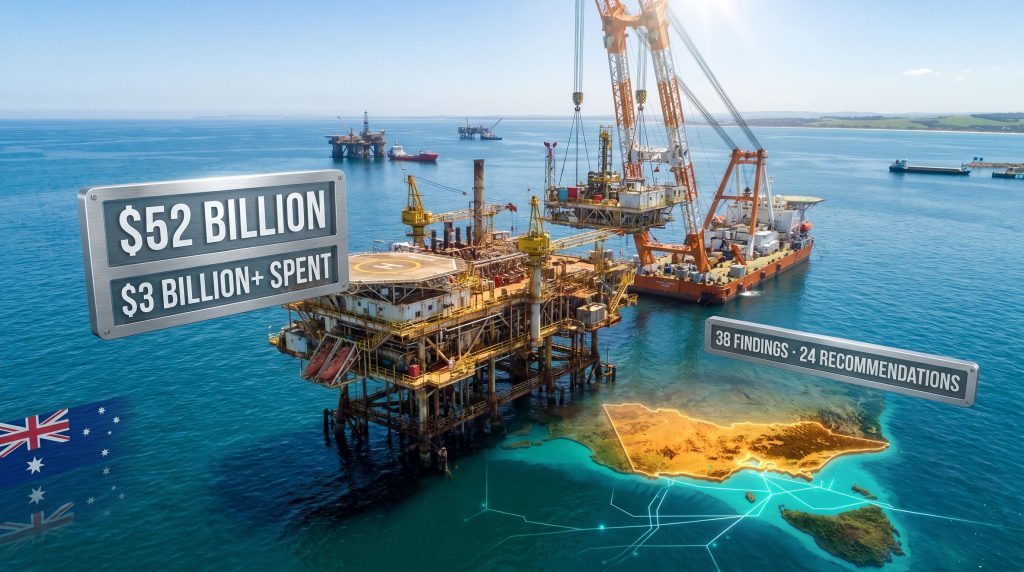
At the national level, the total offshore decommissioning liability across Australia is estimated at approximately $52 billion, with the Gippsland Basin accounting for a disproportionately large share of that figure given the basin's age, infrastructure density, and geographic concentration.
Who Is Currently Paying for Bass Strait Decommissioning?
Operator Expenditure: ExxonMobil's Multi-Billion Dollar Commitment
Esso Australia, operating under the ExxonMobil group, is the dominant operator in the Gippsland Basin and has been the primary funding entity for decommissioning activities to date. The scale of its financial commitment is already significant: more than $3 billion has been spent on early-phase decommissioning work, including the permanent plugging and abandonment of over 200 wells.
Operator-funded activities across the program include:
- Well plugging and permanent abandonment
- Platform topside dismantling
- Jacket and substructure removal
- Subsea pipeline and wellhead decommissioning
- Materials processing, recycling, and waste management
The $3 billion already deployed, however, represents early-stage activity. The bulk of the financial obligation remains ahead as the remaining producing assets retire progressively over the coming decade.
The Tax Dimension: How Public Finances Intersect With Private Costs
A dimension of Bass Strait oil and gas decommissioning funding that receives less public attention is the tax architecture that governs how operator expenditure flows through the national accounts. Two mechanisms are particularly relevant:
Income tax deductibility: Decommissioning expenditure is generally tax-deductible under Australian law. This means a portion of operator costs reduces taxable income, effectively transferring part of the economic burden to the Commonwealth through forgone tax revenue.
Petroleum Resource Rent Tax (PRRT): Eligible decommissioning costs may generate PRRT deductions or refunds under the PRRT framework, further shifting a share of the financial impact toward the public sector.
The practical implication is that while operators are the primary payers of decommissioning costs, Australia's tax framework means the public sector indirectly absorbs a meaningful portion of those costs through reduced tax receipts and potential PRRT refunds. The net cost borne by operators versus taxpayers is therefore considerably more nuanced than headline operator expenditure figures suggest.
Government Investment in Regulatory Capability
The Australian Government established the Offshore Decommissioning Directorate to build national regulatory capability and coordinate industry development programs. Federal investment in this space is focused on regulatory oversight infrastructure, workforce development, supply chain capacity building, and decommissioning-related research rather than directly subsidising operator clean-up costs. In addition, understanding natural capital in mining and resource operations is increasingly shaping how regulators approach end-of-life obligations.
Victoria's Parliamentary Inquiry: 38 Findings, 24 Recommendations
The Victorian Legislative Council Environment and Planning Committee has released a comprehensive inquiry report that establishes a formal regulatory roadmap for Bass Strait decommissioning. With 38 findings and 24 recommendations, the report addresses financial accountability, environmental monitoring, legal liability continuity, and regional economic development.
Committee Chair Ryan Batchelor articulated the core concern driving the inquiry's financial provisions: the decommissioning program will be an enormous undertaking over the coming decades, and Victorian taxpayers should not be left to bear its costs.
Trailing Liability: The Centrepiece Financial Safeguard
The inquiry's most consequential financial recommendation is the introduction of trailing liability provisions into Victorian state law, aligned with existing Commonwealth legislation. This mechanism is designed to close a significant corporate accountability gap.
| Scenario | Without Trailing Liability | With Trailing Liability |
|---|---|---|
| Asset sale | New owner bears full cost; original operator exits | Original operator retains residual liability |
| Corporate restructure | Liability may be extinguished | Liability persists regardless of structure |
| Insolvency | Public sector absorbs unfunded gap | Previous operators remain financially exposed |
| Taxpayer protection | Limited | Substantially strengthened |
Without trailing liability, an operator can technically divest an end-of-life asset to an undercapitalised entity, effectively transferring the decommissioning obligation to a party that lacks the financial capacity to fulfil it. If that party enters administration, the liability falls to the regulator and ultimately to the public. This risk has already materialised in several North Sea jurisdictions, making the Victorian recommendation timely and well-grounded in international precedent.
Consequently, experts have warned that abandoning Bass Strait structures without adequate liability frameworks could breach international law, reinforcing the urgency of these reforms.
Independent Well Verification and Perpetual Monitoring
Beyond the financial architecture, the inquiry recommends two technically important environmental accountability measures:
- Independent third-party verification of plugged and abandoned wells, removing reliance on self-reported operator compliance data
- Perpetual environmental monitoring of seabed and water column conditions following decommissioning completion
These provisions recognise that decommissioning risk does not end at the point of physical removal. Well integrity failures and legacy contamination can emerge over timeframes of decades. A permanently plugged well that was certified compliant at abandonment can still develop integrity issues as cement degrades and formation pressures shift. Independent verification and long-term monitoring are the only credible mechanisms for managing these tail risks.
The "Leave in Place" Debate: Industry Pragmatism or Environmental Loophole?
The most contested element of the inquiry's recommendations is a provision permitting operators to leave certain infrastructure in place if it can be demonstrated that abandonment in situ delivers superior environmental outcomes compared to physical removal.
The environmental community's response to this provision has been pointed. Friends of the Earth Melbourne has characterised the ocean abandonment of contaminated industrial infrastructure as offering no credible environmental benefit, regardless of reef-effect arguments. The group's offshore campaigner, Stanley Woodhouse, stated that there is no scenario in which leaving contaminated industrial waste on the seabed serves the environment and called for a firm commitment to full removal as the default standard.
The policy tension here reflects a genuine technical debate within the decommissioning industry:
- Industry argument: Submerged structures can develop functioning artificial reef ecosystems over decades. Physical removal causes significant seabed disturbance and may destroy established marine communities. In some cases, leaving structures in place is arguably the less damaging option.
- Environmental argument: Purpose-built artificial reef programs are categorically different from abandoned industrial infrastructure with hydrocarbon contamination histories. The reef effect argument should not be used to justify leaving pollutant-bearing structures in Australian waters indefinitely.
Policy Watch: The "leave in place" provision is likely to remain a focal point for regulatory debate as Victoria moves toward legislative implementation. The outcome of this specific question will set a precedent with implications well beyond the Gippsland Basin.
International Benchmarks: How Australia Compares
Australia's decommissioning funding framework is still maturing relative to more established offshore jurisdictions. The following comparison illustrates key structural differences:
| Jurisdiction | Primary Funding Model | Trailing Liability | Domestic Recycling |
|---|---|---|---|
| Australia (current) | Operator-led, tax-deductible | Partial (Commonwealth) | Emerging |
| United Kingdom | Operator-led, Decommissioning Security Agreements | Yes | Established |
| Norway | Operator-led, state co-ownership via Equinor | Yes | Strong |
| United States | Operator-led, bonding requirements | Yes | Limited |
| Australia (proposed) | Operator-led, trailing liability aligned | Yes (proposed) | Recommended |
The United Kingdom's North Sea decommissioning program is the most instructive international case study. The UK system requires operators to enter Decommissioning Security Agreements (DSAs), under which ring-fenced funds proportional to decommissioning liability must be set aside. This model ensures that financial provisions exist independent of corporate solvency at the time decommissioning activity is required.
The North Sea experience also illustrates the asset transfer risk that the Victorian trailing liability proposal directly addresses. Several North Sea fields changed hands in their late-life stage only for the acquiring entities to subsequently encounter financial difficulties, leaving regulatory bodies scrambling to enforce decommissioning obligations against parties with limited assets.
The next major ASX story will hit our subscribers first
Regional Economic Opportunity: South Gippsland's Industrial Window
Bass Strait oil and gas decommissioning funding is not purely a liability story. The inquiry explicitly identifies Barry Beach Marine Terminal in South Gippsland as a strategic hub for decommissioning-related industrial activity, including specialised recycling and materials processing operations. The mine reclamation importance recognised across the broader resources sector similarly highlights how end-of-life planning creates lasting regional economic value.
The economic opportunity is time-limited but substantial:
- Specialised steel and materials recycling from platform removal and pipeline decommissioning
- Logistics and heavy transport operations associated with offshore lifts and material movements
- Diving, remotely operated vehicle (ROV), and subsea inspection services
- Environmental monitoring, sampling, and analysis contracts
Australia's estimated $52 billion national decommissioning liability represents long-term demand for this specialised capability. Bass Strait's geographic concentration and proximity to established port infrastructure positions the Gippsland region to develop transferable expertise applicable to decommissioning projects across the broader Asia-Pacific region as other mature basins enter their own end-of-life phases.
The $52 Billion Liability: Is It Adequately Provisioned?
A critical and underappreciated dimension of the Bass Strait decommissioning challenge is that the $52 billion national liability figure is a high-level industry estimate, not a certified financial provision. Actual costs will depend on:
- Scope decisions around full removal versus leave-in-place determinations
- Technology choices for well plugging, platform removal, and pipeline decommissioning
- Regulatory requirements as the framework evolves
- Market conditions for specialist vessels, equipment, and labour
- Scope creep as legacy contamination or unexpected structural conditions are encountered
In mature offshore basins globally, decommissioning costs have consistently exceeded initial estimates. The North Sea experience suggests that final costs typically run 20 to 50 percent above early projections, driven by the complexity of aged infrastructure that was designed for production rather than removal.
Given that ExxonMobil's $3 billion already deployed represents early-phase activity focused primarily on well abandonment, and that platform removal and pipeline decommissioning are generally more complex and expensive activities, the financial provisions currently in place across the industry may not fully reflect the liability ahead. However, the adoption of renewable mining solutions and advanced technologies across the resources sector is beginning to reduce operational costs, potentially offering some relief in decommissioning programmes as well.
Frequently Asked Questions: Bass Strait Oil and Gas Decommissioning Funding
Who holds primary legal responsibility for paying decommissioning costs in Bass Strait?
The companies that own and operate offshore infrastructure hold primary legal responsibility. In the Gippsland Basin, Esso Australia under ExxonMobil is the dominant operator and principal funder of decommissioning activities, having already deployed more than $3 billion on early works including the permanent plugging of over 200 wells.
Can Australian taxpayers end up bearing decommissioning costs?
Not directly, but indirectly through the tax system. Decommissioning expenditure is tax-deductible, reducing operator tax obligations and representing forgone Commonwealth revenue. PRRT refunds can transfer additional economic burden to the public sector. The trailing liability provisions recommended by the Victorian inquiry are specifically designed to prevent unfunded liabilities from defaulting to government.
What is trailing liability and why does it matter here?
Trailing liability is a legal mechanism that keeps original operators financially responsible for decommissioning costs even after assets have been sold or transferred. It prevents the risk of end-of-life assets being divested to entities without the financial capacity to fund clean-up obligations, ensuring accountability cannot be extinguished through corporate transactions.
How long will the Bass Strait decommissioning program run?
The program is expected to continue through the 2020s and into the 2030s as remaining producing assets progressively reach end-of-life. Given that the majority of infrastructure has already ceased production, the program is well advanced but represents a multi-decade undertaking before the basin is fully decommissioned.
What economic opportunities does decommissioning create for regional Victoria?
South Gippsland's Barry Beach Marine Terminal is identified in the inquiry as a key hub for decommissioning-related industrial activity including specialised recycling and materials processing. The concentration of work in the region creates employment opportunities and the potential to develop transferable offshore decommissioning expertise applicable across Australia and the broader Asia-Pacific. Furthermore, the mining decarbonisation benefits emerging across extractive industries demonstrate how end-of-life transitions can simultaneously generate economic and environmental value.
Key Takeaways for Stakeholders Tracking This Regulatory Evolution
- Primary financial responsibility rests with operators, led by ExxonMobil, which has already committed more than $3 billion to Gippsland Basin decommissioning and has permanently plugged over 200 wells
- Victoria's 38-finding, 24-recommendation inquiry establishes a comprehensive framework to formalise operator accountability and protect public finances from unfunded liabilities
- Trailing liability provisions are the centrepiece safeguard, ensuring decommissioning costs cannot be escaped through asset sales or corporate restructuring
- Australia's $52 billion national decommissioning liability makes robust funding frameworks a fiscal imperative, with the Gippsland Basin representing a disproportionately large share of that total
- North Sea precedent strongly supports the trailing liability and financial security mechanisms being proposed, particularly the risk of late-stage asset transfers to undercapitalised entities
- The "leave in place" provision remains the most contested policy question and is likely to face sustained pressure from environmental groups as Victorian legislation is developed
- Regional economic opportunity is substantial for South Gippsland, particularly if domestic recycling and supply chain development recommendations are fully implemented
This article contains forward-looking statements and references to industry estimates that involve uncertainty. The $52 billion national decommissioning liability figure is an industry-level estimate subject to revision as regulatory requirements, scope decisions, and market conditions evolve. Readers should not rely on this material as financial or investment advice.
Further analysis and ongoing coverage of Australia's offshore decommissioning challenge is available through Petroleum Australia at petroleumaustralia.com.au.
Want To Stay Ahead of Major Resource Sector Developments Shaping the ASX?
Discovery Alert's proprietary Discovery IQ model scans ASX announcements in real time, instantly identifying significant mineral discoveries and turning complex resource data into actionable investment insights — so subscribers can act before the broader market reacts. Explore how historic discoveries have delivered substantial returns on Discovery Alert's dedicated discoveries page, and begin your 14-day free trial today to secure a genuine market-leading edge.