June 19, 2026
The Hidden Cost Equation Reshaping Africa's Mining Investment Landscape
Resource nationalism is not a new phenomenon. From the nationalisation waves of the 1970s to the indigenisation policies of the 2000s, the tension between sovereign resource control and foreign capital has cycled through African mining jurisdictions with remarkable regularity. What distinguishes the current moment is the convergence of two powerful forces: the critical minerals demand created by the global energy transition and resource-rich nations recalibrating how much value they are willing to export alongside the raw ore itself. Mozambique's revised mining legislation sits precisely at this intersection, and the implications for the Mozambique new mine ownership rules foreign investment dynamic extend well beyond the country's borders.
When big ASX news breaks, our subscribers know first
Why Mozambique's Mineral Endowment Makes This Policy Moment Unusually High-Stakes
To understand the significance of Mozambique's legislative revision, it is worth first appreciating what the country actually holds beneath its soil. Mozambique consistently ranks among the world's top graphite-producing nations, with the commodity occupying a critical position in the lithium-ion battery supply chain powering electric vehicles and grid-scale energy storage systems. Graphite serves as the anode material in virtually every commercial lithium-ion cell currently manufactured at scale, and natural flake graphite from high-grade deposits remains technically preferred for many battery applications over synthetic alternatives.
The global graphite shortage conversation makes Mozambique's deposits even more strategically significant, given their superior electrochemical properties and lower production energy footprint compared to synthetic alternatives.
The Balama graphite operation in northern Mozambique, operated by Syrah Resources, is one of the largest graphite deposits globally by both reserve size and annual production capacity. Its scale and ore quality have positioned it as a reference-grade asset in global battery supply chain discussions. Balama produces large flake, high-purity natural graphite concentrate, a specification that commands premium pricing and strategic interest from battery manufacturers seeking to diversify supply away from dominant Chinese production.
Beyond graphite, Mozambique's mineral portfolio includes:
- The Montepuez ruby deposit in the country's north, operated by Gemfields, which is widely regarded as the world's largest ruby mine by production volume, having fundamentally reshaped the global coloured gemstone market since its development.
- Substantial thermal coal reserves in the Tete province, historically developed by major global miners including Rio Tinto and Brazil's Vale, representing significant long-term infrastructure and rail corridor investment.
- Emerging heavy mineral sands assets along the coastal zones, adding titanium and zircon exposure to the country's multi-commodity profile.
This depth and diversity of mineralisation is precisely why legislative changes carry outsized significance. Mozambique is not a marginal jurisdiction with replaceable assets. For several commodity categories, its deposits are globally irreplaceable, which fundamentally complicates how investors must weigh regulatory friction against asset quality.
What Exactly Has Changed: Unpacking the Revised Mining Law
The 15% Free-Carry State Stake
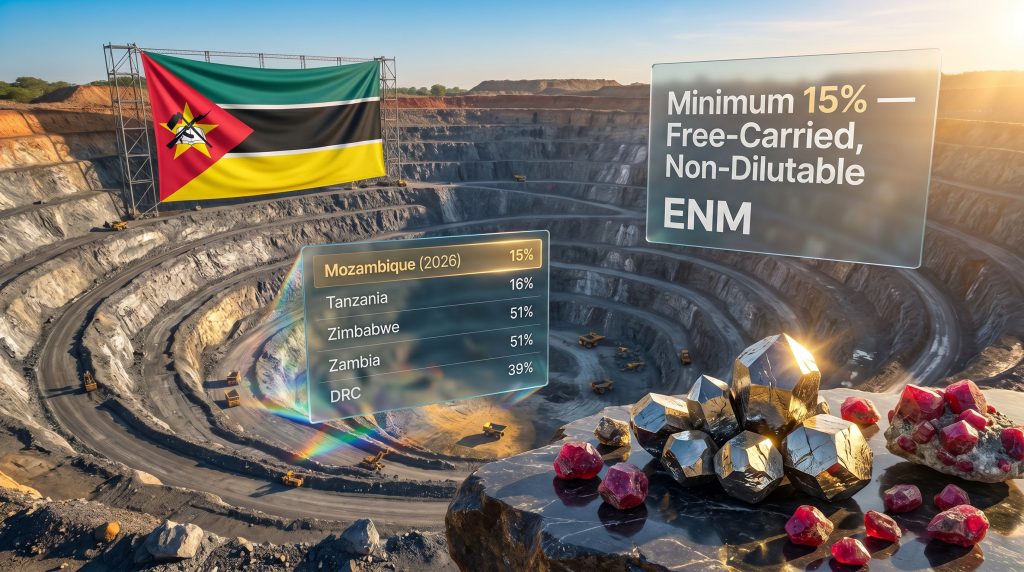
The centrepiece of the revised framework is a mandatory minimum 15% equity participation for the Mozambican state in all mining ventures. Critically, this stake is structured as both free-carried and non-dilutable. Furthermore, the Mozambique mining law revisions have drawn considerable scrutiny from industry bodies warning of potential capital flight.
A free-carried, non-dilutable state stake fundamentally restructures project economics. Private investors bear 100% of capital expenditure while yielding a fixed share of future cash flows, a dynamic that compresses projected returns and elevates the effective cost of capital for any new mining venture.
The practical effect of this structure is a form of capital burden asymmetry that project finance professionals are well-versed in scrutinising. Under a conventional equity arrangement, all shareholders contribute capital proportional to their ownership stake. Under a free-carry model, the private investor funds exploration, development, construction, and commissioning costs in their entirety, while the state receives its equity share without contributing to those expenditures. The state then participates in cash flows once production commences, effectively receiving a perpetual royalty-like return structured as equity participation.
The State's Representative Entity: Empresa Nacional de Minas
The state's equity interest across all mining ventures will be held through Empresa Nacional de Minas (ENM), a newly established national mining company created specifically to fulfil this mandate. ENM's operational capacity, governance standards, and technical competency will be critical variables in determining how smoothly the framework functions in practice.
Institutional investors and project lenders will be carefully assessing whether ENM can operate as a credible, commercially-oriented partner rather than a passive equity holder with limited sector knowledge.
Comparative Policy Framework
| Policy Element | Pre-2026 Framework | 2026 Revised Law |
|---|---|---|
| State equity participation | Limited, project-specific | Minimum 15% mandatory |
| State stake structure | Negotiable | Free-carried, non-dilutable |
| State representative entity | Ad hoc, ministry-level | ENM (dedicated entity) |
| Mineral export permissions | Broadly permitted | Restricted, ministerial approval required |
| Local content obligations | Preferences-based | Mandatory association requirements |
| Construction mineral rights | Open to foreign entities | Reserved for Mozambican nationals |
Export Restrictions and the Value-Add Imperative
The revised law prohibits the export of unprocessed or semi-processed mineral products as a default position. Operators seeking to export raw or partially processed minerals must obtain ministerial approval, contingent on demonstrating credible plans for domestic processing.
The Mozambique Chamber of Mines has indicated it supports the principle of greater in-country value addition, acknowledging this as a regional trend with legitimate economic rationale. However, the industry body has also stressed that meaningful domestic processing requires reliable water supply, consistent electricity infrastructure, and functional logistics networks — without which processing investments become economically unviable regardless of policy intent.
Is the 15% Free-Carry Rule a Deal-Breaker for Foreign Capital?
Regional Comparison
Mozambique's approach does not exist in a vacuum. Consequently, understanding how it compares to peer African jurisdictions is essential for investors assessing the broader mining geopolitics of the continent.
| Country | State Equity Requirement | Carried Interest? | Dilution Protections? |
|---|---|---|---|
| Mozambique (2026) | Minimum 15% | Yes, free-carried | Yes, non-dilutable |
| Tanzania | Up to 16%, negotiated | Partial | Variable |
| Zimbabwe | 51% in select sectors | No | No |
| Zambia | Historically negotiated | No | No |
| DRC | 10% royalty-equivalent | Partial | No |
Note: Regional legislative frameworks are subject to ongoing revision. Investors should obtain current jurisdiction-specific legal counsel before making capital allocation decisions.
At first glance, 15% appears modest relative to Zimbabwe's indigenisation requirements, which have historically mandated majority local ownership in certain sectors. However, the non-dilutable free-carry structure is the critical differentiating factor. Zimbabwe's 51% requirement is commercially severe but does not necessarily impose the full capital burden on the minority foreign partner. Mozambique's structure ensures that the entire capital cost is absorbed by private investors, with zero risk-sharing from the state entity that nonetheless receives a permanent, protected equity position.
How IRR Calculations Are Affected
From a project finance perspective, the compression of investor economics operates across several dimensions:
- Effective project ownership is reduced from 100% to 85% or below, while capital obligations remain at 100%.
- Hurdle rate adjustments are required upward to account for this effective dilution of returns before a single tonne of ore is processed.
- Debt serviceability becomes more complex, as lenders assessing project cash flow coverage ratios must factor in the state's unconditional claim on distributable cash.
- Offtake agreement structures may need renegotiation where financing was modelled under the previous legislative regime.
The Mozambique Chamber of Mines has voiced concern that this combination of factors reduces the country's attractiveness as an investment destination for foreign capital, a warning that carries weight given the body's direct representation of active operators in the sector.
The Value-Add Dilemma: Processing Ambitions Versus Infrastructure Realities
The regional push to restrict raw mineral exports in favour of domestic processing has gained meaningful momentum across Sub-Saharan Africa. Indonesia's 2020 nickel ore export ban provides the most frequently cited precedent, having catalysed rapid downstream investment in nickel smelting and processing capacity. However, Indonesia entered that policy experiment with considerably more developed industrial infrastructure, power generation capacity, and access to capital than most Sub-Saharan African resource states currently possess.
For Mozambique, the infrastructure prerequisites are not academic. Graphite purification to battery-grade specifications — typically requiring carbon purity above 99.95% — demands stable, high-voltage power supply and chemical processing infrastructure. The northern provinces where Mozambique's flagship mining assets are concentrated have historically faced infrastructure constraints that increase operational costs substantially relative to more developed jurisdictions.
The broader battery raw materials market context is also relevant here, as global manufacturers increasingly require supply chain certainty that processing restrictions could either support or undermine, depending on infrastructure delivery.
Governments committed to in-country processing as a value capture strategy must recognise that the policy obligation and the enabling infrastructure must advance in parallel. Export restrictions without corresponding investment in power, water, and logistics risk deterring rather than directing capital.
Scenario Analysis: Three Investor Response Pathways
How foreign capital responds to Mozambique's new framework will likely diverge significantly by investor type, asset quality, and development stage:
Scenario 1: Strategic Withdrawal
Investors with optionality across competing jurisdictions redirect exploration and development capital toward lower-restriction environments. Greenfield project pipelines slow, and Mozambique's medium-term production growth underperforms its geological potential.
Scenario 2: Renegotiation and Restructuring
Existing operators with sunk capital and world-class assets seek to renegotiate project terms within the new legal framework, accepting modified economics in exchange for continued operating certainty and long-term access to irreplaceable deposits.
Scenario 3: Selective Engagement
Assets of globally strategic significance — particularly large-scale graphite deposits given the accelerating battery supply chain buildout — continue attracting capital despite elevated regulatory friction. Supply scarcity at the global level outweighs jurisdiction-specific risk premiums, particularly for commodities where Mozambique holds structural advantages in grade, scale, and established logistics.
The most probable outcome is not a single scenario but a differentiated response across commodity classes. Graphite and ruby assets will likely attract continued engagement, while early-stage projects in less strategically critical categories face genuine capital flight risk. The critical minerals energy security imperative driving Western nations will be a key determinant of which scenario plays out most forcefully.
The next major ASX story will hit our subscribers first
Frequently Asked Questions: Mozambique Mining Law and Foreign Investment
What is the minimum state equity stake under Mozambique's revised law?
The legislation mandates a minimum 15% state equity participation in all mining ventures, structured as free-carried and non-dilutable.
Which entity holds the state's mining stake?
ENM, Empresa Nacional de Minas, a newly created national mining company, will represent the state's equity interest across the sector. Notably, analysis of Mozambique's revised mining regime by UNCTAD highlights the broader trend of reducing incentives while increasing state monitoring across the sector.
Are mineral exports prohibited?
Unprocessed and semi-processed mineral exports are restricted by default. Operators may seek ministerial approval by demonstrating viable domestic processing plans.
Does the law apply to existing operations?
The application of transitional provisions to existing concessions remains a critical area of legal interpretation. Active operators should seek current legal advice to assess their exposure.
Is Mozambique still open to foreign investment?
The revised framework does not prohibit foreign participation. However, mandatory state equity, export restrictions, and local content obligations make market entry more conditional and may reduce projected returns relative to the previous legislative regime.
Key Takeaways at a Glance
| Dimension | Assessment |
|---|---|
| State equity requirement | 15% minimum, free-carried, non-dilutable |
| New state entity | Empresa Nacional de Minas (ENM) |
| Export policy | Unprocessed mineral exports restricted by default |
| Local content | Mandatory procurement and partnership obligations |
| Reserved sectors | Construction minerals ring-fenced for Mozambican nationals |
| Industry sentiment | Cautious; Chamber of Mines warns of reduced investment attractiveness |
| Strategic asset quality | Remains world-class across graphite, gemstones, and coal |
| Regional alignment | Consistent with broader African resource sovereignty trend |
Ultimately, Mozambique's revised mining law represents a calculated assertion of sovereign resource management rather than a prohibition on foreign participation. Whether that calculation achieves its intended outcomes — greater state revenue capture, expanded domestic processing, and sustainable long-term industrialisation — will depend heavily on how credibly ENM is established, how consistently ministerial approval processes operate, and whether the government delivers on the infrastructure commitments that would make in-country processing commercially viable.
For investors already positioned in Mozambique's world-class deposits, the revised rules demand careful financial modelling and legal review. For those considering entry, the Mozambique new mine ownership rules foreign investment landscape has unquestionably become more complex, though for the right asset at the right grade, the geological case for engagement remains compelling.
This article is intended for informational purposes only and does not constitute financial, legal, or investment advice. Investors and operators should obtain independent legal and financial counsel before making decisions based on Mozambique's revised mining legislative framework. Legislative details referenced are based on reporting current as of June 2026 and remain subject to regulatory implementation and transitional provision interpretation.
Want to Stay Ahead of Significant Mineral Discoveries as Resource Nationalism Reshapes African Mining?
While Mozambique's revised mining framework adds complexity to frontier investment decisions, significant ASX-listed mineral discoveries continue to emerge across multiple commodities — and timing remains critical to capturing maximum upside. Discovery Alert's proprietary Discovery IQ model delivers real-time alerts the moment significant ASX mineral discoveries are announced, translating complex geological data into clear, actionable insights for both short-term traders and long-term investors. Explore historic examples of major discovery returns on Discovery Alert's dedicated discoveries page and begin your 14-day free trial today to ensure you're positioned before the broader market reacts.