June 19, 2026
When Geopolitical Risk Becomes a First-Order Investment Crisis
For decades, frontier jurisdiction mining was understood to carry a certain category of risk: currency instability, permitting delays, infrastructure gaps, and the occasional political transition. What the Antilles Gold Cuban joint venture sanctions episode reveals is something categorically different. It demonstrates that US extraterritorial enforcement has matured to a point where a company incorporated in Australia, operating through a locally registered joint venture in Cuba, can have its entire project halted overnight by a regulatory body in Washington DC. This is not a peripheral risk to be buried in a prospectus footnote. It is now a front-page, board-level crisis.
The mechanics of how this happened, what it means legally, and what comes next are questions that matter far beyond one ASX-listed explorer. They define the emerging compliance landscape for any resource company operating in OFAC-targeted economies. Furthermore, understanding geopolitical mining risks of this nature is increasingly essential for investors navigating frontier markets.
When big ASX news breaks, our subscribers know first
Executive Order 14404 and the OFAC Designation of Minera La Victoria
On 1 May 2026, the United States government signed Executive Order 14404, a directive specifically authorising sanctions against foreign entities operating within Cuba's state-controlled economic sectors. The metals and mining sector was explicitly named as a target, on the basis that resource revenues flowing through Cuban state enterprises contribute directly to the government's fiscal base.
The US Department of the Treasury's Office of Foreign Assets Control, universally known as OFAC, is the enforcement arm that converts executive orders into legally binding designations. On 4 June 2026, OFAC added Minera La Victoria S.A. (MLV) to its Specially Designated Nationals and Blocked Persons List, commonly referred to as the SDN List. MLV is the joint venture vehicle through which the Nueva Sabana gold and copper project is being developed in Cuba.
What an SDN Designation Actually Does
An SDN designation is among the most powerful tools in the US sanctions arsenal, and its effects extend well beyond the named entity. Under US law, any transaction involving an SDN entity is prohibited for US persons, and all assets connected to the designated party within US jurisdiction are immediately frozen.
Critically, the consequences do not stop at the US border. Foreign banks that maintain correspondent banking relationships with US financial institutions face the risk of losing those relationships if they continue to process transactions involving an SDN-listed entity. This secondary sanctions exposure is what gives OFAC designations genuine extraterritorial force.
An SDN listing does not merely restrict the named organisation. It creates an expanding web of compliance liability that reaches every counterparty in the designated entity's commercial ecosystem, from trade finance banks in Hong Kong to engineering contractors in China.
The distinction between an SDN designation and a sector-wide sanctions measure is also critical for investors to understand. Sector sanctions restrict a category of activity but do not freeze specific entities. An SDN designation is a surgical strike that names and isolates a particular organisation, making it effectively untouchable for the global financial system. This US mineral policy shift represents a significant escalation in how Washington targets foreign-operating resource ventures.
The Joint Venture Architecture and Why It Complicates Everything
Understanding the Antilles Gold Cuban joint venture sanctions situation requires clarity on the ownership structure that sits at the centre of it.
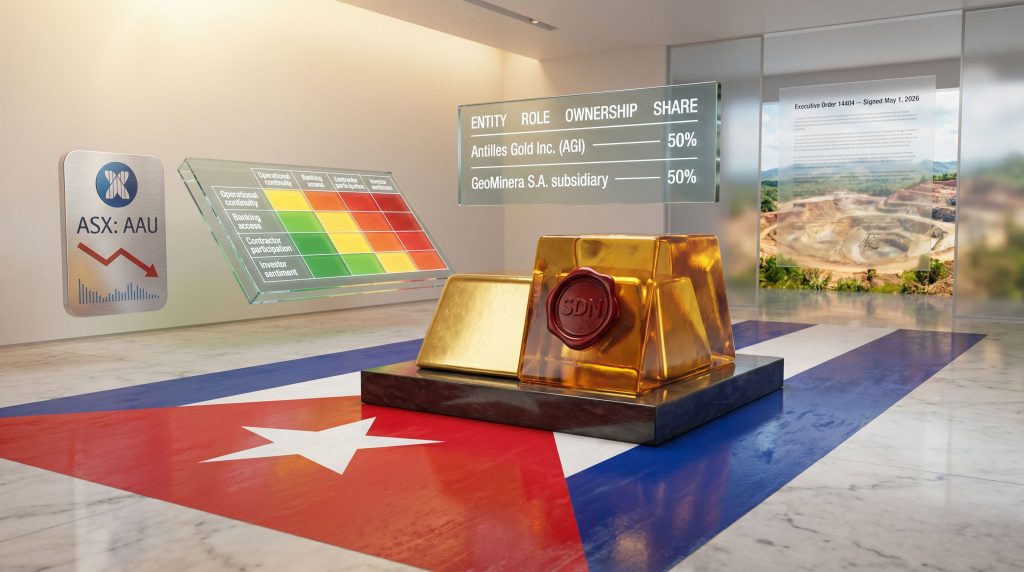
| Entity | Role | Ownership Share |
|---|---|---|
| Antilles Gold Inc. (AGI) | Australian-incorporated subsidiary | 50% |
| GeoMinera S.A. subsidiary | Cuban state-owned enterprise | 50% |
| Minera La Victoria S.A. (MLV) | Designated joint venture entity | N/A (JV vehicle) |
GeoMinera S.A. is a prominent mining corporation owned by the Cuban government. Its presence as a co-owner is precisely what triggered the designation pathway under Executive Order 14404, since the joint venture's operational activities are classified as providing economic sustenance to a state-controlled sector.
The legal nuance that Antilles Gold is navigating is the distinction between passive equity ownership and active participation. Under SDN rules, retaining an equity stake in a designated entity is not automatically prohibited for non-US persons, provided that stake does not involve active management, funding, or administrative support to the designated entity. This is why Antilles Gold announced the suspension of all direct management, administration, and funding obligations toward MLV, while simultaneously confirming that the 50% equity position would be retained.
This is a deliberate legal strategy designed to preserve future optionality. If the designation is eventually lifted or a specific licence is granted, Antilles Gold needs its ownership stake intact to recommence operations. Divesting the stake under sanctions pressure could also trigger its own compliance complications.
Secondary Sanctions Exposure Across the Project Ecosystem
The sanctions freeze does not affect only Antilles Gold. Several other parties face immediate compliance obligations:
- Xinhai Mining, the primary engineering, procurement, and construction contractor, confirmed the immediate suspension of all EPC activities at the Nueva Sabana site following the June 4 designation.
- Foreign banks that have financed or processed payments related to MLV's operations now face potential restrictions on their US correspondent banking access.
- Third-party service providers operating at the La Demajagua gold-silver deposit and across the broader Nueva Sabana project area must assess their own exposure before resuming any engagement.
The halting of Xinhai Mining's EPC activities is particularly consequential. Construction momentum in mining projects is difficult to rebuild. Equipment demobilisation, contractor reassignment, and the administrative complexity of remobilising a site can add months or years to a development timeline, even after the underlying sanctions obstacle is resolved.
The Nueva Sabana Project: What Was Paused and What Was at Stake
The Nueva Sabana mine is the flagship asset at the centre of the Antilles Gold Cuban joint venture sanctions crisis. Located within Cuba's historically underexplored gold and copper belt, the project targets gold-silver mineralisation at the La Demajagua deposit alongside copper mineralisation across the broader Nueva Sabana development area.
At the time OFAC made its designation, the project was in an active EPC phase, with Xinhai Mining engaged as primary contractor and capital already committed to advancing the development. The suspension froze the project at this critical juncture, precisely the point in a junior miner's development cycle where capital is being consumed but no revenue is yet being generated.
Conditions Required Before Development Can Resume
- OFAC grants MLV a specific licence authorising it to transact with US persons and Western-aligned entities under a defined compliance framework.
- The SDN designation is formally removed from MLV's listing, restoring unrestricted operational capacity.
Neither pathway is simple. Specific licence applications require detailed justification, compliance program documentation, and OFAC review — a process that carries no statutory timeline. SDN delisting requires either a demonstrable change in circumstances or a broader shift in US-Cuba policy that alters the regulatory logic underpinning the designation.
If OFAC licensing is granted, EPC work could potentially resume under a tightly controlled compliance structure. If the designation remains in place indefinitely, the Nueva Sabana project faces an open-ended development freeze with compounding cost and momentum consequences.
The Geopolitical Architecture Driving the Sanctions Escalation
The 2026 intensification of US Cuba sanctions policy represents a meaningful departure from the enforcement patterns of the preceding several years. Executive Order 14404 reflects a deliberate strategic choice to target foreign companies that provide economic sustenance to Cuba's state sector, rather than limiting sanctions pressure to Cuban government entities themselves. Consequently, the broader strategic minerals deal implications for Western-aligned resource companies operating in state-partnered ventures are becoming increasingly difficult to ignore.
The metals and mining sector was selected as a priority target because resource revenues represent a significant and trackable component of the Cuban government's income base. By cutting off foreign investment and development activity in this sector, the policy aims to reduce the fiscal headroom available to the Cuban government.
The table below illustrates how the SDN designation has transformed the operational and investor risk profile of the project:
| Risk Factor | Pre-Designation | Post-Designation |
|---|---|---|
| Operational continuity | Active EPC underway | Fully suspended |
| Banking access | Functional | Severely restricted |
| Contractor participation | Xinhai Mining engaged | Immediately paused |
| Investor sentiment | Speculative-positive | Materially impaired |
| Regulatory pathway | Clear development roadmap | Subject to OFAC licensing uncertainty |
The Geopolitical Risk Premium in Junior Mining Valuations
What the Antilles Gold case illustrates with unusual clarity is the asymmetric nature of geopolitical risk in frontier jurisdiction resource development. Upside scenarios in sanctioned-jurisdiction projects are always speculative and time-dependent. Downside scenarios, however, can be triggered overnight by a regulatory action in a third country, with no warning and no immediate remedy.
For small-cap mining companies, this asymmetry has a particular valuation consequence. The geopolitical risk premium required by the market to hold equity in a Cuba-exposed asset should logically be substantial, yet in practice, junior mining investors often underprice this risk until a designation event crystallises it. This is a pattern consistent with broader investor psychology in speculative resource stocks, where upside narratives tend to crowd out tail-risk assessment.
Antilles Gold's Response Strategy and the Path to Resolution
Following the June 4 OFAC designation, Antilles Gold moved on several fronts simultaneously. ASX-listed shares (ASX: AAU) were placed into a voluntary trading suspension on 10 June 2026, allowing management time to assess the full strategic implications before exposing the stock to market pricing.
The company's formal response has included:
- Complete suspension of direct participation in MLV's administration, management, and funding.
- Retention of the 50% equity stake in MLV as a residual value anchor and optionality position.
- Initiation of preliminary discussions with the US Department of State regarding potential remediation pathways.
- Commitment to submit a formal proposal to OFAC seeking either a specific licence or a review of the SDN designation.
Management acknowledged publicly that resolution is not guaranteed and that no timeline can be committed to, which is an important piece of investor disclosure in the context of ASX continuous disclosure obligations.
The board's position, as reflected in its market communications, centres on proactive engagement with US regulatory authorities while managing corporate costs during the operational freeze. Whether that engagement yields results will depend heavily on the broader trajectory of US-Cuba diplomatic relations, a variable entirely outside the company's control.
Three Scenarios Shaping the Path Forward
| Scenario | Probability Driver | Project Impact |
|---|---|---|
| OFAC grants specific licence | Active diplomatic engagement; precedent for licensed Cuba operations | Conditional EPC restart under compliance framework |
| SDN designation removed | Shift in US-Cuba policy; successful State Dept. advocacy | Full operational restoration |
| Prolonged designation | Hardening US Cuba policy; failed diplomatic remediation | Extended development freeze; equity value erosion |
Each of these scenarios carries distinct implications for how investors should value the retained 50% equity stake. Scenario one represents a partial recovery with operational constraints. Scenario two is the full-value restoration case. Scenario three is the capital erosion pathway, where the equity stake retains nominal value but generates no cash flow indefinitely.
The next major ASX story will hit our subscribers first
What This Means for ASX-Listed Explorers Operating in OFAC-Targeted Jurisdictions
Perhaps the most enduring significance of the Antilles Gold Cuban joint venture sanctions case lies not in its specific facts, but in what it signals for the broader population of ASX-listed resource companies with exposure to politically sensitive jurisdictions.
Australian companies are not shielded from US sanctions by virtue of their place of incorporation. OFAC's extraterritorial authority is activated through several channels that routinely intersect with Australian company operations:
- US dollar-denominated transactions, which route through US correspondent banks regardless of which country the parties are incorporated in.
- US-person involvement, including US-citizen employees, directors, or advisers who participate in sanctioned activities.
- Correspondent banking relationships maintained by Australian banks with US financial institutions, which create leverage points for OFAC enforcement.
A Practical Risk Framework for Resource Companies in Frontier Markets
The lessons embedded in the Antilles Gold case suggest a more rigorous pre-investment sanctions diligence framework than has historically been applied in the junior mining sector. In addition, the US policy impact on mining in politically sensitive jurisdictions continues to reshape how Australian boards approach sovereign risk assessments.
- Pre-entry sanctions screening: Assess whether the target jurisdiction is subject to comprehensive US sanctions, sector-specific sanctions, or executive order authorities that could be applied to the proposed activity.
- Joint venture structural analysis: Evaluate whether co-ownership with a state-owned enterprise in a sanctioned jurisdiction creates compounded SDN designation exposure for the JV vehicle.
- Banking and contractor chain review: Map the full counterparty ecosystem before committing capital, including which banks will process project payments and which contractors will be engaged.
- Contingency and suspension protocols: Negotiate pre-agreed suspension and resumption mechanisms into joint venture agreements, including provisions for preserving equity stakes during any sanctions-driven operational pause.
- Continuous disclosure readiness: Ensure legal and compliance teams are positioned to respond to a designation event within ASX continuous disclosure timeframes, which are measured in hours, not days.
Furthermore, government intervention in mining is no longer confined to the jurisdictions in which a project is physically located. Western governments, and Washington in particular, are increasingly willing to reach across borders through sanctions mechanisms to influence resource sector outcomes.
The Antilles Gold case should serve as a structural reference point for every junior miner's board risk committee when evaluating assets in Cuba, Venezuela, Iran, Russia, or any other jurisdiction subject to active US sanctions authorities.
Frequently Asked Questions: Antilles Gold Cuban Joint Venture Sanctions
What is OFAC and why can it sanction a Cuban mining joint venture?
OFAC is the US Treasury's primary economic sanctions enforcement body. It holds authority to designate foreign entities, including joint ventures with no direct US ownership, when those entities operate in sectors explicitly targeted by US executive orders. Cuba's state-controlled metals and mining industry falls within this scope under Executive Order 14404.
Does Antilles Gold still own its share of the joint venture?
Yes. Antilles Gold has retained its 50% equity stake in Minera La Victoria S.A. The company has suspended active management, administration, and funding contributions, but has not divested its ownership position.
What needs to happen before the Nueva Sabana mine can restart?
OFAC must either grant a specific licence permitting MLV to transact with Western entities, or the SDN designation must be formally removed. Both outcomes require active regulatory engagement with US authorities.
What is Executive Order 14404?
Executive Order 14404, signed on 1 May 2026, authorises US sanctions against entities operating within Cuba's state-controlled economic sectors. It explicitly identifies metals and mining as a targeted industry on the basis that revenues from these activities support the Cuban government's fiscal operations.
Are other foreign mining companies at risk of similar designations for operating in Cuba?
The Antilles Gold case establishes a clear enforcement precedent. Foreign-incorporated companies operating in Cuba's state-controlled sectors now face material SDN designation risk regardless of their country of incorporation, and their banking and contractor networks carry secondary sanctions exposure by association.
Readers seeking additional context on US sanctions frameworks and their application to international resource sectors can explore regulatory guidance published by the US Department of the Treasury's Office of Foreign Assets Control at ofac.treasury.gov, as well as ongoing coverage of developments in the Australian mining sector at resourcesreview.com.au.
This article contains forward-looking scenarios and regulatory analysis. It does not constitute financial or legal advice. Investors should conduct independent due diligence and seek professional counsel before making investment decisions related to ASX-listed companies exposed to US sanctions jurisdictions.
Want to Stay Ahead of Significant ASX Mineral Discoveries Before the Broader Market Does?
Discovery Alert's proprietary Discovery IQ model delivers real-time alerts on significant ASX mineral discoveries, instantly translating complex mineral data into actionable investment insights for both short-term traders and long-term investors — begin your 14-day free trial at Discovery Alert today, or explore the dedicated discoveries page to understand how historic finds have generated substantial market returns.