June 24, 2026
The Engineering Reality Behind Mining's Hardest Decarbonisation Problem
Electrifying a passenger car is a straightforward engineering proposition. Electrifying a 240-tonne autonomous haul truck operating 24 hours a day across the remote, heat-scorched terrain of Western Australia's Pilbara region is something else entirely. The physical and logistical complexity of replacing diesel in large-scale open-cut iron ore mining has made haulage the most resistant segment of the mining value chain to meaningful emissions reduction. While underground mining has made progress with smaller battery-electric vehicles, the sheer scale and operational intensity of surface haulage has, until recently, made battery-electric technology look commercially implausible at the heavy end of the spectrum.
That calculus is beginning to shift. The BHP Rio Tinto Caterpillar battery-electric haul truck trial currently underway at BHP's Jimblebar iron ore mine in Western Australia represents the most operationally significant test of this technology ever attempted in a real-world production environment. Understanding why this trial matters requires more than reading a headline. It demands a close examination of the engineering choices made, the infrastructure dependencies involved, and the strategic logic driving two of the world's largest iron ore producers to collaborate on a problem that will ultimately define the cost structure of Pilbara mining for decades.
When big ASX news breaks, our subscribers know first
Why Diesel Has Held an Unbreakable Grip on Open-Cut Haulage
Diesel's dominance in large open-cut mining is not a failure of ambition. It reflects a set of operational realities that have historically made alternatives unworkable at scale. Large haul trucks at major Pilbara iron ore operations run continuous shift rotations across haul distances measured in kilometres, carrying payloads that rival the weight of commercial aircraft fully loaded. Diesel engines provide the energy density, refuelling speed, and powertrain robustness that these conditions demand.
Haulage fleets at large open-cut iron ore operations are consistently identified as the single largest source of Scope 1 greenhouse gas emissions at the mine site level. For BHP and Rio Tinto, each of which has committed to achieving net-zero operational emissions by 2050, this makes fleet electrification not a peripheral sustainability initiative but a central operational transformation. The broader shift towards renewable energy in mining is accelerating this pressure considerably.
The scale of the challenge is compounded by the fact that solving it is not a single technology decision. Battery chemistry, charging infrastructure, grid power capacity, autonomous fleet management integration, and battery lifecycle management must all advance simultaneously. Failure in any one dimension undermines the entire system.
The Cat 793 XE: Engineering Architecture Explained
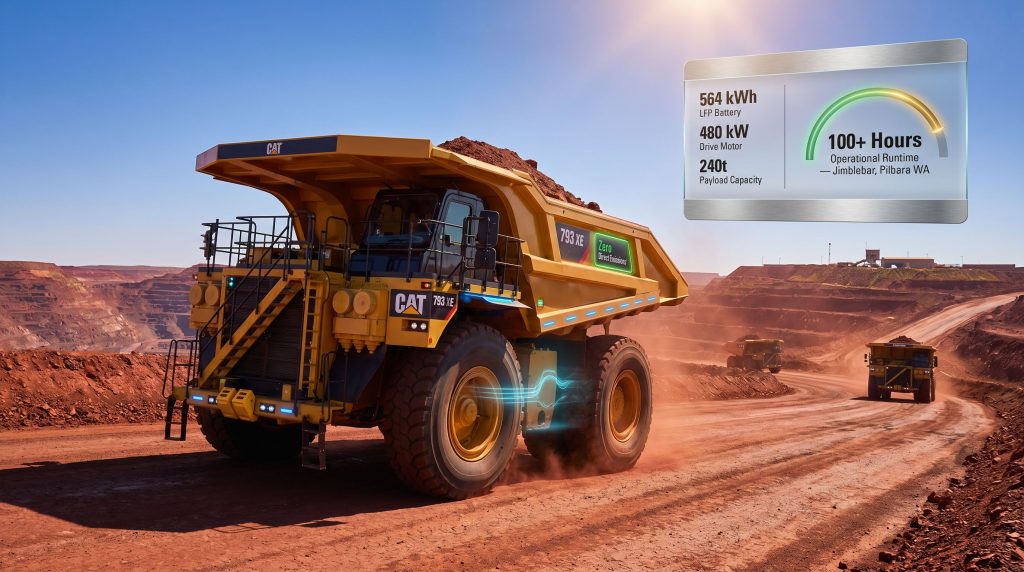
At the centre of the Jimblebar trial is the Cat 793 XE Early Learner, a purpose-built battery-electric haul truck developed by Caterpillar specifically for high-intensity open-cut mining environments. The specifications are worth examining in detail, because the engineering choices made here reflect hard trade-offs that will define the commercial viability of the platform.
| Specification | Detail |
|---|---|
| Truck Model | Cat 793 XE Early Learner |
| Payload Capacity | 240 tonnes |
| Battery System | 564 kWh lithium iron phosphate (LFP) pack |
| Drive Motor Output | 480 kW (645 hp) |
| Top Operating Speed | 38 mph, equivalent to diesel counterpart |
| Direct Emissions | Zero during operation |
| Operational Mode | Fully autonomous with remote operator integration |
Why LFP Chemistry Was the Right Call for the Pilbara
The selection of lithium iron phosphate battery chemistry over competing options such as nickel-manganese-cobalt is not incidental. LFP cells trade some energy density for substantially greater thermal stability and cycle longevity. In an environment where ambient temperatures regularly exceed 40 degrees Celsius and equipment operates continuously across multiple shifts, thermal management is not a secondary concern. It is existential.
LFP chemistry carries a significantly lower risk of thermal runaway compared to NMC alternatives, which is a critical safety consideration when the battery system is integrated into a fully autonomous 240-tonne vehicle operating without an onboard driver. The 564 kWh pack capacity represents an engineered balance between the weight penalty of additional battery mass and the energy sufficiency needed to complete full haul cycles without interruption. Furthermore, well-established battery recycling processes for LFP chemistry provide a clearer end-of-life pathway compared to some competing chemistries.
A less widely understood dimension of this trade-off is the relationship between battery weight and tyre wear. Haul truck tyres in Pilbara operations are among the most expensive consumable line items at any mine site, with individual tyres costing tens of thousands of dollars and operating lives measured in months under heavy load. Any increase in gross vehicle weight from battery mass translates directly into accelerated tyre degradation, making payload-versus-battery-size optimisation a financially material engineering decision, not merely a performance one.
Regenerative Braking: The Operational Game-Changer
The most strategically important feature of the Cat 793 XE architecture is its regenerative braking system. During downhill haul segments, the truck's drivetrain captures kinetic energy and converts it back into stored electrical charge. In haul cycle configurations optimised for gradient and distance, this mechanism can sustain battery state of charge sufficiently to enable continuous round-the-clock operation without scheduled stationary charging stops.
This capability fundamentally reframes the commercial viability question. Eliminating charging downtime was widely considered the primary barrier to battery-electric haul truck adoption in high-throughput environments. Regenerative energy recovery, when properly matched to haul profile geometry, dissolves that barrier without requiring the massive stationary fast-charging infrastructure that would otherwise be necessary.
This is not a universally applicable solution. It depends on haul road geometry delivering sufficient downhill gradient during the loaded return leg to generate meaningful regenerative recovery. Mine designs that lack this gradient profile will require alternative charging strategies. The Jimblebar trial is, in part, generating the operational data needed to quantify exactly how much regenerative recovery different haul profiles can deliver in real conditions rather than simulated ones.
How the Trial Was Structured: A Phased Operational Approach
Phase One: Proving Ground Validation in Tucson
Before either truck turned a wheel at a live mine site, both Cat 793 XE units underwent comprehensive safety validation at Caterpillar's proving ground facility in Tucson, Arizona. Controlled testing established baseline performance parameters across payload handling, speed profiles, braking behaviour, and battery management system responses under simulated operational stress. This step is standard practice for prototype-class heavy equipment but carries particular weight when the platform will subsequently operate autonomously in a live production environment.
Phase Two: Jimblebar Commissioning and Active Operations
The two trucks were delivered to BHP's Jimblebar iron ore mine in December 2025. Jimblebar was selected as the trial site due to its haul road profiles, gradient conditions, and ambient temperature ranges, which are representative of large-scale Pilbara operations generally. As of mid-2026, the trial has logged more than 100 hours of operational runtime and completed in excess of 200 test laps, generating real-world data on battery state-of-health across repeated charge-discharge cycles, energy consumption per haul cycle, regenerative recovery efficiency, and autonomous system behaviour under production-environment variability.
Caterpillar's vice-president of product management for Resource Industries has noted that testing in the Pilbara's demanding environment allows validation of both battery-electric trucks and charging infrastructure in the precise conditions that large-scale iron ore operations actually face. That distinction between proving-ground simulation and live-environment validation is commercially critical. Laboratory results may establish theoretical capability, but only field data can underwrite fleet procurement decisions at the scale BHP and Rio Tinto are contemplating.
Phase Three: Dynamic Charging Technology Evaluation
The next phase of the trial will introduce dynamic charging technology, a system designed to recharge trucks while they remain in motion during haul operations. This represents a meaningful leap beyond regenerative braking recovery, actively supplying electrical energy to the truck during transit rather than simply capturing energy from kinetic deceleration.
Successful dynamic charging validation would materially reduce the physical infrastructure burden of stationary fast-charging networks across large mine footprints. For operations where haul roads span several kilometres and trucks cycle continuously, embedding charging capability into the road surface or overhead infrastructure along sections of the haul route could eliminate the need for dedicated charging bays entirely. The capital and operational implications of this are substantial, and the Jimblebar trial is positioned to generate the first real-world performance data for this technology in a heavy mining context.
The Pre-Competitive Collaboration Model: Why Rivals Are Working Together
One of the most structurally significant aspects of the BHP Rio Tinto Caterpillar battery-electric haul truck trial is the cooperation between BHP and Rio Tinto, two companies that compete directly for market share in the global iron ore trade. Their decision to pool investment and share operational learnings from the Jimblebar trial reflects a strategic recognition that the technical and financial scale of decarbonising Pilbara haulage exceeds what any single operator can practically achieve in isolation. Indeed, Australia's iron ore dominance in global markets means the outcomes of this trial will carry implications well beyond either company's balance sheet.
Rio Tinto's Iron Ore chief executive has stated publicly that decarbonising haulage across the Pilbara is a complex challenge that will require collaboration across the industry to resolve. This framing positions the pre-competitive data-sharing arrangement not as altruism but as a rational response to a collective action problem, where the cost of independent parallel trials across multiple mine sites would be significantly higher than the cost of shared infrastructure and pooled learnings.
Despite sharing the Jimblebar trial baseline, both companies are pursuing independent OEM relationships for subsequent fleet evaluation:
| Company | Battery-Electric Truck Partner | Trial Commencement |
|---|---|---|
| BHP | Caterpillar (Cat 793 XE) | December 2025 (active) |
| Rio Tinto | Komatsu (930E variant) | 2026 (planned) |
This parallel-track approach effectively turns the Pilbara into the world's most demanding real-world testing environment for competing battery-electric haul truck platforms, with outcomes that will directly inform global mining fleet procurement for the foreseeable future.
Infrastructure: The Three Co-Dependencies That Cannot Be Ignored
Battery-electric haul truck technology does not operate in isolation. Its successful deployment at scale depends on three infrastructure systems that must develop in parallel with the trucks themselves.
1. High-Power Charging Infrastructure
- Large-format 240-tonne electric trucks require high-power charging installations capable of servicing multiple vehicles simultaneously without disrupting haul cycle throughput
- Charging station placement must be optimised within the haul circuit geometry to minimise productive time lost per charging event
- Dynamic in-motion charging, currently under evaluation at Jimblebar, could substantially reduce the physical footprint of stationary charging networks required per mine
2. Electrical Grid Capacity and Renewable Power Integration
- Replacing diesel haul fleets with battery-electric equivalents dramatically increases site-level electricity consumption, requiring grid capacity that simply does not currently exist across most Pilbara operations at the scale needed for full fleet electrification
- For Scope 1 emissions reductions to be genuine rather than displaced to Scope 2, the electricity supply must itself transition to renewable sources, whether solar, wind, or future green hydrogen-derived power
- Grid expansion and renewable energy procurement are therefore structural co-dependencies of battery-electric fleet deployment, not downstream considerations
3. Battery Supply Chain and Lifecycle Management
- Fleet-scale adoption of LFP-powered haul trucks creates material demand across lithium, iron, and phosphate supply chains, with implications for upstream mining and processing sectors
- End-of-life management for large-format mining truck battery packs, each representing hundreds of kilowatt-hours of stored capacity, presents an emerging operational and regulatory challenge that the industry has not yet fully resolved
- Second-life battery applications and recycling partnerships will become increasingly important components of total cost of ownership modelling as fleet transition accelerates
The next major ASX story will hit our subscribers first
Powertrain Technology Comparison: Where Battery-Electric Sits in the Field
Understanding the competitive landscape among powertrain alternatives helps clarify why battery-electric has emerged as the preferred near-term pathway despite its infrastructure demands. In addition, examining the full range of hydrogen haul truck alternatives reveals why battery-electric technology currently holds the practical edge in Pilbara deployment scenarios.
| Powertrain Type | Emissions Profile | Operational Continuity | Infrastructure Complexity | Commercial Maturity |
|---|---|---|---|---|
| Diesel (conventional) | High Scope 1 | Continuous | Low (established) | Fully mature |
| Battery-Electric (BEV) | Zero direct | High with regen recovery | Moderate to High | Early commercial |
| Hydrogen Fuel Cell | Zero direct | Moderate | Very High | Pre-commercial |
| Diesel-Electric Hybrid | Reduced | Continuous | Low to Moderate | Commercially available |
| Trolley-Assist Electric | Low direct | High (fixed routes) | High (fixed catenary) | Commercially available |
Hydrogen fuel cell trucks offer comparable emissions outcomes but face significantly greater infrastructure complexity in remote Pilbara locations, where hydrogen supply chains do not yet exist at the required scale. Trolley-assist systems require permanent overhead catenary infrastructure tied to fixed haul road alignments, which are fundamentally incompatible with the dynamic pit configurations typical of large open-cut operations. Battery-electric platforms, leveraging rapidly maturing LFP chemistry and improving regenerative recovery, represent the most operationally adaptable solution available in the near term. Broader mining electrification trends further reinforce this direction across the industry.
Strategic and Investor Implications: What Successful Outcomes Would Unlock
The Jimblebar trial is not simply a technology demonstration exercise. It is the foundational data-collection programme upon which consequential financial and operational decisions will subsequently be built. Mining companies that successfully validate and scale battery-electric haulage ahead of carbon pricing escalation or regulatory mandate carry a structural cost advantage in future operating environments, particularly as carbon border adjustment mechanisms and ESG scrutiny of Scope 1 emissions intensify pressure on major resource producers.
Early technology adoption also positions BHP and Rio Tinto to actively shape OEM product development roadmaps, ensuring that next-generation battery-electric platforms are optimised for Pilbara-specific operating conditions. Furthermore, Reuters has reported on the broader significance of this trial as a bellwether for the global mining industry's decarbonisation trajectory. This influence over the technology development cycle is itself a meaningful competitive asset.
From an investor perspective, the BHP Rio Tinto Caterpillar battery-electric haul truck trial signals that haulage electrification has moved from strategic aspiration to operational testing. The key milestone sequence that will define the transition timeline includes:
- Near-term (2026 to 2027): Completion of dynamic charging evaluation and accumulation of battery degradation data sufficient to model total cost of ownership at fleet scale
- Medium-term (2028 to 2032): Potential first commercial fleet procurement decisions contingent on validated trial outcomes, with parallel infrastructure investment decisions for charging networks and renewable power
- Long-term (post-2032): Progressive diesel fleet replacement as existing trucks reach end-of-service life, with battery-electric platforms becoming the default for new haul capacity additions
Disclaimer: Timeline projections and technology adoption pathways described above involve inherent uncertainty. Actual outcomes depend on battery technology advancement, infrastructure investment decisions, regulatory frameworks, and operational trial results that remain subject to change. This article does not constitute financial advice.
Frequently Asked Questions
What is the Cat 793 XE Early Learner?
The Cat 793 XE Early Learner is a 240-tonne fully autonomous battery-electric haul truck developed by Caterpillar, equipped with a 564 kWh lithium iron phosphate battery pack and a 480 kW electric drive motor. It is engineered to deliver performance equivalent to conventional diesel-powered haul trucks while producing zero direct exhaust emissions during operation.
Where is the BHP Rio Tinto Caterpillar battery-electric haul truck trial taking place?
The trial is being conducted at BHP's Jimblebar iron ore mine in the Pilbara region of Western Australia. Trucks were delivered to site in December 2025 following safety validation at Caterpillar's Tucson, Arizona proving ground.
How does the truck manage battery charge during operations?
The primary energy management mechanism is regenerative braking, which captures kinetic energy during downhill haul segments and converts it back into stored battery charge. In haul cycle configurations with adequate gradient profiles, this can sustain continuous operation without scheduled stationary charging stops. An upcoming trial phase will evaluate dynamic in-motion charging as a supplementary and potentially primary charging solution.
Will Rio Tinto trial battery-electric trucks independently?
Yes. Following the joint Jimblebar programme, Rio Tinto plans to independently trial Komatsu 930-series battery-electric haul trucks at its own Pilbara operations from 2026 onwards, creating a parallel evaluation of competing OEM platforms against a shared operational baseline.
Want to Know Which ASX Mining Companies Are Leading the Electrification Revolution?
Discovery Alert's proprietary Discovery IQ model scans ASX announcements in real time, delivering instant alerts on significant mineral discoveries — including the lithium, iron, and phosphate resources that will underpin the next generation of battery-electric mining infrastructure. Explore historic discoveries and their exceptional market returns, then begin your 14-day free trial to position yourself ahead of the market.