May 13, 2026
The Uncomfortable Truth About Being the World's Battery Cupboard
There is a persistent assumption in Australian industrial policy circles that sitting atop some of the world's most critical mineral reserves automatically confers strategic advantage in the energy transition. The logic seems intuitive: lithium from Western Australia, manganese from Queensland and the Northern Territory, cobalt deposits scattered across multiple states. Surely a nation this well endowed with battery raw materials is positioned to capture significant value from the global shift toward electrification.
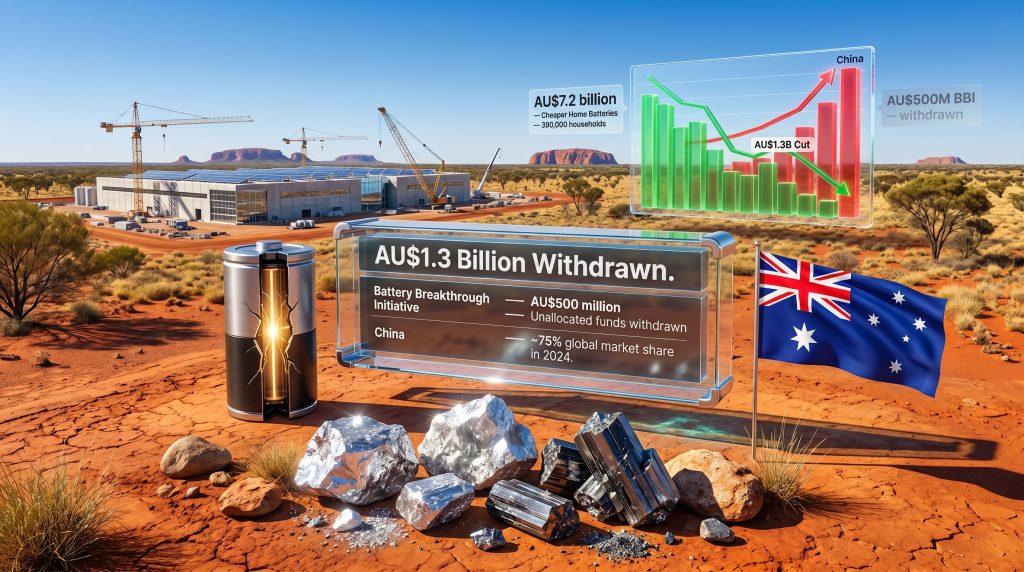
The 2025-26 Federal Budget has delivered a pointed rebuttal to that assumption. By withdrawing unallocated funding from the Battery Breakthrough Initiative, scaling back commitments to Solar Sunshot, and restructuring the Hydrogen Headstart program, the Australian government cuts funding for domestic battery manufacturing have revealed a structural preference for demand-side energy policy over supply-side industrial development. This shift comes at precisely the moment when the global battery manufacturing race is entering its most consequential phase.
Understanding why this matters requires stepping back from the budget line items and examining what is actually being competed for, and what Australia stands to lose if it remains a raw materials exporter while the rest of the world builds the factories.
When big ASX news breaks, our subscribers know first
What the 2025-26 Federal Budget Actually Did to Battery Manufacturing
The headline figure is AU$1.3 billion in cumulative savings across three flagship renewable energy programs over a ten-year horizon. However, the composition of those cuts tells a more nuanced story than a single number can convey.
Breaking Down the Program Changes
| Program | Original Commitment | 2025-26 Budget Outcome |
|---|---|---|
| Battery Breakthrough Initiative (BBI) | AU$500 million | Unallocated funds withdrawn |
| Solar Sunshot | AU$1 billion | Uncommitted funding pulled |
| Hydrogen Headstart | AU$2 billion | Structural changes announced |
| Powering the Regions Fund | Ongoing | AU$93.8 million cut over 2 years |
| Regional Hydrogen Hubs | Ongoing | AU$78.6 million cut over 4 years |
Beyond this AU$1.3 billion reduction, more than AU$600 million in additional cuts affects a range of other clean energy and climate solutions initiatives, deepening the cumulative impact on Australia's manufacturing ambitions.
A critical distinction in how these cuts have been framed is the term unallocated or uncommitted funding. This refers to money that had been appropriated by parliament but not yet distributed to specific project recipients. Funds already awarded to companies before the budget decision remain intact. The distinction matters enormously for understanding the policy mechanics: the government is not clawing back grants already made, but it is shutting the pipeline of future support.
For the BBI specifically, this means that only a fraction of the AU$500 million was ever deployed. Two confirmed recipients received funding before the programme's closure:
- PowerPlus Energy (Victoria): Awarded AU$2.3 million to support plans to triple annual battery module production capacity to 150 MWh by 2026-27
- Firebird Metals (Perth): Awarded AU$2 million to develop a demonstration-scale facility processing manganese concentrate into cathode materials for batteries
The arithmetic is sobering. Approximately AU$4.3 million of the AU$500 million was distributed before the programme closed, meaning roughly AU$495.7 million in unallocated funding is being redirected elsewhere. The gap between intention and execution is stark.
What the Budget Kept: Consumer Energy Policy Survives Intact
Not everything in the clean energy portfolio was cut. The Cheaper Home Batteries programme retains AU$7.2 billion over the forward estimates and has already delivered measurable outcomes. Within just eleven months of operation, the programme facilitated battery storage installations in more than 390,000 Australian homes, adding over 10 GW of renewable capacity to the national electricity grid.
However, as research from UNSW highlights, most of these home battery subsidies have disproportionately benefited wealthier households, raising questions about the equity and broader social effectiveness of demand-side energy subsidies.
The government also committed AU$97.2 million over five years to continue implementing the National Consumer Energy Resources Roadmap, including AU$71.8 million in the current budget to establish a National Technical Regulator. This body will be responsible for setting technical standards to support the integration of solar, batteries, and electric vehicles into the National Electricity Market.
The Structural Problem: Demand-Side versus Supply-Side Industrial Policy
The contrast between what was cut and what was retained reveals a fundamental orientation in Australian energy policy. Consumer subsidies for home batteries remain well-funded. Manufacturing grants for the companies that make those batteries have been wound back.
This is not merely a question of fiscal preference. It represents a structural decision with compounding consequences. When the Australian government cuts funding for domestic battery manufacturing while maintaining demand-side subsidies, it effectively accelerates the market for imported battery products. Every household battery system installed under the Cheaper Home Batteries programme represents a purchasing decision. If domestic manufacturing capability does not exist or cannot compete on price, that purchasing decision flows to offshore suppliers.
Furthermore, consideration of the battery raw materials market makes this tension even more apparent — Australia exports the inputs but imports the finished goods, surrendering the most valuable steps of its own resource chain.
"The distinction between supporting battery consumers and supporting battery manufacturers is the difference between building a market and building an industry. One generates demand; the other generates capability."
In the short term, consumer subsidies are politically popular and economically measurable. In the medium term, they can inadvertently cement dependency on foreign manufacturing, particularly when the dominant global supplier holds approximately 75% of global battery production capacity.
What the Battery Breakthrough Initiative Was Designed to Do
Launched in August 2025 and administered by the Australian Renewable Energy Agency (ARENA), the BBI was structured around a recognition that Australia's battery industry faced capability gaps across the entire value chain. It was not simply a manufacturing subsidy; it was a targeted industrial development instrument designed to address specific structural absences in Australia's clean energy sector.
The initiative covered three key areas of the battery value chain:
- Advanced materials processing: Converting raw mineral inputs like manganese, lithium, and cobalt into battery-grade intermediary materials
- Battery cell production: Manufacturing finished electrochemical cells from processed materials
- Battery pack assembly: Integrating cells into complete systems for domestic and commercial use
The rationale for this structure reflects an important technical reality about battery manufacturing that is rarely discussed publicly. The value in a battery supply chain is not distributed evenly. Raw ore extraction captures a relatively small share of the final product value. Battery-grade materials processing captures significantly more. Cell manufacturing captures the largest share of all. A country that exports ore and imports finished batteries is, in economic terms, giving away the most valuable steps of its own resource chain.
Firebird Metals' work on converting manganese concentrate into cathode materials sits precisely at this intermediate processing stage. It is the kind of capability that is essential for Australia to progress from a minerals supplier to a genuine participant in battery manufacturing. The fact that a AU$2 million demonstration grant represents one of the only funded steps in this direction underscores how nascent this capability actually is.
Australia's Strategic Position in a Global Context
To properly assess the significance of these budget decisions, it is necessary to understand the competitive environment Australia is operating in. In addition, understanding the broader battery metals investment landscape helps contextualise how global capital is flowing — and how Australia risks missing out.
The Global Battery Manufacturing Landscape in 2025-26
| Region | Policy Architecture | Observed Outcomes |
|---|---|---|
| China | State-directed industrial strategy, vertically integrated supply chains, domestic content focus | Approximately 75% of global battery supply in 2024 (IEA, March 2025) |
| United States | Inflation Reduction Act production tax credits, domestic content requirements | Significant gigafactory expansion activity across multiple states |
| European Union | Net-Zero Industry Act, European Investment Bank financing frameworks | Mixed results; several manufacturers facing viability challenges |
| Australia | Grant-based programmes, now partially withdrawn | Nascent industry base, growing policy uncertainty |
The International Energy Agency's March 2025 assessment confirmed that China supplied approximately three-quarters of a 1 TWh global battery market in 2024. Importantly, the IEA also noted that China's dominance enabled steep cost savings and facilitated a widespread transition toward lithium ferro-phosphate (LFP) technology, which now represents the dominant chemistry in stationary storage and increasingly in vehicle applications.
LFP batteries are technically significant for Australia because their primary active cathode materials include iron and phosphate rather than cobalt and nickel, while still utilising lithium. This chemistry shift is one reason why Australia's manganese resources have attracted growing attention: high-purity manganese sulphate is a critical precursor for next-generation LMFP cathode formulations, which promise higher energy density than standard LFP. The Firebird Metals project sits directly in this technical context.
The Morrow Batteries Warning
The May 2026 bankruptcy filing by Norway's Morrow Batteries provides a sobering reference point for the difficulty of establishing battery manufacturing outside China's industrial ecosystem. Despite having product development successes, the company succumbed to a deteriorating liquidity position, reflecting the fundamental challenge that faces Western manufacturers: competing on cost against producers whose scale, supply chain integration, and capital access have been built over decades of state-coordinated industrial development.
This does not mean battery manufacturing outside China is impossible. It does mean that the cost of entry is high, the timeline is long, and the policy support required needs to be sustained and predictable rather than cyclical.
What Industry and Investors Are Saying
The Smart Energy Council, which assessed the 2025-26 budget as broadly positive for renewable energy deployment, specifically identified the withdrawal of BBI and Solar Sunshot funding as a disappointing outcome for domestic manufacturing and critical energy infrastructure investment. The SEC's assessment reflects a tension within the budget itself: supporting energy consumption while pulling back from energy production capability.
More pointed criticism came from the Investor Group on Climate Change (IGCC), which represents superannuation funds and retail investment managers with more than AU$4.5 trillion in assets under local management. The IGCC characterised the budget as sending mixed messages to investors and raised explicit concern about the risk of investment capital moving to other jurisdictions with clearer and more durable policy signals.
"Institutional investors making multi-decade infrastructure and manufacturing commitments require policy certainty above almost any other factor. When a AU$500 million programme is launched in August 2025 and its unallocated funds are withdrawn by the following budget cycle, the message received by capital markets is about programme durability, not just programme scope."
This concern is not abstract. The capital expenditure required to establish meaningful battery cell manufacturing capacity runs into hundreds of millions of dollars per facility. Investment decisions of that magnitude require confidence that the policy framework supporting them will remain stable across multiple electoral cycles.
The next major ASX story will hit our subscribers first
The Federal-State Divide Compounds the Problem
Federal policy uncertainty does not exist in isolation. Queensland's withdrawal of AU$105 million from the Australian Battery Industrialisation Centre compounds the signal being sent to domestic and international investors. When both levels of government appear to be retreating from manufacturing investment commitments, the cumulative effect on industry planning horizons is significant.
Companies making decisions about where to locate manufacturing facilities, processing plants, or research and development operations assign considerable weight to government policy consistency. A pattern of pledges announced and subsequently reversed creates a risk premium that makes Australian locations less competitive relative to jurisdictions offering more durable policy frameworks. Australia's critical minerals strategy faces similar challenges in this regard, as policy inconsistency undermines the long-term investment signals the sector requires.
The Policy Contradictions Within Australia's Own Strategy Documents
The 2025-26 budget cuts sit in uncomfortable tension with other active commitments that remain in place.
| Policy Commitment | Value | Current Status |
|---|---|---|
| Future Made in Australia Innovation Fund (clean energy manufacturing) | AU$1.7 billion | Active |
| Building Future Battery Capabilities programme | AU$20.3 million | Active |
| Australian Made Battery Precinct (scaling target) | AU$100 million | Planned |
| Battery Breakthrough Initiative | AU$500 million | Unallocated funds withdrawn |
Australia's National Battery Strategy, which sets ambitious targets for a scaled domestic manufacturing sector by 2035, remains an active policy document. However, the coherence between that strategy's long-term goals and near-term budget decisions is difficult to establish. The remaining active programmes are significantly smaller in scale than the BBI was designed to be, and the 2035 target represents a nine-year horizon that requires sustained capital commitment beginning now, not deferred to future budget cycles.
Frequently Asked Questions
What is the Battery Breakthrough Initiative and has it been cancelled?
The Battery Breakthrough Initiative was a AU$500 million programme launched in August 2025, administered by ARENA, designed to support domestic battery manufacturing across the full value chain. The 2025-26 Federal Budget withdrew all unallocated funding from the programme, effectively ending its operation. Funding already distributed to recipients, such as PowerPlus Energy and Firebird Metals, remains in place.
How much has the Australian government cut from renewable energy programmes in 2025-26?
The budget confirmed AU$1.3 billion in cumulative savings across the BBI, Solar Sunshot, and Hydrogen Headstart programmes over a ten-year period, alongside more than AU$600 million in cuts to other clean energy initiatives.
Does the Cheaper Home Batteries programme still have government support?
Yes. The Cheaper Home Batteries programme retains AU$7.2 billion over the forward estimates and is considered one of the budget's clean energy priorities.
What is Australia's National Battery Strategy and is it still active?
Australia's National Battery Strategy is a government policy framework targeting a scaled domestic battery manufacturing sector by 2035. It remains active as a policy document, though the budget decisions of 2025-26 have raised questions about near-term execution. Furthermore, Australia's lithium tax breaks and other incentive structures will need to compensate if manufacturing ambitions are to remain credible.
What is the difference between the BBI and the Cheaper Home Batteries programme?
The BBI was a supply-side industrial development programme targeting battery manufacturers and materials processors. The Cheaper Home Batteries programme is a demand-side consumer subsidy supporting household battery storage purchases. The two programmes addressed fundamentally different parts of the battery economy.
Three Scenarios for Australia's Battery Manufacturing Future
Scenario A: Policy Recalibration
The government uses remaining active programmes, particularly the Future Made in Australia Innovation Fund and the Australian Made Battery Precinct, to implement more targeted and commercially structured support mechanisms. Rather than broad grant programmes, future policy tools focus on production tax credits, co-investment structures, and long-term offtake certainty. This approach would more closely resemble the US Inflation Reduction Act model and could attract serious private capital into the manufacturing sector.
Scenario B: Continued Retreat
Without renewed manufacturing investment commitments, Australia's battery industry remains confined to raw materials extraction and limited demonstration-scale processing. The 2035 National Battery Strategy targets become aspirational rather than operational, and Australia's participation in the global battery value chain is structurally limited to the least value-additive segments.
Scenario C: State-Federal Realignment by 2027
A coordinated industrial policy framework emerges between federal and state governments, potentially driven by the commercial success of early BBI recipients demonstrating viable domestic manufacturing models. This scenario requires political alignment across multiple jurisdictions and a willingness to recommit capital after the current budget consolidation cycle. Establishing a critical minerals strategic reserve could form one pillar of such a realignment, providing greater supply chain certainty for downstream manufacturers.
Disclaimer: The scenarios above represent analytical projections based on current policy settings and publicly available information. They are not investment advice and should not be treated as predictions of specific government policy outcomes. Investors and companies should conduct independent analysis before making decisions based on future policy assumptions.
The Deeper Question Australia Must Answer
The core tension in Australia's position is not difficult to describe, even if it is politically complex to resolve. A country that possesses the raw materials for battery manufacturing, the existing renewable energy infrastructure to power clean production, and an educated technical workforce capable of operating advanced manufacturing facilities is choosing, through its budget decisions, to remain primarily a supplier of inputs to other countries' industries.
The global battery manufacturing race will not pause while Australia decides whether industrial policy is worth the fiscal commitment. China's 75% market share was not achieved by accident or by market forces alone. It was the product of decades of coordinated industrial investment. The United States is now attempting to build a competitive manufacturing base through the IRA, committing hundreds of billions of dollars to domestic production incentives. Europe is learning painful lessons about the cost of under-investment, with Morrow Batteries' bankruptcy the latest in a series of cautionary examples.
For Australia, the window to develop meaningful battery manufacturing capability is not permanently open. The decisions made in the 2025-26 budget, and in the state-level reversals that accompanied them, represent a genuine inflection point. Consequently, whether that inflection point ultimately leads to a more focused and commercially credible industrial policy — or to a longer-term retreat from manufacturing ambition — will shape how the Australian government cuts funding for domestic battery manufacturing is remembered, and what it ultimately costs the nation in lost industrial value for decades to come.
Want To Track The ASX Mineral Discoveries Powering The Battery Revolution?
Discovery Alert's proprietary Discovery IQ model delivers real-time alerts on significant ASX mineral discoveries — including the lithium, manganese, and cobalt plays central to the global battery supply chain — turning complex geological announcements into actionable investment insights. Explore how historic mineral discoveries have generated substantial returns and begin your 14-day free trial today to position yourself ahead of the broader market.