May 13, 2026
The Geology That Should Have Changed Everything
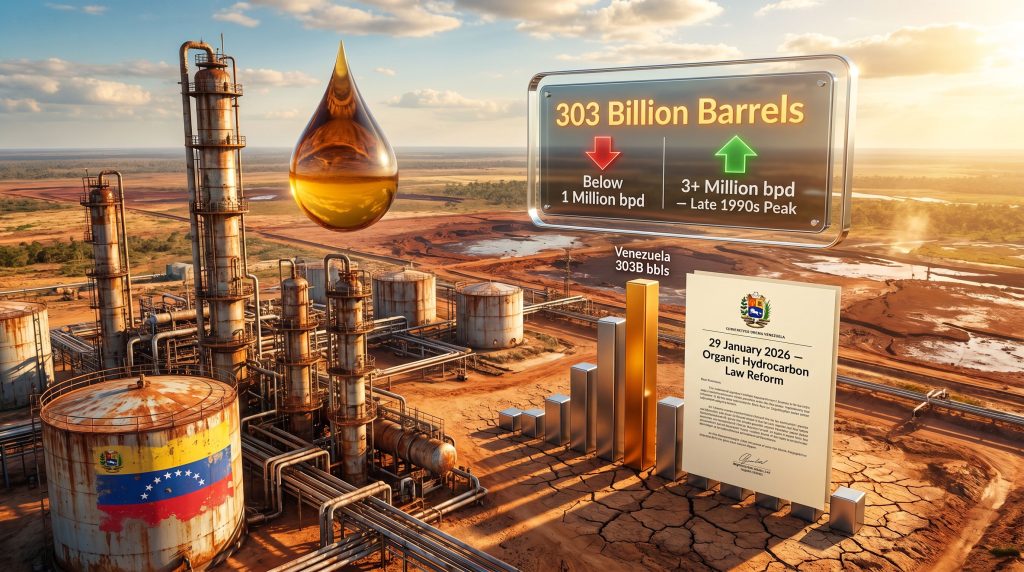
Few resource endowments in petroleum history have generated as much theoretical excitement and practical disappointment as Venezuela's. The country sits atop a geological phenomenon that defies easy comparison: an estimated 303 billion barrels of proven oil reserves, representing roughly 17% of total global crude supply, the majority of which is concentrated in the Orinoco Belt, a vast sedimentary basin stretching across the central plains of the country. Venezuela oil investment uncertainty, however, continues to cast a long shadow over this immense potential.
Yet production has collapsed to below 1 million barrels per day, a figure that represents less than a third of the 3+ million barrels per day the country was producing in the late 1990s. This is not a geological failure. It is an institutional one, and understanding that distinction is central to understanding the challenge investors face today.
When big ASX news breaks, our subscribers know first
Understanding the Orinoco Belt: Why Extra-Heavy Crude Changes the Economics
The Orinoco Belt is not a conventional oil deposit. Its reserves consist predominantly of extra-heavy crude, a high-viscosity hydrocarbon with a density typically below 10 degrees API. Unlike light crude, which flows readily and can be transported and refined with standard infrastructure, extra-heavy Orinoco crude behaves more like thick bitumen under reservoir conditions. It requires either blending with lighter diluents or processing through dedicated upgrading facilities that convert it into a synthetic crude grade exportable to international refineries.
This technical reality has significant economic implications:
- Upgrader construction and rehabilitation costs are capital-intensive, often requiring billions of dollars per facility
- Extra-heavy crude has a lower market value per barrel than benchmark grades until upgraded
- Field operations require continuous power supply to sustain injection and extraction systems, creating vulnerability to Venezuela's chronic electricity infrastructure problems
- The upgrading process generates substantial CO2 emissions, which adds a long-term regulatory dimension for investors with ESG commitments
Despite these challenges, the sheer volumetric scale of the Orinoco Belt means the resource base still represents one of the most significant untapped petroleum prizes on earth. As Maria Angela Capello, president at Red Tree Consulting and a participant in the How US Energy Companies Are Sizing Up Venezuela's Revival executive dialogue at the Offshore Technology Conference 2026, described it, Venezuela occupies a position that combines the scale of a frontier discovery with the development characteristics of a large, mature brownfield asset.
There is no comparable opportunity in global petroleum today in terms of the combination of reserve scale, infrastructure presence, and development upside. The challenge is not whether the resource justifies investment, but whether the institutional environment can justify the capital.
The January 2026 Law Reform: What Actually Changed
Following the removal of Nicolás Maduro from power, Venezuela enacted a reform to its Organic Hydrocarbon Law on 29 January 2026. The amendment represented a structural departure from the legal framework that had governed upstream petroleum for over two decades.
Before the reform, Venezuelan law required the state oil company, PDVSA, to maintain a controlling equity stake in all upstream joint ventures. This mandatory state-majority requirement effectively capped private capital participation and limited the degree to which international operators could exercise operational control over projects. Under the reformed framework, private parties are now legally permitted to participate in upstream exploration, production, and transportation without automatic state equity dominance.
On paper, this is a significant shift. In practice, the reform leaves several critical architectural elements unresolved:
| Reform Element | Current Status |
|---|---|
| Standardised contract model templates | Not yet issued by the oil ministry |
| Tax legislation alignment | Pending, creating regulatory uncertainty |
| US sanctions compliance framework | No formal guidance issued |
| First commercial transaction completed | None executed under the new law |
| Dispute resolution mechanism testing | Entirely untested |
Ted Borrego, energy law professor at the University of Houston Law Centre and co-panelist at the OTC 2026 dialogue, framed this gap with unusual candour. His assessment was that the absence of completed transactions means the law's practical operation remains entirely unknown, even to Venezuelan legal professionals. He stated plainly that local lawyers working in the jurisdiction face the same interpretive uncertainty as international counsel, because no commercial precedent yet exists under the reformed framework.
This creates a particularly difficult problem for capital allocation. Investors in long-duration petroleum projects do not simply need a favourable law. They need a tested legal architecture with demonstrated enforcement, predictable tax treatment, and a track record of consistent application across political administrations. Furthermore, the broader geopolitical risk landscape continues to shape how international capital approaches this market.
Venezuela Oil Investment Uncertainty: The Four-Layer Risk Framework
Experienced upstream investors evaluating Venezuelan opportunities are not assessing a single risk. They are navigating a compounded structure where multiple distinct risk categories interact and amplify each other. Understanding each layer independently is necessary before considering how they compound.
Layer 1: Legal System Risk
The January 2026 hydrocarbon law reform is a legislative signal, not a commercial guarantee. Until the first transaction is executed, priced, and enforced under the new framework, investors have no empirical basis for understanding how contract terms will be interpreted, how disputes will be resolved, or how regulatory discretion will be exercised. This is not unusual in post-transition markets, but it is a genuine constraint on capital deployment.
Layer 2: Political Governance Risk
Following Maduro's removal, the political landscape in Venezuela has not resolved into a clear democratic trajectory. Maduro loyalist Delcy Rodriguez currently serves as the country's political head, reportedly with US backing, while US President Donald Trump declared that the United States would take on a governing role in Venezuela. When free and fair elections might be held, and under what constitutional framework, remains undefined. For investors structuring 20-to-30-year capital programmes, an undefined governance timeline represents a fundamental planning constraint.
Layer 3: Sanctions and Geopolitical Risk
Venezuela's energy sector carries a long and complex history of US sanctions exposure. Even under a nominally pro-investment political arrangement, the risk of abrupt policy shifts in Washington is a live variable that operators must account for across the full duration of capital deployment. The US policy on PDVSA remains a central variable in this equation, and major integrated oil companies including Shell have publicly indicated that they require sustained and formally documented sanctions clarity before committing new upstream capital.
Layer 4: Expropriation and Contract Enforcement Risk
ExxonMobil's experience in Venezuela is among the most frequently cited case studies in international petroleum investment risk. The company experienced asset expropriation on two separate occasions under the Chávez-era nationalisation programme, and ExxonMobil's leadership has characterised the current Venezuelan investment environment as uninvestable without deep structural reform. This institutional memory of broken contracts and forced renegotiations shapes risk appetite at the board level across the major integrated operators.
Who Is Actually Positioned to Move First
The investor universe for Venezuela is not monolithic. Different capital categories carry different risk tolerances, exit optionality, and return requirements. Understanding which investors are structurally capable of engaging ahead of full legal clarity is essential for mapping the realistic near-term investment trajectory.
| Investor Category | Near-Term Entry Likelihood | Primary Motivation |
|---|---|---|
| Existing operators with legacy positions | High | Protect sunk costs, optimise current assets |
| Oilfield services companies | Moderate to High | Equipment and service contracts carry lower sovereign exposure |
| US independent E&P companies | Moderate | Higher risk tolerance, potentially higher return thresholds |
| Private capital and distressed asset funds | Moderate | Discounted asset pricing may justify exposure |
| Major integrated IOCs (ExxonMobil, Shell, BP) | Low | Governance and sanctions clarity required first |
| Chevron | Low to Moderate | Currently focused on optimising existing operations |
The distinction between service company exposure and operator-level equity exposure is strategically significant. Oilfield services firms providing equipment, drilling services, or engineering support operate under contracts with shorter durations, clearer exit provisions, and no direct balance sheet exposure to reserve valuations or production economics. This structural difference makes them capable of engaging in Venezuela ahead of the legal and governance clarity that equity operators require.
Capello's assessment at OTC 2026 reflected this tiered engagement model. She indicated that near-term opportunities are already being evaluated, with the implication that early movers are likely to be service-oriented or positioned in existing ventures, rather than new greenfield equity entrants from major IOCs. Consequently, commodity market volatility will also influence which capital pools are willing to act earliest.
The $100 Billion Infrastructure Problem
Venezuela's production collapse is not simply a function of policy. Decades of underinvestment, political interference in PDVSA's operational management, and the systematic emigration of skilled petroleum engineers and technicians have left the physical infrastructure of the Venezuelan oil industry in severe disrepair. Any credible revitalisation programme must address:
- Pipeline network reconstruction across the Orinoco Basin, where corrosion and neglect have degraded transportation capacity
- Heavy crude upgrader rehabilitation, the single most capital-intensive component of the Orinoco production chain
- Refinery restoration across a network that processed significantly higher volumes two decades ago
- Power infrastructure investment, as chronic electricity shortages directly constrain field operations and injection systems
- Workforce reconstruction, addressing a generational gap in petroleum engineering expertise created by emigration
Industry estimates place the total capital requirement for meaningful production restoration at approximately $100 billion, with investment returns spread across 20 to 30 year horizons. This duration profile is critical because it amplifies every dimension of political, legal, and sanctions risk. A capital decision made today carries exposure not just to the current administration's policies, but to every political transition that may occur over the next three decades.
The core investor demand is not simply a favourable law on the books. It is the credible expectation that the legal framework will remain enforceable, consistent, and resistant to politically motivated reversal across multiple administrations and geopolitical cycles.
This is precisely what Borrego articulated at OTC 2026. His position was that investors require the general legal framework to be established and demonstrably durable, not just legislatively enacted. In addition, legal uncertainty surrounding contract enforcement continues to deter the scale of capital commitment the sector requires.
The next major ASX story will hit our subscribers first
Venezuela vs. Comparable Frontier Oil Markets
Contextualising Venezuela's risk-return profile against comparable frontier and emerging market petroleum jurisdictions helps clarify where it sits on the global investment opportunity spectrum.
| Market | Reserve Scale | Political Risk | Legal Framework Maturity | Sanctions Exposure | IOC Appetite |
|---|---|---|---|---|---|
| Venezuela | Very High | Very High | Low, untested | High | Low to Moderate |
| Iraq | High | High | Moderate | Low | Moderate to High |
| Libya | Moderate | Very High | Low | Low | Low to Moderate |
| Guyana | Moderate | Low | High | None | Very High |
| Nigeria | High | Moderate to High | Moderate | None | Moderate |
Venezuela's reserve position is unmatched in this comparison. However, its composite risk score, combining legal immaturity, political instability, workforce deterioration, and sanctions history, places it at the most challenging end of the frontier investment spectrum even relative to other complex jurisdictions. Guyana represents a useful contrast: a smaller reserve base but a stable governance framework, clear contract models, and functioning dispute resolution, resulting in dramatically higher IOC engagement.
Three Scenarios for Venezuelan Oil's Future
The following scenario analysis is speculative and intended for informational purposes only. It does not constitute investment advice. Actual outcomes will depend on political, legal, and macroeconomic factors that are inherently unpredictable.
Scenario A: Stalled Transition (Base Case)
Legal and political uncertainty persists through 2027-2028. No standardised contract templates are issued, the first commercial transaction under the new law remains uncompleted, and major IOCs maintain their current posture. Production stays below 1 million barrels per day. Global market impact is negligible.
Scenario B: Partial Opening (Moderate Case)
The first transactions are completed under the new hydrocarbon framework by late 2026. US independents, services companies, and existing operators lead early-stage engagement. Production recovers toward 1.5 to 2 million barrels per day within three to five years. Global market impact is modest, with some downward pressure on medium-grade crude spreads. Furthermore, shifting crude oil price trends will shape how quickly international capital responds to early commercial signals.
Scenario C: Full Revitalisation (Optimistic Case)
A credible democratic transition is established, a formal US sanctions framework is resolved, and major IOC capital begins deploying post-2027. Production trajectory moves toward 3+ million barrels per day over a 10 to 15 year horizon. Analysis from financial institutions including UBS suggests this scenario could produce structurally lower global oil prices as Orinoco Belt supply enters markets at scale. Any resulting oil price rally would consequently affect the broader calculus for both investors and producing nations.
The Confidence Threshold That Preconditions Everything
Both expert perspectives presented at OTC 2026 converged on a single underlying principle despite their differences in near-term optimism. Legal architecture must demonstrably protect investor interests over the long term, not just in statute but in commercial practice, before capital at the scale Venezuela requires can be mobilised.
The preconditions checklist before major investment flows can realistically begin includes:
- Standardised contract models issued and validated by the oil ministry
- Tax legislation harmonised with the reformed hydrocarbon framework
- US sanctions clarity established through formal licences or a defined regulatory pathway
- A credible democratic governance roadmap with an election timeline
- The first commercial transaction completed under the new law to establish legal precedent
- Dispute resolution mechanisms tested and demonstrated to function independently of political influence
- Financing structures developed for multi-decade capital programmes in a high-risk jurisdiction
Until these conditions are met, Venezuela oil investment uncertainty ensures that the country's 303 billion barrel reserve base remains, in practical terms, stranded capital. The gap between geological abundance and investable opportunity is bridged not by legislation alone, but by the sustained institutional credibility that turns a new law into a functioning commercial framework. That credibility, as of mid-2026, has yet to be established.
This article is intended for informational purposes only and does not constitute financial or investment advice. Readers should conduct independent due diligence before making any investment decisions related to the Venezuelan petroleum sector or related securities.
Want To Stay Ahead Of The Next Major Resource Discovery?
While Venezuela's stranded 303 billion barrel reserve base illustrates how geology alone never guarantees returns, Discovery Alert's proprietary Discovery IQ model scans the ASX daily to deliver real-time alerts on significant mineral discoveries — instantly translating complex data into actionable opportunities for investors at every experience level. Explore historic discoveries and their extraordinary returns, then begin your 14-day free trial at Discovery Alert to position yourself ahead of the market.