May 13, 2026
The Diplomatic Choreography Behind High-Stakes Trade Summits
When two rival superpowers sit down to negotiate, the venue itself carries meaning. Neutral ground has long served as the preferred staging post for great-power diplomacy, offering each side the ability to engage without the optics of concession that a visit to the other's capital implies. In the context of US-China relations, where every symbolic gesture is parsed by financial markets, domestic political audiences, and allied governments simultaneously, the choice of where to talk matters almost as much as what is said.
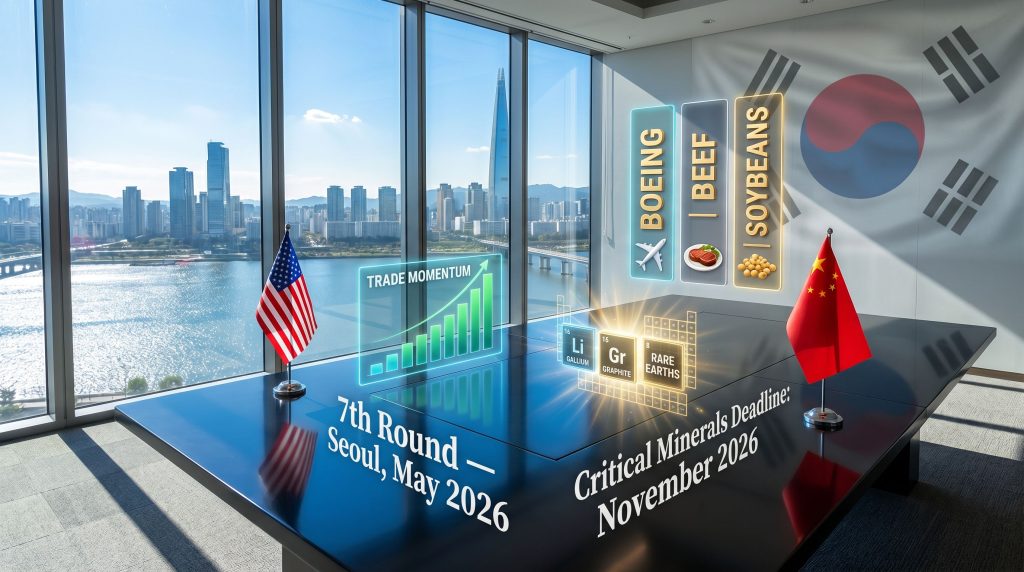
The ongoing China-US trade talks in Seoul represent more than a pre-trip formality. They form the seventh and most consequential chapter in a negotiating arc that began when tariff escalation reshaped the bilateral trade relationship and set off a chain of diplomatic responses that continues to define global economic policy in 2026.
When big ASX news breaks, our subscribers know first
Why Seoul Functions as a Strategic Diplomatic Stage
South Korea occupies an unusual position in the Asia-Pacific power structure. It maintains deep security ties with the United States while sustaining substantial economic interdependence with China. That dual exposure makes Seoul a politically acceptable venue for both Washington and Beijing, a city neither side can credibly accuse the other of favouring.
The practical logic reinforces the symbolic. Incheon International Airport, where both delegations arrived around noon on Wednesday Seoul time, sits within a short flight of Beijing, making the geographic sequencing of the talks straightforward: Seoul for final alignment, then Beijing for the summit itself.
South Korean President Lee Jae Myung received separate courtesy calls from both US Treasury Secretary Scott Bessent and Chinese Vice-Premier He Lifeng on the morning of the talks. That protocol detail is significant. It signals that South Korea is not merely a passive host but an active stakeholder whose economic interests are directly shaped by whatever framework emerges from the negotiations.
What Abbreviated Talks Actually Signal
Previous negotiating rounds between Bessent and He Lifeng typically extended across approximately two days. The Seoul session is structured to run for only a few hours, after which Bessent is scheduled to depart for China to join President Trump ahead of his arrival in Beijing. Reporting from Channel News Asia confirms that both sides entered the session with expectations already aligned at the working level.
In diplomatic practice, a compressed session following multiple extended rounds typically indicates that the substantive bargaining has already concluded at working levels. What remains is confirmation, framing, and the choreography of announcement. The summit becomes the announcement platform, not the negotiating room.
This compression pattern is well understood by experienced trade diplomats. When senior officials have already conducted six prior rounds of detailed negotiation, a brief final session serves to lock in the sequencing of deliverables rather than to resolve outstanding disagreements.
Seven Rounds of Negotiation: How the Bessent-He Talks Evolved
The Seoul meeting represents the seventh round of direct negotiations between He Lifeng and Scott Bessent since President Trump returned to office and initiated what became a wide-ranging global tariff campaign. That sequence of engagement, spanning multiple formats, locations, and issue clusters, has progressively narrowed the gap between both parties' stated positions. The broader US-China trade war impact on global markets has made these successive rounds of dialogue increasingly urgent for both sides.
| Round | Approximate Timeframe | Format | Reported Focus |
|---|---|---|---|
| 1-4 | 2025 (various) | Mixed in-person/virtual | Tariff de-escalation frameworks |
| 5 | Early 2026 | In-person | Trade balance, market access |
| 6 | April 2026 | Virtual | Preparatory alignment |
| 7 | May 13, 2026 | In-person (Seoul) | Pre-summit deal finalisation |
Note: Rounds 1-5 details are based on reporting from multiple Asia-Pacific news sources. The Seoul Round 7 details are confirmed via South China Morning Post reporting dated May 13, 2026.
The Tariff Escalation That Made Negotiation Necessary
The current negotiating cycle did not emerge from diplomatic goodwill. It was triggered by a period of significant tariff escalation following Trump's return to the presidency, which put substantial pressure on trade flows between the world's two largest economies. Furthermore, Trump tariffs and global trade disruption created a tit-for-tat structure of reciprocal duties that generated enough economic friction on both sides that structured de-escalation became a shared interest.
The Busan summit in October 2025 established a trade truce framework that gave both sides a structured foundation for subsequent negotiations. That framework created both the conditions for dialogue and the deadline pressure that makes the current round urgent. Trade truces, by their nature, expire, and the Seoul talks are in part an exercise in determining what replaces the initial ceasefire arrangement.
From Confrontation to Managed Engagement
What distinguishes the current phase from prior periods of US-China trade friction is the apparent shift toward what analysts describe as managed competition rather than unstructured rivalry. Both governments appear to have accepted that complete economic decoupling carries costs neither side is willing to absorb, while also recognising that unrestricted economic integration has strategic vulnerabilities.
The repeated negotiating rounds, the reciprocal visit framework now being constructed, and the willingness to use neutral venues for structured dialogue all point toward an emerging institutional architecture for managing the relationship rather than resolving it.
The Core Issues Driving the Seoul Agenda
Agricultural Trade as Political Currency
Three commodity categories have emerged as the most politically viable near-term deliverables from the negotiations: soybean purchases, beef market access, and commercial aircraft procurement. These are sometimes referenced collectively in market commentary as a cluster of high-visibility, symbolically significant commitments that serve domestic political audiences in both countries.
Each carries a different economic and political weight:
-
Soybeans: Volume purchase commitments provide a direct and visible benefit to US agricultural states that are politically important to the Trump administration. China has historically been the largest buyer of US soybeans, and any commitment to resume or increase purchases carries outsized symbolic weight beyond its raw trade value.
-
Beef: Market access for US beef in China has been a recurring point of negotiation in bilateral trade discussions for years. Expansion of beef import permissions represents a concession China can make without directly touching industrial or technology policy.
-
Commercial Aircraft: Boeing aircraft procurement signals are among the highest-value single-item commitments China can offer. Aircraft purchases are tracked closely by both the aviation industry and broader markets as indicators of bilateral economic confidence.
Critical Minerals: The Structural Wildcard
Beyond agricultural trade, the issue carrying the greatest structural weight is China's export control regime on critical minerals. A key suspension of those controls is scheduled to expire in November 2026, creating a hard deadline embedded within the broader negotiating calendar. Indeed, China's rare earth export restrictions have emerged as one of the most consequential pressure points in the entire negotiating framework.
China's position in global critical mineral supply chains reflects decades of investment in processing infrastructure. The following table illustrates the scale of that dominance:
| Critical Mineral | China's Approximate Global Processing Share | Primary End-Use Sectors |
|---|---|---|
| Rare Earth Elements | ~85-90% | Defence systems, EVs, electronics |
| Gallium | ~80%+ | Semiconductors, 5G infrastructure |
| Germanium | ~60%+ | Fibre optics, infrared technology |
| Natural Graphite | ~70%+ | EV batteries, steel production |
Note: Figures represent approximate processing share estimates drawn from publicly available industry data including US Geological Survey annual reports. Processing share differs from reserve share; China's dominance in processing is significantly higher than its share of global reserves.
That distinction between processing and reserves is technically important and often misunderstood in public commentary. A country can hold substantial mineral reserves while remaining entirely dependent on a single processing nation to convert those resources into usable industrial inputs. The United States and its allies have significant reserves of several critical minerals but have invested comparatively little in domestic processing capacity, which is the bottleneck that creates strategic vulnerability.
The November 2026 suspension expiry is not merely a trade policy deadline. It is a national security pressure point that affects US defence procurement, semiconductor manufacturing, and clean energy supply chains simultaneously.
Why Export Controls Function as Economic Statecraft
China's use of mineral export controls as a negotiating instrument reflects a broader pattern in which resource dominance is converted into diplomatic leverage. This is distinct from conventional tariff policy. Tariffs raise prices; export controls can sever supply entirely, which is a qualitatively different form of economic pressure.
For sectors like defence manufacturing and advanced semiconductor production, where specific rare earth compounds or gallium-based materials have no readily available substitutes, supply disruption creates operational rather than merely financial consequences. Consequently, the critical minerals demand surge from allied nations has intensified pressure on negotiators to secure meaningful outcomes from the Seoul process. This gives export control policy a coercive dimension that exceeds its direct economic impact, and explains why its suspension status sits at the centre of the Seoul agenda.
Trump's Beijing Visit: Historical Weight and Market Implications
An Eight-Year Gap in Presidential Diplomacy
Trump's scheduled Wednesday-to-Friday visit to Beijing marks the first trip by a sitting US president to China in more than eight years. His last state visit occurred during his first non-consecutive term in 2017. The gap between these two engagements spans one of the most turbulent periods in US-China relations, encompassing the initial trade war, the COVID-19 pandemic, technology export restrictions, Taiwan Strait tensions, and the broader restructuring of global supply chains.
Restoring presidential-level, in-person diplomacy after such a prolonged absence carries institutional significance beyond whatever specific agreements are announced. It signals that both governments regard structured engagement as preferable to managed distance, which itself represents a meaningful shift from the posture that characterised much of the 2018–2024 period. Analysis from CNBC highlights that the summit agenda extends well beyond trade, encompassing Taiwan, Iran, and the broader architecture of great-power competition.
How Markets Are Positioned
Financial markets have demonstrated consistent sensitivity to US-China diplomatic signals since the initial tariff escalation cycle began. The pattern that has emerged across multiple episodes is broadly asymmetric: markets tend to price in modest upside from incremental deal announcements while retaining vulnerability to sharper downside if talks deteriorate or collapse.
Several asset classes face particular exposure to summit outcomes:
-
Agricultural commodities: Soybean and corn futures markets are directly sensitive to any announcement of Chinese volume commitments. US agricultural commodity prices fell substantially during the initial tariff war as China redirected purchases to Brazil and other suppliers.
-
Currency markets: The USD/CNY rate and currencies of commodity-exporting nations (particularly Brazil, Australia, and Canada) tend to move on trade announcement signals.
-
Equity sectors: US aerospace (Boeing), agricultural equipment manufacturers, and technology companies with China supply chain exposure face announcement-day volatility risk.
-
Critical mineral-related equities: Companies operating in rare earth processing, gallium production, and natural graphite supply face binary outcomes depending on whether the November suspension is extended or allowed to expire.
The Reciprocal Visit Framework
Confirmed planning for a reciprocal Xi Jinping visit to the United States later in 2026 adds an important structural dimension to the current talks. Reciprocal visit frameworks transform what might otherwise be one-off diplomatic events into an institutionalised engagement schedule. This reduces the binary risk attached to any single summit and creates ongoing pressure for incremental progress between meetings.
The shift from crisis-driven engagement to scheduled diplomatic architecture is itself a market signal. It suggests both governments are invested in maintaining the dialogue infrastructure regardless of any single meeting's specific outcomes.
The Broader Geopolitical Context: Iran, Oil, and Competing Priorities
How External Pressures Shape Negotiating Bandwidth
The Seoul talks and Beijing summit do not occur in isolation from other geopolitical pressures bearing on the Trump administration. Ongoing instability in the Middle East, including dimensions related to Iran, consumes diplomatic bandwidth and shapes the priority hierarchy within which US trade negotiators operate. Furthermore, the shifting geopolitical landscape for mining adds another layer of complexity to the minerals dimension of the Seoul agenda.
Rising oil prices driven by regional conflict dynamics also have secondary effects on the US-China trade balance calculation. Higher energy costs affect manufacturing competitiveness, currency valuations, and inflation profiles in ways that complicate the arithmetic of any trade deal announcement.
These external pressures create a structural tension: the administration has strong incentives to produce a visible diplomatic success in Beijing, but its negotiating flexibility may be constrained by competing foreign policy demands that require attention and resources simultaneously.
South Korea's Stake in the Outcome
South Korea is not a neutral bystander to US-China trade outcomes. Its economy is deeply integrated with both, and shifts in bilateral trade flows between Washington and Beijing reverberate through Korean manufacturing, technology, and financial sectors.
President Lee Jae Myung's decision to conduct courtesy meetings with both delegations before the talks began reflects Seoul's interest in signalling engagement with both powers without being seen to align exclusively with either. That balancing act is itself characteristic of South Korea's broader strategic posture in an era of great-power competition.
The next major ASX story will hit our subscribers first
What Analysts Expect: Scenarios and Constraints
The Managed Competition Baseline
The analytical consensus among US-China relations scholars and trade policy experts is that the Seoul-to-Beijing diplomatic sequence is designed to manage friction rather than eliminate it. The structural drivers of US-China rivalry, including technology competition, Taiwan, military posture, and competing visions of global economic governance, are not addressable in a summit format.
What summits can accomplish is the creation of visible agreement on specific, bounded issues that serve both governments' domestic political needs while leaving deeper structural tensions unresolved. Agricultural purchase commitments, minerals suspension extensions, and aircraft procurement signals fit this pattern precisely.
The Cautious Optimism Case
A more optimistic reading of the Seoul process points to the evidence of genuine pre-negotiation. Seven rounds of direct engagement between Bessent and He Lifeng across multiple formats and locations suggest that substantive alignment has occurred below the summit level. The compressed nature of the Seoul session reinforces this reading: officials do not fly to Seoul for a few hours if there is nothing to confirm.
The restoration of face-to-face presidential diplomacy after eight years also provides a structural floor beneath which both sides have clear incentives not to let talks fall. A failed summit would have consequences for both governments that outweigh the costs of modest compromise.
Risks That Could Disrupt Outcomes
Several scenarios carry the potential to complicate or derail the expected announcement package:
-
Geopolitical escalation: A sudden deterioration in the Middle East situation could divert Trump administration attention and reduce the political space available for trade concessions.
-
Implementation disputes: Both sides have prior experience of announcing agreements that prove difficult to implement. Domestic political pressures in both Washington and Beijing can constrain the flexibility needed to honour commitments.
-
Minerals deadline miscalculation: If the November suspension expiry is not addressed in Seoul or Beijing, markets may begin pricing in supply chain disruption risks well before the deadline arrives.
-
Summit over-promising: High-profile summits carry the risk of generating announcements that exceed the implementing capacity of either government, creating a credibility gap that undermines subsequent diplomatic rounds.
Frequently Asked Questions: China-US Trade Talks in Seoul
What is the main purpose of the China-US trade talks in Seoul?
The Seoul session functions as the final pre-summit alignment meeting between senior US and Chinese officials before President Trump's state visit to Beijing. Its primary purpose is to confirm the framework of announcements, including trade commitments and minerals policy, that will be presented publicly at the Trump-Xi meeting.
Who is leading each delegation at the talks?
US Treasury Secretary Scott Bessent leads the American delegation. Chinese Vice-Premier He Lifeng leads the Chinese side. Both officials conducted separate courtesy meetings with South Korean President Lee Jae Myung before the trade session commenced.
Why are negotiations being held in Seoul rather than in Washington or Beijing?
Seoul provides a geographically and politically neutral venue that neither side can characterise as a concession. South Korea's dual economic relationships with both the United States and China make it an acceptable intermediate location, and its proximity to Beijing facilitates the logistical sequence of talks followed by Trump's arrival in the Chinese capital.
What makes critical minerals so central to these negotiations?
China controls the processing of a large majority of several minerals that are essential inputs for defence systems, semiconductor manufacturing, and clean energy technology. A suspension of Chinese export controls on these minerals expires in November 2026, creating a hard deadline that gives the issue urgency beyond its long-term structural significance.
Is a comprehensive trade agreement expected?
Analysts broadly regard a comprehensive trade deal as structurally unlikely in the near term. The more probable outcome is a targeted package of commitments in agricultural trade and minerals policy that demonstrates diplomatic progress while leaving deeper structural disagreements unresolved.
How many rounds of talks have taken place?
The Seoul meeting represents the seventh direct negotiating session between Bessent and He Lifeng since Trump's return to office initiated the current tariff and trade engagement cycle.
Key Data Summary: The Seoul Talks in Numbers
| Metric | Detail |
|---|---|
| Negotiation round | 7th Bessent-He Lifeng session |
| Session duration | Hours (abbreviated from standard two days) |
| Trump Beijing visit | Wednesday to Friday (first in 8+ years) |
| Last US presidential China visit | 2017 (Trump first term) |
| Critical minerals deadline | November 2026 suspension expiry |
| Reciprocal Xi visit | Planned for later in 2026 |
| Trade truce established | October 2025 (Busan summit) |
Three Structural Signals the Seoul Process Sends
-
Compression indicates pre-agreement: A brief session following six prior rounds points to substantive alignment already achieved at working levels, with Seoul serving as the final choreography rather than substantive bargaining.
-
Minerals policy carries structural urgency: The November 2026 deadline transforms what might otherwise be a symbolic agenda item into a genuine time-constrained negotiating priority with real supply chain consequences.
-
Institutional architecture is being built: The reciprocal visit framework, the regular negotiating cadence, and the use of neutral venues all suggest both governments are constructing a managed engagement infrastructure designed to persist beyond any single summit outcome.
Disclaimer: This article is intended for informational purposes only and does not constitute financial or investment advice. Forecasts, market analysis, and geopolitical projections referenced herein involve inherent uncertainty. Readers should conduct independent research before making any investment or policy-related decisions. Statistics relating to China's critical mineral processing share are drawn from publicly available industry estimates and may vary across sources and reporting periods.
Want to Track the Investment Opportunities Emerging From Critical Minerals Diplomacy?
Discovery Alert's proprietary Discovery IQ model delivers real-time alerts on significant ASX mineral discoveries — including critical minerals directly affected by shifting US-China trade policy — instantly empowering subscribers to identify actionable opportunities ahead of the broader market. Explore historic examples of major mineral discoveries and their market returns on Discovery Alert's dedicated discoveries page, and begin your 14-day free trial today to position yourself ahead of the next major announcement.