August 21, 2026
Battery Material Cost Dynamics Reshape Global Energy Storage Economics
The global energy transition faces a critical recalibration as battery material prices experience their first sustained upward trajectory in over two years. This fundamental shift in cost structures presents both challenges and opportunities for the rapidly expanding energy storage system (ESS) market, forcing industry stakeholders to reassess deployment strategies, technology choices, and investment frameworks.
Market fundamentals that previously supported aggressive ESS expansion now operate within a different economic paradigm. The convergence of supply chain rebalancing, strategic resource nationalism, and manufacturing cost inflation has created a complex environment where rising battery material prices impact on ESS demand in unprecedented ways.
When big ASX news breaks, our subscribers know first
Understanding the Supply Chain Transformation Behind Rising Material Costs
The battery material price surge reflects deeper structural changes within global supply chains that extend far beyond typical commodity cycles. Furthermore, mining industry evolution has demonstrated how sector consolidation has emerged as a primary driver, with previous lithium oversupply conditions leading to production curtailments that now create artificial scarcity as demand rebounds.
Strategic resource nationalism has intensified across major producing regions, with export policy modifications affecting traditional supply flows. These policy shifts represent calculated moves by resource-rich nations to capture greater value from their mineral endowments, fundamentally altering the cost structure for downstream battery manufacturers.
Manufacturing cost inflation compounds these challenges through multiple vectors:
- Energy cost escalation affecting upstream production facilities
- Labour market tightening in key mining jurisdictions
- Equipment replacement cycles requiring capital expenditure at higher price points
- Environmental compliance costs increasing operational expenses across the value chain
Critical Material Categories Experiencing Price Pressure
Lithium carbonate markets have begun stabilising after the dramatic price corrections of 2024-2025, finding new equilibrium levels that reflect both production cost realities and strategic inventory management. However, ongoing lithium market challenges demonstrate how this stabilisation represents a maturing market dynamic where price discovery mechanisms operate more efficiently.
Secondary materials including copper and nickel face independent supply constraints that compound battery material cost pressures. These base metals experience their own supply-demand imbalances, creating compounding effects throughout the battery supply chain.
Electrolyte and separator components, often overlooked in material cost analysis, have experienced significant price increases due to supply-demand imbalances in specialised chemical markets. These components represent critical bottlenecks that can disproportionately impact overall battery system costs.
Regional ESS Market Responses to Cost Pressures
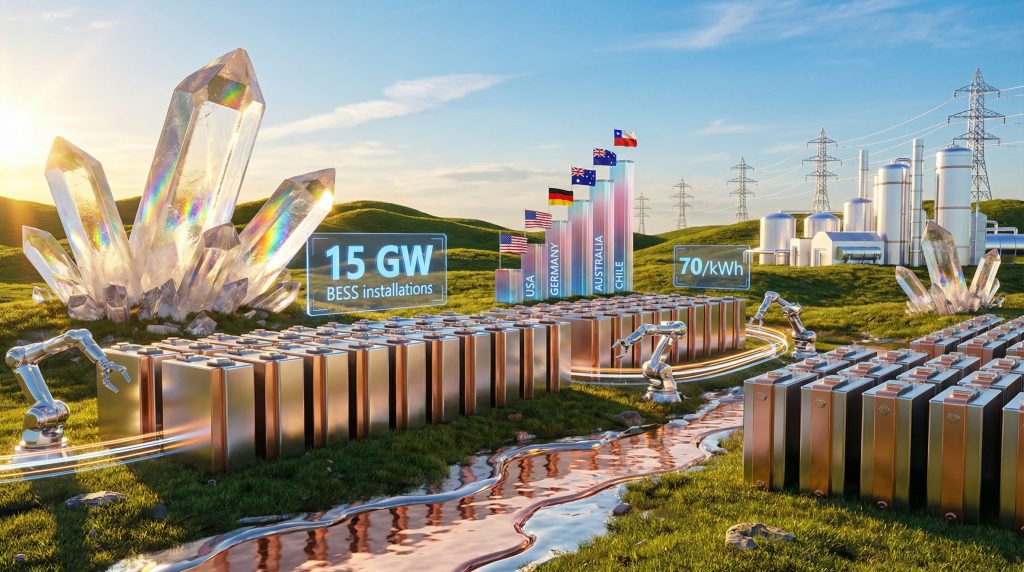
Despite rising battery material prices, regional ESS markets demonstrate remarkable resilience through diversified demand drivers and supportive policy frameworks. The United States ESS market maintains robust deployment projections with 15 GW of battery energy storage system installations anticipated despite material cost headwinds.
FERC regulatory reforms continue supporting grid-scale storage deployment, whilst data centre demand creates additional market pull with a 60 GW pipeline representing substantial long-term demand. This industrial demand provides price support that helps absorb higher material costs.
| Region | 2026 Capacity Target | Primary Market Drivers |
|---|---|---|
| United States | 15 GW BESS | FERC reforms, data centre expansion |
| Germany | 5 GW additions | Renewable integration requirements |
| Australia | 5 GW deployment | Solar curtailment reduction |
| Chile | 12 GW pipeline | Mining electrification initiatives |
European markets, particularly Germany, maintain aggressive capacity addition targets through renewable integration mandates that create regulatory demand regardless of material cost fluctuations. Grid stability requirements provide additional deployment drivers that support continued market expansion.
Australian ESS development focuses on solar curtailment mitigation and hybrid project integration, creating revenue streams that justify higher system costs. The co-location trend with renewable generation provides operational synergies that improve project economics despite rising battery material prices.
Technology Evolution Strategies for Cost Mitigation
Battery chemistry transitions represent the most significant opportunity for mitigating rising battery material prices impact on ESS demand. Lithium iron phosphate (LFP) technology has achieved market dominance in stationary storage applications, reducing exposure to high-cost nickel and cobalt materials.
LFP chemistry advantages include:
- Lower material cost sensitivity to nickel and cobalt price fluctuations
- Improved safety characteristics suitable for grid-scale applications
- Extended cycle life reducing replacement frequency and lifecycle costs
- Simplified thermal management decreasing balance-of-system expenses
Sodium-ion battery commercialisation presents medium-term opportunities for further material cost reduction by eliminating lithium dependency entirely. Early commercial deployments demonstrate technical viability for stationary storage applications where energy density requirements are less stringent than automotive uses.
Next-generation technologies including iron-air and other long-duration storage solutions offer alternative approaches that bypass traditional battery material constraints. In addition, developments in battery recycling breakthrough technologies provide promising pathways for creating circular supply chains.
System-Level Optimisation Approaches
Power electronics efficiency improvements provide significant opportunities for offsetting rising battery material costs through balance-of-system enhancements. Advanced inverter technologies and energy management systems maximise revenue generation from deployed storage capacity.
Installation standardisation through modular deployment approaches reduces project development costs and construction timelines. Standardised designs and pre-engineered systems help maintain competitive project economics despite higher battery costs.
Software optimisation platforms enable advanced energy management that maximises revenue potential from existing storage assets. Machine learning algorithms and predictive analytics improve market participation strategies and operational efficiency.
Policy Frameworks Supporting Market Resilience
Regulatory support mechanisms provide critical underpinning for continued ESS deployment despite rising battery material prices. Renewable energy mandates increasingly include storage requirements that create policy-driven demand independent of pure economic considerations.
Grid modernisation funding programmes support infrastructure investments that incorporate storage solutions as essential grid stability components. These investments recognise storage as critical infrastructure rather than optional market participants.
Carbon pricing mechanisms create additional value streams for clean energy storage solutions by monetising emissions avoidance benefits. Furthermore, global battery energy storage systems demand has jumped 51% in 2025, demonstrating robust market growth despite cost pressures.
Investment Incentives and Financing Evolution
Tax credit extensions maintain project economics through direct cost offsets that partially compensate for higher material costs. Policy support demonstrates government commitment to storage deployment regardless of short-term cost fluctuations.
Green bond markets provide access to low-cost capital specifically designated for clean energy projects, including storage systems. This dedicated financing reduces capital costs and improves project returns despite higher equipment expenses.
Utility procurement programmes offer long-term contracts that provide revenue certainty sufficient to justify higher upfront costs. These programmes recognise storage as essential grid infrastructure requiring stable investment frameworks.
Supply Chain Resilience and Manufacturing Capacity
Chinese manufacturing overcapacity in stationary battery cells, estimated at 557 GWh, provides price stability buffers that help moderate rising battery material prices impact on ESS demand. This manufacturing surplus creates competitive dynamics that benefit storage system developers.
Regional manufacturing initiatives seek to reduce import dependency and create local supply chains less vulnerable to international material cost fluctuations. Localisation efforts include both cell manufacturing and upstream material processing capabilities.
Vertical integration trends among original equipment manufacturers secure supply chains through direct investment in upstream production. These strategies reduce exposure to spot market volatility and provide greater cost predictability for storage system deployment.
Strategic Resource Management Approaches
Government stockpiling programmes and strategic partnerships seek to ensure critical mineral availability for domestic storage manufacturing. These initiatives recognise battery materials as strategic resources requiring supply security measures.
Recycling infrastructure development creates secondary supply sources that reduce dependence on primary material extraction. Battery recycling becomes increasingly economic as material prices rise, creating circular economy opportunities.
Alternative sourcing strategies through geographic diversification reduce single-source supply risks and create competitive dynamics among material suppliers. Consequently, lithium industry innovations in Australia demonstrate how diversified sourcing provides greater negotiating leverage and supply chain resilience.
The next major ASX story will hit our subscribers first
Investment and Valuation Implications
ESS developer margins adapt to new cost structures through contract design modifications and operational efficiency improvements. Successful developers implement cost pass-through mechanisms and focus on projects with superior revenue generation potential.
Battery manufacturer positioning reflects vertical integration advantages in volatile material markets. Companies with upstream integration or long-term supply agreements demonstrate greater margin stability during periods of material cost inflation.
Mining sector revival creates investment opportunities in battery material extraction and processing facilities. Rising material prices support new project development and expansion of existing production capacity.
Risk Assessment Frameworks for Market Participants
Technology transition risks require careful evaluation as battery chemistry evolution creates potential for stranded assets in legacy technologies. Investors must assess technology roadmaps and market adoption patterns when evaluating storage investments.
Regulatory policy risks include potential subsidy reductions or policy changes that could affect project economics. Due diligence processes must evaluate policy sustainability and alternative value creation mechanisms.
Market timing considerations become critical as deployment scheduling around material cost cycles can significantly impact project returns. Strategic timing of procurement and construction activities helps optimise cost structures.
Market Structure Evolution Through 2030
Demand segmentation evolution reflects differentiated market requirements across utility-scale, behind-the-meter, and industrial applications. Each segment demonstrates different sensitivities to material cost fluctuations and varying ability to absorb higher system costs.
Utility-scale projects maintain deployment momentum through regulatory mandates and grid stability requirements that justify premium pricing for essential services. Large-scale deployments benefit from economies of scale that partially offset material cost increases.
Behind-the-meter markets experience acceleration as commercial and industrial customers seek resilience solutions following recent grid stability challenges. These applications often justify higher costs through reliability and power quality benefits.
Industrial applications, particularly in manufacturing and data centres, drive demand growth through mission-critical power requirements. Moreover, the development of battery-grade lithium refinery projects supports premium pricing for storage solutions regardless of material cost fluctuations.
Competitive Landscape Transformation
Technology provider consolidation creates market concentration among leading suppliers with scale advantages and integrated supply chains. Successful companies demonstrate ability to manage material cost volatility through operational excellence and strategic positioning.
New entrant opportunities emerge for alternative chemistry companies and innovative technology providers offering solutions that bypass traditional material constraints. These companies benefit from differentiated value propositions during periods of conventional battery cost inflation.
Service model innovation includes energy-as-a-service offerings that change ownership structures and risk allocation. These models transfer material cost risks to specialised operators with greater ability to manage supply chain challenges.
Long-Term Economic Scenarios and Strategic Planning
Bullish growth projections anticipate 9.1% compound annual growth rates for global battery energy storage system markets from current levels through 2036, despite material cost headwinds. This growth reflects fundamental demand drivers that transcend short-term cost considerations.
Renewable integration requirements drive 39% of storage applications toward co-location with solar and wind generation facilities, creating operational synergies that improve project economics. These hybrid projects demonstrate superior returns that justify higher storage system costs.
Grid modernisation investments provide infrastructure spending support for storage deployment as essential grid stability components. Recognition of storage as critical infrastructure ensures continued investment regardless of material cost fluctuations.
Market Maturation and Price Discovery
Price discovery mechanisms for battery materials continue evolving toward greater transparency and reduced volatility through standardised trading platforms and financial instruments. Additionally, battery energy storage systems are key to renewable power supply-demand gaps, according to IRENA analysis, highlighting their strategic importance.
Supply chain resilience improvements through diversified sourcing and alternative technologies reduce single-point-of-failure risks that previously created extreme price volatility. Greater supply chain stability supports more predictable cost structures for storage deployment.
Technology standardisation around proven chemistries and system designs creates economies of scale and manufacturing efficiencies that help offset raw material cost increases. Industry maturation benefits from standardisation and operational optimisation.
Strategic Recommendations for Industry Participants
Energy storage developers should optimise project pipelines around material cost cycles, timing procurement and construction activities to minimise cost exposure whilst maintaining deployment schedules. Strategic timing can significantly impact project economics and competitive positioning.
Technology diversification strategies reduce single-chemistry exposure and provide flexibility to adapt to changing cost structures. Multi-chemistry capabilities enable developers to select optimal solutions for specific applications and market conditions.
Contract structuring innovations include material cost pass-through mechanisms and escalation clauses that share cost risks between developers and customers. These approaches maintain project viability despite material price volatility.
Investment and Financial Strategy Considerations
Sector allocation strategies should balance upstream materials exposure with downstream applications to capture value across the entire battery value chain. Diversified portfolios provide exposure to both material price appreciation and storage market growth.
Risk management approaches include commodity hedging strategies and supply chain diversification that reduce exposure to material price volatility. Financial instruments and operational strategies provide multiple risk mitigation options.
Due diligence frameworks require enhanced analysis of technology roadmaps, supply chain security, and regulatory policy sustainability. Investment decisions must incorporate greater complexity in evaluating storage market opportunities.
The energy storage sector's adaptation to rising battery material prices demonstrates remarkable resilience through technological innovation, policy support, and market evolution. While cost pressures create near-term challenges, fundamental demand drivers supporting ESS deployment remain robust, indicating continued market expansion despite material price volatility. Success in this environment requires strategic agility, operational excellence, and comprehensive risk management approaches that position companies for sustainable growth through evolving market dynamics.
Looking to Capitalise on Australia's Battery Material Mining Boom?
Discovery Alert's proprietary Discovery IQ model delivers real-time notifications on significant ASX mineral discoveries, including critical battery materials like lithium, copper, and nickel that are reshaping global energy storage economics. With the sector experiencing unprecedented supply chain transformations and rising material costs creating new investment opportunities, subscribers gain immediate insights into actionable trading prospects ahead of the broader market through our comprehensive discoveries platform.