May 12, 2026
When Compliance Becomes Contested: Brazil's Lithium Sector Faces a Governance Reckoning
Across the global lithium market, the assumption that regulatory clarity underpins operational certainty is increasingly being tested. In resource-rich jurisdictions, the presence of multiple oversight authorities with overlapping but legally distinct mandates creates friction that can turn routine compliance into a protracted legal battleground. Brazil, one of the world's most consequential emerging lithium producers, offers a particularly instructive case study in what happens when that friction becomes acute.
The situation unfolding at Sigma Lithium's Grota do Cirilo mine in Minas Gerais state is not simply a story about one company's regulatory missteps. It is a revealing stress test of how Brazil's mining governance architecture handles jurisdictional conflict, and what that means for the companies, investors, and supply chains that depend on Brazilian lithium production moving forward.
When big ASX news breaks, our subscribers know first
Brazil's Lithium Sector: Strategic Weight, Single-Asset Risk
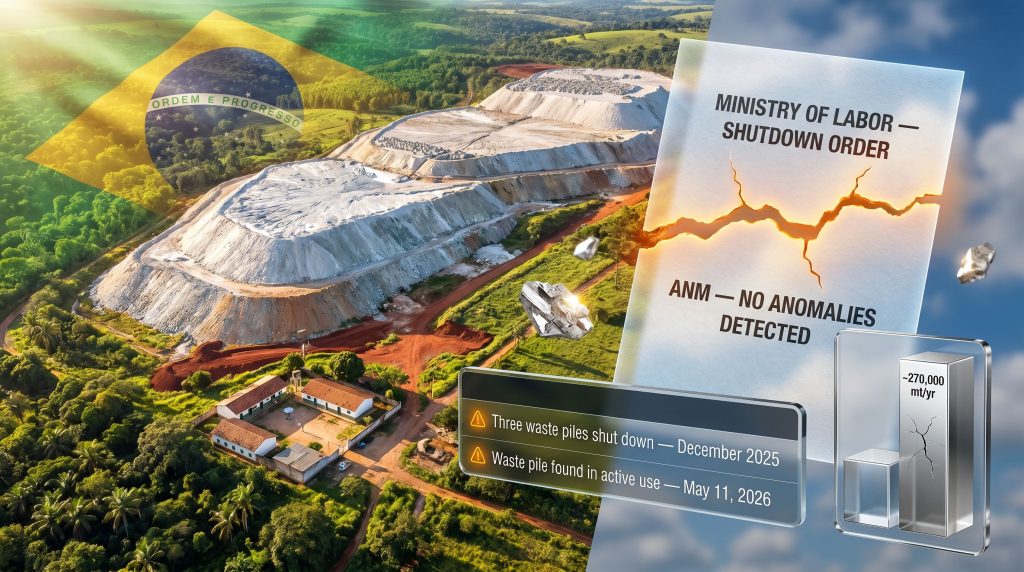
Brazil occupies a growing position in global lithium supply, and the Grota do Cirilo mine sits at the centre of that contribution. As Sigma Lithium's only productive asset, the operation carries an annual production capacity of approximately 270,000 metric tonnes of lithium concentrate, making it the flagship facility of Brazil's largest lithium producer.
The concentrated nature of that output matters enormously from a supply chain risk perspective. Unlike diversified mining companies with multiple operating assets that can absorb disruption at any single site, Sigma's entire production profile rests on Grota do Cirilo's continued operation. A prolonged regulatory-enforced closure is not an inconvenience for the business model; it is an existential threat to it.
The mine had been inactive since October 2025, following the termination of a contractor relationship that previously operated the site. When Sigma announced the resumption of mining activities in February 2026, the announcement came despite an active shutdown order covering three of the mine's waste piles. That decision, and the regulatory chain reaction it triggered, illustrates the operational calculus companies face when their only productive asset becomes the subject of multi-authority enforcement action.
Understanding Brazil's Dual Regulatory Framework
To understand why the Sigma Lithium fined in Brazil for using banned waste pile situation escalated in the way it did, it is necessary to first understand how Brazil's mining regulatory architecture actually works, because it does not operate as a unified system.
Two distinct authorities hold jurisdiction over different dimensions of mining operations in Brazil:
- The National Mining Agency (ANM) is responsible for geotechnical and technical assessments of mining infrastructure, including the physical stability and safety of waste management facilities, under Brazil's mining sector regulatory framework.
- The Ministry of Labor and Employment operates independently through its labor inspectorate, assessing occupational safety conditions and community risk under labor law. Labor inspectors can issue shutdown orders when they identify conditions that meet the threshold of a grave and imminent risk to workers or surrounding communities.
The critical structural point, and the one that creates genuine legal ambiguity for mining operators, is that these two bodies assess different risk dimensions using different methodologies and different legal standards. A technical geotechnical clearance from ANM does not legally cancel a shutdown order issued by the labor inspectorate. Both orders carry independent legal weight, and neither authority is empowered to override the other.
Brazil currently lacks a unified arbitration or conflict resolution mechanism that would allow these contradictory directives to be reconciled without resort to litigation. This is not a procedural gap unique to the Sigma case. It is a structural feature of Brazil's regulatory architecture that creates systemic exposure for any mining operator navigating multi-agency oversight simultaneously.
Waste Piles vs. Tailings: Why the Distinction Matters
What Hard Schist Rock Piles Actually Are
A central technical argument in Sigma's regulatory dispute is the classification of its waste deposits. The company characterises these facilities as hard schist rock piles, a category of solid waste material that carries a meaningfully different safety risk profile compared to wet tailings impoundments.
Hard rock waste piles consist of solid material excavated during the ore extraction process. Because they do not involve liquid slurry retention behind embankment structures, they are generally less susceptible to the dam-breach failure mode that produced the catastrophic consequences of Brazil's two most notorious mining disasters. The 2015 Mariana disaster and the 2019 Brumadinho tragedy both involved the collapse of wet tailings dams, releasing enormous volumes of liquid waste with devastating downstream consequences for communities and ecosystems.
That historical context is critical. In the years following Brumadinho, Brazil's regulatory and community sensitivity to any form of mining waste infrastructure incident became significantly heightened. The Grota do Cirilo waste pile situation, involving a reported partial structural fracture at a pile located near a school in the community of Poco Dantas, arrived into that charged environment.
The Poco Dantas Incident and the Grave and Imminent Risk Threshold
In December 2025, a labor inspector conducting a routine inspection at Grota do Cirilo identified a partial rupture at one of the three waste piles. The pile in question was situated near a school in the nearby community of Poco Dantas. That proximity to an educational facility proved to be a material factor in the regulatory response.
Brazilian labor inspectors apply the grave and imminent risk designation when physical evidence, such as structural fractures or proximity to populated areas, suggests a credible threat to worker or community safety. The combination of observed structural damage and proximity to a school created a compelling basis for that classification, regardless of whether the waste material itself was characterised as solid rock or liquid tailings.
This illustrates an important but often misunderstood principle in mining safety regulation: material type classification does not automatically determine regulatory risk classification. The location, structural integrity, and proximity to sensitive receptors such as schools and residences are equally weighted factors in how inspectors assess and respond to infrastructure concerns.
A Regulatory Conflict in Four Phases: December 2025 to May 2026
The timeline of Sigma Lithium's regulatory conflict demonstrates precisely how the dual-authority system can produce contradictory operational signals for a mining company operating under pressure to resume production.
| Timeline Event | Date | Authority | Outcome |
|---|---|---|---|
| Three waste piles shut down; partial fracture near Poco Dantas school | December 2025 | Ministry of Labor | Shutdown order issued |
| ANM drone and visual inspection conducted | January 20, 2026 | National Mining Agency (ANM) | Inspection completed |
| ANM issues findings: no geotechnical anomalies, no imminent instability | February 4, 2026 | ANM | Contradicts labor order |
| Sigma announces resumption of mining at Grota do Cirilo | February 2026 | Sigma Lithium | Operations restarted |
| Labor inspectors visit surrounding area; observe trucks depositing waste into closed pile | May 11, 2026 | Ministry of Labor | First fine issued |
| Inspectors denied site access by Sigma | May 11, 2026 | Ministry of Labor | Second fine issued |
Phase One: The December Shutdown
The regulatory sequence began in December 2025 when Brazilian labor inspectors shut down three waste piles at Grota do Cirilo following the discovery of a partial structural fracture at the pile near Poco Dantas. The timing intersected with Sigma's decision to terminate its contractor relationship in October 2025, which had already rendered the mine inactive before the shutdown orders arrived.
Phase Two: Contradictory Assessments and Resumed Production
ANM conducted a drone and visual inspection of the waste piles on January 20, 2026. By February 4, 2026, ANM had issued its findings, concluding that no geotechnical anomalies were detected and that no imminent instability was present. On the basis of this clearance, and despite the labor inspectorate's shutdown order remaining active and legally in force, Sigma announced the resumption of mining operations in February 2026.
The company also announced the sale of 100,000 tonnes of high-purity lithium fines during this period, signalling a deliberate return to operational continuity. However, lithium supply dynamics at the broader market level mean any disruption to a producer of this scale carries consequences well beyond the company itself.
Phase Three: Violations Confirmed and Fines Issued
On May 11, 2026, labor inspectors visited the town adjacent to the Grota do Cirilo work site and, from outside the perimeter of Sigma's property, observed trucks actively depositing waste material into the pile that had been under shutdown order since December 2025. The waste pile being used was the same one where the partial fracture near the Poco Dantas school had originally been identified.
Inspectors then sought to enter the work site to assess working conditions, a right explicitly granted to them under Brazilian law. Sigma reportedly denied that access, triggering a second fine. The company did not immediately provide comment in response to inquiries at the time of reporting.
Brazilian labor inspectors confirmed two separate fine-triggering violations on May 11, 2026: continued use of a waste pile under an active shutdown order, and denial of legally mandated site access to inspectors conducting their assessment.
The Legal Battle: Sigma's Challenge and the Unanswered Enforcement Question
Sigma Lithium has filed a lawsuit against the Brazilian government seeking to overturn the December 2025 shutdown order. In its legal submissions, the company has argued that losing access to the waste piles creates significant operational and economic impacts that jeopardise the continuity of mining activity at Grota do Cirilo. This legal framing is strategically coherent: because Grota do Cirilo is the company's only productive asset, any restriction on its waste management capacity creates existential operational consequences.
Furthermore, the legal challenge raises an equally important question that remains unresolved: what enforcement escalation pathway exists if the company continues using the closed pile while the court case proceeds?
Brazilian authorities have not publicly outlined what steps would follow continued non-compliance beyond the issuance of financial penalties. This enforcement ambiguity reflects a broader structural gap in how Brazil currently handles situations where a company continues operations under challenge rather than ceasing them pending judicial resolution. For investors assessing Brazilian mining assets, this gap represents a risk multiplier, because the absence of a clear enforcement ceiling means that the financial and operational consequences of continued non-compliance are genuinely difficult to model.
The next major ASX story will hit our subscribers first
Operational and Reputational Stakes: The ESG Dimension
The Single-Asset Risk Multiplier
The core vulnerability in Sigma's position is architectural. A diversified mining company with multiple producing assets can absorb regulatory disruption at one facility without existential consequence. For Sigma, the Grota do Cirilo mine is not one asset among many; it is the entire business. Every regulatory order that touches the site carries an amplified risk profile compared to what the same order would represent for a producer with broader operational diversification.
The mine had recorded zero lost-time accidents for over two years prior to the December 2025 labor inquiry, which adds a layer of complexity to the situation. A strong safety track record did not insulate the company from enforcement action when physical evidence of structural damage at a community-proximate waste pile triggered the grave and imminent risk designation.
| Risk Category | Short-Term Impact | Long-Term Impact |
|---|---|---|
| Regulatory fines | Immediate financial penalty | Potential escalation of enforcement action |
| Site access denial | Operational friction with inspectors | Risk of compounding violations |
| Legal challenge outcome | Uncertain pending court process | Could set precedent for sector-wide regulation |
| ESG and reputational damage | Investor confidence erosion | Offtake partner and battery manufacturer scrutiny |
| Supply chain disruption | Minimal while operations continue | Significant if full shutdown is enforced |
Positioning as a Sustainable Producer Under Scrutiny
Sigma Lithium has historically positioned itself within global EV supply chains as a producer of high-purity, responsibly sourced lithium concentrate. The Grota do Cirilo operation's marketing appeal has rested partly on its environmental and community credentials, which are precisely the dimensions now under regulatory scrutiny.
For battery manufacturers and automakers committed to responsible sourcing standards, a prolonged enforcement dispute involving community safety concerns and repeated regulatory violations represents a reputational risk that could prompt offtake partner review. Moreover, analysts at Benchmark Minerals have noted that Sigma's Brazil issues could tighten lithium supply conditions in ways that affect downstream pricing and procurement.
The sale of 100,000 tonnes of high-purity lithium fines during the period of operational resumption suggests near-term commercial momentum, but the medium-term reputational calculation is less straightforward if the legal dispute extends and enforcement actions accumulate.
Brazil's Post-Disaster Regulatory Sensitivity and What It Means for Foreign Investors
The political and social environment in which this regulatory conflict is unfolding cannot be separated from Brazil's history with mining disasters. The 2015 Mariana tailings dam collapse and the 2019 Brumadinho disaster fundamentally reshaped community expectations, regulator behaviour, and political calculus around mining waste infrastructure in Brazil.
Any waste pile incident near a school in Minas Gerais state, the same state where both Mariana and Brumadinho occurred, carries symbolic and political weight that transcends the technical specifics of any individual case. Labor inspectors, community groups, and regional governments in Minas Gerais operate with a heightened sensitivity to infrastructure risk signals that would not exist to the same degree in other jurisdictions.
Consequently, this case intersects with broader critical minerals demand pressures, where the urgency to secure lithium supply is being weighed against tightening environmental and community standards across producing nations. Furthermore, debates around direct lithium extraction technologies are gaining relevance precisely because they promise to reduce the waste infrastructure footprint that creates these kinds of regulatory vulnerabilities.
For foreign investors assessing the sovereign risk premium associated with Brazilian mining assets, the Sigma Lithium situation offers several important observations:
- Regulatory risk in Brazil is multi-layered, with independent labor, environmental, and mining authorities capable of issuing conflicting directives simultaneously
- Technical clearances from one authority do not provide legal insulation against enforcement action by a parallel authority
- The post-Brumadinho regulatory environment creates heightened community and political sensitivity to any waste infrastructure incident, regardless of the material type involved
- The absence of a unified dispute resolution mechanism means conflicts default to litigation, extending timelines and uncertainty
- Single-asset operators face amplified existential risk when their only productive operation becomes the subject of multi-agency enforcement action
For investors evaluating Brazilian lithium assets, the Sigma case illustrates that regulatory risk in Brazil is not monolithic. It is multi-layered, with independent labor, environmental, and mining authorities capable of issuing conflicting directives that must each be navigated independently.
In addition, the lithium market downturn already weighing on producer margins means that companies like Sigma have limited financial buffer to absorb the costs of prolonged regulatory disputes, legal proceedings, and potential production interruptions simultaneously.
Frequently Asked Questions
Why was Sigma Lithium fined in Brazil for using a banned waste pile?
Brazilian labor inspectors issued fines against Sigma Lithium on May 11, 2026, after observing trucks depositing waste material into a pile that had been formally shut down since December 2025. The pile had been closed because labor inspectors classified it as posing a grave and imminent risk to workers and the surrounding community, partly because of a partial structural fracture identified near a school in Poco Dantas. A second fine was issued when Sigma denied inspectors their legally mandated right to access the work site.
What is the Grota do Cirilo mine?
Grota do Cirilo is Sigma Lithium's flagship and only active mining operation, located in Minas Gerais state, Brazil. It carries an annual production capacity of approximately 270,000 metric tonnes of lithium concentrate and functions as the single productive asset underpinning the company's entire business model.
Did Brazil's mining regulator reach the same conclusion as the labor inspectors?
No. ANM conducted its own inspection in January 2026 and issued findings on February 4, 2026, concluding that no geotechnical anomalies or signs of imminent instability were present at the waste piles. However, that assessment carries no legal authority over the independent shutdown order issued by the Ministry of Labor and Employment's inspectorate. Both rulings carry independent legal weight under their respective regulatory frameworks.
Is Sigma Lithium contesting the shutdown order?
Yes. Sigma has filed a lawsuit against the Brazilian government seeking to overturn the shutdown order, arguing that losing access to the waste piles creates disproportionate operational and economic harm and threatens the viability of mining activity at Grota do Cirilo.
What distinguishes hard schist rock waste piles from wet tailings facilities?
Hard schist rock piles consist of solid excavated material and generally carry a lower acute failure risk profile than wet tailings facilities, which retain liquid mineral slurry behind embankment structures. Brazil's most severe mining disasters, at Mariana in 2015 and Brumadinho in 2019, involved catastrophic tailings dam failures. Sigma classifies its Grota do Cirilo waste deposits as hard schist rock rather than liquid tailings. However, this classification did not prevent labor inspectors from applying a grave and imminent risk designation once structural damage near a school was identified.
What happens next if Sigma continues using the closed pile?
This remains legally unclear. Brazilian authorities have not publicly defined the escalation pathway that would follow continued non-compliance beyond the financial penalties already issued. The unresolved nature of that enforcement ceiling represents a significant gap in regulatory clarity for both the company and for investors monitoring the situation.
This article is intended for informational purposes only and does not constitute financial or investment advice. All information is based on publicly available reporting as of the date of publication. Investors should conduct their own due diligence and seek independent professional advice before making any investment decisions. Forecasts and regulatory outcomes discussed in this article involve inherent uncertainty.
Want to Stay Ahead of Major ASX Mineral Discoveries Before the Broader Market?
Discovery Alert's proprietary Discovery IQ model delivers real-time alerts on significant ASX mineral discoveries, transforming complex commodity data into actionable insights for both short-term traders and long-term investors — explore Discovery Alert's discoveries page to see how historic finds have generated substantial returns, and begin your 14-day free trial today to secure a genuine market-leading edge.