July 29, 2026
The Complex Reality of Battery Material Recovery in Europe's Electrification Era
European automotive manufacturers face an unprecedented materials management challenge as electric vehicle adoption accelerates. With lithium-ion battery chemistry presenting unique recycling complexities, the industry must develop sophisticated strategies to transform end-of-life energy storage units into valuable resource streams. The sheer scale of projected battery retirement volumes creates both environmental obligations and strategic supply chain opportunities that extend far beyond traditional waste management approaches.
When big ASX news breaks, our subscribers know first
Understanding Europe's Emerging Battery Waste Volume Crisis
The magnitude of incoming battery waste streams presents logistical challenges that current infrastructure cannot accommodate. McKinsey research indicates that over 100 million EV batteries will reach end-of-life status within the next decade, representing approximately 800,000 tonnes of complex electronic waste requiring specialised processing capabilities. This volume projection assumes continued EV adoption rates of 15-20% annually across European markets, with average battery pack weights of 400-600 kg per unit.
Current European EV fleet composition includes approximately 17 million registered electric vehicles as of 2025, according to European Environment Agency data. Each vehicle contains battery packs with substantial material value: 8-12 kg of lithium, 35-40 kg of nickel, 4-8 kg of cobalt, and 15-20 kg of copper per unit. These materials represent strategic resources essential for continued electrification goals and European supply chain independence initiatives.
The automotive sector's transition creates secondary materials management imperatives that extend beyond environmental responsibility into strategic supply security considerations. Effective battery lifecycle management transforms waste streams into resource loops, addressing both circular economy principles and raw material supply vulnerabilities specific to European manufacturing requirements. Furthermore, the chinese battery recycling breakthrough demonstrates the global urgency in developing advanced processing capabilities.
Regional Infrastructure Capacity Limitations
Different European member states demonstrate varying collection infrastructure maturity levels. Scandinavian countries including Sweden and Norway report collection rates exceeding 70%, while Central European nations average 45-55% according to European Environment Agency waste statistics databases. This disparity creates processing bottlenecks and transport logistics challenges for cross-border material flows.
Processing facility requirements span multiple technical disciplines including electrical engineering, chemical processing, and materials science. Effective operations require discharge capabilities for safe battery deactivation, mechanical separation systems for automated disassembly, hydrometallurgical extraction processes, and quality control systems ensuring recovered materials meet automotive-grade specifications. Additionally, innovations in high-voltage battery recycling are revolutionising safety protocols across the industry.
Technical Barriers in Lithium-Ion Battery Processing
EV battery recycling complexity stems from diverse chemistry compositions and inherent safety hazards requiring specialised handling protocols. Lithium-ion batteries operate at nominal voltages of 3.7V per cell, with thermal instability potential when cell temperatures exceed 60°C. The electrolyte composition, typically lithium hexafluorophosphate in organic solvents, presents toxicity concerns with occupational exposure limits established at maximum permissible concentrations of 0.1 mg/m³.
Chemistry Variation Impact on Processing
Different battery chemistries require distinct processing pathways that complicate material recovery operations:
• NMC (Nickel-Manganese-Cobalt) batteries: Comprise 65-70% of current EV fleet; contain 8-10% lithium, 15-20% nickel, 4-5% cobalt, 3-4% manganese
• LFP (Lithium Iron Phosphate) batteries: Growing segment representing 20-25% of new EV production; contain 5-6% lithium with no cobalt content
• NCA (Nickel-Cobalt-Aluminum) batteries: Premium applications with high energy density; require specialised separation processes for aluminum recovery
Cathode materials containing mixed metal oxides require differentiated processing pathways, with misidentification leading to 15-25% material loss in downstream processing according to Journal of Power Sources research on battery chemistry impact on recycling efficiency.
Critical Material Recovery Targets and Technical Requirements
European regulations establish specific recovery quotas that drive processing technology development:
| Material | 2027 Target | 2031 Target | Processing Challenge |
|---|---|---|---|
| Lithium | 50% recovery | 80% recovery | Soluble salt extraction complexity |
| Nickel | 65% recovery | 85% recovery | High-temperature separation required |
| Cobalt | 65% recovery | 85% recovery | Toxic handling protocols mandatory |
| Copper | 70% recovery | 90% recovery | Established processing pathways |
Thermal runaway prevention represents a critical safety consideration during processing. This phenomenon occurs when internal resistance generates heat exceeding dissipation capacity, typically triggered at temperatures above 200°C, with cascade effects potentially propagating across entire battery packs if containment systems fail.
Extended Producer Responsibility Framework Implementation
European Extended Producer Responsibility regulations, effective since August 2025, fundamentally reallocate battery lifecycle costs from municipalities to original manufacturers. The EU Battery Regulation establishes collection rates of 65% by 2027, escalating to 80% by 2031, with recycling efficiency targets of minimum 65% average recovery for lithium-ion compositions.
Individual System Architecture Advantages
The Individual System framework enables large-scale manufacturers to establish independent collection and recycling infrastructure rather than participating in collective state-managed programs. This approach requires proof of financial capacity and operational infrastructure compliance but provides greater operational control and potential cost optimisation opportunities.
Renault's EV battery recycling strategy demonstrates this approach through The Future is NEUTRAL's operations. Established in 2022, the company manages end-of-life vehicles for 15 car brands and secured Individual System approval status in March 2026, enabling independent battery lifecycle management operations. This approval reinforces competitive advantages through integrated operations compared to collective system participation.
The IS framework offers several operational benefits over collective approaches:
• Supply chain integration: Direct material flows into manufacturing processes
• Cost structure optimisation: Elimination of third-party processing fees
• Quality control: Direct oversight of recovered material specifications
• Logistics efficiency: Reduced transportation and handling stages
Compliance Documentation and Traceability Requirements
EPR legislation mandates comprehensive tracking systems throughout battery lifecycles. Traceability protocols require unique battery identification codes for each unit through production, use, and end-of-life stages. Annual reporting obligations include collection volumes, recycling rates achieved, recovered material quantities, and detailed financial flows.
Non-compliance penalties establish economically material incentives for infrastructure investment. Failure to meet collection quotas triggers fines up to €5,000 per battery unit not collected, creating direct financial motivation for comprehensive collection network development.
Multi-Stage Battery Lifecycle Extension Strategies
Effective battery management extends beyond simple recycling to encompass repair, reconditioning, and secondary application development. Advanced diagnostic systems identify repairable battery modules rather than rejecting entire units, with industry data indicating over 90% of failed batteries can be restored to functional status through targeted interventions.
Capacity Assessment and Application Matching
Battery lifecycle extension operates through structured assessment protocols that match remaining capacity to appropriate applications:
| Assessment Phase | Capacity Range | Diagnostic Method | Optimal Application |
|---|---|---|---|
| Primary Use Extension | 80-100% | Load testing, impedance analysis | Continued automotive service |
| Secondary Applications | 70-80% | Residual capacity measurement | Stationary energy storage |
| Component Recovery | 50-70% | Module-level diagnostics | Parts supply for repairs |
| Material Recovery | Below 50% | Chemical composition analysis | Hydrometallurgical processing |
GAIA's battery reconditioning operations demonstrate practical implementation of this approach. Since 2012, the company has refurbished more than 18,000 units through partnerships with The Future is NEUTRAL, achieving restoration success rates exceeding 90% for batteries initially classified as failed.
Module-Level Repair and Reconditioning Techniques
Battery management systems enable precise identification of underperforming cells within larger pack assemblies. Module-level failure identification allows targeted replacement of affected components rather than full pack disposal, achieving 40-50% cost savings versus complete unit replacement.
Reconditioning processes include:
• Electrolyte restoration: Rebalancing ionic conductivity to recover 3-8% capacity in moderately degraded packs
• Cell rebalancing: Equalising charge states across module arrays
• Thermal management system repair: Replacing degraded cooling components
• Battery management system recalibration: Updating software parameters for optimised performance
Extended useful life through reconditioning typically adds 5-10 years of operational capacity before material recovery becomes necessary, reducing pressure on nascent recycling infrastructure while maximising economic value extraction.
Hydrometallurgical Processing and Closed-Loop Material Recovery
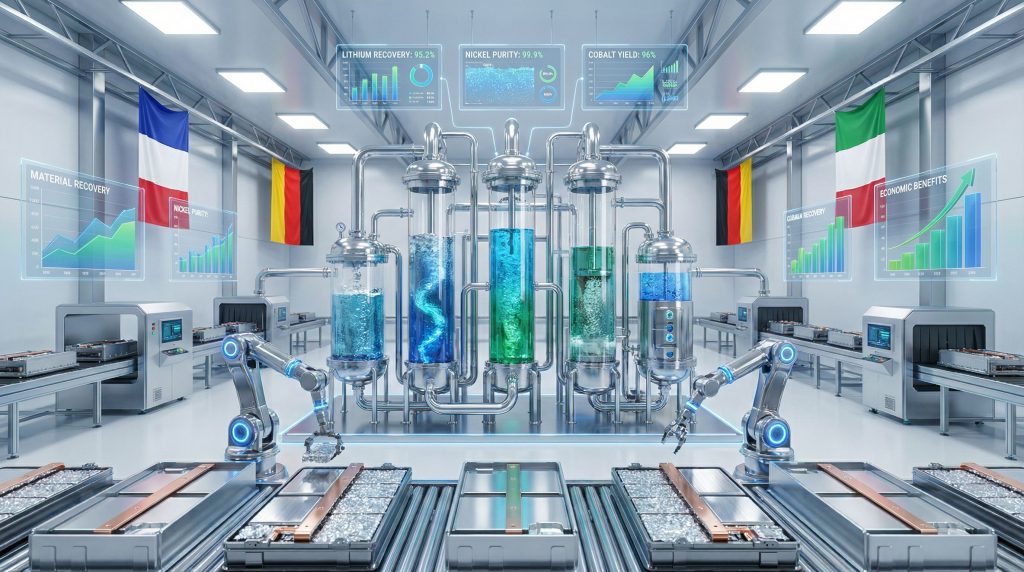
Hydrometallurgical processes represent the most advanced approach to battery material recovery, using aqueous chemical solutions to dissolve and separate component materials. This methodology achieves higher purity levels than pyrometallurgical alternatives while enabling direct reintegration into new battery production without quality degradation. Moreover, the livium battery recycling facility exemplifies next-generation processing capabilities.
Chemical Extraction Methodology and Efficiency Metrics
The hydrometallurgical process operates through sequential chemical treatment stages designed to selectively extract specific materials. Acid leaching dissolves target metals from battery cathode materials, followed by solvent extraction and electrowinning processes that purify and concentrate recovered elements.
Current technology achievements include:
• Lithium recovery: 95%+ extraction rates using selective precipitation techniques
• Nickel separation: 96-98% recovery through sulfate-based extraction
• Cobalt purification: 94-97% recovery with automotive-grade purity specifications
• Copper extraction: 98%+ recovery rates leveraging established metallurgical processes
Redwood Materials' Sparks facility demonstrates industrial-scale implementation, processing end-of-life battery packs through mechanical shredding followed by hydrometallurgical recovery systems targeting 95%+ material recovery rates across all battery chemistries.
Integration with Battery Manufacturing Supply Chains
Recovered materials must achieve automotive-grade specifications for reintegration into new battery production. Advanced purification techniques ensure recycled lithium, nickel, and cobalt match virgin material performance characteristics while reducing overall supply chain carbon intensity.
The EU Battery Regulation mandates minimum recycled content percentages in new batteries from 2031: 12% cobalt, 4% lithium, and 4% nickel. These requirements create direct demand for high-purity recycled materials and establish economic incentives for quality-focused processing investments. Furthermore, the battery-grade lithium refinery developments in India demonstrate global scaling of processing capabilities.
The next major ASX story will hit our subscribers first
Economic Drivers and Market Dynamics in Battery Recycling
Battery recycling viability depends on complex economic factors including raw material pricing, regulatory compliance costs, and infrastructure investment requirements. Fluctuating commodity prices for lithium, nickel, and cobalt directly impact recycling economics, with supply chain disruptions and geopolitical factors creating additional incentives for domestic material recovery capabilities.
Cost-Benefit Analysis Framework
Key economic drivers influencing recycling investment decisions include:
Primary Economic Factors:
Raw material price volatility and long-term supply security concerns drive recycling investment as insurance against market disruptions. Transportation and processing infrastructure require substantial capital commitments with 7-10 year payback periods under current commodity pricing assumptions.
Material pricing dynamics vary significantly by element. Lithium carbonate prices reached $85,000 per tonne in early 2023 before declining to $15,000 per tonne by late 2024, demonstrating volatility that makes recycling economics highly sensitive to market timing. Cobalt prices maintain greater stability at $30,000-40,000 per tonne due to supply concentration and geopolitical factors. Consequently, understanding the battery metals investment landscape becomes crucial for strategic planning.
Revenue Generation from Secondary Applications
Second-life battery applications generate additional revenue streams before material recovery. Batteries retaining 70-80% capacity perform effectively in stationary storage applications where charge cycle rates of 0.5-1 cycles daily are substantially lower than vehicle duty cycles of 1-2+ cycles daily.
This application suitability extends useful lifespan by 10-15 years post-vehicle retirement, creating multiple value extraction opportunities:
• Renewable energy storage: Grid stabilisation and load balancing services
• Commercial backup power: Uninterruptible power supply systems
• Residential energy storage: Solar panel integration and time-of-use optimisation
• Electric vehicle charging infrastructure: Buffer storage for fast-charging stations
Strategic Material Security and Supply Chain Independence
Europe's limited domestic mining capacity for battery materials creates vulnerability to supply disruptions that effective recycling can address. Domestic material recovery reduces import dependence while building regional processing expertise essential for long-term electrification goals.
Carbon Footprint Reduction Through Recycling
Recycled battery materials typically require 50-70% less energy to process compared to virgin mining operations. This carbon intensity advantage becomes increasingly valuable as carbon pricing mechanisms expand across European markets, with current carbon prices of €80-100 per tonne making recycled materials economically competitive with mined alternatives.
Life cycle analysis indicates that recycled lithium carbonate generates 65% fewer carbon emissions than mining-based production, while recycled nickel sulfate achieves 55% carbon intensity reduction. These environmental benefits support corporate sustainability targets while reducing regulatory compliance costs under emerging carbon border adjustment mechanisms.
Geopolitical Risk Mitigation
Current battery material supply chains concentrate in specific geographic regions that present supply security challenges. Lithium production centres in Australia, Chile, and Argentina, while cobalt mining concentrates in the Democratic Republic of Congo. Nickel supply relies heavily on Indonesian and Philippine operations.
European battery recycling development reduces exposure to these supply chain vulnerabilities while building domestic materials processing capabilities. Strategic material stockpiling becomes feasible through recycling infrastructure that can adjust processing rates based on market conditions and supply security requirements.
Technology Innovation and Future Processing Developments
Emerging technologies promise significant improvements in battery recycling efficiency and economics. Artificial intelligence applications enable automated sorting systems that identify battery chemistries and optimise processing pathways, while advanced chemical processes expand material recovery rates and purity levels.
Next-Generation Processing Technologies
Innovation developments focus on several key areas:
• AI-powered sorting systems: Machine learning algorithms achieve 98%+ accuracy in battery chemistry identification, enabling optimised processing pathways
• Advanced chemical processes: Novel extraction methods using ionic liquids and selective precipitation achieve 97%+ recovery rates
• Digital tracking integration: Blockchain-based material provenance systems enable comprehensive lifecycle monitoring and quality assurance
• Direct recycling techniques: Processes that restore cathode materials without full chemical breakdown, preserving crystalline structure and performance
Scaling Infrastructure for Future Waste Volumes
Projected EV adoption rates require proportional recycling capacity expansion. Current European processing capacity handles approximately 50,000 tonnes annually, while projected 2035 requirements exceed 500,000 tonnes based on fleet retirement projections.
This scaling challenge requires coordinated investment across multiple infrastructure categories:
• Collection networks: Expansion from current 500 collection points to 3,000+ locations
• Processing facilities: Development of 15-20 large-scale hydrometallurgical plants
• Workforce development: Training programmes for 10,000+ specialised technicians
• Transportation infrastructure: Specialised logistics networks for hazardous material handling
Implementation Challenges and Risk Factors
Despite technological advances and regulatory support, battery recycling implementation faces several significant challenges that could impact industry development timelines and economic viability.
Technical Risk Factors
Battery chemistry evolution presents ongoing challenges for recycling infrastructure development. Solid-state battery technologies entering commercial production require entirely different processing approaches than current lithium-ion systems. Silicon nanowire anodes and lithium-metal cathodes introduce new material separation complexities that existing infrastructure cannot accommodate.
Recovery rate variations depend heavily on battery age, storage conditions, and initial state of charge. Degraded electrolyte and corroded terminals can reduce processing efficiency by 10-15%, while batteries stored in high-temperature environments experience accelerated material degradation that complicates extraction processes.
Economic and Market Uncertainties
Recycling investment decisions must account for volatile commodity markets and uncertain regulatory evolution. Battery material prices demonstrate significant volatility, with lithium prices fluctuating 400%+ within 24-month periods. This volatility makes long-term investment planning challenging and affects recycling project financing availability.
Competition from alternative supply sources including direct mining expansion, brine extraction technology improvements, and battery chemistry shifts toward more abundant materials could reduce recycled material demand and economic returns on processing infrastructure investments.
Frequently Asked Questions About Battery Lifecycle Management
How long can EV batteries function in second-life applications?
Batteries typically retain 70-80% capacity when retired from vehicles, enabling 10-15 years of additional service in stationary storage applications before final material recovery becomes necessary.
What percentage of battery materials can be recovered through current recycling technologies?
Advanced hydrometallurgical processes can recover 95%+ of lithium, nickel, and cobalt, with ongoing technology development targeting even higher recovery rates and expanded material scope.
How do recycling costs compare to virgin material procurement?
Recycling economics vary by material and market conditions, but typically become attractive when raw material prices exceed $20,000-30,000 per tonne for key battery metals, factoring in transportation and processing costs.
What safety protocols are required for end-of-life battery handling?
Batteries must be discharged to below 3V per cell, stored in temperature-controlled environments, and transported using specialised containment systems designed for hazardous materials to prevent thermal runaway incidents.
How does Renault's EV battery recycling strategy compare to other automotive manufacturers' approaches?
The Renault's EV battery recycling strategy Individual System approach through The Future is NEUTRAL provides greater operational control compared to collective recycling programs, enabling direct supply chain integration and cost optimisation while meeting regulatory obligations independently. This approach is supported by Renault's comprehensive circular economy initiatives and their strategic partnerships with Veolia for battery recycling.
Investment Disclaimer: This article contains analysis of emerging technologies and market trends that involve inherent uncertainties. Battery recycling economics depend on volatile commodity prices, regulatory changes, and technological developments that may differ from current projections. Readers should conduct independent research and consult qualified professionals before making investment decisions related to battery recycling or circular economy ventures.
Ready to Invest in the Next Frontier of Critical Materials?
As Europe's battery recycling landscape unfolds, savvy investors are positioning themselves in the small-cap mining companies that could supply the lithium, nickel, and cobalt essential for this emerging circular economy. Discovery Alert's proprietary Discovery IQ model delivers real-time alerts on significant ASX mineral discoveries, transforming complex commodity data into actionable investment insights that help subscribers identify opportunities ahead of the broader market. Discover how historic mining discoveries have generated substantial returns and begin your 14-day free trial today to secure your market-leading advantage in the critical materials sector.